
A Real Critical Metal Narrative For 2026 - The Year a Minor Metal becomes a Strategic Lever - An Investor's dream with Global Low Inventory and a Surging Demand - Tungsten


As investors, we are always looking for the next investment, and this search is one of the most common headaches for all investors, especially those like me, in the retail end of the spectrum. We are always the last to know about the things we need to know, and we are the ones that help the "Purple Circle" create their wealth, and to top it all off, we are also the ones that help them exit their positions.
As we enter 2026, there is no doubt that all eyes are on Gold and Silver, and closely followed by Copper. I am confused if eyes are still on Antimony, but I suspect there are fewer looking at that now, as the whole Antimony chatter is getting long in the tooth for most investors. I think the heat may have cooled.

Figure 1: The gold and silver price chart as of 7th January 2025 over the last 10 years. (source: macrotrends)
The gold and silver price rise has long been seen as a marriage of the best friends (Figure 1). Although the quantum of the prices is significantly different, the way they "copy" each other is like a suckerfish to a whale. Every time you see a whale, you will see the suckerfish.

The narrative for copper is stronger, and with all the talk of AI and the clean energy transition, copper was always going to appreciate, as it's like the backbone metal of civilisation, like iron ore and the hated oil and gas. There is no doubt in my mind that the value appreciation will continue (Figure 2). It is not a rare metal, but the abundance required makes it critical in the sense of future extraction.

Figure 2: The copper price chart over the last 45 years as of 7th January 2025. (source: Macrotrends)
I know there will be a lot of views on other metals that are going to play a big role, but I think the ones I have mentioned clearly overshadow the other metals. I have not put lithium up as a clear show stopper because I think the discussion of how lithium or EV is going to change the world is not just co mmon speak. It is not, in my opinion, a revelation anymore. Like Vanadium or High Purity Quartz, these are not old news, and frankly, it does not excite people.
A great example is Molybdenum, which is looking like it's going to establish a strong case for all-time high pricing (Figure 3), but the market is not that excited. Anyone who is in the sector has been saying that the market is typically short on supply with an increasing demand for the metal.

Figure 3: The molybdenum price chart since 2006. (source: Daily Metals)
There has been a lack of investment into new mines and existing mines in the US, and most likely in China, are depleting with no new resources to replenish existing reserves. Does the market get excited? No, in fact, I used to say that the market does not even know how to spell the word.
So what Does All This Mean
In October 2025, I had a coffee with an associate, and we had a discussion in a cafe that got me thinking that the current gold price run may just be the start of something much larger in scale than I had ever thought would happen in my lifetime. He told me that a Bank in Europe is telling buyers of gold that delivery is a 6-month wait. If this is true, then are we looking at a shortage of major metals?
“This isn’t a theme trade. This is a supply-chain reality trade.”
Does this mean that the global shortage of these "critical" metals is going to cause the Clean Energy Revolution to take five and slow down, simply due to the fact that there are just not enough materials to build this new world we are being told is coming? As in all supply crunches, does this mean that we are just going to have to accept an increase in metal prices and hence an increase in the pricing of pretty much everything civilisation requires to make our world tick?
What if the discussion of cryptocurrencies is all heading to stable coin representation? The last time I looked, the top 67 cryptocurrencies have a market capitalisation of billions, and the top 11 have multiple billions. Now, if all start to go towards stable coins, then the gold price may just be heading higher. The good news is that there is plenty of gold to extract, but the future demand for gold as a hedge for stable coins may change the availability.
What happens If The Metal Is Important And Hard To Find, Like Tungsten?
In 2012, when I was promoting a tungsten project, one of the exercises was to find and detail projects that I could compare and contrast for my presentations and discussions with shareholders and potential investors.

AS my research grew deeper, it became apparent that there were not that many operational projects, either in the mining or exploration stage. Interestingly, there were not that many exploration projects. The list below is a summary of the main projects (Figure 4) at that time:
Dolphin Tungsten Project — King Island Scheelite Ltd (ASX: KIS) now Group 6 Metals Limited (ASX: G6M) - King Island, Tasmania (Australia). Promoted on the back of a Definitive Feasibility Study (DFS) released in March 2012 and related development messaging.
Mt Carbine Tungsten Project — Carbine Tungsten Ltd (ASX: CNQ) now EQ Resources Limited (ASX: EQR) - Far North Queensland (Australia). Promoted through 2012 investor/market materials positioning Mt Carbine as a restart/upgrade tungsten business.
Nui Phao Tungsten Project - Masan High-Tech Materials (part of the Masan Group) - Polymetallic deposit with scheelite-hosted tungsten, alongside significant fluorspar, bismuth, and copper mineralisation. Reserves (approximate): ~55–83 million tonnes of ore defined, grading around 0.2–0.21 % tungsten (WO₃) — a very substantial resource base.
Watershed Tungsten Project — Vital Metals Ltd (ASX: VML) - North West of Cairns, Queensland (Australia). Promoted in 2012 around feasibility and permitting, including financing to complete DFS work
Barruecopardo Tungsten Project — Ormonde Mining plc (LSE: ORM) - Salamanca Province, Spain. Promoted during 2012 as it moved off a completed DFS (Q1 2012) into permitting, funding, and offtake discussions.
Sangdong Tungsten Project — Woulfe Mining Corp. (TSX-V: WOF at the time) - South Korea. Promoted strongly in 2012 with a Sangdong Feasibility Study (effective June 2012) and ongoing market communications. There was also a connection to Warren Buffett through his company, IMC International Metalworking Companies (IMC), a subsidiary of Berkshire Hathaway. In 2012, IMC invested significantly in Woulfe Mining Corp. (which owned the mine) to secure a major supply of tungsten, a strategic metal for IMC's metal-cutting tool manufacturing in South Korea, positioning Sangdong to become a vital source for the global tungsten market.
Hemerdon / Drakelands Tungsten-Tin Project — Wolf Minerals (ASX: WLF at the time) - Devon, United Kingdom. Widely promoted in the 2011–2012 window on the back of its DFS and development narrative as a major non-China tungsten supply option.
Cantung Tungsten Mine — North American Tungsten Corp. (TSX-V: NTC at the time) - Northwest Territories (Canada). Promoted in 2012 as a restart/production resumption story (road reopening enabling production restart).

Figure 4: Location of Tungsten projects being promoted in 2012. (source: Samso)
As I am writing this blog, I have just realised that apart from the project I was promoting, there was only one other company that was promoting tungsten exploration, and that was Tungsten Mining Limited (ASX: TNG), which had just listed at the end of 2012. They were promoting a project called Kilba (Figure 5), which had a JORC-compliant Indicated and Inferred Resource of 5.0MT @ 0.27% WO3 that was announced on the 31st May 2013.

Figure 5: Location of the Kilba Tungsten project. (source: TGN ASX Release 12th June 2013)
Today, the majority of the projects are no longer in a near-production state. I am told that Nui Phao has reduced its production (though with the current pricing, they may be doing better). The Barruecopardo Tungsten Project appears to be in production, and Sangdong is "near" production. None of the projects is in a big production state; however, with the recent surge in pricing, things may start to look different soon.
The Tungsten narrative is largely driven by the following: "China dominates it, and now the Trump factor has come to save it, but the market is somehow not interested, even when the metal price (ATP) is surging to an all-time high of USD $900 per mtu (metric ton unit).
If you strip away the noise, tungsten’s 2026 story is simple: it sits at the intersection of defence, industrial capability, and supply-chain leverage. It’s not a “new economy” metal, but it has become a strategic economy metal—because so much of the upstream and processing chain still runs through China.
Price reality check: what the market is actually saying (2025–early 2026)
On the pricing front, APT (Ammonium Paratungstate) remains the benchmark reference point used across the industry, because it’s the key intermediate feeding most downstream tungsten products.
Metal
Recent market pricing snapshots show APT (CIF Rotterdam) sitting in a high band late 2025 into early 2026, alongside elevated China APT pricing.
Metal
A useful “market narrative” datapoint that’s been cited publicly is the view that APT moved materially higher across FY2025 and into 2026, reinforcing the idea that tungsten is trading above older baselines (regardless of the exact source you prefer).
“When a minor metal holds high prices for long enough, it stops being a spike and starts looking structural.”
The true driver: policy and permissions, not geology
The tungsten market in 2026 is heavily shaped by export controls/licensing frameworks and policy signalling, especially out of China. Reuters has reported China expanding export restrictions to include tungsten-related products (among other critical minerals) using a licensing approach tied to national security framing.
“Supply isn’t just ‘how much is mined’—it’s ‘how much can move’.”
Will the “Fanya shadow” appear in 2026
The Fanya Metal Exchange was a China-based metals trading platform from 2011 to 2015 that accumulated huge rare-metal inventories (including tungsten in the form of ammonium paratungstate). When it collapsed in 2015, investors were left unable to withdraw funds, and courts seized the metal holdings. A lot of the stockpiles were later sold or absorbed by state-linked buyers.
“Fanya taught the market what hidden inventory can do. 2026 is about controlled inventory and controlled flows.”
How Big Were the Stockpiles?
Analysts looked closely at the Fanya data in its final years:
Reported holdings for tungsten (in the form of ammonium paratungstate, or APT) were allegedly around 29,000+ tonnes, or approximately as much as 30% of China’s annual production at one point.
It stored significant quantities of other metals too — including large amounts of indium, bismuth, and rare earths — which in some cases were multiple times annual world output.
These stockpiles were stored in warehouses across China under the exchange’s control.
Why the Stockpiles Matter to Markets
The existence — and then liquidation — of these stockpiles had major effects on metal prices and supply dynamics:
Price Suppression from Overhang
When the exchange collapsed, and authorities seized its inventory, there was concern that the sudden release of metal onto the market would depress prices — especially for tungsten and other hard-to-produce metals.
At times, analysts suggested that if the Fanya APT stocks were released, prices could fall back to levels seen in earlier market lows, because a large overhang would flood available supply.
Price Volatility Before Collapse
During Fanya’s accumulation phase (2011–2014), speculative buying and accumulation pushed prices up because physical supply was being warehoused rather than hitting the open market.
This distortion was widely blamed for significant price spikes during that period.
What Happened to the Stockpiles After the Collapse?
After Fanya froze operations in 2015:
Chinese courts seized the exchange’s metal inventories.
Some metals (like indium and antimony) were auctioned off or bought in bulk by large state outfits such as China Minmetals
Auctions were conducted via online platforms like Taobao, often below market value, making it unclear how much of the backlog was fully absorbed or held strategically by state actors rather than released into open commerce.
Not all stockpiled metals have been transparently returned to market: some were bought privately, some moved into strategic government inventories, and some may still be held in various forms under Chinese oversight.
Is the Fanya Stockpiles Still Relevant?
In 2025–2026, the Fanya Metal Exchange stockpile issue is generally not a major direct driver of tungsten markets anymore, though it still comes up in historical context. The relevance of the Fanya Shadow is no longer an issue for the following reasons:
Less Direct Impact on Prices Now
The bulk of the ex-Fanya APT stockpiles has been seized and at least partially absorbed into industry inventories or held by corporate/state buyers. Small Caps
Market commentary and price behavior in late 2025/early 2026 focus much more on current supply tightness, geopolitical export controls, and Chinese production/export policy, rather than potential liquidation of Fanya stocks. Discovery Alert+1
In other words, the idea that a large stockpile could suddenly hit the market and pull prices down is less relevant now than it was a decade ago.
Current Drivers That Matter More
Recent supply/demand dynamics are shaped by:
Chinese export controls and licensing strategies affecting tungsten supply globally.
Geopolitical tensions and diversification of supply chains (e.g., Western buyers seeking non-China sources).
Strong prices and tight inventory levels in the tungsten market through late 2025/early 2026, with prices at elevated levels and market participants in a wait-and-see mode.
These factors are driving price trends and investment interest now far more than the remnants of Fanya stockpiles.
Tungsten Price Trends (2025–2026): What the Market Is Really Responding To Now.
1. Prices: Structurally Higher, Not Speculative
Through late 2025 into early 2026, tungsten prices (typically referenced via APT – Ammonium Paratungstate) have remained elevated and relatively firm compared to the long-term average.
This is not being driven by financial speculation (as seen during the Fanya years), but by:
Persistent supply tightness
Limited new mine development
Rising strategic demand, particularly from defence, aerospace, and advanced manufacturing
The market tone is best described as tight but orderly.
2. China Policy Is the Dominant Lever
China remains the key swing factor in tungsten pricing, but the influence today is policy-driven rather than inventory-driven.
Key factors:
Export licensing and quota controls on tungsten products
Environmental and energy-cost pressures on domestic producers
Strategic retention of critical metals, aligned with broader industrial policy
Rather than flooding the market, China’s behaviour in 2025–26 has leaned toward controlled supply, which supports higher floor prices.
3. Inventory Levels Are Thin
Unlike the 2012–2015 period:
Western inventories are low
There is no visible overhang equivalent to the Fanya stockpiles
Buyers are increasingly working on just-in-time or short-term contracts
This makes the market more sensitive to:
Temporary supply disruptions
Export approval delays
Geopolitical or trade-policy shocks
4. Demand Is Shifting from “Industrial” to “Strategic.”
Traditional demand drivers (hard metals, tooling, wear-resistant alloys) remain solid, but the growth is coming from:
Defence and munitions
Aerospace and space applications
Energy transition technologies
High-performance electronics
This matters because strategic buyers are less price-elastic — they prioritise security of supply over marginal price movements.
5. What This Means for New Projects
In 2026, tungsten is increasingly viewed as:
A strategic metal, not just a cyclical commodity
A sector where permitting, jurisdiction, and ESG profile matter as much as grade
One where credible non-China supply attracts disproportionate interest
Projects with:
Simple metallurgy
Clear permitting pathways
Potential domestic or allied-nation offtake
are being assessed through a longer-term strategic lens, not short-cycle commodity pricing.
Samso Concluding Comments
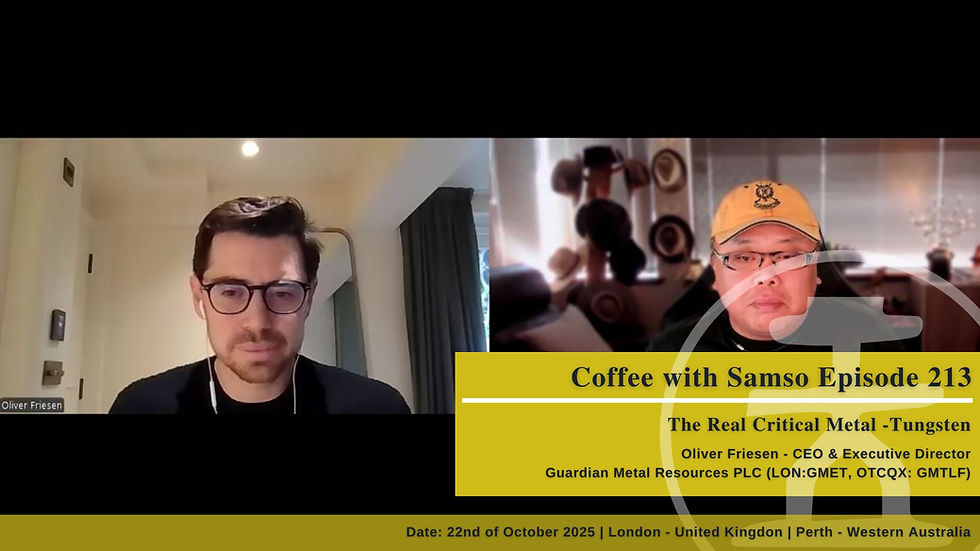
For those who have been following our coverage of tungsten, you will have seen our multiple posts on this space and realised that the next excitement among the ASX hopefuls is the rush into the tungsten space. The incredible fact is the surge in the price of tungsten in mtu. We have been raising awareness among investors on the potential rise to fame for a long time. In fact, the very first episode of Coffee with Samso was on tungsten, and that was in 2019 (A conversation about Tungsten).
What is an MTU? - A Metric Ton Unit is defined as 1% of a metric ton (1,000 kg) and therefore equals 10 kilograms. Tungsten is primarily traded in the form of Ammonium Para Tungstate (APT) or tungsten concentrates, with prices quoted per MTU of tungsten trioxide ( WO3) content.
Since that time, the price of tungsten has gone from sub USD $300 per mtu to a mind-boggling USD $1,000 per mtu as we write this blog today on 9th January 2026. The Samsop platform started covering tungsten again in earnest in May 2025, and the price then was in the USD $400 mark.
Since that period, it has been an incredible rise to today's price in a very short time frame, and for those companies that are now rushing into this space, the big question is really about where they are going to find a tungsten deposit that can become economical, and this is the main issue that will keep driving the price. This Samso Insight is highlighting this very point, as what I see today is no different from when I was promoting a tungsten project in 2012.
The main difference is the influx of exploration projects that seem to be banking on the Trump factor, and the focus is really on US projects. If one looks at what is available for mining, there are really not that many. If this continues to be the case, and we all know that developing a producing mine is something that takes years and in most cases decades. If that is the case, then you will have to think hard about what the sustainable price for tungsten will be if the lead time to relieve the supply crunch is the only way to reduce the surging price, and when that will happen.

Figure 6: An article taken from SMM. (source: SMM)
The article (Figure 6) from SMM (Shanghai Metals Market) is the perfect way to close this discussion. If you read the heading, it tells of a stable market that is very ordinary. The underlying truth is that the price have surge to a level now that is more than 300% times what it would have been 12 months ago. If there is no obvious relief in supply (assuming there is no Fanya Shadow lurking), what will be the ultimate multiple for the price before it is considered a stable market?
The Samso Way – Seek the Research
Here at Samso, we pride ourselves on delivering content for investors that is independent and informed by over three decades of experience in the industry. Our content is well-researched and is only created if I see merit in discussing the company's story.
Investors can view our three main products in Coffee with Samso, Samso News and Samso Insights.
There may be numerous paths to success in investing, but the common thread among successful individuals is that they remain committed to making informed decisions. Equip yourself with the right knowledge and tools, and you will be well on your way to achieving your financial goals.
Most importantly, investors need to be diligent in understanding their own risk-reward tolerance and capabilities. Never bite off more than you can chew is my parting comment. As they say, Rome was not built in a day, and the Great Wall is a great phenomenon because it took centuries to build.
As usual, Happy Investing and remember, always DYOR.
Our mission is simple: cut through the noise and spotlight what matters—genuine stories, grounded insights, and real opportunity.
Our content is well-researched and is only created if the team sees merit in discussing the company or concept. Investors can explore our three core platforms:
There may be numerous paths to success in investing, but the common thread among successful individuals is that they remain committed to making informed decisions. Equip yourself with the right knowledge and tools, and you will be well on your way to achieving your financial goals.
Most importantly, investors need to be absolutely diligent in understanding their own risk-reward tolerance and capabilities. Never bite off more than you can chew. As they say, Rome wasn’t built in a day, and the Great Wall stood because it took centuries to complete.
The Samso Philosophy:
Stay curious. Stay sharp. And remember—digging deeper always uncovers the real value.
In Life, there is no such thing as a Free Lunch.
Happy Investing, and the only four-letter word you need to know is DYOR.
To support our independent nature of our work, please head over to our Support Page and give us a helping hand in any of the ways listed. This is a new initiate for the Samso Platform, and it was always the concept of Samso when we started this journey in 2018.
Disclaimer
The information or opinions provided herein do not constitute investment advice, an offer, or solicitation to subscribe for, purchase, or sell the investment product(s) mentioned herein. It does not take into consideration, nor have any regard to your specific investment objectives, financial situation, risk profile, tax position and particular, or unique needs and constraints.
Share to Grow: Your Bonus
Samso has just released an eBook: How to Add Value to your Share Portfolio
A lesson on geological models sought by mining companies that gives insight and an understanding of which portfolios are better - and potentially more lucrative – investments. Click here to download this eBook.

If you find this article informative and useful, please help me share the information. I try to write about topics that are interesting and have the potential to be of investment value. It is not easy to find stories that fit those parameters. If you or your organisation sees the benefit of what Samso is trying to achieve and has a need to share your journey, please contact me at noel.ong@samso.com.au.
Samso is a trusted platform that equips dedicated investors with up-to-date industry knowledge and insights from top CEOs and thought leaders. By staying informed on business advancements and market trends, investors can enhance their financial decisions through a combination of expert guidance and their own research.


Comments