


Iron Ore Price Forecast to 2030 and What a Rising Surplus Means for ASX Stocks

Shanghai Metals Market's iron ore price forecast eases to about US$90 a tonne by 2030 as the market surplus grows to 309 million tonnes. Part 1 of Metals to 2030 sets that forecast against the September quarter results of the ASX iron ore stocks, against Southeast Asia's growing role in finishing steel, and against the reasons the price may hold up better than SMM expects.


Shanghai Metals Market (SMM), a Chinese metals price reporting and research company, expects the iron ore surplus to grow from 115 million tonnes in 2026 to 309 million tonnes in 2030, with the price easing to about US$90 a tonne. On 29 October 2026 the price was US$90.71 a tonne, already at the level SMM forecasts for 2030. SMM presented the forecast at its Australia Metals and Mining Investment Seminar in Sydney on 26 October 2026, which Samso attended.[R1][R2]
SMM's analysts presented on iron ore, steel trade, aluminium and copper. Its iron ore forecast runs to 2030. Those topics are the basis of this four-part Samso series, Metals to 2030. The numbers on each chart come from SMM's slides and are credited to SMM. Samso has redrawn every chart rather than reproduce the slides.[R1]
Part 1 is about iron ore. SMM's message was that new mines are coming into production faster than steelmakers need the ore, so the surplus grows each year to 2030 and the price drifts lower. SMM also showed Southeast Asia changing from a place that buys finished steel into a place that finishes steel made elsewhere.[R1]
The piece looks at where the price is now and what SMM and other forecasters expect. It then looks at where the new tonnes come from and what the September quarter reports say about each ASX iron ore company. Samso has written before on the dilemma of investing in the iron ore story.
HOW TO USE THIS PIECE, AND A NOTE ON THE VOCABULARY Mining and steel terms are explained in plain English where they first appear, and all of them are collected again in a vocabulary box at the back, above the references. Each source carries an identifier, [R1] to [R57], at the point it is used. Click the marker to jump to the source in the reference list at the end. Where two published figures for the same thing disagree, this article quotes both as they were published and names the document each came from. It does not try to resolve them. Where Samso does arithmetic, the text says so. |
READING THE SERIES, METALS TO 2030 Part 1 (this piece). Iron ore. The surplus to 2030, the price, Southeast Asia as a steel processing hub, and the ASX iron ore stocks. Part 2. Copper against aluminium in AI data centres. Where each metal is gaining or losing ground. Part 3. Aluminium. New smelting capacity outside China and SMM's LME aluminium price to 2030. Part 4. Copper. Refined copper supply, new smelters, and SMM's balance turning from surplus to shortfall. |
All prices in this piece are as at the close of ASX trading on 30 October 2026. The iron ore price is the latest daily figure available at that time, which is for 29 October 2026.
WHAT THIS PIECE COVERS 1.00 THE IRON ORE PRICE IN OCTOBER 2026 Where the price is now, what 62% Fe means, and the change over a year. 2.00 SMM'S IRON ORE FORECAST TO 2030 SMM's price and surplus forecast, year by year, and what a surplus means. 3.00 WHAT OTHER FORECASTERS SAY Other published forecasts for 2026 and 2027, and a surplus measured two ways. 4.00 WHERE THE NEW IRON ORE COMES FROM Simandou's ramp-up and disruptions in Guinea, BHP's growth, and the Pilbara mines that replace old ones. Falling Chinese steel output, the 2025 export record, and China's state buying agent. 6.00 SOUTHEAST ASIA AS A STEEL PROCESSING HUB SMM's view of Southeast Asian steel trade, the tariffs behind it, and what it means for iron ore. 7.00 THE FOUR ASX MAJORS IN THE SEPTEMBER QUARTER Shipments, costs, prices received and share prices for the four large ASX producers. 8.00 GRADE AND THE PRICE OF A TONNE How ore grade changes the price received, and the market for direct reduction grade feed. 9.00 THE SMALLER ASX IRON ORE STOCKS What the September quarter reports of the smaller ASX iron ore companies show. 10.00 THE CASE AGAINST A FALLING PRICE Why the surplus may arrive more slowly, and why the iron ore price may hold or recover to the low US$100s. |
1.00 — THE IRON ORE PRICE IN OCTOBER 2026
Iron ore near a two-year low
The iron ore price was US$90.71 a tonne on 29 October 2026, for the 62% Fe benchmark delivered to China, as tracked by Trading Economics.[R2] That is about 14 per cent lower than a year earlier on the same Trading Economics series. On 27 October the Singapore Exchange (SGX) futures contract that the industry watches most closely traded as low as US$89.25 a tonne during the day, its lowest level since September 2024.[R3]
A year earlier, on 30 October 2025, the benchmark December contract on the Singapore Exchange traded at US$107.25 a tonne.[R4] The average for the whole of 2025 was US$100.18 a tonne, down 8 per cent on 2024, according to the United States Geological Survey (USGS).[R5] So the price has been falling for two years. On 27 October 2026 Singapore futures fell to US$89.25 a tonne in intraday trade, the lowest since September 2024.[R3]
Iron ore is priced by its iron content. 62% Fe means ore that is 62 per cent iron by weight, Fe being the chemical symbol for iron. The price is for a tonne delivered to a port in northern China, which the trade calls CFR (cost and freight). A miner selling from a Western Australian port at FOB (free on board) receives the delivered price less the cost of shipping. Ore with less iron, or with more silica, alumina or phosphorus, sells at a discount to the benchmark. Ore with more iron sells at a premium. Section 8.00 covers grade, which is where the ASX companies differ most.
From 1 January 2026 S&P Global Platts, which publishes the most widely used index, lowered the grade of its benchmark from 62% Fe to 61% Fe.[R36] Rio Tinto, Fortescue and Mineral Resources now quote their prices against the 61% index. SMM's charts still use a 62% series. The two move together but are not the same number, so a 61% price and a 62% price from the same week will differ slightly.
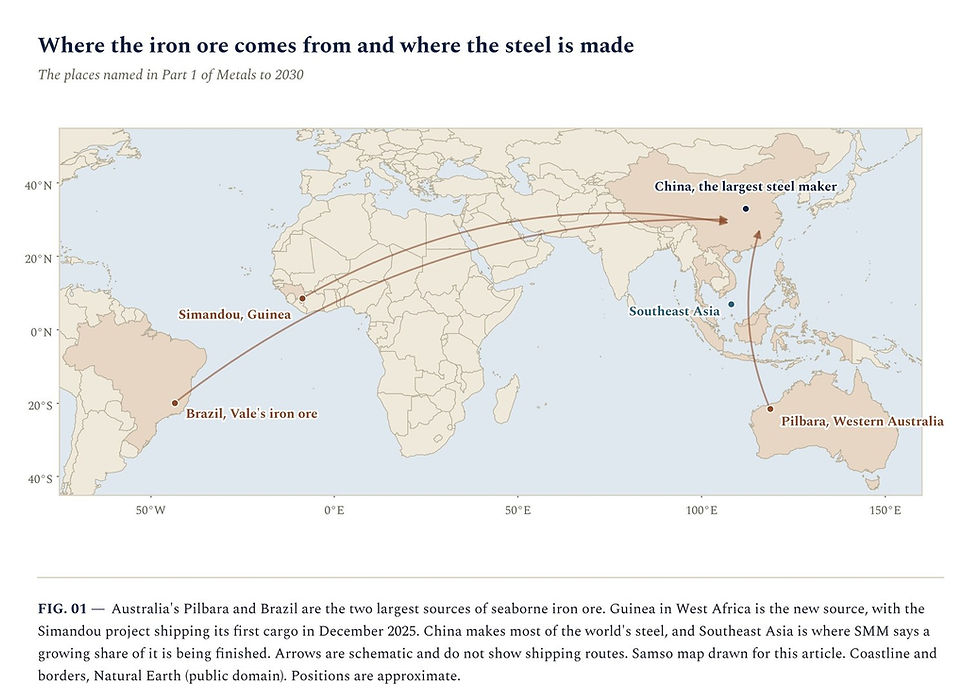
FIG. 01 shows the places this article covers. Iron ore moves from the Pilbara, Brazil and now Guinea to China, which makes most of the world's steel. Southeast Asia is the other end of SMM's story, a region that is building a steel industry with feed from China.
This means the iron ore price is close to the bottom of its range of the past two years, and it got there before most of the new supply that SMM expects has arrived.
2.00 — SMM'S IRON ORE FORECAST TO 2030
A surplus that SMM expects to almost treble
SMM's slide carried the title "A rising surplus caps iron ore prices through to 2030". FIG. 02 redraws it. The bars are SMM's estimate of the surplus, which is the amount of iron ore produced in a year beyond what steelmakers use. The line is the 62% Fe price series on SMM's slide.[R1]

SMM puts the surplus at 115 million tonnes in 2026, 148 million tonnes in 2027 and 198 million tonnes in 2028, rising to 259 million tonnes in 2029 and 309 million tonnes in 2030. Samso's arithmetic is that 309 million tonnes is about 2.7 times the 2026 figure. SMM marked two points on the chart. 2026 is the peak year for new iron ore projects being commissioned, and 2028 is when large projects reach full capacity one after another.[R1]
SMM's price for the same years runs US$100 in 2026, US$94 in 2027, US$89 in 2028, US$92 in 2029 and US$90 in 2030. These are SMM's forecasts. The figures for 2021 to 2025 are SMM's historical numbers, a fall from US$160 in 2021 to US$102 in 2025.[R1]
On a single day, 29 October 2026, the price was US$90.71, the level of SMM's average forecast for 2030. The market has moved faster than the forecast, although one day's price and a year's average are not the same thing. SMM also shows a surplus in every year since 2021, between 82 and 122 million tonnes, and the price averaged more than US$100 in each of those years. So the price has lived with a surplus of this size before. What SMM forecasts from 2027 on is a surplus large enough to keep the price from recovering.
If a surplus were all unsold ore, it would build up at Chinese ports and at the mines, and the price would fall until the miners with the highest costs cut back. Samso's reading is that SMM's surplus has not piled up as unsold ore so far. It is better read as a measure of how loose the market is than as tonnes piling up. Forecasters still watch the cost of the highest-cost producers, because that cost is the level at which supply starts to leave the market.
SAMSO TAKE We came away from the SMM session with one simple message. More iron ore is coming than China needs, and the people who track Chinese steel mills every day expect that to show in the price for the rest of the decade. What we found interesting is that the price has already touched the level SMM has for 2030. So is the market ahead of the forecast, or is the forecast still too high? We do not know yet. It is the question to keep in mind as the new tonnes from Guinea and the Pilbara arrive over the next two years. |
3.00 — WHAT OTHER FORECASTERS SAY
How SMM compares with the World Bank and the banks
Other forecasters also expect a lower price. FIG. 03 sets SMM's forecast beside the others Samso could find for 2026 and 2027.
According to the World Bank's Commodity Markets Outlook of April 2026, iron ore will average US$97 a tonne in 2026 and US$95 in 2027, after an average of US$100.2 in 2025.[R6] Two bank forecasts were reported in June 2026 by GMK Center, a Ukrainian steel market consultancy and news service. Fitch Ratings raised its forecast to US$100 a tonne for 2026 and US$90 for 2027, and Macquarie kept US$103 for 2026.[R7][R8] Samso is quoting the Fitch and Macquarie figures as GMK Center reported them, not from the notes themselves.

Every 2026 forecast in FIG. 03 is higher than the price at the end of October. The forecasts are averages for the whole year, and the price was higher earlier in 2026. Rio Tinto reported that the 61% index averaged US$105 a tonne in the June quarter and US$97 in the September quarter.[R10] So the 2026 average is likely to come in above today's price. For 2027 the forecasts range from US$90 to US$95 a tonne, close to where the price is now.
A surplus measured two ways
S&P Global Commodity Insights, writing in June 2026, projected a surplus in seaborne iron ore of about 16 million tonnes for 2026.[R9] SMM's figure for the same year is 115 million tonnes.[R1] The two figures probably measure different things. Seaborne trade is ore shipped between countries. SMM's slide does not say whether its balance also counts ore mined and used inside China, which is large.
What the forecasters agree on is the direction. They see more supply than demand from 2026 and a price that settles in the US$90s rather than returning to the US$100s and above of 2021 to 2024.

4.00 — WHERE THE NEW IRON ORE COMES FROM
Simandou, and new mines in the Pilbara
By Samso's comparison, the largest single source of new iron ore is Simandou, shown in FIG. 04. Simandou, in Guinea in West Africa, holds high-grade iron ore of about 65 per cent iron.[R48] Operations began in November 2025, and the first ore was shipped in December 2025.[R10][R11]

The project is split in two. The southern blocks belong to SimFer. The Government of Guinea holds 15 per cent of SimFer and Simfer Jersey holds 85 per cent. Rio Tinto owns 53 per cent of Simfer Jersey and Chalco Iron Ore Holdings, a Chinalco-led group, owns 47 per cent. The northern blocks belong to WCS, owned 51 per cent by a consortium of Winning International, Weiqiao and United Mining Suppliers, and 49 per cent by Baowu Resources.[R10][R11]
The two halves share a railway, which Rio Tinto describes as a main line of about 536 kilometres and the partners' joint release as more than 600 kilometres of rail.[R10][R11] Each half has its own port. SimFer's ore is going through the WCS port for now. Rio Tinto expects the first ore through SimFer's own port in the December quarter of 2026. Together the two halves are designed for up to 120 million tonnes a year.[R10][R11]
Rio Tinto's September quarter report gives the most recent numbers. Simandou produced 2.5 million tonnes in the quarter on a 100 per cent basis, meaning the whole of SimFer's output rather than Rio's share. Rio's figures do not include the WCS blocks. That is an annualised rate of about 10 million tonnes a year. It shipped 2.2 million tonnes in the quarter and 4.4 million tonnes in the first nine months. Rio expects 5 to 10 million tonnes of SimFer sales in 2026, and says SimFer remains on track to reach a rate of 60 million tonnes a year during the second half of 2028.[R10]
Simon Trott, Rio Tinto's Chief Executive, said in the report that "Our major projects remain on schedule and budget, underwriting our growth profile to 2030."[R10] S&P Global said in June 2026 that Guinea's exports could reach 70 million tonnes in 2028. It expects the full 120 million tonnes to take more than five years.[R9] For SMM's forecast, the timing is important. A slower ramp-up, the period in which a new mine works up to its full rate, would spread the new tonnes over more years.
Samso's view on Simandou supply
Rio Tinto says Simandou is on schedule.[R10] Samso's view is that the supply that actually comes out of Simandou will most likely face disruption along the way. Samso has made this point before, including in its piece on whether the market has overestimated Simandou.
The record so far points that way. Guinea's military government, which took power in a coup in September 2021, ordered all work at Simandou to stop in March 2022 while it sought terms that preserved Guinea's interests.[R49] After production began, work at the SimFer mine was suspended after a contract worker died on 14 February 2026.[R50] On 28 April 2026 about 3,000 workers on the northern blocks went on strike over pay, and mining there stopped.[R51] It resumed on 7 May after an agreement between the company, the unions and Guinean officials.[R52] TABLE 01 lists these events.

None of these events ended the project, but each one stopped work for a time. Simandou depends on a new railway of more than 500 kilometres, new ports and a government that has shown it will step in. Each of those is a point where a delay can start.
Large projects often run late, even for experienced builders. In its earlier Simandou piece, Samso pointed to Rio Tinto's Oyu Tolgoi copper mine in Mongolia. Its underground production started about three years after the original target. Samso also pointed to Anglo American's Minas-Rio iron ore mine in Brazil, which lost about nine months to a pipeline shutdown in 2018 and 2019.[R57] Oyu Tolgoi's delay was underground, and Simandou is an open pit, so that comparison is not a forecast. Minas-Rio is closer, because its lost months came from the pipeline that carries its ore to port, and Simandou also depends on a long link to the coast. Both show how far a schedule can move once ground, weather or logistics prove harder than planned.
SimFer's recognised sales in the first nine months of 2026 were 1.7 million tonnes on a 100 per cent basis, against Rio Tinto's guidance of 5 to 10 million tonnes for the year. It had shipped 4.4 million tonnes by then. Rio says that at full production it is targeting a cycle of about 75 to 90 days from mine to recognised sale, with up to a further 30 days for customer collection, so shipments run ahead of sales.[R10] By Samso's arithmetic the bottom of the range needs about 3.3 million tonnes of sales in the December quarter, and much of that is ore already shipped. The 2026 guidance looks within reach. Samso's concern is the ramp-up after it.
In Samso's view a disruption is more likely to delay Simandou's tonnes than to remove them. The supply that Rio Tinto and S&P Global expect around 2028 would then arrive closer to 2030. S&P Global's timetable of more than five years for the full 120 million tonnes already leans that way.[R9]
What that does to the surplus depends on which surplus is used. SMM's slide does not show its Simandou assumption. Other things equal, every tonne Simandou does not ship comes off the surplus. On SMM's numbers the surplus is 148 million tonnes in 2027 and 309 million tonnes in 2030.[R1] If SMM's 2030 balance counts Simandou at its full 120 million tonnes and none of it shipped, SMM's surplus would still be about 189 million tonnes by Samso's arithmetic. If SMM assumed less, the surplus left would be larger. So a Simandou delay on its own does not remove SMM's surplus. It makes it smaller and later. FIG. 05 shows SMM's surplus against Simandou's full rate.

S&P Global's seaborne measure is much tighter. It projects a seaborne surplus of about 16 million tonnes in 2026, with Guinea's iron ore exports forecast at about 15 million tonnes.[R9] Rio's guidance of 5 to 10 million tonnes of 2026 sales covers SimFer only and leaves out WCS, so the two figures measure different things. On S&P's measure a delay at Simandou would change the surplus a lot. By Samso's arithmetic, if Guinea's 2026 exports came in at half the S&P figure, the seaborne surplus would be about half its forecast size.
This is why Samso reads the surplus forecasts with caution. The forecasters in section 3.00 agree on the direction. The timing of Simandou's tonnes, and so the size of the surplus in any one year, is where Samso expects those forecasts to be tested.
The Pilbara, growth and replacement
The Pilbara in Western Australia, shown in FIG. 06, is where BHP, Rio Tinto and Fortescue mine and where Mineral Resources runs Onslow Iron. Its export ports are Port Hedland, Dampier, Cape Lambert and the Port of Ashburton near Onslow.

Iron ore mines run out, and a large share of the new Pilbara mines are built to replace old ones. Rio Tinto lists three Pilbara projects with first production in 2027. They are Brockman Syncline 1 at 34 million tonnes a year, Hope Downs 2 at 31 million tonnes and West Angelas at 35 million tonnes. Rio describes each one as extending the life of an existing operation.[R10] Rio's guidance for Pilbara shipments in 2026 is 323 to 338 million tonnes.[R10]
BHP is adding real growth. It plans to lift its Western Australia Iron Ore (WAIO) business to more than 305 million tonnes a year by the end of its 2028 financial year. That is on a 100 per cent basis, against guidance of 286 to 298 million tonnes on the same basis for its 2027 financial year. BHP lists a sixth car dumper, the machine that tips ore out of rail wagons at the port, among the investments behind it.[R12]
Mineral Resources' Onslow Iron was new supply in 2024 and 2025. It reached its nameplate rate of 35 million tonnes a year in August 2025. Nameplate is the rate a mine was designed to run at. In the September quarter of 2026 it shipped at an annualised rate of about 36.9 million tonnes, so its tonnes are already part of today's market.[R16][R17]
Put together, the new tonnes to 2030 come mostly from Guinea, with smaller additions from Vale and BHP. Vale in Brazil expected to produce about 335 million tonnes in 2025 and is targeting 360 million tonnes in 2030.[R43]
5.00 — CHINA, THE BUYER
Chinese steel output and a new state buyer
China buys most of the world's seaborne iron ore, so the demand side of SMM's surplus is mostly a story about Chinese steel. China produced 960.81 million tonnes of crude steel in 2025, down 4.4 per cent on 2024, according to the National Bureau of Statistics.[R18] From January to September 2026 it produced 724.77 million tonnes, down a further 2.9 per cent.[R19] FIG. 07 shows both.

Chinese steel use at home is also falling. Rio Tinto estimated that China's finished steel use fell about 4 per cent from the June quarter and about 2 per cent from a year earlier.[R10] Steel that is not used at home is exported. China exported a record 119.02 million tonnes of finished steel in 2025.[R20] In the first nine months of 2026 finished steel exports were 85.64 million tonnes, down 2.6 per cent.[R21] Rio Tinto put the rate for the September quarter alone at 122 million tonnes a year.[R10]
An SMM analysis quotes a higher figure, 131 million tonnes for 2025, from the OECD's Steel Outlook 2026.[R25] Customs data give 119.02 million tonnes for finished steel.[R20] The OECD figure may include semi-finished steel such as billet, a solid bar of steel that is rolled into product later, which a finished steel figure leaves out. Billet is a large part of what China sends to Southeast Asia, covered in section 6.00.
For iron ore, this means its largest buyer is making less steel each year, which is the demand side of SMM's surplus.
China Mineral Resources Group
A newer factor is how China buys. China Mineral Resources Group (CMRG) is a state-owned company set up to negotiate iron ore purchases on behalf of Chinese steelmakers. In the September quarter it was in negotiations with the miners over supply terms. Fortescue sold 42.9 million tonnes in the quarter, 3.9 million tonnes less than it shipped, which it said reflected "the impact of ongoing negotiations with CMRG".[R14] Fortescue also said that "If negotiations with CMRG are not concluded by calendar year-end, operations may be affected, potentially including adjustments to production."[R14]
Bloomberg reported on 27 October 2026 that the standoff had eased after settlements including one with Rio Tinto, while Fortescue was still in talks.[R3] Iron Road, a South Australian developer of magnetite, a lower-grade iron ore that is upgraded before it is sold, also described "purchasing friction from China's centralised state buying agent, CMRG" in its September quarter report.[R41]
China now has a single negotiating desk for at least part of its purchases. That gives the buyer more say over price and timing, in a market that is already forecast to be in surplus.
6.00 — SOUTHEAST ASIA AS A STEEL PROCESSING HUB
Southeast Asia, from steel buyer to steel finisher
According to SMM, ASEAN is pivoting "from end market to processing hub". ASEAN is the Association of Southeast Asian Nations, the regional group that includes Vietnam, Indonesia, Malaysia, Thailand and the Philippines. FIG. 08 redraws the trade flows SMM showed.[R1]

The largest flow is about 40 million tonnes of steel feedstock from East Asia, mainly hot rolled coil and billet. Hot rolled coil is flat steel rolled thin at high temperature and wound into a coil, the starting point for car panels, pipes and roofing. SMM describes the region as a "conversion zone" that finishes imported material rather than making steel from iron ore. Smaller flows then leave the region, about 3 million tonnes each to Europe and East Asia and about 2 million tonnes each to Turkey, India and North America.[R1] The direction of each flow, and the reading of the 12 million tonne figure as trade within the region, are Samso's reading of the slide.
SMM gave three reasons on the slide. The first it called a "tariff bridge". Vietnam and Indonesia import Chinese steel, process it, and export it to Western markets as goods of ASEAN origin, which avoids barriers aimed at China. The second is the European Union's Carbon Border Adjustment Mechanism (CBAM) and its steel tariffs, which SMM said price high-carbon blast furnace steel out of Europe. A blast furnace makes molten iron from ore using coke, a fuel made from coal, and the iron is then made into steel. It is the most carbon-intensive way to make steel. The third reason is the United States, where direct steel exports face the Section 232 tariff and Southeast Asia has turned to exporting finished goods such as car parts instead.[R1]
All three measures are in force in 2026. CBAM charges importers for the carbon emitted in making goods such as steel. After a transitional phase from 2023 to 2025, it entered its definitive period on 1 January 2026.[R26] A separate EU measure that applies from 1 July 2026 cut the quotas for steel imports by about 47 per cent and set a 50 per cent duty on steel above the quota.[R27][R28] In the United States the Section 232 tariff on steel was raised from 25 to 50 per cent on 4 June 2025.[R29] Changes in April 2026 kept 50 per cent on articles made wholly or almost wholly of steel and set 25 per cent on many other steel-containing goods.[R30]
In plain terms, SMM sees Southeast Asia finishing steel that China starts, with tariffs in Europe and the United States pushing trade that way.
Southeast Asian steel output, imports and new plants
The region is also building steelworks that start from iron ore, shown in FIG. 09. Hoa Phat, Vietnam's largest steelmaker, lifted crude steel output by 36 per cent in the first half of 2026 to about 7 million tonnes. SteelOrbis reported in July 2026 that it exported about a fifth of its hot rolled coil sales.[R24] In Indonesia PT Dexin Steel began exporting billet in January 2020. It was then majority Chinese-owned and part-owned by the Indonesia Morowali Industrial Park.[R47] Indonesian billet is, in SMM's words, "displacing local production in India and Turkey".[R1] In Malaysia, SMM's analysis names Alliance Steel at Kuantan and Eastern Steel at Kemaman among the new upstream plants.[R25]

The Southeast Asia Iron and Steel Institute (SEAISI), the region's steel industry body, shows how far the region still has to go. SEAISI estimated crude steel output of about 51 million tonnes against demand forecast at 87.9 million tonnes for 2026, and put imports at 60 per cent or more of what the region uses.[R22] Regional exports were 22 million tonnes in 2025, of which Indonesia exported 8 million tonnes.[R22] SEAISI has also warned that if every planned plant were built, capacity in six ASEAN countries could reach 184.5 million tonnes by 2029 to 2030, more than double the region's demand forecast for 2026. It expects blast furnaces and the converters that turn their iron into steel to make up 59 per cent of the region's capacity by 2028, up from 29 per cent in 2022.[R23]
For iron ore the trend works two ways. Steel re-rolled from Chinese billet and coil starts as Chinese iron ore demand, and that ore was already counted when China made the steel. New blast furnaces in Vietnam, Indonesia and Malaysia use iron ore directly, outside China, which is the part Australian miners would want to grow. SEAISI reported a slowdown in new blast furnace investment outside Vietnam.[R22] So the hub has changed steel trade most so far, and it may change where iron ore is used later in the decade.

7.00 — THE FOUR ASX MAJORS IN THE SEPTEMBER QUARTER
BHP, Rio Tinto, Fortescue and Mineral Resources
The four largest ASX iron ore producers all reported their September quarter in October 2026. TABLE 02 sets out the main numbers. Each company reports on a different basis, and the table gives each figure the way the company published it.

BHP's WAIO business produced 64.3 million tonnes for BHP's share, up 4 per cent on a year earlier, and kept its guidance for the 2027 financial year at 253 to 264 million tonnes for its share. BHP received an average of US$76.27 a wet tonne, FOB, 9 per cent less than a year earlier.[R12] BHP Chair Ross McEwan told the annual general meeting on 22 October that "China remains a major centre of industrial activity and commodity demand."[R13] That is a view on Chinese demand in general. It does not address the supply side of SMM's forecast.
Rio Tinto sold 85.7 million tonnes from the Pilbara on a 100 per cent basis, up 2 per cent, and kept its 2026 guidance. Rio does not report a realised price in its production report. It reported that the 61% Fe index averaged US$97 a tonne in the quarter, down from US$105 in the June quarter.[R10]
Fortescue shipped 46.8 million tonnes, 6 per cent less than a year earlier, during what Chief Executive Metals and Operations Dino Otranto called "our biggest-ever shutdown across port operations". Its C1 cost, the direct cash cost of mining, processing, railing and loading a tonne, rose 21 per cent to US$21.98 a wet tonne, partly because of higher diesel prices. Its hematite sold for US$79.79 a dry tonne, 82 per cent of the 61% index.[R14] Net debt rose to US$2.8 billion from US$0.9 billion at 30 June.[R14]
Mineral Resources shipped 9.2 million tonnes from Onslow Iron on a 100 per cent basis, including a record 3.49 million tonnes in September. Onslow's cost of A$53 a wet tonne FOB was below the company's guidance of A$54 to A$58. The company's iron ore sold for US$83 a dry tonne, 85 per cent of the 61% index across both of its iron ore operations, and 86 per cent for Onslow on its own. Net debt fell to about A$4.1 billion from A$4.3 billion at 30 June.[R16]

Ore is shipped wet and priced dry. Pilbara ore carries about 7 to 8 per cent water, going by Mineral Resources' figures for its two operations.[R16] By Samso's arithmetic, Fortescue's C1 cost of US$21.98 a wet tonne is about 28 per cent of its price of US$79.79 a dry tonne. The real share is higher. A dry tonne costs more than a wet one, and C1 leaves out shipping, royalties and overheads, while the price is for ore delivered to China. PLATE 01 shows Fortescue's port at Port Hedland.[R15]
Over the year to 30 October 2026, BHP shares rose 31.2 per cent to A$57.56 and Rio Tinto rose 10.4 per cent to A$147.31. Fortescue fell 33.6 per cent to A$14.27 and Mineral Resources fell 8.5 per cent to A$44.09.[R45] BHP and Rio Tinto have large copper businesses as well as iron ore. Fortescue is almost entirely iron ore. So Fortescue, the one that depends most on iron ore, fell furthest of the four.
In plain terms, the large Pilbara producers still mine at a C1 cost well below the price, before royalties, freight and sustaining capital. For them a surplus usually shows up as lower profit. The pressure shows first in companies with higher costs, more debt or a lower-grade product.
8.00 — GRADE AND THE PRICE OF A TONNE
Why a tonne of high-grade ore earns more
In iron ore, grade decides a large part of the price a miner receives. Much of what the Pilbara ships sells at a discount to the 61% benchmark, as FIG. 10 shows for Fortescue and Mineral Resources. High-grade ore of 65 per cent iron and above is a smaller market, and in the September quarter it was priced very differently. FIG. 10 shows what each company's ore sold for as a share of the 61% index.

Fortescue's Pilbara hematite sold for 82 per cent of the index. Ore from its Iron Bridge mine sold for US$111.09 a dry tonne, 115 per cent of the index, in the same quarter from the same company.[R14] Iron Bridge is a magnetite mine. Magnetite is a magnetic iron oxide, usually mined at around 30 per cent iron, that is crushed, ground and separated with magnets into a concentrate of 65 per cent iron or more. That processing costs money, and the higher price is what pays for it.
Rio Tinto reported that the 65% Fe index, published by Fastmarkets, averaged US$113 a tonne in the quarter, and that the Platts 61% index averaged US$97.[R10] Samso's arithmetic puts the first about 16 per cent above the second. Part of that gap is simply the extra iron in each tonne. MGX Resources, formerly Mount Gibson Iron, measures what is left after allowing for the extra iron, and put that premium at 9.0 per cent in the quarter, against 9.8 per cent a year earlier.[R36]
At the other end of the scale, MGX sold the last low-grade ore from Koolan Island, at 42.7 per cent iron, for US$32 a dry tonne FOB in July 2026. It sold the ore from stockpiles after a rockfall stopped mining in the Main Pit in October 2025.[R36] Low-grade ore is usually the first to be discounted when supply is plentiful, because steelmakers can buy better ore instead.
Much of the coming supply is high grade. Simandou ships ore of about 65 per cent iron.[R48] At up to 120 million tonnes a year, it is by Samso's comparison the largest single source of new ore to 2030.[R10][R43] So the premium that high-grade ore earned in the September quarter may narrow as Simandou ramps up.
Direct reduction and green iron
The highest-grade products go to a different kind of steelmaking. Direct reduction (DR) turns iron ore pellets into iron using natural gas or hydrogen instead of coal, and the iron is then melted in an electric arc furnace, which melts metal with electric current. DR needs very pure feed. Iron Bear's planned DR product is 71 per cent iron[R38], and Champion's DR pellet feed is designed for up to 69 per cent.[R31] Iron Bear's PFS expects demand for DR pellets to grow from about 180 million tonnes in 2024 to 447 million tonnes by 2050, as steelmakers move from the blast furnace to this lower-carbon route.[R38] Samso's earlier Insight Green Iron in Labrador. Is Iron Bear Still in Play? looks at that market in detail.[R46] Samso has also looked at who is producing DR pellets for the green steel market.
Champion Iron shipped its first commercial cargo of DR quality pellet feed from Bloom Lake in Quebec, shown in FIG. 11. Pellet feed is the fine concentrate that is made into pellets. The project is designed to make pellet feed of up to 69 per cent iron.[R31] Fortescue reported first hot metal, meaning molten iron, from its Green Metal Project at Christmas Creek in the September quarter, the first operation of its electric smelting process. That is a different route from DR.[R14]

Champion also shows the limit of a grade premium. Champion's concentrate, from Bloom Lake and Rana Gruber, sold for a gross US$105.5 a tonne. Bloom Lake's product averaged 66.7 per cent iron. That was below the 65% index average of US$112.8 that Champion compares itself with. After US$40.4 a tonne of freight and other costs, and a small pricing adjustment, its net price was US$64.0, and its cash operating margin was negative C$8.0 a tonne in the quarter.[R31] A long voyage to China can take back most of a grade premium. So a high-grade product earns more per tonne, and where the mine is and how far its ore travels decide how much of that the miner keeps.

9.00 — THE SMALLER ASX IRON ORE STOCKS
Producers, developers and explorers below the majors
Below the four majors the ASX has a group of smaller iron ore producers and a longer list of developers. FIG. 12 shows where the Australian projects are. TABLE 03 summarises each company from its September 2026 quarterly report or its latest study.


The producers
Fenix Resources ships direct shipping ore (DSO) from Weld Range in Western Australia's Mid West through Geraldton. DSO is ore that is crushed and screened but not otherwise processed, which keeps costs low. Fenix shipped 1.1 million tonnes in the quarter and received US$89.4 a tonne delivered to China, a discount of 7.7 per cent to the 61% index. Its C1 cost was A$81.8 a wet tonne, above its guidance of A$70 to A$80.[R34] Its Weld Range scoping study of December 2025 used a long-term price of US$85 a tonne for 61% Fe ore.[R35] Put together, Fenix is receiving a price a little above the long-term price in its study, and its cost in the quarter was above guidance.
Grange Resources mines magnetite at Savage River in Tasmania and makes pellets at its Port Latta plant on the north-west coast. Its pellets sold for US$116.13 a tonne FOB in the September quarter, up from US$114.32 in the June quarter, while the 61% index fell.[R32] Pellet prices carry their own premium and do not track the fines index month by month. Grange took the final investment decision on its Savage River underground mine on 14 October 2026, with capital of A$287 million and a study price of US$90 a tonne for 62% Fe ore.[R33] That price assumption is close to where the market is now.
The developers
The developers are mostly building towards high-grade magnetite concentrate. Most are at the study stage. A scoping study is the first rough test of whether a mine could pay, and a prefeasibility study (PFS) is the more detailed one that follows. Hawsons Iron's PFS update of May 2026 assumes US$140 a tonne for concentrate of 68 per cent iron or more. That figure was extrapolated from prices on 3 December 2025, when 62% Fe ore was US$110.33 a tonne.[R40] With 62% Fe now at US$90.71, what we still need to know is how the concentrate price holds up at today's benchmark. Hawsons had A$901,000 in cash at 30 September.[R39]
Magnetite Mines released a new scoping study for Razorback in South Australia in September 2026 and is looking at royalty funding, where an investor pays cash now in return for a share of future sales.[R42] Iron Road holds a mining lease for its Central Eyre Iron Project in South Australia and is seeking investment.[R41]
Iron Bear Resources is developing a magnetite project in the Labrador Trough in Canada, about 30 kilometres north-west of Schefferville. Its PFS of July 2026 is built around DR pellets priced at US$212.3 a tonne delivered, against a long-term 65% Fe benchmark of US$120.[R38] The 65% index averaged US$113 in the September quarter.[R10] In the September quarter Vale chose not to proceed to the second phase of its development agreement. Iron Bear keeps 100 per cent of the project, and its Managing Director said the company was disappointed. Its pre-production capital of US$4.2 billion compares with A$13.6 million in cash at 30 September.[R37] Noel Ong, who writes for Samso, is a shareholder in Iron Bear Resources.
Arrow Minerals is exploring for DSO in the Pilbara and is adding ground. Its Managing Director David Flanagan said that market conditions combined with haulage and port opportunities make the chance to build another mid-cap iron ore company "too good to pass".[R44]

FIG. 13 shows the share prices over the year to 30 October 2026. BHP, Rio Tinto and Arrow Minerals rose. Every other company fell, and most of the smaller ones fell by more than half.[R45] The high-grade developers fell as far as the producers, and Magnetite Mines and Iron Road fell further, so the grade premium in section 8.00 is yet to show in their share prices. The developers that need the most capital are the ones furthest from production, and Hawsons' study price was set when 62% Fe ore was US$110.33.
10.00 — THE CASE AGAINST A FALLING PRICE
What could keep the iron ore price up
SMM's chart shows a surplus in each year from 2021 to 2025 while the price averaged more than US$100. This section sets out the reasons the price may hold up better than SMM expects.
THE COUNTERARGUMENT The new supply may arrive more slowly. SimFer, the Rio Tinto-led half of Simandou, shipped 4.4 million tonnes in the first nine months of 2026 on a 100 per cent basis. It reached an annualised production rate of about 10 million tonnes a year in the September quarter, against a design rate of up to 120 million tonnes a year for the two halves together. Rio's indication for SimFer's 2026 sales is 5 to 10 million tonnes.[R10] S&P Global's longer timetable for the full 120 million tonnes, in section 4.00, points the same way. Supply is also leaving. Rio Tinto reported that seaborne supply fell 1 per cent from the June quarter, as high operating and freight costs pressured marginal producers. It also reported that China's domestic iron ore output fell 8 per cent from a year earlier, which it linked partly to flooding and safety inspections.[R10] Macquarie was reported in June 2026 as putting the 90th percentile production cost, the cost level below which 90 per cent of supply is produced, at about US$85 a tonne, which it sees as a floor.[R8] Much of the new Pilbara capacity replaces old mines, as section 4.00 sets out, so net growth to 2030 is smaller than the project list suggests. These points qualify SMM's forecast. They are reasons the price may hold rather than fall steadily. |
Iron ore depletion, disruption and demand from India
The forecasts Samso found, SMM's included, have the iron ore price easing towards US$90 a tonne. Samso thinks a second case needs to be weighed alongside them. Old mines are running out, new supply is prone to disruption, and steel demand is growing in other regions as they build infrastructure. Together these could keep the price where it is, or lift the 62% Fe price back to the low US$100s.
On depletion, BHP's Economic and Commodity Outlook of August 2026 cites Wood Mackenzie's estimate that about 250 million tonnes of operating seaborne supply will deplete between 2026 and 2035.[R53] BHP does not say whether that is a yearly rate or a total. Samso reads it as yearly supply, the same measure BHP uses for its 260 million tonnes of higher-cost supply. On that reading it is about twice Simandou's full rate of 120 million tonnes a year.
Rio Tinto estimates that about 800 million tonnes needs to be added globally over the next decade to maintain supply, and Reuters reported that only 300 million tonnes has been committed. Matthew Holcz, Rio Tinto's iron ore chief executive, spoke about depletion in Melbourne in August 2026. In his words, "It feels like every year, the demise of iron-ore is very much being exaggerated."[R54] Rio's figure is much larger than Wood Mackenzie's depletion estimate. The report does not say whether it is a yearly rate or a total over the decade, or what else it covers, so Samso does not add the two together.
Existing supply also costs more to produce than it used to. BHP estimates that about 260 million tonnes of supply now needs a price above US$80 a tonne CFR to stay economic, up from about 180 million tonnes in 2025. It also estimates that the 90th percentile cost of supply in the December quarter of 2025 was about 40 per cent higher than before the pandemic, in nominal terms.[R53] BHP says that for the price to stay well below US$80 a tonne CFR, a significant volume of that 260 million tonnes would need to be displaced.[R53]
On disruption, section 4.00 sets out Samso's view that Simandou will most likely face disruption as it ramps up. The Pilbara has its own pattern. Holcz pointed to the Pilbara cyclone season, from November to April, and said disruptions on the supply side have been underestimated.[R54]
The third force is demand outside China. The World Steel Association expects India's steel demand to grow 7.9 per cent to 172.4 million tonnes in 2026, and 8 per cent to 186.2 million tonnes in 2027, with infrastructure construction among the drivers.[R55] India was once a large iron ore exporter. It exported 98 million tonnes in 2009, according to BHP. Its imports reached 12 million tonnes in 2025, and industry consultants cited by BHP expect them to pass 80 million tonnes by 2030.[R53] India's exports of iron ore and pellets fell about 15 per cent to 25.78 million tonnes in the year to March 2026, and BigMint, an Indian commodity price service, linked part of that to strong demand at home.[R56] Section 6.00 shows Southeast Asia building blast furnaces that use iron ore directly, although SEAISI has reported a slowdown in new blast furnace investment outside Vietnam.
Put together, the call on new supply is large. By Samso's arithmetic, India's import growth of about 70 million tonnes a year by 2030 and Wood Mackenzie's depletion of about 250 million tonnes by 2035, read as yearly supply, add up to more than 300 million tonnes a year. The periods differ, so the sum is a rough guide only. It is still more than twice Simandou's full rate. FIG. 14 sets these numbers side by side.

The price has held up in a surplus before. SMM's chart shows five years of surplus, from 2021 to 2025, with a price that averaged more than US$100 in every year.[R1] In 2026 the 61% index averaged US$105 a tonne in the June quarter before easing to US$97 in the September quarter.[R10] In both quarters the 61% index stayed within about US$5 of US$100.
This case has limits too. China's steel output is falling, as section 5.00 shows. The Reuters report of Holcz's speech says China's demand is expected to be stable until 2030 before declining slightly.[R54] India's growth would have to absorb new supply quickly for the price to recover. Much of the case for a firmer price also comes from BHP and Rio Tinto, two of the largest sellers of seaborne iron ore, which benefit from a higher price.
In Samso's view, a price that holds at today's level, or recovers to the low US$100s, is a case to weigh alongside the forecasts of a falling price. Samso does not put a forecast number on it. The point is that a falling iron ore price should not be treated as settled.
SAMSO TAKE We went to the SMM seminar to hear how the Chinese side sees the next five years. On iron ore the answer was clear enough. More ore is coming, China is using less steel at home, and the price is expected to stay around US$90. For the big Pilbara miners that is a lower profit, not a crisis. Their cash costs are well below the price. For the smaller producers and the developers it is harder. Hawsons' study was built when 62% ore was US$110, and at US$90 it does not look the same, and money for new projects is harder to find when the price is falling. Grade earned a clear premium in the September quarter, and Champion's DR pellet feed plans depend on it. So the question we would leave with a reader is this. How much of that premium survives once Simandou's high-grade tonnes arrive? |
THE VOCABULARY, IN PLAIN ENGLISH 62% Fe, 61% Fe The iron content of the ore by weight. The benchmark price is for ore of 62 per cent iron, lowered to 61 per cent by Platts from 1 January 2026. CFR and FOB Cost and freight, a price for ore delivered to the buyer's port. Free on board, a price for ore loaded onto the ship at the seller's port, before shipping. Surplus Iron ore produced in a year beyond what steelmakers use. Seaborne surplus counts only ore traded by sea between countries. Hematite A red iron oxide and the main ore in the Pilbara. Often shipped with little processing. Magnetite A magnetic iron oxide, usually mined at around 30 per cent iron and upgraded with magnets into a high-grade concentrate. Concentrate Ore that has been crushed, ground and separated to raise its iron content, usually to 65 per cent or more. Pellets Small balls of concentrate hardened by heating, fed to blast furnaces or direct reduction plants. DSO Direct shipping ore. Ore that is crushed and screened and then shipped without further processing. Direct reduction (DR) Turning iron ore pellets into iron with natural gas or hydrogen instead of coal. The iron is melted in an electric arc furnace. A lower-carbon route than the blast furnace. Blast furnace A furnace that makes molten iron from ore using coal. The most common and most carbon-intensive way to make steel. Billet, hot rolled coil Semi-finished steel. Billet is a solid bar rolled into products later. Hot rolled coil is flat steel rolled thin when hot and wound into a coil. C1 cost The direct cash cost of mining, processing, transporting and loading a tonne of ore, before royalties, freight and corporate costs. Wet tonne, dry tonne Ore is shipped with a few per cent of water in it (wet) and priced with the water taken out (dry). 100 per cent basis, attributable A whole operation's output, compared with the share that belongs to one owner. Nameplate rate, ramp-up, run-rate The rate a mine is designed for, the period in which it works up to that rate, and its current output expressed as a yearly rate. Replacement project A new mine built to keep output steady as an old mine runs out, rather than to lift output. Scoping study, PFS A scoping study is the first rough test of whether a mine could pay. A prefeasibility study (PFS) is the more detailed study that follows it. CMRG China Mineral Resources Group, a state-owned company that negotiates iron ore purchases for Chinese steelmakers. CBAM, Section 232 The EU's charge on the carbon emitted in making imported goods such as steel, and the United States tariff on steel imports, at 50 per cent since June 2025. ASEAN, SEAISI The Association of Southeast Asian Nations, and the Southeast Asia Iron and Steel Institute, the region's steel industry body. |
11.00 — REFERENCES AND SOURCES
References and sources
Each source below carries an identifier, [R1] to [R57], which also appears in the text where the source is used. Company documents are ASX releases unless stated. Figures labelled FIG. are original Samso illustrations, either maps drawn on Natural Earth public-domain data or charts of the sourced data named in each caption. FIG. 02 and FIG. 08 redraw SMM slides with SMM's numbers. PLATE 01 is a photograph reproduced from a company release. Market-sensitive numbers are as at the dates given and change daily.
[R1] Shanghai Metals Market (SMM). Presentation slides, SMM Australia Metals and Mining Investment Seminar, Sydney, 26 October 2026. Slide pages 23 ("ASEAN pivots from end market to processing hub") and 24 ("A rising surplus caps iron ore prices through to 2030"). Photographed by Samso at the seminar. Samso has redrawn the charts.
[R2] Trading Economics. Iron Ore, 62% Fe fines CFR China, price page, read 30 October 2026 (latest value 29 October 2026). tradingeconomics.com/commodity/iron-ore
[R3] Bloomberg News. Report on iron ore falling to a two-year low, 27 October 2026, via Yahoo Finance UK. uk.finance.yahoo.com/news/iron-ore-declines-two-low-024620035.html
[R4] Reuters, via Business Recorder. Iron ore prices report, 30 October 2025. www.brecorder.com/news/amp/40389914
[R5] United States Geological Survey. Mineral Industry Surveys, Iron Ore, December 2025. d9-wret.s3.us-west-2.amazonaws.com/assets/palladium/production/s3fs-public/media/files/mis-202512-feore.pdf
[R6] World Bank. Commodity Markets Outlook, April 2026, forecasts annex. thedocs.worldbank.org/en/doc/f3138644a1e8e2bb631399ae11d6c408-0050012026/related/CMO-April-2026-Forecasts.pdf
[R7] GMK Center. "Fitch raises its iron ore price forecast for 2026 to $100 per tonne", 12 June 2026. Reports a Fitch Ratings forecast, not read by Samso. gmk.center/en/news/fitch-raises-its-iron-ore-price-forecast-for-2026-to-100-per-tonne/
[R8] GMK Center. "Macquarie has maintained iron ore price forecast at $103/t for 2026", 26 June 2026. Reports a Macquarie forecast, not read by Samso. gmk.center/en/news/macquarie-has-maintained-iron-ore-price-forecast-at-103-t-for-2026/
[R9] S&P Global Commodity Insights. Ferrous Week, Guinea's Simandou ramp-up boosts iron ore exports, 17 June 2026. www.spglobal.com/energy/en/news-research/latest-news/metals/061726-ferrous-week-guineas-simandou-ramp-up-boosts-iron-ore-exports-surpassing-forecasts
[R10] Rio Tinto (ASX: RIO). Rio Tinto releases third quarter 2026 production results, ASX release, 14 October 2026. www.sec.gov/Archives/edgar/data/0000863064/000086306426000041/ex1prodresults.htm
[R11] Simandou partners. Simandou partners celebrate start of operations, joint release, 11 November 2025, via Business Wire. secure.businesswire.com/news/home/20251111830386/en/Simandou-partners-celebrate-start-of-operations
[R12] BHP (ASX: BHP). Operational review for the quarter ended 30 September 2026, ASX release, 20 October 2026.
[R13] BHP (ASX: BHP). Annual General Meeting 2026, Chair and CEO addresses, ASX release, 22 October 2026.
[R14] Fortescue (ASX: FMG). September 2026 Quarterly Production Report, ASX release, 22 October 2026.
[R15] Fortescue (ASX: FMG). Annual General Meeting presentation, ASX release, 28 October 2026. Source of PLATE 01.
[R16] Mineral Resources (ASX: MIN). Quarterly Activity Report Q1 FY27, ASX release, 23 October 2026.
[R17] Mineral Resources. Onslow Iron underpins record year for iron ore division, company news, 3 September 2026. www.mineralresources.com.au/news/stories/onslow-iron-underpins-records-year-for-iron-ore-division/
[R18] SMM (metal.com), citing the National Bureau of Statistics of China. China's 2025 crude steel output, January 2026. news.metal.com/newscontent/103726234-chinas-2025-crude-steel-output-hits-96081m-tons-with-mixed-yoy-trends
[R19] SteelOrbis, citing the National Bureau of Statistics of China. China's crude steel output down 2.9 percent in January to September 2026, 19 October 2026. www.steelorbis.com/steel-news/latest-news/chinas-crude-steel-output-down-29-percent-in-january-september-2026-1484541.htm
[R20] SteelOrbis, citing Chinese customs data. China's finished steel exports increase by 7.5 percent in 2025, 14 January 2026. www.steelorbis.com/steel-news/latest-news/chinas-finished-steel-exports-increase-by-75-percent-in-2025-1429312.htm
[R21] SteelOrbis, citing China's General Administration of Customs. China's finished steel exports, January to September 2026, 14 October 2026. www.steelorbis.com/steel-news/latest-news/chinas-finished-steel-exports-down-26-in-jan-sept-up-33-in-sept-from-aug-1483606.htm
[R22] SteelOrbis, reporting the Southeast Asia Iron and Steel Institute (SEAISI). ASEAN steel demand to keep improving in 2026, 18 May 2026. www.steelorbis.com/steel-news/latest-news/seaisi-asean-steel-demand-to-keep-improving-in-2026-but-market-faces-import-penetration-and-iran-war-impact-1454047.htm
[R23] Southeast Asia Iron and Steel Institute. Secretary General's message on ASEAN capacity, 24 May 2024. www.seaisi.org/details/24754?type=news-rooms
[R24] SteelOrbis. Hoa Phat sees sharp increases in crude steel output and HRC sales in H1 2026, 9 July 2026. www.steelorbis.com/steel-news/latest-news/hoa-phat-sees-sharp-increases-in-crude-steel-output-and-hrc-sales-in-h1-2026-1463503.htm
[R25] SMM (metal.com). SMM analysis, China is no longer exporting just steel to Southeast Asia, 2026. news.metal.com/newscontent/104096463-smm-analysis-china-is-no-longer-exporting-just-steel-to-southeast-asia
[R26] European Commission, Directorate-General for Taxation and Customs Union. Carbon Border Adjustment Mechanism. taxation-customs.ec.europa.eu/carbon-border-adjustment-mechanism_en
[R27] Council of the European Union. Council and European Parliament strike deal to protect EU's steel industry from global overcapacity, press release, 13 April 2026. www.consilium.europa.eu/en/press/press-releases/2026/04/13/council-and-european-parliament-strike-deal-to-protect-eu-s-steel-industry-from-global-overcapacity/
[R28] Crowell & Moring. EU Steel Overcapacity Regulation, new permanent measure in force from 1 July 2026, client alert, 9 July 2026. www.crowell.com/en/insights/client-alerts/eu-steel-overcapacity-regulation-new-permanent-measure-in-force-from-1-july-2026
[R29] United States. Proclamation 10947, Adjusting Imports of Aluminum and Steel into the United States, 3 June 2025. www.govinfo.gov/content/pkg/DCPD-202500655/html/DCPD-202500655.htm
[R30] White & Case. United States modifies steel, aluminum and copper Section 232 tariffs, April 2026. www.whitecase.com/insight-alert/united-states-modifies-steel-aluminum-and-copper-section-232-tariffs
[R31] Champion Iron (ASX: CIA). Quarterly Activities Report, Q2 FY27 Results, ASX release, 29 October 2026.
[R32] Grange Resources (ASX: GRR). Quarterly Report for the three months ended 30 September 2026, ASX release, 28 October 2026.
[R33] Grange Resources (ASX: GRR). Final Investment Decision to Deliver the Savage River Underground Project, ASX release, 14 October 2026.
[R34] Fenix Resources (ASX: FEX). Quarterly Activities Report, ASX release, 22 October 2026.
[R35] Fenix Resources (ASX: FEX). Weld Range Scoping Study, ASX release, 23 December 2025.
[R36] MGX Resources (ASX: MGX). Quarterly Activities Report, ASX release, 29 October 2026.
[R37] Iron Bear Resources (ASX: IBR). Quarterly Activities and Appendix 5B Cash Flow Report, ASX release, 30 October 2026.
[R38] Iron Bear Resources (ASX: IBR). Iron Bear Project PFS delivers outstanding results, ASX release, 29 July 2026.
[R39] Hawsons Iron (ASX: HIO). Quarterly Activities and Appendix 5B Cash Flow Report, ASX release, 29 October 2026.
[R40] Hawsons Iron (ASX: HIO). Strong PFS Update Delivers 37% Increase in Project NPV to AU $1.87B, ASX release, 26 May 2026.
[R41] Iron Road (ASX: IRD). Quarterly Activities and Cashflow Report 30 September 2026, ASX release, 14 October 2026.
[R42] Magnetite Mines (ASX: MGT). First Quarter Activities and Cash Flow Reports, ASX release, 30 October 2026.
[R43] Mining.com, citing Reuters. Vale expects iron ore output to rise by up to 3% in 2026, 2 December 2025. www.mining.com/web/vale-expects-iron-ore-output-to-rise-by-up-to-3-in-2026/
[R44] Arrow Minerals (ASX: AMD). September 2026 Quarterly Activities Report, ASX release, 30 October 2026.
[R45] Yahoo Finance. Daily closing prices for the ASX codes named, read 30 October 2026. A secondary source. Percentage changes are Samso's calculation.
[R46] Samso. Green Iron in Labrador. Is Iron Bear Still in Play?, Samso Insights, October 2026. www.samso.com.au/post/green-iron-labrador-trough-iron-bear
[R47] SteelOrbis. Indonesia's PT Dexin Steel starts billet export sales, 9 January 2020. www.steelorbis.com/steel-news/latest-news/indonesias-pt-dexin-steel-starts-billet-export-sales-1127361.htm
[R48] Mining Weekly. China receives first shipment of Simandou iron ore, 19 January 2026. www.miningweekly.com/article/china-receives-first-shipment-of-simandou-iron-ore-2026-01-19
[R49] Reuters, via Engineering News. Guinea suspends Simandou iron-ore project, saying there has been no progress, 11 March 2022. www.engineeringnews.co.za/article/guinea-orders-halt-at-simandou-iron-ore-mine-project-2022-03-11-1
[R50] Rio Tinto Guinée. Fatal incident at Simandou project, press release, 16 February 2026. riotintoguinee.com/en/media/press-release/fatal-incident-at-simandou-project-2/
[R51] Reuters, via Mining.com. Mining halted at Baowu-led Simandou site over pay dispute, 6 May 2026. www.mining.com/web/mining-halted-at-baowu-led-simandou-site-over-pay-dispute/
[R52] Reuters, via Kitco. Mining resumes at Baowu-led Simandou site as workers end strike, 7 May 2026. www.kitco.com/news/off-the-wire/2026-05-07/mining-resumes-baowu-led-simandou-site-workers-end-strike
[R53] BHP. Economic and Commodity Outlook, Financial Year 2026, 18 August 2026. www.bhp.com/investor-centre/reports-and-presentations/economic-and-commodity-outlook/2026/08/economic-and-commodity-outlook
[R54] Reuters, via Mining Weekly. Depletion of iron-ore mines to underpin next decade's prices, Rio Tinto executive says, 5 August 2026. www.miningweekly.com/article/depletion-of-iron-ore-mines-to-underpin-next-decades-prices-rio-tinto-executive-says-2026-08-05
[R55] SteelOrbis. Worldsteel lowers global steel demand outlook as China's downturn delays recovery (Short Range Outlook, October 2026), 12 October 2026. www.steelorbis.com/steel-news/latest-news/worldsteel-lowers-global-steel-demand-outlook-as-chinas-downturn-delays-recovery-1482953.htm
[R56] BigMint. India's iron ore and pellet exports drop by over 15% y-o-y in FY'26 on easing Chinese steel production, 25 April 2026. www.bigmint.co/events/bigmint-india-ferrous-week-2026/blog/indias-iron-ore-and-pellet-exports-drop-by-over-15-y-o-y-in-fy26-on-easing-chinese-steel-production
[R57] Samso Insights. Has the Market Overestimated Simandou?, 4 September 2026, and the sources cited there. www.samso.com.au/post/has-the-market-overestimated-simandou
Cover photo: GWA narrow-gauge iron ore train, Middleback Range-Whyalla, Alexander Macduff. CC0, via Wikimedia Commons (https://commons.wikimedia.org/wiki/File:GWA_narrow-gauge_iron_ore_train,_Middleback_Range-Whyalla.jpg)
 The Samso Way – Seek the ResearchHere at Samso, we pride ourselves on delivering content for investors that is independent and informed by over three decades of experience in the industry. Our content is well-researched and is only created if I see merit in discussing the company's story. Our mission is simple. Cut through the noise and spotlight what matters. Genuine stories, grounded insights, and real opportunity. Investors can explore our four core platforms: There may be numerous paths to success in investing, but the common thread among successful individuals is that they remain committed to making informed decisions. Equip yourself with the right knowledge and tools, and you will be well on your way to achieving your financial goals. Most importantly, investors need to be absolutely diligent in understanding their own risk-reward tolerance and capabilities. Never bite off more than you can chew. As they say, Rome wasn't built in a day, and the Great Wall stood because it took centuries to complete. The Samso Philosophy: Stay curious. Stay sharp. And remember, digging deeper always uncovers the real value. In Life, there is no such thing as a Free Lunch. Never bite off more than you can chew is my parting comment. Happy Investing, and the only four-letter word you need to know is DYOR. To support our independent work, please head over to our Support Page and give us a helping hand in any of the ways listed. This is a new initiative for the Samso Platform, and it was always the concept of Samso when we started this journey in 2018. DisclaimerThis article is general information only. It is not financial product advice and it does not take into account any reader's objectives, financial situation or needs. It contains no price targets, no valuations and no recommendation to buy, hold or sell any security. Companies named in this article are used as historical illustrations of events that have already occurred and no view is expressed on their current merits. Readers should consider obtaining advice from a licensed financial adviser and should conduct their own research before making any investment decision. Samso and its associates may hold interests in companies mentioned. About SamsoSamso is a trusted platform that equips dedicated investors with up-to-date industry knowledge and insights from top CEOs and thought leaders. By staying informed on business advancements and market trends, investors can enhance their financial decisions through a combination of expert guidance and their own research. Coffee with Samso, Samso Insights, Samso News and Samso Research are four ways into the same work. Interviews, long-form research, short takes on announcements and company-specific studies. Every one of them is about how to think about investing rather than what to buy. Samso Insights | www.samso.com.au | An Investor Lens on ASX-Listed Companies Samso Insights are independent research commentary for general information only. Nothing in this document is financial product advice, and it does not take into account any reader's objectives, financial situation or needs. Figures are drawn from public sources believed reliable at the stated dates but are not guaranteed; market-sensitive numbers change daily. Samso or associated parties may hold positions in, or have commercial arrangements with, companies mentioned. Seek professional advice before making investment decisions. © Samso 2026 · samso.com.au |

Comments