

Has the Market Overestimated Simandou?

Updated: 11 hours ago
Simandou is set to add up to 120 Mtpa of high-grade iron ore once fully ramped, and the market has read that number as a straightforward reason for lower prices. This Insight asks a different question. What is the net change in global supply once the tonnes the industry is already losing every year, the years Simandou will take to reach full output, and the tonnes buyers actually want are all set against the headline figure. The strongest case against that reading gets equal space here too, including a major producer's own forecast that the higher-grade market barely grows before 2030.

Samso Insights | Metals & Mining | Iron Ore | Samso Market Strategy |
WHAT THIS PIECE COVERS The bear case in one line, and whether the line holds. What Simandou is, stated before any of the qualifications. 3.00 NAMEPLATE IS A DESTINATION, NOT DAY ONE Where 120 Mtpa sits against where the project actually is. 4.00 THE TONNES THE WORLD IS ALREADY LOSING Depletion, the variable the consensus case leaves out. Why steel demand is not a single country's story. Why not all iron ore competes in the same market. 7.00 THE BENCHMARK INVESTORS MIGHT BE WATCHING Why the 62% Fe price is not the only price worth following. 8.00 THREE GENERATIONS, ONE VERDICT Where all of this leaves the consensus equation. Every figure traced back to its primary source. |
A note on the vocabulary and the sources. Technical and mining terms are explained in plain English where they first appear, and all of them are collected in one box at the back. Every source carries an identifier, [R1] to [R31], and that identifier appears in the body text at the point the source is used, so any figure can be traced to where it came from.

1.00 — THE CONSENSUS EQUATION
A single equation is carrying the whole argument - is this the Simandou factor
The bear case on iron ore prices runs in one line. Simandou reaches its full 120 Mtpa, Vale keeps recovering toward its pre-2019 output, Australian exporters keep shipping near capacity, and Chinese steel demand keeps softening, so the seaborne market ends up longer than it is today and the price falls. Every part of that line is defensible taken alone. Set together, the equation only has one side filled in.
The missing side is what happens to the tonnes the world already produces while the new tonnes arrive. Every iron ore mine has a finite life. Grades decline, strip ratios rise (the ratio of waste rock moved to ore recovered), and eventually the ore body is worked out or the cost of reaching what remains stops making economic sense. That process is running in the Pilbara, in Brazil, in Canada, in South Africa and in India at the same time as Simandou is being built, and it removes tonnes from the market every year whether or not a single new mine opens.
The other missing piece is demand. China is the largest steel producer in the world and its consumption is slowing, but China is not the only buyer, and the growth happening in India, Indonesia, Vietnam and elsewhere does not show up in a story that treats "demand" as a synonym for "Chinese demand."
This Insight does not argue Simandou is unimportant, or that prices cannot fall, or that the consensus view is wrong to watch the project closely. It argues that "more supply equals lower prices" only holds if nothing else in the ledger moves, and iron ore's ledger is already moving on the depletion side and the demand side in ways a single new mine, however large, does not fully offset. The six sections that follow test each part of the consensus equation in turn, starting with the deposit itself.
It helps to place the argument inside a longer arc, sketched in FIG 02. For roughly the 2000s and early 2010s, iron ore competitiveness rewarded whoever could bring the most tonnes to market fastest, as China's construction boom absorbed almost any volume at almost any grade. Call that the first generation. From around the mid-2010s, competitiveness shifted toward cost. The Pilbara's low strip ratios and short rail hauls to port, and Brazil's high-grade ore bodies, turned Australia and Brazil into the world's lowest-cost seaborne suppliers, and the second generation rewarded whoever could land a tonne in China most cheaply. The question this Insight tests, discussion point by discussion point, is whether the industry is now moving into a third generation, in which the winning position is producing the highest-quality feedstock for a steel industry that increasingly needs it, rather than simply the most tonnes or the cheapest tonnes.

Simandou fits uneasily across all three generations at once. It is being built with first-generation ambitions of scale, it will compete on second-generation cost once ramped given its grade and its rail-to-port logistics, and its ore quality gives it a genuine claim on the third generation this Insight argues the industry is moving toward. Whether that combination makes Simandou bearish for price, neutral, or something the market has not fully priced, is the question the rest of this piece works through.
2.00 — A WORLD-CLASS DEPOSIT
Nothing that follows is intended to diminish it
Simandou lies in the Simandou mountain range in south-eastern Guinea, a country most seaborne iron ore investors have never had reason to follow closely. It is worth being direct about scale before anything else. This is one of the largest untapped high-grade iron ore deposits in the world, and its arrival is a genuine event for the seaborne market, not a rounding error.
The project is split into two halves. Blocks 3 and 4, in the south of the range, are held by SimFer, a joint venture in which Rio Tinto Group (ASX: RIO) holds 53% of the holding company Simfer Jersey Limited [R1], and the remaining 47% is held by Chalco Iron Ore Holdings, a consortium led by Chinalco and including Baowu, China Rail Construction Corporation and China Harbour Engineering Company. Simfer Jersey Limited in turn holds 85% of the project company Simfer SA, with Guinea's government holding the other 15%.
Blocks 1 and 2, in the north, are held by Winning Consortium Simandou, in which Winning International Group and Weiqiao Aluminium held 51% and Baowu Resources 49% as at Rio Tinto's own November 2025 disclosure, with Guinea again holding 15% of the operating company. Rail and port infrastructure are jointly owned through a third entity, La Compagnie du TransGuinéen, split 42.5% each between Simfer and Winning Consortium Simandou, with Guinea's 15% carried free.
Reported ownership has continued to move since that disclosure. Reuters and Mining.com have reported that Baowu subsequently increased its stake in Winning Consortium Simandou to a controlling 51%, with the entity now described in some coverage as the Baowu Winning Consortium Simandou. [R5] Samso has not been able to confirm that shift against a primary statement from either party, and it is treated here as reported, not established.

The ore itself justifies the attention. Rio Tinto's own reserve statement puts SimFer's proved reserves at 66.4% Fe (the proportion of iron contained in a tonne of ore) and probable reserves at 65.0% Fe, an average of 65.3% Fe across the reserve base. For comparison, the seaborne benchmark price has historically referenced ore at 62% Fe, and the major Pilbara export blends now stand at 60.6% to just under 61% Fe following the specification downgrades discussed in section 4.00. Combined nameplate capacity across both halves of the project is up to 120 Mtpa (million tonnes per annum) once fully commissioned, of which SimFer's own share is around 60 Mtpa. China's steel industry has an obvious and long-stated interest in a large new high-grade source outside Australia and Brazil, and Chinese state-linked entities are present across both halves of the ownership structure.

PLATE 01 Simandou operations, Guinea. Reproduced from Rio Tinto's public media library (operations imagery, undated). No specific press release is tied to this particular image.
None of the analysis in the sections that follow is an argument that Simandou is a poor deposit, badly located, or badly owned. It is the opposite. The project's scale and grade are exactly why the market has treated it as such a significant bearish input, and exactly why it is worth asking whether "significant deposit" and "significant near-term price impact" are the same claim.
3.00 — NAMEPLATE IS A DESTINATION, NOT DAY ONE
120 Mtpa is where the project is going, not where it is
A nameplate capacity, the maximum output a mine or plant is designed to sustain once fully built and running, is a design target, not a day-one result. Every large mine in the world has taken years to move from first ore to a sustained run at nameplate, and Simandou's own disclosures suggest it will be no exception.
First ore left Guinea in December 2025, with the project's "start of operations" formally marked on 11 November 2025 as testing and commissioning began across the mine, rail and barge port infrastructure. [R1] Rio Tinto's own guidance for 2026, the project's first full year, is for total Simandou sales of just 5 to 10 million tonnes on a 100% basis, against the combined 120 Mtpa design capacity. [R3] That is low single-digit output as a share of nameplate in year one. SimFer has separately guided to a 30-month ramp-up from first ore to reach its own 60 Mtpa share [R2], implying full SimFer output is not expected before roughly mid-2028, with Mining Weekly separately reporting a similar "H2 2028" target for that half of the project. Analyst firm Breakwave Advisors described the project's near-term effect in January 2026 as "more symbolic than volumetric," estimating 2026 production at only 15 to 20 million tonnes. [R8]
How unusual is a multi-year ramp-up. FIG 03 sets four comparable projects against Simandou's own guidance. Rio Tinto's Gudai-Darri mine in the Pilbara, a more straightforward open-pit project with existing regional infrastructure, still took roughly a year from first ore in June 2022 to its guided nameplate of 43 Mtpa. [R10] Hancock Prospecting's Roy Hill, also in the Pilbara, took closer to two years from first shipment in December 2015 to confirmed nameplate operation in September 2017. [R11] Anglo American's Minas-Rio in Brazil, which relies on a 529 kilometre slurry pipeline rather than rail, took longer again, and then lost roughly nine months of production entirely in 2018 to 2019 when the pipeline had to be shut down and inspected after a leak, meaning a durable nameplate run was still not clearly established years after first ore. [R9]

Rio Tinto's own underground copper project at Oyu Tolgoi in Mongolia, included here as a risk comparable rather than an iron ore project, is the more cautionary case. Its original "early 2020" target for underground production slipped roughly three years to 2023, with disclosed cost overruns of at least US$1.9bn against an original US$5.3bn estimate and final capital cost above US$7bn, driven by shaft-sinking delays and more difficult ground conditions than expected. [R12]
Simandou is not an underground mine, and the comparison is not a prediction that it will suffer the same fate. It is a reminder that even a major diversified miner with deep project-delivery experience can see a schedule slip by years once ground conditions, weather or logistics turn out harder than planned, and Simandou combines a new 600-plus kilometre rail corridor, a new barge port at Morebaya, and Guinea's own political and workforce risk in a way none of the Pilbara comparables had to manage.
Simandou has already produced examples of exactly that kind of friction. A locomotive supply dispute in November 2025 delayed early shipments and stranded over 150,000 tonnes of ore. A fatal incident at the mine site in February 2026 led Rio Tinto to suspend SimFer's mine operations while it investigated. A nine-day strike across Baowu and Winning Consortium Simandou operations in April and May 2026 [R6], involving roughly 3,000 workers in a dispute over pay parity with the neighbouring SimFer operation, was resolved through a tripartite agreement with Guinea's government.
As construction winds down from a peak workforce reportedly above 60,000 toward a planned operational headcount under 15,000, mass layoffs at individual work sites have drawn scrutiny from Guinea's own mines ministry. [R7] None of this makes Simandou unusual for a project of its size in a developing country. It does mean the 120 Mtpa figure is a multi-year destination the project is still travelling toward, not a switch the market can assume is already on.

There is also a live discrepancy in how far along the project actually is. SimFer's own Q1 2026 update, dated 26 March 2026, reported the mine 73% complete and the port 75% complete. Mining Weekly, reporting in July 2026 on the same 31 March 2026 reference date, cited 74% and 78% completion [R4] respectively. Samso has not found a primary release reconciling the difference, and treats SimFer's own figure as the more reliable of the two while flagging the gap rather than picking a number and moving on.
SAMSO ACCESS Some of the work does not appear hereSamso holds back a set of Insights for members. Same method as this piece, the same sourcing and the same counterweights, on companies and sectors that do not make the public feed. ● Every member-only Samso Insight unlocked ● Full access to the gated Insights archive ● New member-only pieces included as they publish  |
4.00 — THE TONNES THE WORLD IS ALREADY LOSING
Depletion is the variable the consensus case leaves out
Every seaborne iron ore mine eventually runs out of easily accessible high-grade ore. Grades decline, strip ratios rise, and processing plants built for one ore specification have to be adjusted or the product specification quietly lowered. This is the variable missing from the simple consensus equation, and BHP (ASX: BHP), one of the two largest seaborne exporters in the world, has put a number on it.
In its own Economic and Commodity Outlook, published in August 2025, BHP estimated that approximately 250 million tonnes of operating seaborne iron ore supply will deplete between 2025 and 2035. [R13] BHP separately identified around 180 million tonnes of existing supply produced at US$80 to 100 per tonne cost, and a further 110 to 120 million tonnes above US$90 per tonne, as marginal capacity vulnerable to closure if prices fall.
This is not an independent analyst's estimate. It is BHP's own company forecast, published to explain its own investment case, and it should be read with that context in mind rather than as a neutral third party's number. Samso has deliberately not combined BHP's depletion estimate with Simandou's 120 Mtpa into a single net supply figure, shown separately in FIG 04. The two numbers describe different things, a cumulative ten year run-off against a single project's eventual annual rate, and turning them into one figure would create a precision the underlying data does not support.

The depletion story is visible mine by mine, not just in one company forecast. In the Pilbara, BHP cut its Mining Area C Fines specification to 60.6% Fe from July 2024, and Rio Tinto has lowered its flagship Pilbara Blend Fines from a typical 61.6% Fe to below 61% Fe as it described its own "ore quality weakening" in a March 2025 statement. [R15] S&P Global Platts, which sets the industry's reference benchmark price, has itself been moving that benchmark from 62% Fe toward 61% Fe to reflect the sector-wide grade decline, and Fastmarkets launched a separate 61% Fe fines index in mid-2025. Mineral Resources closed its entire five-mine Yilgarn hub in Western Australia in mid-2024, citing limited remaining mine life, at a cost of around 1,000 jobs, and BHP announced in October 2025 that it would wind down its Yandi mine through 2026 as that operation's output continued its multi-year decline. [R16]
Brazil tells a version of the same story from a different starting point. Vale produced 336.1 million tonnes of iron ore in 2025, its highest output since 2018, a result the company reported in growth terms. [R17] What that framing leaves out is that 2018 output, immediately before the Brumadinho tailings dam disaster in January 2019, was 384.6 million tonnes. Seven years after that disaster, Vale's 2025 production remains roughly 49 million tonnes, or around 13%, below its pre-disaster peak. In South Africa, Anglo American's Kumba Iron Ore reported in its own December 2025 reserve statement that both its Sishen and Kolomela mines have a reserve life of 16 years, to around 2041 [R18], and described Sishen's reserves as showing "annual depletion," down 15.2 million tonnes, or 2%, over the preceding year. In Canada, Rio Tinto's Iron Ore Company has faced repeated operational setbacks, including a 2023 production cut tied to extended plant downtime and wildfire recovery.
India tells the same story from an unexpected direction. Most investors associate India with rising steel demand rather than falling ore exports, and both are true at once. Iron ore exports have fallen from an average of 72 million tonnes a year between 2005 and 2014 to just 28 million tonnes a year between 2015 and 2024 [R19], as rapidly growing domestic steel demand absorbs an increasing share of a production base that has itself nearly doubled. The tonnes have not disappeared from the ground. They have been redirected inward, which for the seaborne market that Simandou sells into amounts to much the same thing as depletion.

Historically, major producers have rarely volunteered this framing in their own investor communications, but that may be starting to change. Matthew Holcz, Rio Tinto's iron ore chief executive, told a Melbourne Mining Club lunch on 5 August 2026 that "the rate of depletion is very much underestimated," according to a Reuters report carried by MINING.com the same day. [R14] He pointed to Pilbara assets built during the 2005, 2010 and 2015 investment waves that are now 15 to 20 years old and running at higher marginal cost. Rio Tinto has committed to spending more than US$13bn on new Pilbara mines, equipment and infrastructure between 2025 and 2027, and Holcz quantified the wider problem directly, estimating the industry needs to add 800 million tonnes of new supply globally over the coming decade just to hold output steady, against only 300 million tonnes currently committed.
He also pushed back on recurring predictions of the sector's decline, saying "it feels like every year, the demise of iron ore is very much being exaggerated." A company executive making the public case for higher prices deserves the same caution Samso applies to BHP's own depletion estimate earlier in this section, since Rio Tinto benefits directly if the market believes supply is tighter than it looks. Even allowing for that, it is the clearest on-the-record confirmation yet that a senior figure inside one of the world's largest iron ore producers sees the same gap this Insight has been describing.
That kind of public statement is still the exception rather than the rule. Rio Tinto's own December 2023 messaging on the Pilbara was built around expansion, a system capacity target of 345 to 360 million tonnes and a study into the Rhodes Ridge deposit, with no depletion language at all, even as the same period saw its product specifications quietly downgraded. The gap between the expansion story majors tell investors in routine disclosures and the grade and reserve-life data they also disclose is worth pausing on. It does not mean the majors are misleading anyone. Expansion and depletion can both be true of the same company at the same time, one describing total volume and the other describing the quality and duration of the ore body behind it. It does mean an investor reading only the headline production and capacity numbers is seeing one side of the picture.
None of this amounts to a claim that global reserves are running out. The US Geological Survey's February 2026 Mineral Commodity Summaries put world iron ore reserves at 200 billion tonnes of crude ore containing 87 billion tonnes of iron, and world resources, a broader and less certain category than reserves, at more than 900 billion tonnes of ore. [R20] The point is narrower and more relevant to a pricing question. A large share of the capital being spent across the industry, Simandou included, is not simply adding to total supply so much as replacing tonnes the market is simultaneously losing elsewhere, and BHP's own 250 million tonne, ten-year depletion estimate is larger than Simandou's entire nameplate capacity even before the years Simandou will spend ramping up are taken into account.

5.00 — BEYOND CHINA
Demand is not a single country's story
China produces and consumes more steel than any other country by a wide margin, and its slowdown is real. Apparent steel use per capita, a country's steel consumption divided by its population and the standard measure economists use to compare how steel-intensive different economies are, fell from 634.9 kilograms in 2023 to 601.1 kilograms in 2024 in China, according to the World Steel Association. [R21] Chinese crude steel production fell from 1,005.1 million tonnes in 2024 to a provisional 960.8 million tonnes in 2025, and the industry's own Short Range Outlook forecasts a further 2.0% demand decline in 2025 and 1.0% in 2026. None of that is in dispute, and it is the single largest reason the consensus bear case exists.
What the consensus case tends to skip is that "demand" is not a synonym for "Chinese demand," as FIG 05 sets out by country. India's apparent steel use per capita rose from 93.0 to 102.6 kilograms over the same year, and its crude steel output has climbed from 120.3 million tonnes in the 2021 to 2022 financial year to a record 169.2 million tonnes in the 2025 to 2026 financial year, an average annual growth rate of close to 9%. India's government has an official target of 300 million tonnes of steel capacity by the 2030 to 2031 financial year, and officials have floated an aspirational 500 million tonnes by 2047, though that longer-range figure is a stated ambition rather than codified policy. The World Steel Association's Short Range Outlook forecasts roughly 9% Indian demand growth in both 2025 and 2026.

India is not alone. Indonesia's crude steel production rose 7.1% to 18.0 million tonnes in 2024. Vietnam's rose 14.6% to 22.0 million tonnes, the fastest growth rate among the major producers the World Steel Association tracks.
The Middle East's apparent steel use per capita rose from 193.0 to 196.7 kilograms, with Saudi Arabia named alongside Vietnam, Egypt and India as a driver of the industry's expected 2026 demand rebound, even though Saudi Arabia's own domestic production actually fell slightly over the same period, a reminder that rising demand and rising domestic output are not the same thing when a country imports the difference. Africa's steel demand, flat for the best part of a decade at 35 to 40 million tonnes, grew at an average of 5.5% a year across 2023 to 2025 to reach around 41 million tonnes, against a continental infrastructure financing gap the African Development Bank put at US$75bn a year in a November 2025 report. [R22]
None of these countries individually approaches China's scale, and none is likely to on its own. Set together, though, they describe a demand base that is broadening rather than simply shrinking, at exactly the moment the consensus supply case assumes demand is a single, softening number. There is a genuine measurement complication worth flagging here. The World Steel Association's own forecast for global 2026 demand growth was revised down between its October 2025 outlook, which put global growth at 1.3%, and an April 2026 update cited by India's Ministry of Steel, which put it at just 0.3%. Both figures come from the same forecaster months apart, and the gap between them is itself a sign of how much genuine uncertainty runs through the aggregate global number, even before it is broken down by country.
There is a second demand channel, separate from population and income growth. Resource-producing developing economies have spent the past few years renegotiating for a larger share of the value their own resources generate, rather than simply exporting them under older contracts. In Malaysia's Sarawak state, a 5% sales tax the state now levies on petroleum products raised RM (Malaysian ringgit) 2.5bn to RM4.8bn a year, depending on oil prices, according to the state government's own figures, and its 2026 budget projects RM3.5bn from that tax alone. [R23] Sarawak has also legislated, under a 2023 ordinance, for its own state gas company to become the state's sole gas distributor, though that transition is still being contested with Petronas, the national oil company, and has not been fully resolved.
Ghana has followed a similar pattern in mining. The government's free carried interest, an equity stake it holds in a project without paying for it, in the Ewoyaa lithium project was increased from the 10% set by national law to 13% under a renegotiated agreement, though the lease was still moving through parliamentary ratification as of November 2025. [R24]
The premise worth testing is that revenue captured this way tends to fund the kind of domestic infrastructure, roads, ports, housing and power, that first-world economies built decades ago and that steel-intensive construction still requires. Sarawak's Premier, Abang Johari Openg, said in May 2026 that "stronger revenue means greater capacity to invest in public development." Samso has not found data tying either arrangement directly to steel demand, and the sums involved are small next to China's economy. Sarawak's population is around 2.8 million and Ghana's around 34 million, against more than a billion tonnes of Chinese steel consumption a year. The mechanism is plausible rather than proven. It is worth watching precisely because it lies outside the China-only framing the consensus case relies on, and because a growing number of resource-producing economies appear to be moving in the same direction.
There is also a case that the effect works less directly than a government simply spending its own new revenue. Captured revenue can strengthen a government's own investment case, with agencies that look well funded and prudently run appearing a safer, more credible destination for other people's capital. Sarawak's Premier was reported in February 2024 as saying that prudent financial management of the state's finances, funded in large part by its growing petroleum revenue, would attract more investors to the state. Sarawak's own approved investment figures give some support to that reading. Total approved investment reached RM10.4bn in the first half of 2024, roughly evenly split between foreign and domestic capital, and the state posted a further RM4bn in the first quarter of 2026, the fifth-highest of any Malaysian state that quarter. [R25]
The connection is not clean. Most of that 2026 figure, RM3.2bn of the RM4bn, was itself oil and gas exploration investment, the same sector generating the state's revenue, rather than evidence of a wider diversification effect. Analysts covering Ghana's lithium sector separately warn that whether resource revenue growth broadens into wider investor confidence depends on governance credibility and consistent policy implementation, not on the size of the government's take alone. [R26] The mechanism Samso would expect, revenue capture improving a government's fiscal standing and in turn its attractiveness to capital beyond the resource sector itself, is plausible and partly supported by Sarawak's own investment data. It is not yet demonstrated cleanly enough to treat as settled.
COFFEE WITH SAMSO The same companies, on the recordCoffee with Samso is the interview series. Management answering questions in long form, so the people behind a project can be judged alongside the numbers in a piece like this one. Free to watch. Companies commission an interview, and it stays free to everyone, permanently.  |
6.00 — THE QUALITY SHIFT
Not all iron ore is competing in the same market
The traditional route to steel, the blast furnace, smelts iron ore with coke, a processed form of coal, in a large furnace, and is responsible for the majority of the steel industry's carbon emissions. Two other routes are growing their share of global output, and both need a different kind of ore than the blast furnace does.
The electric arc furnace, or EAF, melts scrap steel or direct reduced iron using electricity rather than coke, producing far less carbon per tonne of steel made. EAF's share of global crude steel production rose from around 26% in 2020 to 28.6% in 2023 and 29.1% in 2024, according to the World Steel Association, and Wood Mackenzie's October 2023 analysis projects that share reaching 50% by 2050. Direct reduced iron, or DRI, is made by removing oxygen from ore using heat and a reducing gas without fully melting it, and DRI feeds electric arc furnaces in place of scrap where scrap supply runs short. Global DRI production rose from 106.2 million tonnes in 2020 to 144.1 million tonnes in 2024 on the World Steel Association's count, or to 140.8 million tonnes on the independent Midrex count. [R27] The two series differ because they use different methodologies, and should be cited separately rather than averaged.

The catch, and the reason this section is directly relevant to the Simandou debate, is that direct reduction needs ore purer than most of what the seaborne market currently supplies. Midrex, the industry's leading DRI technology licensor, specifies a minimum of 66% Fe, ideally above 67%, with low acid gangue content, to feed a direct reduction plant reliably. BHP itself has separately stated that DRI production needs ore in the range of 67% Fe. [R28]
Simandou's average reserve grade of 65.3% Fe falls close to, but just below, that threshold on the figures Rio Tinto has disclosed, and no primary source Samso has reviewed confirms the ore ships as direct-reduction-ready without further beneficiation, the process of upgrading raw ore's iron content before it is sold. Simandou is a materially higher grade than the Pilbara benchmark, and it is a useful input for blending toward direct-reduction specification. It is not, on the disclosed numbers, automatically the same product as ore already refined to the 67% Fe threshold the technology prefers.
Forecasts for how much extra DR-grade ore the market will need vary widely by source and should be treated as scenarios rather than facts. The International Iron Metallics Association estimated merchant DR-grade pellet demand rising from around 38 million tonnes in 2020 to 81 million tonnes by 2030. Wood Mackenzie identified 213 million tonnes a year of announced projects at 67% Fe or above, but rated only 41 million tonnes of that as "probable or highly probable." BloombergNEF's more aggressive scenario projects a DR-grade ore deficit of 15 million tonnes a year by 2030, widening to 133 million tonnes a year by 2040 under a net-zero pathway. [R29] These are modelled outcomes from named forecasters, not settled facts, and the range between them, from a modest gap to a large one, is itself informative about how uncertain the quality transition's pace really is.
Not every major producer accepts that the quality shift will move fast enough to affect pricing. Vale, one of the two largest seaborne exporters, told investors in September 2021 that it expected no change in the proportion of seaborne ore above 66% Fe by 2030, with that share remaining at just 3% of the total market. [R30] If Vale is right, the high-grade segment of the market stays a small niche for years yet, direct reduction capacity grows more slowly than the more aggressive forecasts in this section suggest, and Simandou's grade advantage becomes less relevant to its pricing than its sheer volume. This is the single strongest challenge to the quality-led argument in this piece, and it comes from a company with every incentive to get its own market forecast right.
7.00 — THE BENCHMARK INVESTORS MIGHT BE WATCHING
The 62% Fe price is not the only price worth watching
Most reporting on iron ore prices quotes a single number, the benchmark price for fines at 62% Fe. That convention made sense when most seaborne ore traded close to that grade. It becomes less useful as a single reference point as the market splits into a lower-grade product competing on cost and a higher-grade product competing on quality, and an investor who only watches the 62% Fe benchmark may be watching one line on the chart rather than the line most relevant to a project like Simandou.
Higher-grade ore already earns a premium over the benchmark, and lower-grade ore is sold at a discount to it. Fortescue (ASX: FMG), whose product grades below benchmark, realised only 73% and then 68% of the 62% Fe benchmark price across the first two quarters of its 2022 financial year [R31], an illustration of how material the discount for lower-grade ore can be in practice. Fastmarkets, the pricing agency, publishes both the 62% Fe benchmark and separate premium indices for higher-grade fines and pellets, confirming that a distinct higher-grade market exists and is priced separately.
What Samso could not find, after searching public sources, is a published figure showing exactly how many dollars a tonne of premium each additional percentage point of Fe grade is worth. Those coefficients are held inside subscription-only Fastmarkets, Mysteel and Platts products and are not publicly disclosed in a form this piece can cite. Any investor relying on a specific per-point premium figure they have seen quoted informally should treat it as an estimate, not a published fact, unless they can trace it to one of those primary pricing services.

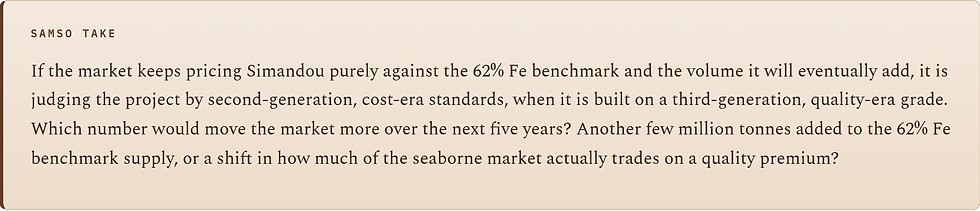
Samso's own reading, after setting the forecasts and Vale's counter-view against each other, is that the fair position is uncertainty rather than conviction in either direction. The EAF and DRI growth trends in section 6.00 are real and moving in one direction, but the pace forecasters expect ranges from modest to dramatic, and Vale's flat 2030 estimate cannot be dismissed simply because it is the least exciting scenario on the table. What can be said with more confidence is that Simandou's grade gives it optionality a lower-grade Pilbara tonne does not have, whether or not the direct-reduction market grows quickly enough to reward that optionality at scale within this decade.
SUPPORT SAMSO Independent, organic, and free to read We produce independent organic content and need your support to keep that going. Every contribution covers the cost of research, keeps the site running, and buys the time to write the next piece. A$10, A$20, A$30 or an amount you choose One time, weekly, monthly or yearly A donation buys nothing and unlocks nothing. It keeps the work going. |
8.00 — THREE GENERATIONS, ONE VERDICT
Where this leaves the consensus equation
Return to FIG 02 and the three generations it sets out. The first generation rewarded scale, the second rewarded cost, and this Insight has argued the industry is moving into a third generation that rewards quality. Simandou is a genuine test case of that shift, a project scaled and financed like a first-generation mine, priced to compete like a second-generation one once ramped, and graded like a third-generation one from the start.
Running back through the six discussion points, none of them individually overturns the consensus bear case, and this piece has not tried to make them. Simandou is exactly as large and as high-grade a deposit as its owners say it is. Its 120 Mtpa nameplate is real, even if it will take years and has already produced fatal incidents, strikes and logistics disputes on the way there. Mine depletion, at BHP's own estimated 250 million tonnes over ten years, is large enough to be significant but does not on its own cancel out a project of Simandou's scale. Demand outside China is growing but starts from a smaller base than China's own consumption. The quality shift toward direct reduction is real but its pace is disputed, including by Vale, one of the two companies best placed to know. Each variable, taken alone, leaves the consensus case largely intact.
What changes when the variables are read together is the confidence the consensus case is entitled to claim. A single new mine, however large and however high-grade, is not entering a static market. It is entering a market that is simultaneously losing tonnes to depletion, gaining demand from countries the standard narrative rarely names, and slowly re-pricing quality relative to volume. None of those forces is large enough on its own to be a headline. Together, they are the reason "Simandou means lower prices" is a less certain conclusion than its confident repetition across 2025 and 2026 forecasting notes would suggest. The realistic position for an investor is not that Simandou is bullish or bearish. It is that the market may have done its supply-side arithmetic more carefully than its net-supply arithmetic, and the gap between the two is where the real research still needs to be done.

9.00 — REFERENCES AND SOURCES
References & sources
Figures below are drawn from the primary company, government and exchange sources named first in each entry, supplemented by the secondary press and analyst sources listed where no primary disclosure was found. Every company and analyst figure carries the date it was published or reported, and every figure that is Samso's own reading of an underlying disclosure is described as such in the body text rather than presented as fact. FIG 01 through FIG 06 are original Samso illustrations of the data and sources named in each caption. PLATE 01 through PLATE 03 are reproduced from Rio Tinto's public media library and are undated operational images not tied to a specific press release, as noted in each caption.
[R1] Rio Tinto, "Simandou partners celebrate start of operations," 11 November 2025, and "Simandou iron ore project update," 6 December 2023, and "Conditions on Simandou investment now satisfied," 16 July 2024, riotinto.com. Ownership structure, nameplate capacity, ore grade, start-of-operations date.
[R2] SimFer SA, "Rio Tinto SimFer provides update on the progress of the Simandou Project during the first quarter of 2026," 26 March 2026, and SimFer "About Us" page, simfer-sa.com. Completion percentages, ramp-up guidance, first ore and shipment dates, fatal incident confirmation.
[R3] Rio Tinto, Q2 2026 results release, 15 July 2026. 2026 full-year Simandou sales guidance of 5 to 10 million tonnes.
[R4] Mining Weekly, "Guinea iron-ore development reaches 74% completion," 24 July 2026, miningweekly.com. Alternative completion percentages for the same reference date, flagged in section 3.00 as unreconciled against the SimFer primary figure.
[R5] Reuters and MINING.com, "China's Baowu takes control of Simandou iron ore operator." Reported shift in Winning Consortium Simandou ownership, not independently confirmed against a primary statement.
[R6] Businesswire (Financial Content), 15 February 2026, and Discovery Alert, 7 May 2026, citing Reuters. Fatal contractor incident and April to May 2026 strike at Baowu and Winning Consortium Simandou operations.
[R7] MINING.com, "Mass layoffs overshadow Guinea's Simandou mega-mine as output accelerates." Construction workforce wind-down and reported layoffs.
[R8] Westpac (Justin Smirk), 19 December 2025. Goldman Sachs (Aurelia Waltham), 29 October 2025, reported via MINING.com. S&P Global Commodity Insights, 19 January 2026, citing CERA. Breakwave Advisors, 21 January 2026 and 27 May 2026, breakwaveadvisors.com. Analyst price and production forecasts, attributed as analyst views rather than fact.
[R9] Anglo American, "Anglo American delivers first ore on ship from Minas-Rio," 27 October 2014, and "Anglo American suspends Minas-Rio iron ore operation for pipeline checks," 3 April 2018, angloamerican.com. Minas-Rio ramp-up and 2018 pipeline suspension.
[R10] Rio Tinto, "Rio Tinto opens Gudai-Darri, its most technologically advanced mine," 21 June 2022, and "Rio Tinto to increase Gudai-Darri iron ore mine capacity," 18 October 2023, riotinto.com. Gudai-Darri ramp-up and later expansion.
[R11] Business News (WA), "Roy Hill hits 55mtpa rate," 4 October 2017, businessnews.com.au. Roy Hill nameplate confirmation.
[R12] Rio Tinto, "Oyu Tolgoi partners reach comprehensive agreement...," 25 January 2022, and "Underground production celebrated at Oyu Tolgoi," 13 March 2023, riotinto.com. MINING.com coverage of the 2018 and 2019 delays and cost overruns. Oyu Tolgoi schedule and cost comparison.
[R13] BHP, "Economic and Commodity Outlook," 19 August 2025, bhp.com. The 250 million tonne, 2025 to 2035 seaborne supply depletion estimate.
[R14] Reuters and MINING.com, "Depletion of iron ore mines will underpin next decade's prices, Rio Tinto executive says," 5 August 2026, mining.com. Matthew Holcz's Melbourne Mining Club comments, the US$13bn Pilbara investment figure, and the 800 million tonne versus 300 million tonne global supply gap.
[R15] S&P Global Commodity Insights, "BHP's iron ore brand specification revisions...," 5 June 2024, and "Australia's Rio Tinto to lower iron content of flagship Pilbara Blend Fines...," 28 March 2025, spglobal.com. Pilbara grade downgrades.
[R16] Mining Weekly, "MinRes to shut Yilgarn iron-ore mine," 19 June 2024. Resources Review, "BHP to scale down operations at Yandi mine," 29 October 2025. Pilbara mine closures and wind-downs.
[R17] Mining Weekly, "Vale's iron-ore output hits seven-year high in 2025...," 28 January 2026, reporting Vale's own Q4/FY2025 production report. Vale 2025 and 2018 production figures.
[R18] Anglo American Kumba Iron Ore, "Ore Reserve (and Saleable Product) and Mineral Resource Report 2025," 31 December 2025, angloamericankumba.com. Sishen and Kolomela reserve life and depletion language.
[R19] CRU Group, "All you need to know about Indian iron ore supply," 2025, crugroup.com. Indian iron ore export decline.
[R20] US Geological Survey, Mineral Commodity Summaries 2026, February 2026, and Mineral Commodity Summaries 2025, January 2025, pubs.usgs.gov. World iron ore reserve and resource estimates.
[R21] World Steel Association, World Steel in Figures 2025, and Short Range Outlook, 13 October 2025, worldsteel.org. India Ministry of Steel, "An Overview of Steel Sector," April 2026, steel.gov.in. Steel use per capita, production and demand forecasts by country.
[R22] African Development Bank, 2025 Africa Investment Forum panel report, 28 November 2025, afdb.org. African infrastructure financing gap.
[R23] The Star, "Higher oil prices to buoy Sarawak's state sales tax revenue," 26 May 2026, thestar.com.my. Malay Mail, "Petros now sole gas distributor as Sarawak legal advisor says state received RM49b in royalties, Petronas kept the rest," 4 September 2025, malaymail.com. Sarawak's petroleum sales tax revenue, the Premier's quoted remarks, and the contested status of Petros as gas distributor.
[R24] Ecofin Agency / FinancialContent, "Ghana's Ewoyaa Mining Lease Ratification Advances: A New Dawn for African Lithium Supply," 12 November 2025. Natural Resource Governance Institute (Thomas Scurfield and Denis Gyeyir), "Assessing the Fiscal Regime in Ghana's Lithium Agreement," 22 July 2024, resourcegovernance.org. Ghana's free carried interest in the Ewoyaa lithium project and its parliamentary ratification status.
[R25] The Borneo Post, reported via PressReader, 16 February 2024. Sarawak Premier's reported remarks connecting prudent financial management to investor attraction. Malay Mail, "Awang Tengah: Sarawak Records Total Approved Investment of RM10.4b in H1 2024," 29 July 2024, malaymail.com. DayakDaily, "Sarawak Draws RM4 bil in Approved Investments for Q1 2026," 2026, dayakdaily.com. Sarawak approved investment figures and sector breakdown.
[R26] Bloomsbury Intelligence and Security Institute, "Ghana's Lithium Strategy: Can Value Addition Happen Without Deterring Investment?," 17 March 2026, bisi.org.uk. Governance credibility and policy implementation as conditions for investor confidence in Ghana's mining sector.
[R27] World Steel Association, World Steel in Figures 2025, worldsteel.org, and Midrex Technologies, "World DRI Production Reaches 140.8 Mt in 2024," 25 August 2025, midrex.com. EAF share and DRI production figures.
[R28] Midrex Technologies, "The Iron Ore Challenge for Direct Reduction on Road to Carbon-Neutral Steelmaking," June 2022, midrex.com. BHP statement on DRI ore quality, October 2021, reproduced via IEEFA, "Iron Ore Quality a Potential Headwind to Green Steelmaking," June 2022. DR-grade Fe thresholds.
[R29] Wood Mackenzie, "Steel decarbonisation to redefine supply chains by 2050," 19 October 2023, woodmac.com. International Iron Metallics Association and BloombergNEF estimates, reproduced via IEEFA, June 2022. DR-grade ore demand forecasts.
[R30] Vale, September 2021, reproduced via IEEFA, "Iron Ore Quality a Potential Headwind to Green Steelmaking," June 2022. Vale's own forecast on the share of seaborne ore above 66% Fe by 2030.
[R31] Fastmarkets, "How Is Iron Ore Priced? VIU & Index Explainer," updated 14 July 2026, fastmarkets.com. Fortescue financial year 2022 realised pricing data, reproduced via IEEFA, June 2022. Benchmark pricing methodology and grade discount example.
Cover photo: Hematite (GeoDIL number - 1313), Darla Sondrol. CC0, via Wikimedia Commons (https://commons.wikimedia.org/wiki/File:Hematite_(GeoDIL_number_-_1313).jpg). Reproduced photograph, shown faded under a navy overlay on the article thumbnail.
 The Samso Way – Seek the ResearchHere at Samso, we pride ourselves on delivering content for investors that is independent and informed by over three decades of experience in the industry. Our content is well-researched and is only created if I see merit in discussing the company's story. Our mission is simple. Cut through the noise and spotlight what matters. Genuine stories, grounded insights, and real opportunity. Investors can explore our four core platforms:
There may be numerous paths to success in investing, but the common thread among successful individuals is that they remain committed to making informed decisions. Equip yourself with the right knowledge and tools, and you will be well on your way to achieving your financial goals. Most importantly, investors need to be absolutely diligent in understanding their own risk-reward tolerance and capabilities. Never bite off more than you can chew. As they say, Rome wasn't built in a day, and the Great Wall stood because it took centuries to complete. The Samso Philosophy: Stay curious. Stay sharp. And remember, digging deeper always uncovers the real value. In Life, there is no such thing as a Free Lunch. Never bite off more than you can chew is my parting comment. Happy Investing, and the only four-letter word you need to know is DYOR. To support our independent work, please head over to our Support Page and give us a helping hand in any of the ways listed. This is a new initiative for the Samso Platform, and it was always the concept of Samso when we started this journey in 2018. DisclaimerThis article is general information only. It is not financial product advice and it does not take into account any reader's objectives, financial situation or needs. It contains no price targets, no valuations and no recommendation to buy, hold or sell any security. Companies named in this article are used as historical illustrations of events that have already occurred and no view is expressed on their current merits. Readers should consider obtaining advice from a licensed financial adviser and should conduct their own research before making any investment decision. Samso and its associates may hold interests in companies mentioned. About SamsoSamso is a trusted platform that equips dedicated investors with up-to-date industry knowledge and insights from top CEOs and thought leaders. By staying informed on business advancements and market trends, investors can enhance their financial decisions through a combination of expert guidance and their own research. The Investor's Playbook is an open-ended, evergreen educational series about how to think about investing rather than what to buy. Samso Insights | www.samso.com.au | An Investor Lens on ASX-Listed Companies |

Comments