

The Business of FDA Approvals

As investors, have you ever wondered what it takes to win FDA approval for a drug, a medical device or a diagnostic test? On a single day, an FDA decision has sent ASX health stocks up as much as 60 per cent and down as much as 57 per cent. This Samso Insight explains the steps, what an approval gives a company, what it does not, and what happened to the ASX and US companies that went through it.


For many ASX health companies, the US Food and Drug Administration decides access to one of their largest markets. Clinuvel took A$40.7 million of its A$94.0 million revenue in FY2026 from the United States [R1]. Nanosonics took A$180.4 million of its A$198.6 million in FY2025 from North America [R2]. PolyNovo took A$104.1 million of its A$138.4 million in FY2026 commercial sales from the Americas [R3]. The US share of that money depends on an FDA decision.
The FDA approval decision is a regulatory one. For a company with one product, it is also a commercial one, and the share price treats it that way. On the ASX the one-day moves on FDA decision days range from a 60 per cent rise for Clinuvel in 2019 to a 57 per cent fall for Mesoblast in 2023 (FIG. 01, in section 1.00).
HOW TO READ THIS PIECE A note on the vocabulary. Every regulatory and medical term is explained where it first appears. The terms are also collected in one box at the back, above the references. How to use the references. A marker such as [R5] in the text points to the numbered source in the list at the back. Clicking it jumps there. A note on the numbers. Where a company's documents give two different figures for the same thing, both are quoted as published, with the document each came from. Share prices are daily closing prices from Yahoo Finance, an aggregator rather than the ASX, and each one carries its date. Percentage moves are Samso's arithmetic on those closes. The latest price quoted is the close of 21 October 2026. |
WHAT THIS PIECE COVERS 1.00 WHY ONE US REGULATOR DECIDES SO MUCH OF A HEALTH COMPANY'S VALUE Why an FDA decision moves an ASX health company's share price, and twelve decisions compared. 2.00 THE FDA DRUG APPROVAL PROCESS, FROM THE LABORATORY TO THE DECISION LETTER Preclinical work, the IND, three trial phases, the NDA or BLA, the fee and the PDUFA clock. 3.00 THE ODDS, THE TIME AND THE COST The chance of approval at each stage, how long it takes and what it costs. Fast Track, Breakthrough, priority review, accelerated approval, orphan drugs and vouchers. The 510(k), De Novo and PMA routes for devices, and tests run inside a laboratory. 6.00 WHAT FDA APPROVAL MEANS, WHAT IS ALREADY IN THE PRICE, AND WHAT IT DOES NOT MEAN What an approval gives, what the market has already priced and what approval does not give. 7.00 ASX DRUG COMPANIES THAT LIVED THROUGH THE DECISION Mesoblast, Telix, Clinuvel, Neuren and Syntara, and what each FDA decision did to the company. 8.00 ASX DEVICE AND SOFTWARE COMPANIES EchoIQ, 4DMedical, EBR Systems, PolyNovo and Nanosonics. US companies that failed after approval, recovered from a CRL or grew on one approval. 10.00 THE FDA ITSELF IN 2025 AND 2026 Leadership, review times, published rejection letters and the next fee agreement. 11.00 WHAT THE PUBLIC RECORD LETS AN INVESTOR CHECK BEFORE AN FDA DATE Ten things an investor can check on the public record before an FDA date. |
1.00 — WHY ONE US REGULATOR DECIDES SO MUCH OF A HEALTH COMPANY'S VALUE
A licence to sell, granted one product at a time
The FDA is the US agency that decides whether a medicine, a medical device or a diagnostic test may be sold in the United States. The law says a new drug "may not be marketed until the date of approval" [R4]. Devices and tests have their own versions of the same rule, set out in section 5.00.
The FDA approves one product at a time, for a stated use in a stated group of patients. A company with three products in development faces three separate decisions, and each one can be different. Telix had one imaging agent approved in September 2026 while another was still waiting to resubmit after a rejection [R5] [R6].
A large drug company has many products, so one decision is a small part of its value. Most ASX health companies have one or two, so one decision can carry most of their value. That is why the share price moves on the day. FIG. 01 sets out the closing share price move on the first trading day after twelve FDA decisions on ASX-listed companies.

On average across these twelve events, which are a small sample, a rejection took away more than an approval added. An approval does not always lift the price, and EBR Systems fell 17 per cent on the day its device was approved. And the same company can appear on both sides of the chart, as Mesoblast and EchoIQ both do.
2.00 — THE FDA DRUG APPROVAL PROCESS, FROM THE LABORATORY TO THE DECISION LETTER
Five steps, two applications and one letter
The FDA describes drug development in five steps. Discovery and development, preclinical research, clinical research, FDA review, and post-market safety monitoring [R7]. FIG. 02, and FIG. 03 further down this section, are the FDA's picture of the path, published by its drug review centre, known by the initials CDER [R8].

Preclinical work and the IND
Preclinical research is testing in the laboratory and in animals, before any person takes the drug. It has to give the FDA "detailed information on dosing and toxicity levels" [R7].
To give the drug to people, the company files an Investigational New Drug application, or IND. It holds the animal and toxicity data, the manufacturing information and the plan for the human trials [R7]. The IND takes effect 30 days after the FDA receives it, unless the FDA imposes a clinical hold [R9]. A clinical hold is an order to delay or stop a trial. The FDA's patient page says a clinical hold is rare [R7].
The three phases of human trials
Phase 1 tests safety and dose in a small group. The FDA's patient page gives 20 to 100 people [R7]. The regulation says "generally in the range of 20 to 80" [R9]. Both are quoted here as published.
Phase 2 tests whether the drug works and what its side effects are, in up to several hundred patients who have the disease [R7].
Phase 3 is the large trial the approval will rest on, and is often called the pivotal trial. The FDA's page gives 300 to 3,000 patients over one to four years [R7].
Between Phase 2 and Phase 3 the company can hold an end-of-Phase-2 meeting with the FDA, to agree how Phase 3 will be run [R7]. Companies are not required to take the FDA's suggestions [R7].
The application, an NDA or a BLA
With the trials done, the company files its marketing application. A New Drug Application, or NDA, is for a chemical drug. A Biologics License Application, or BLA, is for a biologic, which is a medicine made by or from living cells, such as an antibody, a vaccine or a cell therapy [R10].
The application holds everything, from the first animal study to the last Phase 3 result, plus the proposed label and the manufacturing details [R7]. Mesoblast's Ryoncil is a BLA because it is made of living cells. Telix's Zircaix is a BLA because it uses an antibody. Telix's Illuccix is an NDA [R11] [R12].
The FDA then has 60 days to decide whether the application is complete enough to review. If it is not, the FDA can refuse to file it [R4].

The fee, the review clock and the PDUFA date
The FDA fee for a drug application with clinical data was US$4,682,003 in the US financial year to 30 September 2026 [R13]. From 1 October 2026 it is US$4,600,753 [R14]. Designated orphan drugs are exempt from this fee for their orphan use [R14]. Small businesses can apply for a waiver, although the FDA's proposal for the next fee agreement would limit that waiver to US-based companies [R15].
The review clock comes from the Prescription Drug User Fee Act, or PDUFA, the law under which companies pay these fees. Under the current agreement the FDA aims to act on 90 per cent of applications for new active ingredients within 10 months of the 60-day filing date, or six months for a priority review [R16]. In practice that is about 12 months from submission for a standard review and eight months for a priority one.
The target date is called the PDUFA date. It is the date the FDA aims to act, which is a different thing from the date it approves. Under the agreement, acting means sending a letter, and the letter can say no [R16]. If the company sends a major new piece of data during the review, the FDA can push the date back three months, once [R16].
The date can also be missed. KalVista Pharmaceuticals said on 13 June 2025 that the FDA would not meet its 17 June goal date, citing the agency's workload [R17]. The FDA approved the drug on 3 July 2025 [R17]. For KalVista the missed date meant a wait of about two weeks before approval.
The advisory committee
The FDA can ask a panel of outside experts to vote on an application in a public meeting [R7]. The vote is advice. Under the FDA's regulations the Commissioner "has sole discretion" on what to do with it [R18].
Mesoblast saw the FDA go the other way from its panel. The FDA's oncology panel voted 9 to 1 in August 2020 that Mesoblast's data supported Ryoncil [R19] [R20]. The FDA rejected it seven weeks later [R20]. Syntara, then called Pharmaxis, shows that a panel can change its view as the evidence changes. A panel voted unanimously against its cystic fibrosis drug Bronchitol in January 2013, and a second panel voted 9 to 7 in favour in May 2019 [R21]. The FDA approved Bronchitol in October 2020, for adults only [R22].
The decision letter, approval or a complete response letter
The FDA's decision comes in a letter. An approval letter means the product may be sold for the uses on its label [R4].
The other letter is a Complete Response Letter, or CRL. The FDA sends one when it "will not approve the application ... in its present form" [R4]. The letter lists the problems and, where it can, what would fix them [R4]. The market reads a CRL as a rejection, and it usually is one for that review cycle.
A CRL is not always the end. The company can fix the problems and resubmit. A Class 1 resubmission covers minor items and the FDA aims to act within two months. A Class 2 resubmission covers anything larger and gets six months [R4] [R16]. Mesoblast went through two CRLs and two resubmissions before Ryoncil was approved [R20] [R23] [R24].
3.00 — THE ODDS, THE TIME AND THE COST
How the odds change from Phase 1 to filing
A drug entering Phase 1 has a 7.9 per cent chance of being approved, according to the most cited study of the odds [R25]. The study is by BIO, the US biotechnology industry body, with Informa and QLS Advisors. It tracked 12,728 moves from one trial phase to the next, in 9,704 drug programs, between 2011 and 2020. FIG. 04 shows how those odds improve as a drug moves along.

The hardest step is Phase 2. Only 28.9 per cent of drugs in Phase 2 moved on to Phase 3 [R25]. Phase 2 is the first proper test of whether the drug works, and most drugs do not get past it.
Once a company has filed its application, the odds turn the other way. In the BIO study, 90.6 per cent of filed applications were approved in the end, including those approved after a CRL and a resubmission [R25]. The FDA's report to Congress gives first-time approval rates for applications filed in its 2024 financial year of 76 per cent for priority reviews and 68 per cent for standard ones [R26]. So about one filing in four to one in three is turned down the first time. The BIO figure of 90.6 per cent suggests most of those are approved later, although the two sources cover different years.
The odds change with the disease
The odds from Phase 1 differ a great deal by disease. They range from 23.9 per cent for blood disorders down to 3.6 per cent for urology. Cancer was 5.3 per cent and heart and blood vessel disease 4.8 per cent [R25]. Drugs for rare diseases had a 17.0 per cent chance from Phase 1 [R25]. In Samso's reading, those better odds are one reason small companies often choose rare diseases.
The time
The same study puts the average time from the start of Phase 1 to approval at 10.5 years. That is 2.3 years in Phase 1, 3.6 in Phase 2, 3.3 in Phase 3 and 1.3 years in review [R25]. Clinuvel said its path to US approval for Scenesse had "taken over a decade" [R27]. Mesoblast completed its first Ryoncil application in January 2020 and was approved in December 2024 [R28] [R24]. Most of those nearly five years went on answering two CRLs and resubmitting.
The cost
Two studies are usually quoted on cost, and they give very different answers. Both include the cost of the drugs that failed along the way, and both charge 10.5 per cent a year for the use of the money [R29] [R30].
Wouters, McKee and Luyten, writing in the Journal of the American Medical Association in 2020, used public company filings for 63 approved drugs. They put the median cost of bringing one new drug to market at US$985.3 million in 2018 dollars [R29]. Their sample leaned towards smaller companies and rare disease drugs [R29].
DiMasi, Grabowski and Hansen, writing in the Journal of Health Economics in 2016, used confidential data from ten large drug companies. They put the average at US$2,558 million in 2013 dollars [R30].
The two studies counted different drugs from different kinds of company, and in Samso's reading that explains most of the gap. For a small ASX company the first figure is the closer guide.
A failure before the FDA ever decides
Most of the money is lost before an application is filed. Opthea, which now trades as Ceryvyn Therapeutics according to its website, is the ASX example. Its eye drug sozinibercept failed its first Phase 3 trial, COAST, in March 2025. The drug added to standard treatment gave a gain of 13.5 letters on an eye chart against 13.7 letters for standard treatment alone [R31]. The second Phase 3 trial, ShORe, also failed and the program was stopped [R32]. The FDA was never asked to decide.
Opthea had funded the trials partly through an agreement with investors that could have required repayment of up to US$680.0 million if the agreement was terminated [R31]. It was settled in August 2025 for US$20 million in cash and 9.99 per cent of the company [R33]. The failed trials left shareholders with a funding agreement to settle as well as the cost of the trials.

4.00 — THE FASTER LANES
Fast Track, Breakthrough, priority review, accelerated approval, orphan drugs and vouchers
The FDA has several programs that speed up drugs for serious diseases. Companies announce these designations, and the market often reacts to them. Fast Track, Breakthrough and priority review speed up the FDA's work. The standard for approval stays the same. Accelerated approval is different. It lets the FDA approve on earlier evidence, on condition that a later trial confirms the benefit.
Fast Track and Breakthrough Therapy
Fast Track is for drugs that treat a serious condition and fill an unmet need. It gives more meetings with the FDA and lets the company send in its application in parts as each part is finished, which the FDA calls a rolling review [R34]. The FDA decides on a request within 60 days [R34].
Breakthrough Therapy designation needs early clinical evidence that the drug "may demonstrate substantial improvement over available therapy" [R34]. It adds intensive FDA guidance from as early as Phase 1 [R34]. Telix's Zircaix had Breakthrough Therapy designation. Its CRL in August 2025 was about manufacturing [R12]. In Samso's reading, the designation speeds up the FDA's guidance but does not change what the factory must show.
Priority review
A priority review cuts the FDA's target from 10 months to six [R34]. The FDA's page states that it "does not alter the scientific/medical standard for approval" [R34].
Accelerated approval
Accelerated approval lets the FDA approve a drug on a surrogate endpoint. A surrogate is a measurement thought to predict a benefit, such as a tumour shrinking, in place of the benefit itself, such as living longer [R34]. The company must then run a confirmatory trial. If that trial fails, the FDA can withdraw the approval [R34].
The FDA's table lists 36 cancer uses approved this way and later withdrawn, up to the end of September 2026 [R35]. Withdrawal used to be slow. Makena, a drug to prevent premature birth, took about two and a half years from the FDA's proposal to withdraw it in October 2020 to the final withdrawal on 6 April 2023 [R36]. A 2022 law, the Food and Drug Omnibus Reform Act, gave the FDA a faster route [R37]. Ocaliva, a liver drug approved this way in 2016, was withdrawn in November 2025 after its confirmatory trial did not show a benefit [R38]. The FDA had recommended in August 2025 that the company withdraw it, and the company asked for withdrawal in September, so the process took about three months.
Orphan drugs
An orphan drug is one for a rare disease, which in the US means fewer than 200,000 patients [R39]. Orphan designation brings tax credits on trial costs, freedom from the FDA application fee, and seven years in which the FDA will not approve a competing version of the same drug for the same use [R39]. FIG. 05 shows that about half of the novel drugs approved by the FDA's drug centre carry orphan designation [R40]. Cell and gene therapies, which a separate FDA centre reviews, are not counted.

The vouchers
A priority review voucher is a right to a six-month review on a later application, and it can be sold [R41]. The FDA gives one to a company that wins approval for a drug for a rare disease in children.
New awards under that program were winding down from December 2024. It was revived by a US law on 3 February 2026, so the FDA can award these vouchers again until 30 September 2029 [R41]. Two vouchers sold in 2026 went for US$205 million and US$180 million [R42] [R43]. The buyer still pays the FDA an extra fee of US$1,798,596 to use one in the year to September 2027 [R41].
Neuren is entitled to one third of the net proceeds of the US$150 million that its partner Acadia received for the voucher awarded with Daybue [R44]. For the company that wins one, a voucher can bring in cash before the drug has sold much.
The FDA also runs a newer pilot, the Commissioner's National Priority Voucher. It aims to cut the review to one or two months. These vouchers cannot be sold [R45]. The FDA's page lists 11 approvals under the pilot up to 19 October 2026 [R45].
5.00 — DEVICES AND DIAGNOSTICS
510(k) clearance, De Novo grant and PMA approval
Medical devices follow a different system from drugs. The FDA sorts each type of device into one of three classes by risk. Class I is the lowest risk. Class III is the highest and includes devices that support or sustain life [R46] [R47]. The class decides the route to market, and the route decides the word the FDA uses at the end. TABLE 01 sets out the three routes side by side [R47] [R48] [R49].

510(k) devices are cleared
Most moderate-risk devices go through a 510(k), named after the section of the law that created it. The company shows that its device is "substantially equivalent" to one already legally sold, which the FDA calls the predicate [R47]. If the FDA agrees, the device is cleared. The FDA says the decision is "usually made within 90 days" [R47]. The FDA fee was US$26,067 in the year to September 2026 [R48].
If the FDA does not agree, it issues a Not Substantially Equivalent decision. The company can then file a new 510(k), ask for a De Novo grant or appeal. EchoIQ announced one on 8 September 2026 for its heart failure software [R50]. Section 8.00 covers what followed.
De Novo devices are granted
A new kind of low- or moderate-risk device with no predicate goes through a De Novo request. If the FDA agrees, it grants the request and creates a new device type. That device then becomes the predicate for later competitors [R47]. Nanosonics' CORIS endoscope cleaner went this way. The FDA's order of 19 March 2025, corrected on 16 May 2025, created a new type called the automated endoscope channel cleaner [R51]. FIG. 06 is the first page of the corrected order.

PMA devices are approved
High-risk Class III devices need Premarket Approval, or PMA. The FDA calls it "the most stringent type of device marketing application" [R47]. It needs clinical evidence that the device is safe and works, and the FDA usually inspects the factory first [R47]. The fee was US$579,272 in the year to September 2026 [R48]. EBR Systems' WiSE heart device was approved this way in April 2025 [R52].
Of these three routes, only the PMA ends in an approval. In everyday use a 510(k) clearance is often called an approval. The FDA's own word for that route is "cleared".
How long devices take
The FDA's device fee agreement, the Medical Device User Fee Amendments (MDUFA), aims for an average total time to a decision of 112 days for a 510(k) and 285 days for a PMA, counting the time the company takes to answer questions [R49]. Both are far shorter than the clock for a new drug.
The FDA also runs a Breakthrough Devices Program. By 30 June 2026 it had granted 1,320 breakthrough designations, and 210 of those devices had reached the market [R53]. That is about one in six designated devices on the market so far.
Diagnostics and the laboratory route
A diagnostic test sold as a kit is a device and goes through the same three routes [R54]. A test designed and run inside one laboratory is different. It is called a laboratory developed test, or LDT. For decades the FDA chose not to enforce its device rules on most of them, and the laboratories were regulated for quality under a separate law, the Clinical Laboratory Improvement Amendments, or CLIA [R54]. CLIA checks that a laboratory runs a test accurately. Whether the result means what the laboratory says it means rests on the laboratory's own validation work.
In May 2024 the FDA made a rule to phase in its device rules for these tests over four years, including premarket review [R54]. A US court set the rule aside on 31 March 2025, and the FDA removed it from its regulations on 19 September 2025 [R55]. For now a laboratory can offer its own test in the US without an FDA review.
The LDT route is quicker and cheaper, and many US laboratory tests reach patients this way. It also means no FDA reviewer checks the test before patients use it, although the laboratory is still checked for quality under CLIA. The best-known failure is Theranos, the US blood testing company, which ran its tests in its own laboratory. It raised more than US$700 million and was charged with fraud by the US Securities and Exchange Commission in 2018. The SEC alleged that most patient tests had been run on modified and standard commercial analysers rather than its own device [R56].
The two ASX blood test companies Samso has covered are taking different routes. BCAL Diagnostics is developing its breast cancer test as an LDT, with validation at Sonic Healthcare USA's laboratory in Austin, Texas [R57]. Cleo Diagnostics plans a 510(k) submission for its ovarian cancer test in the first half of 2027 [R58].
6.00 — WHAT FDA APPROVAL MEANS, WHAT IS ALREADY IN THE PRICE, AND WHAT IT DOES NOT MEAN
What an approval gives a company and where it stops
What approval means
An approval gives the company the legal right to sell the product in the United States, for the uses on its label and nothing more. Doctors may prescribe it for other uses, but the company may not promote those uses [R59].
Approval also starts a period in which the FDA will not accept or approve a copy. A new chemical drug gets five years. An orphan drug gets seven years for its approved use. A biologic gets twelve years before a copy, called a biosimilar, can be approved [R60] [R61]. These periods run alongside the company's patents, and they are a separate protection [R60]. FIG. 07 is the FDA's summary of the drug exclusivity periods.

What is already in the price
When a strong trial result is already public, much of the value of an approval can be in the share price before the decision. FIG. 01 shows that this is not always so.
Madrigal Pharmaceuticals in the US is one example. Its shares rose 268 per cent in one day in December 2022 when its Phase 3 liver trial succeeded, as reported by TipRanks [R62]. On the day after its approval in March 2024 they were up 15.5 per cent, as reported by Schaeffer's Research [R63]. Both figures are from news reports, not exchange data.
On the ASX, EBR Systems had told the market it expected approval on or before 13 April 2025 [R64]. The approval came on that date and the shares fell 17 per cent the next trading day (FIG. 01). Clinuvel closed at A$28.09 before its approval in October 2019 and at A$45.00 the next trading day, a 60 per cent rise. On 18 October, seven trading days later, it closed at A$31.85 and most of the rise had gone [R65].
In Samso's reading of FIG. 01, a rejection is seldom fully priced in, because the market has usually been pricing in an approval. That would explain why the falls in FIG. 01 are larger on average than the rises, although four rejections are a small sample.
What approval does not mean
Payment is a separate step from approval. The FDA does not set a price or guarantee payment. Hospitals bill insurers and the government's Medicare scheme through billing codes, and Medicare decides what it will cover [R66]. Mesoblast's Ryoncil was approved in December 2024. Its permanent billing code, called a J-code, came into effect on 1 October 2025 [R67]. Aduhelm, the Alzheimer's drug from Biogen and Eisai, was approved in June 2021. Medicare decided in April 2022 to pay for it only inside clinical trials [R68]. Biogen wrote off about US$275 million of stock and stopped selling it in 2024 [R69] [R70].
Australia makes its own decision. The decision is made by the Therapeutic Goods Administration, Australia's regulator. It has a shorter route for medicines already approved by a regulator it trusts, which includes the FDA. That route takes 120 or 175 working days, depending on the type [R71].
An approval can be narrowed or withdrawn. The FDA can narrow a label or withdraw an approval when later evidence shows a problem. Ocaliva was withdrawn in November 2025, as section 4.00 describes [R38]. Pfizer withdrew its sickle cell drug Oxbryta from all markets in September 2024 [R72]. STAT reported that Pfizer had paid US$5.4 billion for Oxbryta's developer two years earlier [R73].
Patents are decided in the courts, separately from the FDA. Amarin's fish oil capsule Vascepa won an expanded US approval in December 2019. On 30 March 2020 a US court ruled for two generic makers in the case over its patents, in a quarter when Vascepa sales were at a record [R74]. BioPharma Dive reported that the shares fell about 70 per cent and about US$3.5 billion of market value was lost [R75].
Section 9.00 sets out US companies that failed after approval, recovered after a CRL or grew on one approval.
When approval is the value event
Once a company files, the odds favour it. As section 3.00 showed, most filed applications are approved in the end, and a CRL is often a delay rather than an end [R25]. Mesoblast, Syntara and the US company Replimune all received at least one CRL and were later approved [R24] [R22] [R76] [R77]. A company that has finished Phase 3, has filed a complete application and has the cash to answer a CRL is in a very different position from one waiting on its first Phase 2 result. For Telix and Neuren, approval opened the revenue set out in section 7.00, and for Clinuvel it added a second market. Mesoblast raised money at A$2.50 a share less than four weeks after its approval, against A$0.30 after its second rejection [R78] [R79]. |

7.00 — ASX DRUG COMPANIES THAT LIVED THROUGH THE DECISION
Mesoblast, Telix, Clinuvel, Neuren and Syntara
Mesoblast, two rejections and then an approval
Mesoblast's Ryoncil is a cell therapy. It is made from cells grown from donated bone marrow, frozen, and given into a vein. It treats children whose bodies are being attacked by a donor's immune cells after a bone marrow transplant, when steroids have failed [R24].
FIG. 08 sets the Mesoblast share price against each FDA event.
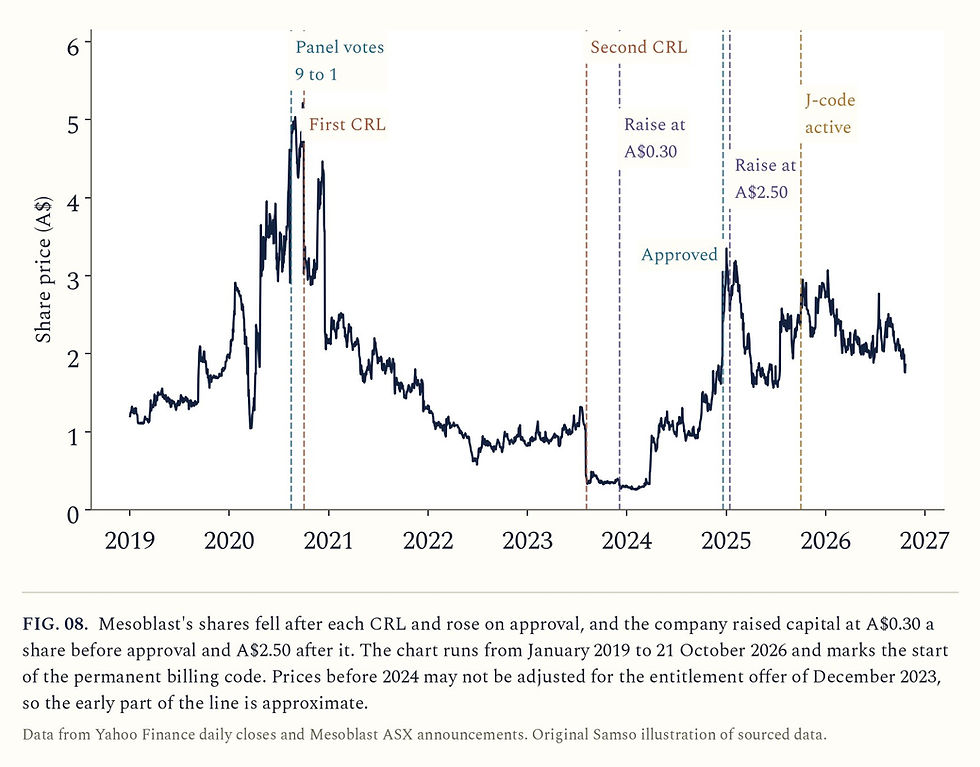
August 2020. The FDA's oncology panel voted 9 to 1 that the data supported Ryoncil [R19] [R20]. The shares rose 39 per cent the next trading day [R65].
October 2020. The FDA sent a CRL. It asked for at least one more randomised, controlled trial in adults or children [R20]. The shares fell 37 per cent [R65].
August 2023. After resubmitting, Mesoblast received a second CRL. Mesoblast said the FDA "requires more data to support marketing approval". Its inspection of the plant had found no problems [R23]. The shares fell 57 per cent [R65].
December 2023. Mesoblast announced a raising of up to A$97.0 million at A$0.30 a share, completed in March 2024 [R78].
December 2024. The FDA approved Ryoncil, the first mesenchymal stromal cell product it has approved for any use [R24]. Mesenchymal stromal cells are the bone marrow cells the product is grown from. The shares rose 54 per cent [R65].
January 2025. Mesoblast raised A$260 million at A$2.50 a share [R79].
The same company raised money at A$0.30 a share after its second rejection and at A$2.50 a share less than four weeks after its approval [R78] [R79]. Raising before the approval meant issuing far more shares for each dollar raised than raising after it.
Ryoncil's list price is US$194,000 per infusion [R80]. In the year to 30 June 2026, its first full year on sale, it brought in net revenue of US$115.2 million [R81]. In the September 2026 quarter net revenue was US$28 million [R82]. The company reported a net loss of US$57.5 million for FY2026 [R81]. Ryoncil is selling, and the company is still spending more than it earns.
Telix, an approval that built a company and a rejection over manufacturing
Telix sells radioactive imaging drugs. A small dose is injected, it attaches to cancer cells, and a PET (positron emission tomography) scanner shows where the cancer is.
The FDA approved its prostate cancer imaging kit Illuccix in December 2021, and Telix announced it on the ASX on 20 December [R11]. Telix's revenue was A$7.6 million in 2021 [R83]. It was A$160.1 million in 2022, the first year of Illuccix sales, which began in April [R84] [R85]. Its group revenue was US$803.8 million in 2025, and US$621.6 million of that was sales in its Precision Medicine business, where the prostate imaging kits Illuccix and the newer Gozellix were the main driver [R85]. FIG. 09 is Telix's chart of quarterly Illuccix sales from early 2024 to mid 2025 [R86].

Telix has also had two CRLs. Its brain cancer imaging drug Pixclara received a CRL in April 2025 asking for more evidence that it worked [R87]. Telix resubmitted and Pixclara was approved in September 2026 [R5].
Its kidney cancer imaging agent Zircaix received a CRL on 28 August 2025 [R12]. Telix said the FDA asked for data showing that the drug made at commercial scale matches the drug used in the trial, and it found problems at two outside manufacturers [R12]. The shares fell 19 per cent [R65].
Telix's interim report of August 2026 says the FDA issued a corrected CRL on 10 April 2026 and extended the resubmission deadline [R88]. As at 21 October 2026, Telix said it was finalising the resubmission [R6].
Clinuvel, approval for a company that was already profitable
Clinuvel's Scenesse is a small implant placed under the skin. It releases a drug that darkens the skin and protects patients with a rare genetic disorder in which light causes severe pain [R27].
The FDA approved it on 8 October 2019 [R27]. Clinuvel was already selling Scenesse in Europe and was already profitable [R89]. The United States brought in A$47.9 million of Clinuvel's A$95.0 million revenue in FY2025 [R1]. In FY2026 the US figure was A$40.7 million of A$94.0 million [R1]. For Clinuvel the approval added a market to a business that was already earning.
Neuren, approval through a partner
Neuren invented trofinetide, a drug for Rett syndrome, a rare genetic brain disorder that mostly affects girls. Its partner Acadia Pharmaceuticals ran the US application and sells the drug as Daybue [R44]. The FDA approved it on 10 March 2023 [R44].
Neuren carried none of the launch cost. It receives a royalty of 10 to 15 per cent of North American sales, rising in steps as sales grow, plus sales milestones [R44]. FIG. 10 shows Daybue's sales and Neuren's royalty income in each of the first three years [R90].

Syntara, two panels, two CRLs and eight years
Syntara, then called Pharmaxis, filed the US application for Bronchitol, an inhaled powder for cystic fibrosis, in May 2012 [R21]. By the time of approval its US partner Chiesi held the application [R22]. An FDA panel voted unanimously against it in January 2013, and the FDA sent a CRL in March 2013 [R21] [R91]. A second panel voted 9 to 7 in favour in May 2019. The FDA sent a second CRL in June 2019, this time because health workers could not reliably run the test needed to start a patient safely [R91]. The FDA approved Bronchitol on 30 October 2020 for adults only, rather than for patients aged six and older as first proposed [R22]. Bronchitol was approved more than eight years after filing, through two panels and two CRLs.
8.00 — ASX DEVICE AND SOFTWARE COMPANIES
EchoIQ, 4DMedical, EBR Systems, PolyNovo and Nanosonics
EchoIQ, one clearance and one refusal
EchoIQ makes software that reads the measurements from a heart ultrasound and flags patients who may have a serious heart condition, so a cardiologist looks again [R92].
Its first product, EchoSolv AS, looks for a narrowed heart valve. It was cleared through a 510(k) on 8 October 2024 [R92]. The shares rose 29 per cent [R65].
Its second product, EchoSolv HF, looks for heart failure. A validation study with Mayo Clinic Platform covering about 17,000 heart scans met its main goal [R93]. EchoIQ lodged the 510(k) on 15 December 2025 [R94]. While it was under review the shares rose from A$0.275 on 12 December 2025 to a high close of A$1.75 on 2 July 2026 [R65]. On 1 July 2026 EchoIQ raised about A$110 million at A$1.45 a share [R95].
On 8 September 2026 the FDA issued a Not Substantially Equivalent decision for EchoSolv HF [R50]. EchoIQ said the FDA's concerns were "limited to aspects of statistical analysis supporting the clinical validation" [R96]. The FDA's public letter database covers drugs and biologics, not device refusals, so EchoIQ's announcement is the public account of the decision [R97]. The shares fell from A$1.28 to A$0.64 [R65]. EchoIQ has asked for a review of the decision inside the FDA. EchoIQ said on 12 October 2026 that the FDA had accepted the request, and it had announced no outcome by 22 October 2026 [R98]. The review inside the FDA is the next step. FIG. 11 sets out the record.

What can go wrong in a 510(k)
A 510(k) is not a checklist that passes once every item is ticked. The company has to show, with its own evidence, that its device is at least as safe and effective as the predicate [R47] [R99]. For software that reads patient data, that evidence is usually a clinical study.
Before submitting, a company can ask the FDA to comment on its plans. This is called a Pre-Submission, or Pre-Sub, and it is "entirely voluntary" [R100]. The FDA intends its feedback not to change, as long as the later application matches what was discussed and nothing important has changed in the science [R100]. A Pre-Sub is not a look at the results, though. The FDA says it "is not intended to be a pre-review of an intended submission or a pre-review of data", and that it "does not guarantee a favorable decision" [R100]. The Pre-Sub can agree the plan. The review then judges the results.
The FDA's 510(k) guidance sets out where an application can fail. The device may have a different intended use from the predicate. Its technology may differ in a way that raises different questions of safety and effectiveness. Or the information may be "insufficient to demonstrate substantial equivalence" [R99]. The FDA says it rarely refuses on the technology question [R99]. During the review it can also stop the clock and ask for more information. If the answers are still not enough, the evidence remains insufficient and the FDA can refuse [R99].
What may have happened at EchoIQ
We do not know what the FDA's letter to EchoIQ says. EchoIQ has not published it, and the FDA's public letter database does not cover device refusals [R97]. EchoIQ has said the concerns were "limited to aspects of statistical analysis supporting the clinical validation", and that it had "not identified concerns relating to the underlying technology or core functionality" [R96]. A summary of its 8 September investor webinar by Quartr describes the issue as "specific aspects of statistical analysis and ground truth" [R101]. Ground truth is the industry term for the reference standard. We have not heard the webinar recording ourselves. EchoIQ's announcements do not say whether it held a Pre-Sub on the heart failure study [R50] [R96] [R98].
The FDA's guidance on diagnostic tests and on AI software names the places where statistical questions usually come up [R102] [R103]. What follows are possibilities. None of them has been reported for EchoIQ.
The reference standard. This is how a study decides which patients truly have the condition. The FDA calls it "the best available representative truth" [R103]. If the FDA did not accept how heart failure was confirmed in the study, every accuracy figure built on it would be in question.
The cut-off. Software like EchoSolv HF produces a score, and a cut-off turns the score into a flag. The FDA asks companies to explain "how any thresholds (e.g., operating points) were determined" [R103].
The patients and the sites. The FDA recommends testing on data from sites different from those used to build the software, with results broken down by groups such as age and sex [R103]. It warns that leaving out difficult cases "produces an overly optimistic picture" [R102].
The uncertainty. The FDA recommends reporting accuracy with two-sided 95 per cent confidence intervals [R102]. A study can meet its goal on average and still leave a range the FDA considers too wide.
It may be one of these, more than one, or something else. EchoIQ disputes parts of the decision. It has filed a supervisory review, which is an appeal inside the FDA. On 12 October 2026 it said the appeal had been accepted and that it expected a meeting with the FDA within 30 days [R98]. A new 510(k) is also open to it [R96].
Three questions are worth putting to the company. Did it hold a Pre-Sub on the heart failure study, and did the FDA agree the statistical plan? Which part of the analysis did the FDA object to? And does the fix need new analysis of the same data, or new data?
4DMedical, a clearance and a large share price rise
4DMedical's CTVQ software works out how air and blood reach different parts of the lungs from an ordinary CT scan. Today that information comes from a nuclear medicine scan using radioactive tracers [R104]. FIG. 12 is from the company's presentation and shows the nuclear scan images that CTVQ is meant to replace.

CTVQ was cleared through a 510(k) on 1 September 2025 [R105]. The shares rose 36 per cent that day [R65]. They closed at A$0.24 on 30 June 2025 and A$4.53 on 30 June 2026, a rise of 1,788 per cent over the financial year [R65]. 4DMedical's revenue for FY2026 was A$7.06 million [R106]. In Samso's reading, the share price has risen far more than revenue so far, so the price carries expectations of US sales still to come.
EBR Systems, approved and then the commercial test
EBR Systems' WiSE CRT device, for cardiac resynchronisation therapy, paces the left side of the heart without a wire into the heart. A tiny electrode is placed inside the heart and powered by ultrasound from a unit under the skin [R52]. PLATE 01, from EBR's presentation on the day of approval, shows the electrode beside other wireless pacemakers [R107].

The FDA approved WiSE through the PMA route on 13 April 2025 [R52]. The shares fell 17 per cent [R65]. EBR's 2025 revenue, its first, was US$1.617 million, with a net loss of US$48.8 million [R108]. In June 2026 it raised A$150.0 million at A$0.38 per CDI, the form in which its US-registered shares trade on the ASX. It said the money was intended to fund it to cash flow breakeven [R109]. The CDIs closed at A$0.145 on 21 October 2026, below the price of that raising [R65].
PolyNovo and Nanosonics, the slow build
PolyNovo's NovoSorb BTM is a synthetic sheet laid on a deep burn, which the body grows new tissue into. It was cleared through a 510(k) in December 2015 [R110]. In FY2026 PolyNovo's sales in the Americas were A$104.1 million [R3].
Nanosonics sells trophon, a machine that disinfects ultrasound probes between patients. In FY2025 it took A$180.4 million of its A$198.6 million revenue from North America [R2].
In both cases sales in the Americas were built over years after the FDA decision.
9.00 — THE US RECORD
US companies that failed after approval, recovered from a CRL or grew on one approval
The US market has a longer record of FDA decisions. The cases below show each kind of outcome. They are examples, not a sample, and most US approvals end less dramatically than these. TABLE 02 sets them out in one place.

Approved and later failed
Dendreon. Its prostate cancer treatment Provenge, made separately for each patient from his own immune cells, was approved in April 2010 [R111]. It was priced at US$93,000 for a course, as reported at the time [R112]. Sales did not grow fast enough to carry its debt. Dendreon filed for Chapter 11 bankruptcy protection on 10 November 2014 with US$620 million of convertible notes outstanding [R113].
Achaogen. Its hospital antibiotic Zemdri was approved in June 2018 [R114]. Doctors hold new antibiotics back for the hardest cases to slow the spread of resistance, so sales start small. Achaogen's FY2018 sales of Zemdri were US$783,000, as reported by MedCity News [R115]. Achaogen filed for Chapter 11 on 15 April 2019, ten months later [R116]. Its assets sold for about US$16 million [R117].
Aduhelm. Biogen's Alzheimer's drug was approved in June 2021, after an FDA panel voted against it, as reported by RAPS [R118]. Medicare limited its coverage in April 2022 and Biogen stopped it in 2024 [R68] [R70]. Section 6.00 has the detail.
Clovis Oncology. Its ovarian cancer drug Rubraca was approved under accelerated approval in December 2016 [R119]. Later trial data led to its label being narrowed [R120]. Clovis missed an interest payment on 1 December 2022 and filed for Chapter 11 on 11 December 2022 [R120].
After a CRL
Replimune. Its melanoma treatment RP1 received a CRL in July 2025. The FDA said its main trial was "not considered to be an adequate and well-controlled clinical investigation" [R76]. The shares were down about 75 per cent during the day, as reported by Benzinga [R121]. A second CRL followed in April 2026. An FDA panel then voted 10 to 3 in its favour in July 2026, and the FDA approved RP1 as Tudriqev on 6 August 2026 [R122] [R77].
Capricor. Its cell therapy for Duchenne muscular dystrophy, an inherited muscle-wasting disease in boys, received a CRL on 11 July 2025 [R123]. Its Phase 3 trial then met its main goals in December 2025, as reported by Clinical Trials Arena [R124]. Trade press reports an FDA panel vote of 9 to 3 against in July 2026 and a decision date of 22 November 2026 [R125].
Approval that became most of the revenue
Vertex. Its cystic fibrosis pill Trikafta was approved in October 2019 [R126]. In 2025 Trikafta and its European version brought in US$10.3 billion of Vertex's US$12.0 billion revenue [R127].
Madrigal. Its liver drug Rezdiffra received accelerated approval in March 2024. Net sales were US$364.3 million in the June 2026 quarter, and the company still reported a net loss [R128].
Vertex's pill treats the cause of the disease. Dendreon's made-to-order treatment was costly, and the company could not carry its debt.

10.00 — THE FDA ITSELF IN 2025 AND 2026
Leadership changes, published rejection letters and a new fee deal
Who is running it
Martin Makary was FDA Commissioner from 25 March 2025 to 13 May 2026 [R129]. As at 22 October 2026 the FDA is run by an Acting Commissioner, Kyle Diamantas [R129]. In March 2025 the US health department said the FDA would cut about 3,500 staff and that drug and device reviewers would not be affected [R130].
Whether the reviews are on time
The FDA's report to Congress says its 2024 group of applications met all ten review goals. Its 2025 group was meeting eight of ten at 30 September 2025, with 1,672 submissions still under review [R26]. Its hiring under the fee agreement reached 17 of a target of 44 staff in the year to 30 September 2025 [R131].
Complete response letters are now public
Until 2025, the FDA's letter became public only if the product was later approved. For a pending or failed application, investors saw only the company's summary. A 2015 study in the BMJ by FDA researchers compared 61 CRLs with the companies' announcements. No press release was issued for 18 per cent of them [R132]. The FDA's 2025 release says companies left out 85 per cent of its safety and efficacy concerns when announcing a CRL [R133].
On 4 September 2025 the FDA said it would publish CRLs promptly after issuing them, with company names shown [R134]. Its public database held 458 letters at its last update on 13 August 2026 [R97]. The FDA's letter is now published as well as the company's announcement, so both can be read together.
The next fee deal, and what it means for Australia
The current fee agreement ends in September 2027. The FDA's proposal for the next one, published in August 2026, includes money to restaff the drug review program to its 2025 level and aims to reduce missed goal dates [R15]. It also proposes halving the application fee when the application includes data from a US Phase 1 trial started after 1 October 2027 [R15].
Samso reads that second point as aimed partly at Australia. The FDA's release of 15 September 2026 says first-in-human trials, which are Phase 1, are completed "much faster in China and Australia" than in the US [R135]. In Samso's reading, many ASX biotechs run their first-in-human trials in Australia. If the proposal goes ahead, a company whose first trials ran in Australia would pay the full fee.
11.00 — WHAT THE PUBLIC RECORD LETS AN INVESTOR CHECK BEFORE AN FDA DATE
Ten things that are on the record
Everything below can be checked in a company's ASX announcements or on the FDA's website. These items show what is known before the decision and what is still open.
Which route, and which word. An NDA or BLA ends in approval or a CRL. A 510(k) ends in clearance or a Not Substantially Equivalent decision. A De Novo ends in a grant. The FDA's word identifies the route. Clearance means a 510(k), a grant means De Novo, and approval means an NDA, BLA or PMA.
The date and what it is. A PDUFA date is the date the FDA aims to act. It can move three months for a major amendment, and it can be missed [R16] [R17].
The trial the application rests on. Whether it had a control group, and whether the FDA agreed the design at the end-of-Phase-2 meeting. Replimune's first CRL turned on the design of its main trial [R76].
Whether a panel will meet, and what it said. The vote is advice, as Mesoblast and Syntara both found [R18] [R20] [R91].
Manufacturing. A CRL can be about the factory rather than the drug. Telix's Zircaix CRL was about manufacturing [R12]. Mesoblast's 2023 inspection found nothing [R23].
The FDA's letter itself. Since September 2025 the FDA has published CRLs for drugs and biologics [R134]. Its public letter database does not cover device refusals [R97].
The cash. How long the company can run under either answer, and whether it has raised money before the date. EchoIQ raised about A$110 million in July 2026, ahead of its decision [R95].
The label. Approval is for the uses and patients on the label. Bronchitol was approved for adults only [R22].
The payment steps. A billing code, Medicare coverage and insurer coverage come after approval. Mesoblast's J-code came about nine months after approval [R24] [R67].
Who earns the money. A company selling through a partner earns a royalty, as Neuren does [R44]. A company selling itself carries the launch cost, as EBR Systems does [R108].
SAMSO TAKE Samso view. When we look at a health company on the ASX, the FDA decision is often the date investors watch most closely. Approval lets the product be sold in the US. For Telix it set up the revenue. For Clinuvel it added a second market to a business that was already earning. For Mesoblast and EBR Systems the harder work came after it. Mesoblast waited nearly five years and went through two rejections for its approval, and then waited about nine months for a permanent billing code that makes it simpler for hospitals to be paid. EBR Systems got its approval by the date it had given the market and the shares fell. Telix's approval for Illuccix became the base of a business that reported US$803.8 million of revenue in 2025. The three companies received the same kind of letter and had very different results. The decision tells us the product can be sold. It does not tell us who will pay for it, how fast the hospitals will use it, or how long the company's cash will last while that happens. So the question we would put to any company heading into an FDA date is a simple one. If the answer is yes, what do the next twelve months look like, and has the company already told us how it will pay for them? |
The vocabulary, in plain English
FDA The US Food and Drug Administration, which decides whether a drug, device or test may be sold in the United States. IND Investigational New Drug application. The filing that lets a company test a drug in people. Clinical hold An FDA order to delay or stop a trial. Phase 1, 2 and 3 The three stages of human trials. Safety and dose, then whether it works, then the large trial the approval rests on. NDA New Drug Application, for a chemical drug. BLA Biologics License Application, for a medicine made by or from living cells, such as an antibody or a cell therapy. PDUFA date The date the FDA aims to act on an application. Acting can mean approving or rejecting. Advisory committee A panel of outside experts that votes on an application. The vote is advice only. CRL Complete Response Letter. The FDA's letter saying it will not approve the application in its present form. Class 1 and Class 2 resubmission A reply to a CRL. Class 1 covers minor items and is reviewed in two months. Class 2 covers anything larger and takes six. Fast Track An FDA program giving more meetings and a rolling review for drugs that treat serious conditions. Breakthrough Therapy An FDA designation for a drug with early evidence of a large improvement over existing treatment. Priority review A six-month review target in place of ten months. Accelerated approval Approval on a measurement expected to predict a benefit, with a later trial required to confirm it. Surrogate endpoint A measurement, such as a tumour shrinking, used in place of the benefit itself. Orphan drug A drug for a disease affecting fewer than 200,000 people in the US. Priority review voucher A right to a six-month review on a later application, which can be sold. 510(k) The route for a moderate-risk device shown to be equivalent to one already on sale. Ends in clearance. Predicate The device already on sale that a 510(k) compares itself to. Not Substantially Equivalent The FDA's refusal of a 510(k). De Novo The route for a new low or moderate risk device with no predicate. Ends in a grant. PMA Premarket Approval, the route for high-risk Class III devices. The main device route that ends in an approval. LDT Laboratory developed test. A test designed and run inside one laboratory. CLIA The US law that regulates laboratory quality. J-code A permanent US billing code for a drug given in a clinic or hospital. TGA The Therapeutic Goods Administration, Australia's medicines and devices regulator. Exclusivity A period after approval in which the FDA will not approve a copy. Separate from patents. |
References and sources
Each marker such as [R5] in the text links to the numbered entry below, and each entry links to the document itself. ASX announcements, FDA documents, US Federal Register notices and SEC filings are primary sources. Entries marked as news reports or trade press are secondary, and the text says so where they are used. FIG. 02, FIG. 03, FIG. 06, FIG. 07, FIG. 09, FIG. 12 and PLATE 01 are reproduced from FDA or company documents with credit. FIG. 01, FIG. 04, FIG. 05, FIG. 08, FIG. 10 and FIG. 11 are Samso charts of sourced data.
[R1] Clinuvel Pharmaceuticals, FY2026 Annual Report, note 19 (revenue by geography), ASX announcement, 27 August 2026. announcements.asx.com.au
[R2] Nanosonics, FY2025 results, ASX announcement, 26 August 2025. announcements.asx.com.au
[R3] PolyNovo, FY2026 results, ASX announcement, 26 August 2026. announcements.asx.com.au
[R4] US Code of Federal Regulations, 21 CFR 314.101 (filing an NDA), 21 CFR 314.105 (approval of an NDA) and 21 CFR 314.110 (complete response letter), eCFR as at 1 October 2026. www.ecfr.gov www.ecfr.gov www.ecfr.gov
[R5] Telix Pharmaceuticals, ASX announcement on FDA approval of Pixclara, 14 September 2026. announcements.asx.com.au
[R6] Telix Pharmaceuticals, September 2026 quarter update, ASX announcement, 21 October 2026. announcements.asx.com.au
[R7] US Food and Drug Administration, "The Drug Development Process", patient pages for steps 1 to 5 (discovery and development, preclinical research, clinical research, FDA drug review, post-market safety monitoring), page current as of 4 January 2018. www.fda.gov www.fda.gov www.fda.gov
[R8] US Food and Drug Administration (CDER), "FDA Drug Approval Process Infographic (Horizontal)", two pages, page current as of 26 February 2016. US Government work, public domain. www.fda.gov www.fda.gov
[R9] US Code of Federal Regulations, 21 CFR 312.21 (phases of an investigation) and 21 CFR 312.40 (when an IND goes into effect), eCFR as at 1 October 2026. www.ecfr.gov www.ecfr.gov
[R10] US Food and Drug Administration, "New Drug Application (NDA)" and "Biologics License Applications (BLA) Process (CBER)" pages, read 22 October 2026. www.fda.gov www.fda.gov
[R11] Telix Pharmaceuticals, ASX announcement on FDA approval of Illuccix, 20 December 2021. announcements.asx.com.au
[R12] Telix Pharmaceuticals, ASX announcement on the complete response letter for Zircaix, 28 August 2025. announcements.asx.com.au
[R13] US Food and Drug Administration, "Prescription Drug User Fee Rates for Fiscal Year 2026", Federal Register, 30 July 2025, FR Doc 2025-14413. www.federalregister.gov
[R14] US Food and Drug Administration, "Prescription Drug User Fee Rates for Fiscal Year 2027", Federal Register, 30 July 2026, FR Doc 2026-15334. www.federalregister.gov
[R15] US Food and Drug Administration, "Reauthorization of the Prescription Drug User Fee Act; Public Meeting; Request for Comments", Federal Register, 14 August 2026, FR Doc 2026-16650. www.federalregister.gov
[R16] US Food and Drug Administration, "PDUFA Reauthorization Performance Goals and Procedures Fiscal Years 2023 Through 2027" (the PDUFA VII commitment letter). www.fda.gov
[R17] KalVista Pharmaceuticals, release on the FDA not meeting the PDUFA goal date, 13 June 2025 (company statement), and openFDA Drugs@FDA record for sebetralstat (approval 3 July 2025). ir.kalvista.com api.fda.gov
[R18] US Code of Federal Regulations, 21 CFR 14.5 (purpose of advisory committees), eCFR as at 1 October 2026. www.ecfr.gov
[R19] Mesoblast, ASX announcement on the Oncologic Drugs Advisory Committee vote, 14 August 2020. announcements.asx.com.au
[R20] Mesoblast, ASX announcement on the FDA complete response letter, 2 October 2020. announcements.asx.com.au
[R21] US Food and Drug Administration, Bronchitol (NDA 202049) multidisciplinary review, approval package published 2021. www.accessdata.fda.gov
[R22] US Food and Drug Administration, Bronchitol (NDA 202049) approval letter to Chiesi USA, 30 October 2020. www.accessdata.fda.gov
[R23] Mesoblast, ASX announcement on the second complete response, 4 August 2023. announcements.asx.com.au
[R24] Mesoblast, ASX announcement on FDA approval of Ryoncil, 19 December 2024. announcements.asx.com.au
[R25] BIO, Informa Pharma Intelligence and QLS Advisors, "Clinical Development Success Rates and Contributing Factors 2011-2020", February 2021. go.bio.org
[R26] US Food and Drug Administration, "FY 2025 PDUFA Performance Report to Congress", created 26 January 2026. www.fda.gov
[R27] Clinuvel Pharmaceuticals, ASX announcement on FDA approval of Scenesse, 9 October 2019. announcements.asx.com.au
[R28] Mesoblast, ASX announcement on completing the rolling BLA for Ryoncil, 3 February 2020. announcements.asx.com.au
[R29] Wouters OJ, McKee M and Luyten J, "Estimated Research and Development Investment Needed to Bring a New Medicine to Market, 2009-2018", JAMA 2020, volume 323, issue 9, pages 844 to 853, DOI 10.1001/jama.2020.1166. doi.org
[R30] DiMasi JA, Grabowski HG and Hansen RW, "Innovation in the pharmaceutical industry: New estimates of R&D costs", Journal of Health Economics 2016, volume 47, pages 20 to 33, DOI 10.1016/j.jhealeco.2016.01.012. doi.org
[R31] Opthea, release on the COAST Phase 3 topline results, 24 March 2025. opthealimited.gcs-web.com
[R32] Opthea, release on the ShORe Phase 3 results and discontinuation of the wet AMD program, 31 March 2025. opthealimited.gcs-web.com
[R33] Opthea, Form 20-F for the year to 30 June 2025, filed with the US SEC. www.sec.gov
[R34] US Food and Drug Administration, patient pages on Fast Track, Breakthrough Therapy, Accelerated Approval and Priority Review. www.fda.gov www.fda.gov www.fda.gov www.fda.gov
[R35] US Food and Drug Administration, "Withdrawn | Cancer Accelerated Approvals", page current as of 5 October 2026. www.fda.gov
[R36] US Food and Drug Administration, press announcement on the decision to withdraw approval of Makena, 6 April 2023. www.fda.gov
[R37] United States Code, 21 USC 356 (expedited approval of drugs, as amended by the Food and Drug Omnibus Reform Act of 2022), 2024 edition. www.govinfo.gov
[R38] US Food and Drug Administration, notice withdrawing approval of Ocaliva (NDA 207999), Federal Register, 24 November 2025, FR Doc 2025-20767. www.govinfo.gov
[R39] US Food and Drug Administration, "Designating an Orphan Product, Drugs and Biological Products", page current as of 12 August 2024, and 21 CFR 316.20. www.fda.gov www.ecfr.gov
[R40] US Food and Drug Administration, "Compilation of CDER New Molecular Entity (NME) Drug and New Biologic Approvals", dataset 1985 to 2025, downloaded 22 October 2026, and "Novel Drug Approvals for 2026", page current as of 20 October 2026. www.fda.gov www.fda.gov
[R41] Consolidated Appropriations Act, 2026, Public Law 119-75, section 6604, 3 February 2026, and US Food and Drug Administration, "Fee Rate for Using a Priority Review Voucher in Fiscal Year 2027", Federal Register, 10 September 2026, FR Doc 2026-18464. www.govinfo.gov www.federalregister.gov
[R42] Fortress Biotech, Form 8-K exhibit 99.1 on the sale of the rare pediatric disease priority review voucher issued with Zycubo, filed with the US SEC 31 March 2026. www.sec.gov
[R43] Rocket Pharmaceuticals, Form 8-K exhibit 99.1 on the sale of the rare pediatric disease priority review voucher from Kresladi, filed with the US SEC 10 August 2026. www.sec.gov
[R44] Neuren Pharmaceuticals, ASX announcements on FDA approval of Daybue and the royalty terms, 13 March 2023, the approval date, 7 June 2023, and the sale of the priority review voucher, 6 November 2024. announcements.asx.com.au announcements.asx.com.au announcements.asx.com.au
[R45] US Food and Drug Administration, "Commissioner's National Priority Voucher (CNPV) Pilot Program", page current as of 19 October 2026. www.fda.gov
[R46] US Food and Drug Administration, "Classify Your Medical Device", page current as of 26 August 2026. www.fda.gov
[R47] US Food and Drug Administration, pages on Premarket Notification 510(k), De Novo Classification Request and Premarket Approval (PMA). www.fda.gov www.fda.gov www.fda.gov
[R48] US Food and Drug Administration, "Medical Device User Fee Rates for Fiscal Year 2026", Federal Register, 30 July 2025, FR Doc 2025-14412. www.federalregister.gov
[R49] US Food and Drug Administration, MDUFA V commitment letter, performance goals for fiscal years 2023 to 2027. www.fda.gov
[R50] EchoIQ, ASX announcement on the FDA Not Substantially Equivalent determination for EchoSolv HF, 8 September 2026. announcements.asx.com.au
[R51] US Food and Drug Administration, De Novo DEN240018 classification order for the CORIS System, 19 March 2025, corrected 16 May 2025. US Government work, public domain. www.accessdata.fda.gov
[R52] EBR Systems, ASX announcement on FDA approval of the WiSE CRT System, 14 April 2025. announcements.asx.com.au
[R53] US Food and Drug Administration, "Breakthrough Devices Program", data as of 30 June 2026, page current as of 31 August 2026. www.fda.gov
[R54] US Food and Drug Administration, "Medical Devices; Laboratory Developed Tests", final rule, Federal Register, 6 May 2024, FR Doc 2024-08935. www.federalregister.gov
[R55] US Food and Drug Administration, final rule reverting 21 CFR 809.3 after American Clinical Laboratory Association v. FDA, Federal Register, 19 September 2025, FR Doc 2025-18239. www.federalregister.gov
[R56] US Securities and Exchange Commission, press release 2018-41 charging Theranos, Elizabeth Holmes and Ramesh Balwani, 14 March 2018. www.sec.gov
[R57] BCAL Diagnostics, FY2026 Annual Report, ASX announcement, 28 August 2026. announcements.asx.com.au
[R58] Cleo Diagnostics, ASX announcement on the FDA 510(k) pathway and analytical validation, 13 October 2026. announcements.asx.com.au
[R59] US Food and Drug Administration, the page on understanding unapproved use of approved drugs off label, page current as of 5 February 2018, and the patient page on step 5, post-market drug safety monitoring. www.fda.gov www.fda.gov
[R60] US Food and Drug Administration, "Frequently Asked Questions on Patents and Exclusivity", page current as of 16 October 2026, and the FDA infographic "Exclusivity and Generic Drugs: What Does It Mean?". US Government work, public domain. www.fda.gov www.fda.gov
[R61] United States Code, 42 USC 262(k)(7), exclusivity for reference biologics, 2024 edition. www.govinfo.gov
[R62] TipRanks, report on Madrigal shares after the MAESTRO-NASH results, December 2022 (news report). www.tipranks.com
[R63] Schaeffer's Investment Research, report on Madrigal shares after the Rezdiffra approval, 15 March 2024 (news report). www.schaeffersresearch.com
[R64] EBR Systems, ASX announcement on the FDA pre-approval inspection and expected approval timing, 20 January 2025. announcements.asx.com.au
[R65] Yahoo Finance, daily closing prices for MSB.AX, TLX.AX, CUV.AX, NEU.AX, EBR.AX, EIQ.AX and 4DX.AX, retrieved 22 October 2026. An aggregator, not an exchange source. Mesoblast prices before 2024 may not be adjusted for the 2023 to 2024 entitlement offer, so they are used only for percentage moves. finance.yahoo.com
[R66] Centers for Medicare and Medicaid Services, "Healthcare Common Procedure Coding System (HCPCS)", read 22 October 2026. www.cms.gov
[R67] Mesoblast, ASX announcement on the permanent J-code J3402 for Ryoncil, 3 October 2025. announcements.asx.com.au
[R68] Centers for Medicare and Medicaid Services, press release finalising Medicare coverage of monoclonal antibodies directed against amyloid, 7 April 2022. www.cms.gov
[R69] Biogen, first quarter 2022 results, Form 8-K exhibit 99.1, filed with the US SEC 3 May 2022. www.sec.gov
[R70] Biogen, release on discontinuing Aduhelm, 31 January 2024. investors.biogen.com
[R71] Therapeutic Goods Administration, COR report-based process for prescription medicines, and the list of comparable overseas regulators, read 22 October 2026. tga.gov.au www.tga.gov.au
[R72] Pfizer, release on voluntary worldwide withdrawal of Oxbryta, 25 September 2024 (Business Wire copy). www.biospace.com
[R73] STAT, report on Pfizer withdrawing Oxbryta, 25 September 2024 (news report). www.statnews.com
[R74] Amarin, first quarter 2020 results, Form 8-K exhibit 99.1, filed with the US SEC 30 April 2020. www.sec.gov
[R75] BioPharma Dive, report on Amarin's court defeat, 31 March 2020 (news report). www.biopharmadive.com
[R76] Replimune, Form 8-K on the complete response letter for RP1, filed with the US SEC 22 July 2025, and company release of the same date. www.sec.gov ir.replimune.com
[R77] US Food and Drug Administration, "2026 Biological License Application Approvals" (CBER), page current as of 17 September 2026. www.fda.gov
[R78] Mesoblast, ASX announcements on the A$97.0 million placement and entitlement offer at A$0.30, 4 December 2023, and its completion, 14 March 2024. announcements.asx.com.au announcements.asx.com.au
[R79] Mesoblast, ASX announcement on the A$260 million global private placement at A$2.50, 14 January 2025. announcements.asx.com.au
[R80] Mesoblast, ASX announcement setting the Ryoncil wholesale acquisition cost, 27 February 2025. announcements.asx.com.au
[R81] Mesoblast, FY2026 annual financial results, ASX announcement, 27 August 2026. announcements.asx.com.au
[R82] Mesoblast, ASX announcement on preliminary September 2026 quarter Ryoncil revenue, 16 October 2026. announcements.asx.com.au
[R83] Telix Pharmaceuticals, FY2021 results, ASX announcement, 24 February 2022. announcements.asx.com.au
[R84] Telix Pharmaceuticals, FY2022 results, ASX announcement, 27 February 2023. announcements.asx.com.au
[R85] Telix Pharmaceuticals, 2025 Annual Report, ASX announcement, 20 February 2026. announcements.asx.com.au
[R86] Telix Pharmaceuticals, "Telix H1 2025 Results Presentation", 21 August 2025, slide 25. announcements.asx.com.au
[R87] Telix Pharmaceuticals, ASX announcement on the complete response letter for Pixclara, 28 April 2025. announcements.asx.com.au
[R88] Telix Pharmaceuticals, Interim Report for the half year to 30 June 2026, ASX announcement, 20 August 2026. announcements.asx.com.au
[R89] Clinuvel Pharmaceuticals, FY2020 results, ASX announcement, 27 August 2020. announcements.asx.com.au
[R90] Neuren Pharmaceuticals, ASX announcements of 28 February 2024 (2023 sales and royalties), 27 February 2025 (2024) and 26 and 27 February 2026 (2025). announcements.asx.com.au announcements.asx.com.au announcements.asx.com.au announcements.asx.com.au
[R91] US Food and Drug Administration, Bronchitol (NDA 202049) other action letters, including the complete response letters of 18 March 2013 and 19 June 2019. www.accessdata.fda.gov
[R92] EchoIQ, ASX announcement on FDA 510(k) clearance for EchoSolv AS, 8 October 2024. announcements.asx.com.au
[R93] EchoIQ, ASX announcement on completion of the Mayo Clinic Platform validation study, 24 November 2025. announcements.asx.com.au
[R94] EchoIQ, ASX announcement on lodging the EchoSolv HF 510(k), 15 December 2025. announcements.asx.com.au
[R95] EchoIQ, ASX announcement on the A$110 million institutional placement at A$1.45, 1 July 2026. announcements.asx.com.au
[R96] EchoIQ, ASX announcement updating on the EchoSolv HF 510(k), 17 September 2026. announcements.asx.com.au
[R97] US Food and Drug Administration, openFDA complete response letter dataset, queried 22 October 2026, data last updated 13 August 2026. api.fda.gov open.fda.gov
[R98] EchoIQ, ASX announcement on the request for supervisory review being accepted, 12 October 2026. announcements.asx.com.au
[R99] US Food and Drug Administration, "The 510(k) Program: Evaluating Substantial Equivalence in Premarket Notifications [510(k)]", guidance for industry and FDA staff, 28 July 2014. www.hhs.gov
[R100] US Food and Drug Administration, "Requests for Feedback and Meetings for Medical Device Submissions: The Q-Submission Program", guidance for industry and FDA staff, issued 29 May 2025. fda.gov
[R101] Quartr, summary of the EchoIQ investor update of 8 September 2026, a third-party summary, not a company document. quartr.com
[R102] US Food and Drug Administration, "Statistical Guidance on Reporting Results from Studies Evaluating Diagnostic Tests", guidance for industry and FDA staff, 13 March 2007. www.fda.gov
[R103] US Food and Drug Administration, "Artificial Intelligence-Enabled Device Software Functions: Lifecycle Management and Marketing Submission Recommendations", draft guidance, issued 7 January 2025. www.fda.gov
[R104] 4DMedical, "Investor Presentation - FDA Submission for CTVQ", 27 May 2025, slide 6, and ASX announcement on the CTVQ 510(k) filing, 26 May 2025. announcements.asx.com.au announcements.asx.com.au
[R105] 4DMedical, ASX announcement on FDA 510(k) clearance for CTVQ, 1 September 2025. announcements.asx.com.au
[R106] 4DMedical, FY2026 Annual Report, ASX announcement, 24 September 2026. announcements.asx.com.au
[R107] EBR Systems, "CEO Investor Presentation for FDA PMA Approval Webinar", 14 April 2025, slide 6. announcements.asx.com.au
[R108] EBR Systems, Form 10-K for the year to 31 December 2025, ASX announcement, 19 March 2026. announcements.asx.com.au
[R109] EBR Systems, ASX announcement on the A$150.0 million capital raising at A$0.38 per CDI, 4 June 2026. announcements.asx.com.au
[R110] US Food and Drug Administration, 510(k) K142879 clearance letter for NovoSorb BTM, 23 December 2015. www.accessdata.fda.gov
[R111] FDA news release on the approval of Provenge, 29 April 2010, as reproduced by FierceBiotech. www.fiercebiotech.com
[R112] The Motley Fool, "Pricey Provenge Pumps Up Dendreon", 30 April 2010 (news report). www.fool.com
[R113] Dendreon, Form 8-K exhibit 99.1 on the Chapter 11 filing, filed with the US SEC 10 November 2014. www.sec.gov
[R114] Achaogen, release on FDA approval of Zemdri, 26 June 2018 (GlobeNewswire copy). www.santelog.com
[R115] MedCity News, "New antibiotics are urgently needed, but economics stand in the way", 21 May 2019 (news report). medcitynews.com
[R116] Achaogen, release on the Chapter 11 filing and structured sale, 15 April 2019 (GlobeNewswire copy). www.einpresswire.com
[R117] Achaogen, release on the results of the auction for substantially all company assets, 6 June 2019. www.globenewswire.com
[R118] RAPS (Regulatory Affairs Professionals Society), report of the FDA advisory committee meeting on aducanumab, 6 November 2020 (trade press). www.raps.org
[R119] ESMO, report of the FDA accelerated approval of rucaparib, December 2016 (news summary of the FDA notice). www.esmo.org
[R120] Clovis Oncology, Form 8-K of 2 December 2022 (label change and missed interest payment) and Form 8-K exhibit 99.1 of 11 December 2022 (Chapter 11 filing), filed with the US SEC. www.sec.gov www.sec.gov
[R121] Benzinga, report on Replimune shares after the complete response letter, 22 July 2025 (news report, intraday figure). feeds2.benzinga.com
[R122] Replimune, Form 8-K of 10 April 2026 (second complete response letter) and Form 8-K exhibit 99.1 of 30 July 2026 (advisory committee vote), filed with the US SEC. www.sec.gov www.sec.gov
[R123] Capricor Therapeutics, Form 8-K exhibit 99.1 on the complete response letter for deramiocel, filed with the US SEC 11 July 2025. www.sec.gov
[R124] Clinical Trials Arena, report on the HOPE-3 Phase 3 results, December 2025 (news report). clinicaltrialsarena.com
[R125] PharmaNow, report on the deramiocel advisory committee vote and review extension, 25 August 2026, updated 10 September 2026 (news report). www.pharmanow.live
[R126] Vertex Pharmaceuticals, release on FDA approval of Trikafta, 21 October 2019. investors.vrtx.com
[R127] Vertex Pharmaceuticals, fourth quarter and full year 2025 results, 12 February 2026. news.vrtx.com
[R128] Madrigal Pharmaceuticals, second quarter 2026 results, Form 8-K exhibit 99.1, filed with the US SEC 30 July 2026. www.sec.gov
[R129] US Food and Drug Administration, "Commissioners" (FDA leadership 1907 to today) and "FDA Commissioner" pages, current as of 15 May 2026. www.fda.gov www.fda.gov
[R130] US Department of Health and Human Services, fact sheet on the HHS restructuring, 27 March 2025. www.hhs.gov
[R131] US Food and Drug Administration, "PDUFA and BsUFA Quarterly Hiring Updates", data as of 30 June 2026. www.fda.gov
[R132] Lurie P, Chahal HS, Sigelman DW, Stacy S, Sclar J and Ddamulira B, "Comparison of content of FDA letters not approving applications for new drugs and associated public announcements from sponsors: cross sectional study", BMJ 2015, volume 350, h2758. www.bmj.com
[R133] US Food and Drug Administration, press announcement on publishing complete response letters, 10 July 2025. www.fda.gov
[R134] US Food and Drug Administration, press announcement on real-time release of complete response letters and a batch of 89 letters, 4 September 2025. www.fda.gov
[R135] US Food and Drug Administration, press announcement launching the Expedited IND Pilot, 15 September 2026. www.fda.gov
[Cover] Cover photo. Rendering of the US Food and Drug Administration White Oak campus, Silver Spring, Maryland, US Food and Drug Administration. US Government work, public domain. www.fda.gov
 The Samso Way – Seek the ResearchHere at Samso, we pride ourselves on delivering content for investors that is independent and informed by over three decades of experience in the industry. Our content is well-researched and is only created if I see merit in discussing the company's story. Our mission is simple. Cut through the noise and spotlight what matters. Genuine stories, grounded insights, and real opportunity. Investors can explore our four core platforms: There may be numerous paths to success in investing, but the common thread among successful individuals is that they remain committed to making informed decisions. Equip yourself with the right knowledge and tools, and you will be well on your way to achieving your financial goals. Most importantly, investors need to be absolutely diligent in understanding their own risk-reward tolerance and capabilities. Never bite off more than you can chew. As they say, Rome wasn't built in a day, and the Great Wall stood because it took centuries to complete. The Samso Philosophy: Stay curious. Stay sharp. And remember, digging deeper always uncovers the real value. In Life, there is no such thing as a Free Lunch. Never bite off more than you can chew is my parting comment. Happy Investing, and the only four-letter word you need to know is DYOR. To support our independent work, please head over to our Support Page and give us a helping hand in any of the ways listed. This is a new initiative for the Samso Platform, and it was always the concept of Samso when we started this journey in 2018. DisclaimerThis article is general information only. It is not financial product advice and it does not take into account any reader's objectives, financial situation or needs. It contains no price targets, no valuations and no recommendation to buy, hold or sell any security. Companies named in this article are used as historical illustrations of events that have already occurred and no view is expressed on their current merits. Readers should consider obtaining advice from a licensed financial adviser and should conduct their own research before making any investment decision. Samso and its associates may hold interests in companies mentioned. About SamsoSamso is a trusted platform that equips dedicated investors with up-to-date industry knowledge and insights from top CEOs and thought leaders. By staying informed on business advancements and market trends, investors can enhance their financial decisions through a combination of expert guidance and their own research. Coffee with Samso, Samso Insights, Samso News and Samso Research are four ways into the same work. Interviews, long-form research, short takes on announcements and company-specific studies. Every one of them is about how to think about investing rather than what to buy. Samso Insights | www.samso.com.au | An Investor Lens on ASX-Listed Companies Samso Insights are independent research commentary for general information only. Nothing in this document is financial product advice, and it does not take into account any reader's objectives, financial situation or needs. Figures are drawn from public sources believed reliable at the stated dates but are not guaranteed; market-sensitive numbers change daily. Samso or associated parties may hold positions in, or have commercial arrangements with, companies mentioned. Seek professional advice before making investment decisions. © Samso 2026 · samso.com.au |

Comments