


Boss Energy - A Producing Uranium Story with a Valuation Disconnect

Updated: 3 days ago
In 2026, the uranium narrative is looking like it is no longer forming, like how most of these narratives develop in reality. This is the very reason why I am looking at Boss Energy Limited (ASX: BOE), a producing uranium story that may be giving potential investors an opportunity to get in with a discount, even when they have a market capitalisation of over AUD $600M.
Today, research is showing that the discussion is now being expressed through observable market behaviour. Not so long ago, most observers will remember that this sector was about a forward-looking thematic built on energy transition and supply concerns has transitioned into a phase where pricing (Figure 1), contracting, and policy alignment are all moving in the same direction. In other words, it is all "talk"

Figure 1: Spot uranium price has fallen about 10% year-to-date but much of this decline was probably due to Trump geopolitical antics, but GlobalX believes that the pricing will stabilise and reset as soon as things smooth over time as these political maneuverings do. (source; globalxetts.com.au)
According to GlobalX, the decline in uranium prices is not expected to continue significantly (Figure 1). Long-term contracts, which are agreements between mining companies and utility firms, account for over 70% of the uranium market. Despite the drop in spot uranium prices since January 2024, long-term uranium prices have remained stable, staying above US$80 per pound with substantial contracting activity. This indicates that utility firms are confident in the sustained high price of uranium and continue to prioritize securing their supply.
If you look into the insides of the story now, the demand conversation is now something that you can touch rather than conceptual. Global nuclear generation has reached record levels, and the build-out of reactors—particularly across Asia—continues to progress, even with the "Green" discussion of no nuclear. In the meantime, global supply of uranium is dwindling (Figure 2), primarily due to the lack of exploration over the decades.

Figure 2: Commercial uranium fuel supplies reached their peak in 2021, due to underutilization during global lockdowns, at 65 million pounds (approximately 30% of global supply). However, they have since decreased to just 17.5 million pounds in 2024 (around 9% of global supply). Predictions indicate that 2024 will be the last year nuclear operators will have access to significant reserves. Commercial inventories are expected to drop below 7 million pounds, or 3% of global supply, and remain at this low level for the foreseeable future. With production projected to stay below global reactor needs from now until 2030 and beyond, the uranium market may soon face a new era of scarcity. (source: livewiremarkets.com)
Why Is Samso Talking About Boss Energy Limited
The recent share price (Figure 3) performance of Boss Energy Limited has drawn attention because it contrasts with the broader uranium narrative. Boss Energy Limited currently has a market capitalisation of AUD $664M. The uranium price has strengthened again, and several global producers have seen positive market responses.

Figure 3: The share price chart for Boss Energy Limited. (source: commsec)
From the lens of a retail investor, the share price path of Boss Energy Limitedis clearly not one that would be fitting for a company that is a uranium producer at a time when the sector momentum is rising. What this makes me think is that it is not whether uranium is working as a theme, but how the market is differentiating between companies within that theme.
This Samso News looks at Boss Energy through a peer comparison lens, focusing on where it sits relative to global uranium producers and why the valuation gap persists.
Introduction – Uranium Strength vs Equity Divergence
A while ago, I had a lesson from Mike Young who was then the Managing Director of Vimy Resources Limited, a uranium developer that was later merged with Deep Yellow Limited (ASX: DYL). It was here that I first learned about the difference in spot and contract pricing and how they work in the business of uranium.

Hence, to understand the uranium business, one must first know about how the spot price and the contract price intermingle with each other and they are required to work like a symbiotic cell (see Figure 1).
The current strong conversations is that the uranium sector is moving through a strong pricing cycle, with spot prices rising materially over the past two years and returning to elevated levels in early 2026 (Figure 1).
At the same time, what appears to be happening is that uranium equities are no longer moving in a uniform manner. The market has shifted from a theme-driven rally to a company-specific assessment phase.
Boss Energy Limited, now transitioning into production at Honeymoon and holding exposure to Alta Mesa, is part of this transition. The share price performance suggests the market is no longer valuing the company on future potential alone, but on operational delivery and consistency.
The Business of Boss Energy Limited – Focus: Uranium Production
Boss Energy Limited is an Australian uranium company focused on restarting and operating its flagship Honeymoon Uranium Project in South Australia. The business is built around in-situ recovery (ISR) mining, which extracts uranium by circulating solutions through permeable ore bodies rather than conventional open pit or underground methods. This approach generally results in a lower physical footprint and reduced upfront capital intensity compared to traditional mining, which is central to the company’s operating model.

Figure 4: The Honeymoon Well operations. (source: Boss Energy Limited)
The Honeymoon project (Figure 5) is a previously producing uranium operation that has been refurbished and redeveloped to align with current market conditions and processing improvements.
The company’s strategy has been to bring this asset back into production, leveraging existing infrastructure while optimising processing efficiencies, particularly through advancements in ion exchange and resin-based recovery systems. Boss Energy is trying to position itself as a near-term and scalable uranium producer, rather than an early-stage explorer.
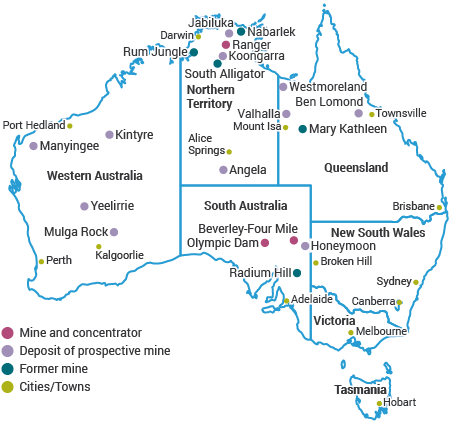
Figure 5: Australian Uranium deposits. (source: World Nuclear Association)
From a commercial perspective, the business is aligned with the uranium contracting cycle. Like any uranium company, Boss Energy has been progressively establishing long-term sales agreements with utilities, which is consistent with how the uranium industry typically operates.
The processing plant at Honeymoon, which has been refurbished as part of the restart, uses ion exchange (IX) to recover uranium from the pregnant solution. Operational updates through 2024–2026 indicate that the plant has moved through commissioning into steady-state optimisation, with resin performance, recovery efficiency, and throughput forming the key operational metrics.
Ion Exchange (IX) - Uranium Mining
Ion exchange (IX) in uranium mining is a process used to pull uranium out of a liquid solution after it has been dissolved underground.
In an ISR operation like Honeymoon, a solution is pumped through the orebody and brings dissolved uranium back to the surface. This liquid is called the pregnant solution because it contains uranium.

Figure 6: The In-situ Uranium Recovery Process. (source USNRC)
The ion exchange step then passes this solution through tanks filled with special resin beads. These beads are designed to attract and hold uranium ions, effectively stripping the uranium out of the liquid. The remaining liquid is then recycled back underground, while the uranium is later removed from the resin and processed into a solid product (yellowcake).
In simple terms, ion exchange is a filtering and capturing step, where uranium is selectively taken out of the solution so it can be recovered and sold.
In terms of production, Boss Energy has mentioned a nameplate capacity of approximately 2.45 million pounds U₃O₈ per annum. The ramp-up phase through 2024 and into 2025 has been focused on progressively increasing output toward this level, rather than achieving full production immediately. Early production has been measured in hundreds of thousands of pounds per quarter, reflecting the staged wellfield development and the time required to reach optimal ISR flow conditions.
On the resource side, the Honeymoon Project hosts a JORC Mineral Resource of approximately 71–72 million pounds U₃O₈, which underpins a long mine life. Within this, a portion has been converted into an Ore Reserve that supports the current production plan, typically in the order of 30+ million pounds U₃O₈, providing the basis for initial mine scheduling and economic extraction.
Beyond Honeymoon, the company maintains exposure to additional uranium assets, including interests in exploration and development projects, which provide optionality for future growth. However, the core of the business remains centred on achieving steady-state production and operational reliability at Honeymoon, as this underpins both cash flow generation and market positioning.
In the broader context of the uranium sector, Boss Energy represents a company transitioning from development into production, with its value proposition tied to execution—bringing an existing asset back online efficiently and participating in a market that is increasingly driven by long-term supply security and contracting behaviour.
Table 1: A comparison of market capitalisation to show the range of valuation in the sector.
Company | Market Cap (Approximately April 2026) |
Cameco Corporation | ~A$70B |
Paladin Energy Ltd | ~A$5.6B |
Boss Energy Limited | ~A$0.65–0.70B |
Lotus Resources Limited | ~A$0.35–0.40B |
Peninsula Energy Limited | ~A$0.25B |
Coming back to the earlier question we posed in the discparity in the share price and valuation and the potential of Boss Energy, Table 2 below may give some insights. These are my opinion and thoughts and I am the first to say these comments in the table is more about my lens as a retail investor.
Table 2: Market Acceptance and the stage of proejcts.
Category | Companies | Market View |
Premium Producers | Cameco | Fully accepted, lower perceived risk |
Accepted Restart | Paladin | Largely accepted but monitored |
Prove-It Producers | Boss, Lotus | Conditional acceptance |
High-Risk Turnarounds | Peninsula | Discounted until proven |
Samso Concluding Comments
The coming of the uranium prophet has been on the cards for a long time. There has been a few false starts but I think the time for the uranium sector is near. I feel that the sector has moved into a phase where company-specific factors are more influential than thematic exposure. This has resulted in differing valuation outcomes across producers, and for me, this means opportunities are being presented.
Boss Energy Limited sits within a group of companies that are transitioning into production and it is accepted that this stage typically carries a higher level of scrutiny from the market.
The comparison with global peers shows that scale, operating history, and market familiarity play a role in valuation. Companies that demonstrate these attributes tend to attract stronger market support.
For Boss, the pathway to a different valuation profile appears to be linked to continued operational delivery rather than external market conditions.
Cover photo: URANIUM MILL JUST OUTSIDE OF MOAB. THE ORE COMES FROM A MINE ABOUT 25 MILES AWAY. THE REGION IS RICH IN URANIUM AND POTASH. THESE MINERALS ARE THE BASIS OF THE TWO MAJOR INDUSTRIES OF THE AREA, David Hiser. Public domain, via Wikimedia Commons (https://commons.wikimedia.org/wiki/File:URANIUM_MILL_JUST_OUTSIDE_OF_MOAB._THE_ORE_COMES_FROM_A_MINE_ABOUT_25_MILES_AWAY._THE_REGION_IS_RICH_IN_URANIUM_AND..._-_NARA_-_545611.jpg)
The Samso Way – Seek the Research
Here at Samso, we pride ourselves on delivering content for investors that is independent and informed by over three decades of experience in the industry. Our content is well-researched and is only created if I see merit in discussing the company's story.
Our mission is simple: cut through the noise and spotlight what matters—genuine stories, grounded insights, and real opportunity.
Our content is well-researched and is only created if the team sees merit in discussing the company or concept. Investors can explore our three core platforms:
There may be numerous paths to success in investing, but the common thread among successful individuals is that they remain committed to making informed decisions. Equip yourself with the right knowledge and tools, and you will be well on your way to achieving your financial goals.
Most importantly, investors need to be absolutely diligent in understanding their own risk-reward tolerance and capabilities. Never bite off more than you can chew. As they say, Rome wasn’t built in a day, and the Great Wall stood because it took centuries to complete.
The Samso Philosophy:
Stay curious. Stay sharp. And remember—digging deeper always uncovers the real value.
In Life, there is no such thing as a Free Lunch.
Never bite off more than you can chew is my parting comment.
Happy Investing, and the only four-letter word you need to know is DYOR.
To support our independent nature of our work, please head over to our Support Page and give us a helping hand in any of the ways listed. This is a new initiative for the Samso Platform, and it was always the concept of Samso when we started this journey in 2018.
Disclaimer
The information or opinions provided herein do not constitute investment advice, an offer, or solicitation to subscribe for, purchase, or sell the investment product(s) mentioned herein. It does not take into consideration, nor have any regard to your specific investment objectives, financial situation, risk profile, tax position and particular, or unique needs and constraints.
Share to Grow: Your Bonus
Samso has just released an eBook: How to Add Value to your Share Portfolio
A lesson on geological models sought by mining companies that gives insight and an understanding of which portfolios are better - and potentially more lucrative – investments. Click here to download this eBook.

If you find this article informative and useful, please help me share the information. I try to write about topics that are interesting and have the potential to be of investment value. It is not easy to find stories that fit those parameters. If you or your organisation sees the benefit of what Samso is trying to achieve and has a need to share your journey, please contact me at noel.ong@samso.com.au.
Samso is a trusted platform that equips dedicated investors with up-to-date industry knowledge and insights from top CEOs and thought leaders. By staying informed on business advancements and market trends, investors can enhance their financial decisions through a combination of expert guidance and their own research.

Comments