


ASX Data Centre Stocks: What the Market Is Actually Paying

Updated: 4 days ago
Eleven companies, three years of price action, and one pattern. The market paid for signatures, not for gigawatts.

Samso Insights | Media & Technology | Data Centres | AI Infrastructure |



1.00 —A real industry, with a forecasting problem
Australia's data centre industry is large and growing quickly. Property advisory firm CBRE puts live national capacity at approximately 1.3 gigawatts in 2025, rising toward 1.8GW within three years, against demand that would support between 0.7GW and 1.7GW more than that. CBRE sizes the current investable universe at roughly A$30 billion, growing toward A$46 billion by 2029.
The demand side is not in dispute. The Australian Energy Market Operator (AEMO), which runs the national electricity system, now forecasts data centres as a category in their own right. Its 2025 assumptions report has data centre electricity consumption growing at approximately 25 per cent a year to reach 12 terawatt hours by the 2030 financial year, about 6 per cent of grid-supplied electricity in the National Electricity Market. That is up from 3.9 terawatt hours, or roughly 2 per cent, in 2024-25.
Then there is the number that should temper everything else in this piece. Research commissioned by AEMO from Oxford Economics found Australia had received connection requests totalling 44GW. Of that, the researchers estimated six in every seven megawatts to be phantom demand, meaning applications that will never be built. They put actual required prospective capacity at approximately 6GW under AEMO's central scenario.
That finding changes how a gigawatt figure in a headline should be read. Applying to connect to the grid is not the same as building anything. A company can lodge an application, announce the megawatts, and never proceed. Roughly 85 per cent of what has been asked for is not expected to happen. No announcement says whether the project it is describing is in the 15 per cent that will proceed or the 85 per cent that will not.
2.00 —Power is the constraint, and Canberra just priced it
What limits Australian data centre construction is not customers. It is deliverable, grid-connected electricity. Connection queues in the main markets can run beyond eight years. At the end of March 2026, AEMO had 11 large projects totalling 5.4GW of maximum demand progressing through transmission connection, roughly 60 per cent in New South Wales and 40 per cent in Victoria, and warned its own forecasts would likely need to rise.
On 15 July 2026 the federal government introduced legislation requiring large data centres to be net generators of the power they use, meaning they must generate on site at least as much electricity as they draw from the shared grid. They must also pay for new renewable generation to be built, cover the full cost of connecting themselves to the grid, and cut their electricity use when the grid comes under strain. The Energy and Climate Change Ministerial Council endorsed national standards along these lines on 28 July 2026, with Queensland and the Northern Territory the only states opposed.
The effect is to raise the cost of any proposal that assumed it could simply plug into the existing network. It rewards whoever already controls generation. That is part of why operators have started describing themselves in units of secured power rather than floor space.

3.00 —The operators, where the business actually is

Four ASX companies own or operate data centres directly. TABLE 01 sets out the full company set covered here, what each one actually does, and what the market currently values it at.
The market cap column covers a wide range. Goodman is worth about A$62.9 billion and DXN about A$57 million. That difference is worth carrying into the sections below, because an A$8.8 million contract does not mean the same thing to both companies. Market capitalisation does not tell us whether a company is well run. It does tell us the scale it is operating at.
NEXTDC (ASX:NXT) is Australia's largest listed pure-play data centre operator, running 17 or more facilities across the mainland capitals plus a Kuala Lumpur site opened in May 2026. Shares were around A$13.98 as at 6 August 2026, giving a market capitalisation of approximately A$10.8 billion.
The company reports its business in megawatts, and the three figures it discloses are worth separating. Contracted utilisation, meaning capacity customers have signed up for, reached 740MW at 30 June 2026. The forward order book, meaning capacity customers are expected to take but have not yet signed for, stood at 565MW. Billing utilisation, meaning the capacity actually earning money today, was 175MW. So roughly three quarters of what NEXTDC has signed up customers for is not yet earning it any money. That is not unusual, because a data centre takes years to build and customers sign well before the building opens. It is also where things can go wrong. Every megawatt in that gap depends on NEXTDC finishing the building on time, and on the customer still wanting it when the building is ready.
PLATE 01 shows what that build looks like on the ground.
PLATE 01

NEXTDC's M3 Melbourne facility under construction. The rows of rooftop cooling units on the completed building, and the partially built structure beside it, show the physical form that contracted megawatts take. NEXTDC had approximately 435MW under construction across its S4 and M3 sites at the time of this presentation. Source: NEXTDC Limited (ASX:NXT), 1H26 Results Presentation, 25 February 2026, page 28 of 38. Reproduced with the company's copyright notice intact.

NEXTDC (ASX:NXT). Weekly closing price, three years to 6 August 2026. Numbered markers correspond to the announcements listed in the key beneath the chart. Where a marker is tagged “date as reported”, the announcement date is taken from secondary reporting and was not independently confirmed against the price action. Samso’s own chart, built from weekly closing price data.
FIG. 01 shows NEXTDC's three-year price action against four announcements. The most instructive pair is markers 1 and 2. On 4 December 2025 the company announced a memorandum of understanding with OpenAI naming it as foundational customer for a proposed A$7 billion, roughly 550MW campus at Eastern Creek in western Sydney. The stock rose 3.1 per cent that day, reached A$14.15, and was lower a week later. On 20 April 2026 the company announced a binding 250MW contract at its S4 facility alongside an A$1.5 billion entitlement offer, which is an issue of new shares offered to existing holders in proportion to what they already own. That move held, and the stock later traded above A$15.
Those two events are the clearest illustration of the pattern this piece describes. A memorandum with a very well known AI company produced a brief move. A signed contract with an unnamed customer produced a lasting one.
Macquarie Technology Group (ASX:MAQ) operates Macquarie Data Centres, focused on government and sovereign workloads, and reports housing approximately 42 per cent of the Australian federal government. Shares were around A$63.58 as at 6 August 2026, giving a market capitalisation of approximately A$1.7 billion.
Its principal project is IC3 Super West at Macquarie Park in Sydney, an approximately A$350 million investment with 47MW of end-state power secured, taking the campus toward roughly 65MW of total IT load. Construction is contracted to FDC Construction, with initial commissioning targeted for around September 2026.

Macquarie Technology Group (ASX:MAQ). Weekly closing price, three years to 6 August 2026. Numbered markers correspond to the announcements listed in the key beneath the chart. Where a marker is tagged “date as reported”, the announcement date is taken from secondary reporting and was not independently confirmed against the price action. Samso’s own chart, built from weekly closing price data.
FIG. 02 covers Macquarie Technology. The clearest catalyst is marker 2, an A$200 million hybrid investment from the National Reconstruction Fund Corporation announced on 11 March 2026. It was the largest single technology-sector investment by that body. Importantly for existing shareholders, the money did not come from issuing new shares. It was raised through a security that sits somewhere between debt and equity, so nobody's stake in the company was made smaller to pay for the build. The market responded positively.
DigiCo Infrastructure REIT (ASX:DGT) owns 13 data centres across Australia and North America, seeded with assets including Global Switch Australia and iSeek. It is externally managed by HMC Capital. Shares were around A$2.76 as at 6 August 2026, giving a market capitalisation of approximately A$1.5 billion, against a A$5.00 offer price at listing.

DigiCo Infrastructure REIT (ASX:DGT). Weekly closing price since listing in December 2024. Numbered markers correspond to the announcements listed in the key beneath the chart. Where a marker is tagged “date as reported”, the announcement date is taken from secondary reporting and was not independently confirmed against the price action. Samso’s own chart, built from weekly closing price data.
FIG. 03 covers DigiCo, which raised approximately A$2.0 billion in the largest ASX listing of 2024. It opened at A$4.98 against that A$5.00 offer on 12 December 2024, closed the day at A$4.55, and has not returned to its issue price since. Marker 3 is the March 2026 departure of a chief executive who had started in January and resigned by June. Marker 4, the US$750 million sale of its Chicago facility, produced the strongest rally in its listed history.
A data centre REIT is not the same investment as a data centre operator. DigiCo owns the assets and collects the rent. Whether that is a good business depends entirely on what was paid for the assets, and the market's answer to that question has been consistent since listing.
HMC Capital (ASX:HMC) requires care, because it is not a data centre business. It is an alternative asset manager, and its data centre exposure is indirect. It manages DigiCo externally and holds approximately 21 per cent of it, partly through management fees paid in DigiCo securities. That stake, plus the fee stream attached to managing the REIT, is the entirety of the connection. Shares were around A$3.12 as at 6 August 2026, giving a market capitalisation of approximately A$1.3 billion, down roughly two thirds over twelve months.

HMC Capital (ASX:HMC). Weekly closing price, three years to 6 August 2026. Numbered markers correspond to the announcements listed in the key beneath the chart. Where a marker is tagged “date as reported”, the announcement date is taken from secondary reporting and was not independently confirmed against the price action. Samso’s own chart, built from weekly closing price data.
FIG. 04 shows why HMC is included with that caveat attached. Its decline over the period is far larger than DigiCo's and reflects concerns about its broader funds management model, not data centres specifically. A reader buying HMC for data centre exposure would be buying a fund manager with a 21 per cent holding in a REIT, wrapped inside a business doing several other things. That is a legitimate investment. It is not a data centre investment, and the chart should not be read as one.
SAMSO ACCESS Some of the work does not appear hereSamso holds back a set of Insights for members. Same method as this piece, the same sourcing and the same counterweights, on companies and sectors that do not make the public feed.
Samso News and Research Workups will join the gated set, with Research Workups also available on their own tier.  A$20 a month · cancel any time |
4.00 —The landlord, and what secured electricity is worth
Goodman Group (ASX:GMG) builds and owns industrial property, mostly warehouses and logistics estates, and has turned a large part of that business toward building data centres. Shares were around A$30.40 as at 6 August 2026, giving a market capitalisation of approximately A$62.9 billion, the largest company in this piece by a wide margin.
The figures Goodman discloses are large. Its total property portfolio is worth A$87.1 billion. Development work in progress, meaning projects it has started but not finished, A$14.5 billion, of which data centres are 73 per cent, up from roughly 40 per cent eighteen months earlier. A global electricity holding of 6.4GW, of which 3.6GW is secured. Goodman calls this its power bank.
That power bank figure needs some explanation. It describes electricity capacity Goodman has identified or secured across its sites. It does not describe signed leases with paying tenants. As at the March 2026 quarter, Goodman had not signed up the big cloud and AI companies as tenants across most of those sites, with completions weighted toward 2028 and 2029.

Goodman Group (ASX:GMG). Weekly closing price, three years to 6 August 2026. Numbered markers correspond to the announcements listed in the key beneath the chart. Where a marker is tagged “date as reported”, the announcement date is taken from secondary reporting and was not independently confirmed against the price action. Samso’s own chart, built from weekly closing price data.
FIG. 05 shows that the pivot has not been a share price event. Goodman is down over twelve months, having lifted data centres from 40 per cent to 73 per cent of its development pipeline and quadrupled its disclosed power bank over the same period. Marker 1 is the February 2025 institutional placement of A$4.0 billion at A$33.50, struck against a close of A$35.98. The shares fell below the offer price within days. The companion retail offer, seeking A$400 million, raised A$5.1 million, because by the time it closed the market price sat below what retail holders were being asked to pay.

5.00 —The suppliers
DXN Limited (ASX:DXN) builds modular and prefabricated data centres from a facility at Welshpool in Western Australia. It is very small. Before 3 June 2026 its market capitalisation was approximately A$6.6 million. After the contract and the placement that followed it, the company was worth approximately A$57 million as at 6 August 2026, still the smallest company in this piece by a wide margin.
On that day it announced a binding A$8.8 million contract to design, build and commission a 1.36MW AI high performance computing modular data centre, using direct-to-chip liquid cooling with GPU racks up to 150kW, for an unnamed United States listed operator. The contract exceeded the entire value of the company.
PLATE 02 shows the inside of one of these units.
PLATE 02

Inside one of DXN's prefabricated modular data centres, showing server racks, switchgear and overhead cable trays within a factory-built unit. DXN manufactures these at Welshpool in Western Australia and ships them to site, which is the approach behind the A$8.8 million contract described above. Source: DXN Limited (ASX:DXN), company website, dxn.solutions.
FIG. 06

DXN Limited (ASX:DXN). Weekly closing price, three years to 6 August 2026. Numbered markers correspond to the announcements listed in the key beneath the chart. Where a marker is tagged “date as reported”, the announcement date is taken from secondary reporting and was not independently confirmed against the price action. Samso’s own chart, built from weekly closing price data.
FIG. 06 shows the result. The shares closed up 590 per cent at A$0.145, the largest single-day move of any company covered here. Marker 2 is the A$7.0 million placement at A$0.13 six days later, funding delivery and diluting holders. Management flagged potential follow-on work exceeding A$278 million within one to two years. That figure is a projection, not an order, and the gap between the two is wider here than anywhere else in this piece given the size of the company against the size of the number.
DUG Technology (ASX:DUG) operates its own high performance computing data centres, originally for oil and gas seismic processing and increasingly for AI workloads. It sells computing capacity as a service and markets an immersion cooling system, DUG Cool, which it reports cuts power use by up to approximately 51 per cent against air cooling. Shares were around A$2.02 as at 6 August 2026, giving a market capitalisation of approximately A$275 million.
FIG. 07

DUG Technology (ASX:DUG). Weekly closing price, three years to 6 August 2026. Numbered markers correspond to the announcements listed in the key beneath the chart. Where a marker is tagged “date as reported”, the announcement date is taken from secondary reporting and was not independently confirmed against the price action. Samso’s own chart, built from weekly closing price data.
FIG. 07 covers DUG. The company deployed 82 NVIDIA H200 machines in January 2026, adding 41 petaflops of capacity, and reported third quarter revenue of US$22.4 million, up 35 per cent, with high performance computing revenue up sharply from a small base. DUG is the one company here that both owns data centre infrastructure and sells a technology into the sector.
Megaport (ASX:MP1) is the genuine connectivity name. Its entire business is interconnection, providing network-as-a-service links between enterprises, cloud providers and data centres. It reported reaching its 1,000th enabled location in August 2025, giving it access to approximately 10 per cent of the world's public data centres. Shares were around A$20.04 as at 6 August 2026, giving a market capitalisation of approximately A$4.6 billion, making it the second largest company in this piece.
FIG. 08

Megaport (ASX:MP1). Weekly closing price, three years to 6 August 2026. Numbered markers correspond to the announcements listed in the key beneath the chart. Where a marker is tagged “date as reported”, the announcement date is taken from secondary reporting and was not independently confirmed against the price action. Samso’s own chart, built from weekly closing price data.
FIG. 08 contains a useful exception to this piece's own argument. In June 2026 Megaport raised approximately A$827 million by issuing new shares to existing holders at A$14.30, funding acquisitions that push it toward AI compute. Raisings of this kind make each existing share a smaller slice of the company, and across this sector they have generally been punished, as Goodman's experience shows. This one was not. The stock was halted at A$16.04 and reopened at A$18.48, up roughly 15 per cent. The market endorsed what the money was for.
That endorsement carries its own risk. Megaport built its reputation on a capital-light interconnection model. Buying into AI compute is a capital-heavy business with a different return profile, and the FY26 results are the first real test of whether that shift is working.
COFFEE WITH SAMSO The same companies, on the recordCoffee with Samso is the interview series. Management answering questions in long form, so the people behind a project can be judged alongside the numbers in a piece like this one. Free to watch. Companies commission an interview, and it stays free to everyone, permanently.  |
6.00 —What the market actually paid for
Reading FIG. 01 through FIG. 08 together, a consistent pattern emerges across three years.
Binding contracts were rewarded and the gains held. NEXTDC's 250MW S4 contract lifted the share price and the gain held. DXN's binding A$8.8 million order produced a 590 per cent day. In both cases there was a contract the customer could be held to, rather than a statement of intent.
Non-binding documents produced short moves that faded. NEXTDC's OpenAI memorandum is the cleanest example, given it involved the best-known name in artificial intelligence and still finished the following week lower than where it started. The market read it as an option on 2027, not as revenue.
Announcing more capacity, without a customer attached, moved share prices very little. Goodman's secured electricity grew to 6.4GW while its shares fell over twelve months. The capacity NEXTDC had signed customers for grew from 316MW to 740MW across the period, and its share price is roughly where it was a year ago. Capacity announcements appear to be treated as necessary rather than sufficient.
Capital raisings were judged on purpose, not on structure. Goodman's A$4.0 billion placement fell below its offer price and its retail component effectively failed. Megaport's A$827 million raise saw the stock reopen 15 per cent higher. Raisings that did not issue new shares, and so did not shrink anybody's existing stake, were received well. Macquarie Technology's government-backed funding and NEXTDC's La Caisse funding were both of this kind.
Governance and execution events were punished quickly. DigiCo fell on a chief executive taking extended leave. NEXTDC took a first strike against its remuneration report at the November 2025 annual meeting.

7.00 —The company that is not what it is called
Superloop (ASX:SLC) appears in a good deal of thematic commentary as an ASX data centre play. Its own disclosures do not support that description, and the reasons are worth setting out, because they double as a test any reader can apply to the next company described this way.
Superloop is a telecommunications company, worth approximately A$1.7 billion as at 6 August 2026. It reports three segments, being consumer, business and wholesale. In the 2025 financial year it generated A$546 million of revenue, of which consumer broadband was A$363.7 million. There is no data centre revenue category in its accounts. Data centres are not identified as a growth driver in its results materials. In its June 2026 investor day strategy, none of the five stated pillars concerns data centre connectivity. The company's network reaches more than 2,400 on-net sites, a figure that appears in an appendix as a footprint metric.
The data centre association comes mainly from its December 2024 acquisition of Uecomm from Optus for approximately A$17.5 million, which added more than 2,000km of metro fibre and, in the company's words, access to approximately 50 data centres. Access means its fibre reaches those buildings. It does not mean the operators of those buildings are customers. Having a network presence inside data centres is ordinary for any carrier.
FIG. 09

Superloop (ASX:SLC). Weekly closing price, three years to 6 August 2026. Numbered markers correspond to the announcements listed in the key beneath the chart. Where a marker is tagged “date as reported”, the announcement date is taken from secondary reporting and was not independently confirmed against the price action. Samso’s own chart, built from weekly closing price data.
FIG. 09 shows where the value came from. Superloop's shares rose from approximately A$0.69 to approximately A$3.22 over three years, so an investor who bought at the start would have roughly four and a half times their money. The catalysts were a wholesale broadband contract with Origin Energy in March 2024, which produced the largest single-day gain in the company's history, the acquisition of Lightning Broadband alongside a strong first half result in February 2026, and successive guidance upgrades. No data centre announcement produced a noticeable move in the share price at any point in the period.
None of this is a criticism of Superloop, which has performed well at what it actually does. It is a narrower observation. A company can hold real infrastructure that touches data centres, be described by others as a data centre play, and still have no disclosed data centre business. The test is not whether the fibre reaches the building. It is whether the company names a customer, books the revenue, and tells its shareholders about it.

SUPPORT SAMSO Independent, organic, and free to read We produce independent organic content and need your support to keep that going. Every contribution covers the cost of research, keeps the site running, and buys the time to write the next piece. A$10, A$20, A$30 or an amount you choose One time, weekly, monthly or yearly A donation buys nothing and unlocks nothing. It keeps the work going. |
8.00 —Could an ASX company move into this business
The obvious question for an ASX investor is whether a company holding suitable assets, meaning land, power, grid access or fibre, could enter this business. There is precedent for the ambition. During the dot-com period around 2000, listed mining shells were routinely acquired by technology start-ups and renamed, a transaction known as a back door listing, where a company obtains a listing by merging into an already-listed vehicle rather than applying for admission itself. The regime was loose, and after the bubble burst ASX tightened it considerably.
That tightened regime still applies. Under ASX Listing Rule 11.1 a company proposing a significant change to the nature or scale of its activities must notify ASX. ASX may then require shareholder approval under Rule 11.1.2, and may require the company to re-comply with Chapters 1 and 2 of the Listing Rules under Rule 11.1.3, meaning it must pass the same admission tests as a company listing for the first time. ASX guidance states it will invariably use this discretion where a transaction amounts to a back door listing. The practical effect is that a full pivot is close to an initial public offering in weight.
There is one real advantage. A company re-complying already has a share register. Where no new shares are issued, ASX may accept an information memorandum rather than a full prospectus, and capital can be sought from existing holders rather than a cold public offer. The admission bar is the same. The path to it is shorter.
Two ASX companies are currently attempting something along these lines, and both are earlier stage than anything in Sections 3.00 through 5.00.
PLATE 03

Aurora Energy Precinct location and existing infrastructure corridor: the 275kV transmission line, water, 33kV distribution line, fibre routes and the planned 330 to 500kV Northern Connector (2030), relative to Port Augusta. Source: 1414 Degrees Limited (ASX:14D), “Investor Presentation AGM 2025”, 19 November 2025, page 11 of 15.
1414 Degrees (ASX:14D) holds the Aurora Energy Precinct, a Crown lease of approximately 1,580 hectares near Port Augusta in South Australia. The company was worth approximately A$36 million as at 6 August 2026. PLATE 03, from the company's own investor presentation, shows why the site is credible. It sits against an existing 275kV transmission line, a 33kV distribution line, water and fibre routes. On 27 July 2026 the company signed a heads of agreement with an unnamed Australian data centre operator covering up to 1GW in stages, granting exclusivity over an initial 40-hectare parcel. The company's own release says almost none of the agreement is binding. The two parts that are: the operator has that 40 hectares to itself for the term, and it gets first claim on any electricity 1414 Degrees generates there. Everything else, including the gigawatt, is an intention rather than a commitment.
FIG. 10

1414 Degrees (ASX:14D). Weekly closing price, three years to 6 August 2026. Numbered markers correspond to the announcements listed in the key beneath the chart. Where a marker is tagged “date as reported”, the announcement date is taken from secondary reporting and was not independently confirmed against the price action. Samso’s own chart, built from weekly closing price data.
Beetaloo Energy Australia (ASX:BTL) holds 28.9 million acres of gas tenements in the Northern Territory, and was worth approximately A$354 million as at 6 August 2026. In July 2026 the Territory government granted its subsidiary exclusive rights over 185 hectares at Weddell, roughly 30km from Darwin, for one year, within which it must complete studies and secure investors for a proposed gas-fired power and data centre campus of up to 2GW. The company has said it expects to attract A$40 billion at full development. That is a company estimate, and it is roughly one hundred and thirteen times the company's own market value.
FIG. 11
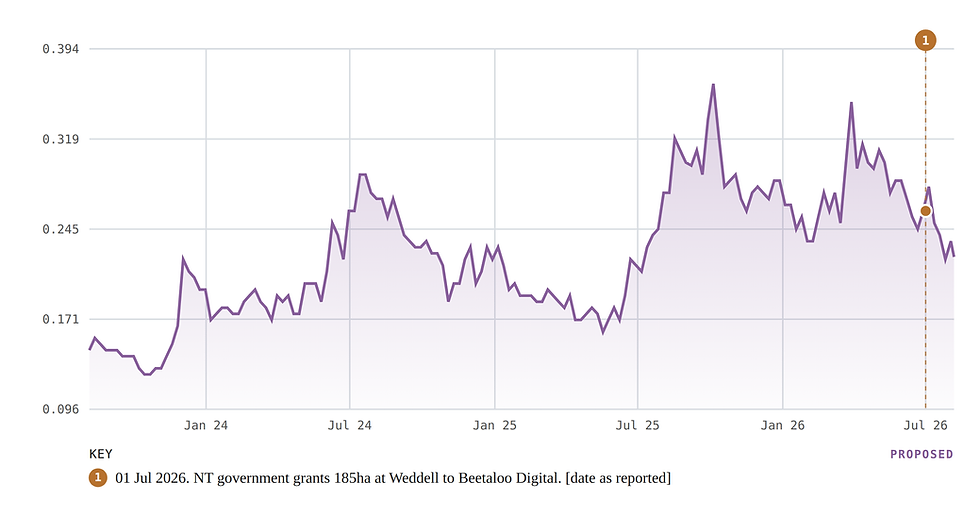
Beetaloo Energy Australia (ASX:BTL). Weekly closing price, three years to 6 August 2026. Numbered markers correspond to the announcements listed in the key beneath the chart. Where a marker is tagged “date as reported”, the announcement date is taken from secondary reporting and was not independently confirmed against the price action. Samso’s own chart, built from weekly closing price data.
FIG. 10 and FIG. 11 show both companies. Both sit in the category described in Section 6.00, being non-binding documents and government allocations, which the market has historically discounted. Neither company has a signed, binding, priced agreement with a named data centre operator.
9.00 —Closing
The Australian data centre industry is real, large, and constrained by electricity rather than by demand. A small number of ASX companies are actually in it. Four own or run the buildings themselves. One builds them and rents them out. Three sell into the industry, supplying factory-built units, computing capacity for hire, or the network links between sites.
The price history suggests a pattern, though it is worth being careful about how far to take it. Over the three years covered here, the companies whose gains lasted were generally the ones that had signed a contract committing a named or unnamed customer to pay them. NEXTDC's 250MW agreement is one example. Announcements that described an intention rather than an obligation, including the memorandum with OpenAI, more often moved the price for a few days and then gave the move back.
That is an observation drawn from eleven companies over three years. It is not a rule, and it may not hold. A company that discloses capacity today could convert it into signed leases next year, and the market might then start paying for the disclosure in advance. The three years covered here also sit almost entirely inside a single period of heavy spending on AI. Nobody has yet seen how these companies trade through a downturn in that spending, so the pattern has not been tested against harder conditions.
So what does this mean for an investor looking at one of these companies? It means there are a few questions worth asking before buying, because the answers change what you are actually paying for.
Ask whether the company has named its customer. If it will not say who the customer is, you are relying on the company's word that a customer exists at all, and you cannot judge whether that customer is good for the money or how long it has committed for.
Ask whether the company has signed a contract, or only a memorandum of understanding. A memorandum sets out what two companies intend to do together. It does not require either of them to actually do it, and either one can change its mind later with nothing owed to the other. If a memorandum is all that has been signed, the revenue investors are already pricing into the share price is revenue that nobody has yet promised to pay.
Ask whether the capacity is contracted to a paying customer, or whether it is land and power the company hopes to fill later. Both get announced in megawatts and both sound impressive. Only one of them has somebody committed to paying for it.
Ask what any money being raised is for. If the company is issuing new shares to fund it, your existing holding becomes a smaller slice of the company, so you are paying for that build twice over, once in cash and once in ownership. There is a difference between raising money to build something a customer has already agreed to pay for, and raising money to build something first and look for a customer afterwards. The first has revenue attached to it. The second does not, yet.
None of these questions requires a view on whether AI demand holds up over the next decade. They are narrower than that, and they are answerable from what the company has already disclosed. Without them, an investor can end up paying today for revenue that nobody has yet agreed to pay the company, on a timetable nobody has committed to.
This piece is analysis rather than a recommendation. The figures in it were current on 6 August 2026 and will not stay that way, particularly for the smaller companies. Anyone acting on any of it should check the current share price and the company's own announcements first.
SAMSO ACCESS Some of the work does not appear hereSamso holds back a set of Insights for members. Same method as this piece, the same sourcing and the same counterweights, on companies and sectors that do not make the public feed. A$20 a month · cancel any time |

References and sources
Share price and market capitalisation data throughout: weekly and daily closing prices to 6 August 2026, retrieved from public market data feeds. All charts are Samso’s own construction from that data.
NEXTDC Limited (ASX:NXT), 1H26 Results Presentation, 25 February 2026 (primary source for PLATE 01).
DXN Limited (ASX:DXN), company website dxn.solutions (primary source for PLATE 02).
1414 Degrees Limited (ASX:14D), “Investor Presentation AGM 2025”, 19 November 2025 (primary source for PLATE 03).
CBRE, “Why Australia for Data Centres”, on national live capacity, the 2028 supply gap and the size of the investable universe.
AEMO, 2025 Inputs, Assumptions and Scenarios Report, on data centre electricity demand growth to FY2030, and AEMO connection-queue data to March 2026.
Oxford Economics research commissioned by AEMO, November 2025, on the 44GW of connection requests and the phantom-demand estimate.
NEXTDC ASX releases and quarterly updates, on the OpenAI memorandum (December 2025), the 250MW S4 contract and entitlement offer (April 2026), the La Caisse hybrid, and contracted, forward-order and billing utilisation to 30 June 2026.
Macquarie Technology Group disclosures on IC3 Super West and the National Reconstruction Fund Corporation hybrid investment, March 2026.
DigiCo Infrastructure REIT listing documents and subsequent results and announcements, including the Chicago disposal.
Goodman Group 1H FY26 results and Q3 FY26 update (26 May 2026), on portfolio value, development work in progress, the power bank, and the February 2025 placement and retail offer.
DXN Limited ASX announcements, 3 June 2026 (binding contract) and 9 June 2026 (placement).
DUG Technology results materials and the January 2026 NVIDIA H200 deployment announcement.
Megaport announcements on enabled locations (August 2025) and the June 2026 entitlement offer and acquisitions.
Superloop FY24 and FY25 annual results, H1 FY26 results, the December 2024 Uecomm acquisition announcement, and the June 2026 investor day strategy materials.
ASX, Listing Rules Chapter 11 and Guidance Note 12 (Significant Changes to Activities), on the re-compliance regime under Listing Rules 11.1 to 11.1.3.
Beetaloo Energy Australia announcements and Northern Territory government statements on the Weddell land allocation, July 2026.
Sourcing note: FIG. 01 through FIG. 11 are Samso’s own charts, built from weekly closing price data, with event markers placed by Samso. PLATE 01, PLATE 02 and PLATE 03 are reproduced from NEXTDC’s, DXN’s and 1414 Degrees’ own published material respectively, each credited in its caption with the company, document, date and page, and each carrying the source company’s copyright notice where one appears in the original. TABLE 01 is Samso’s own compilation. Company facts are drawn from company disclosures and from financial media reporting of those disclosures. Where an event date could not be independently confirmed against price action, the chart key marks it as reported. Marking an event beside a price move records that the two occurred together and is not a claim that one caused the other.
Cover photo: Data center roof, Rsparks3. CC0, via Wikimedia Commons (https://commons.wikimedia.org/wiki/File:Data_center_roof.jpg). Reproduced photograph, shown faded under a navy overlay on the article thumbnail.

 The Samso Way – Seek the ResearchHere at Samso, we pride ourselves on delivering content for investors that is independent and informed by over three decades of experience in the industry. Our content is well-researched and is only created if I see merit in discussing the company's story. Our mission is simple. Cut through the noise and spotlight what matters. Genuine stories, grounded insights, and real opportunity. Investors can explore our four core platforms:
There may be numerous paths to success in investing, but the common thread among successful individuals is that they remain committed to making informed decisions. Equip yourself with the right knowledge and tools, and you will be well on your way to achieving your financial goals. Most importantly, investors need to be absolutely diligent in understanding their own risk-reward tolerance and capabilities. Never bite off more than you can chew. As they say, Rome wasn't built in a day, and the Great Wall stood because it took centuries to complete. The Samso Philosophy: Stay curious. Stay sharp. And remember, digging deeper always uncovers the real value. In Life, there is no such thing as a Free Lunch. Never bite off more than you can chew is my parting comment. Happy Investing, and the only four-letter word you need to know is DYOR. To support our independent work, please head over to our Support Page and give us a helping hand in any of the ways listed. This is a new initiative for the Samso Platform, and it was always the concept of Samso when we started this journey in 2018. DisclaimerThis article is general information only. It is not financial product advice and it does not take into account any reader's objectives, financial situation or needs. It contains no price targets, no valuations and no recommendation to buy, hold or sell any security. Companies named in this article are used as historical illustrations of events that have already occurred and no view is expressed on their current merits. Readers should consider obtaining advice from a licensed financial adviser and should conduct their own research before making any investment decision. Samso and its associates may hold interests in companies mentioned. About SamsoSamso is a trusted platform that equips dedicated investors with up-to-date industry knowledge and insights from top CEOs and thought leaders. By staying informed on business advancements and market trends, investors can enhance their financial decisions through a combination of expert guidance and their own research. Coffee with Samso, Samso Insights, Samso News and Samso Research are four ways into the same work. Interviews, long-form research, short takes on announcements and company-specific studies. Every one of them is about how to think about investing rather than what to buy. Samso Insights | www.samso.com.au | An Investor Lens on ASX-Listed Companies |

Comments