


Almasar Minerals (ASX: AMK) Marks ASX First with Saudi-Focused Front-Door IPO

Updated: Sep 18
Almasar Minerals’ ASX debut puts a fresh spotlight on Saudi Arabia’s push to attract international mining capital via its Vision 2030 reforms. With the IPO now completed and funding secured, the focus shifts to how effectively the company can convert its Arabian Shield tenure into drill-ready targets and, ultimately, discoveries.

Almasar Minerals Ltd (ASX: AMK) has become the first Saudi Arabia-focused exploration company to complete a conventional ASX IPO under the Kingdom’s modern mining regime, marking an important milestone in the growing investment relationship between Saudi Arabia’s mining sector and Australian capital markets.
Saudi Arabia’s Vision 2030 reforms have opened the Kingdom’s mining sector to greater foreign investment, creating the pathway for companies like Almasar to bring Saudi exploration assets to international markets such as the ASX.
Almasar raised the maximum A$12 million sought under its IPO at A$0.20 per share, before closing its first day of ASX trading at A$0.26 - a 30% premium to the issue price.
The portfolio comprises five granted exploration licences - ND28, ND31, ND36, ND41 and NS142 - covering approximately 419.8 square kilometres (Figure 1). The licences sit within two metallogenic belts considered prospective for orogenic gold, volcanogenic massive sulphide copper-gold and porphyry-style mineral systems.
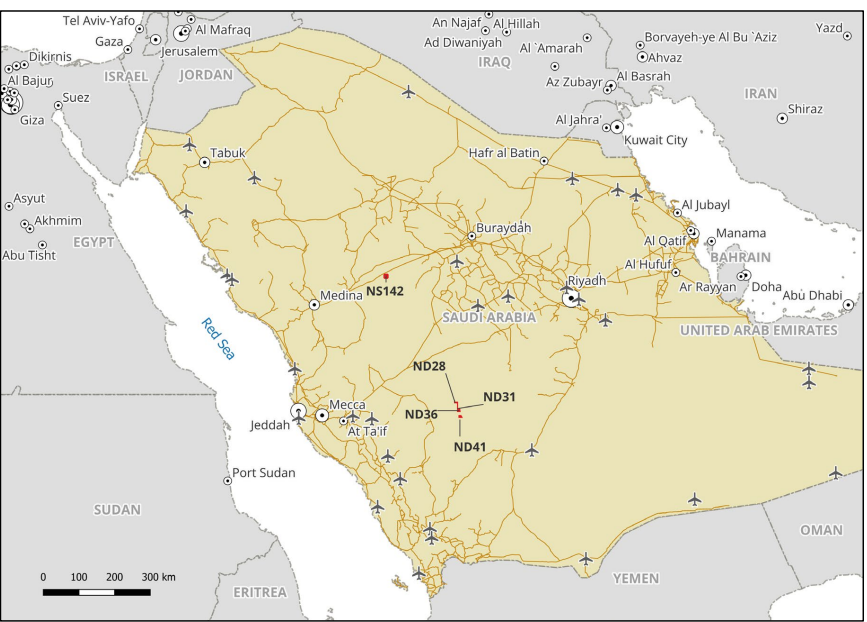
Figure 1: Regional location map of the Almasar licences in relation to major centres and transport infrastructure (Source: IPO Prospectus)
Almasar Minerals Tenements
All five exploration licences are held through Almasar's Saudi operating subsidiary and were granted in February or April 2026 (Figure 2).
Table 1: Al Masar exploration licences
Licence | Area | Geological position | Expiry |
ND28 | 72.4km² | Nabitah-Ad Duwayhi belt | 20 April 2028 |
ND31 | 73.7km² | Nabitah-Ad Duwayhi belt | 20 April 2028 |
ND36 | 89.6km² | Nabitah-Ad Duwayhi belt | 28 April 2028 |
ND41 | 93.8km² | Nabitah-Ad Duwayhi belt | 20 April 2028 |
NS142 | 90.0km² | Nuqrah-As Safra belt | 19 February 2028 |
The contiguous ND28, ND31 and ND36 licences form the main southern cluster. The prospectus describes this area as a structurally controlled corridor containing volcanic, volcaniclastic, sedimentary and intrusive rocks affected by northwest-trending shear systems.
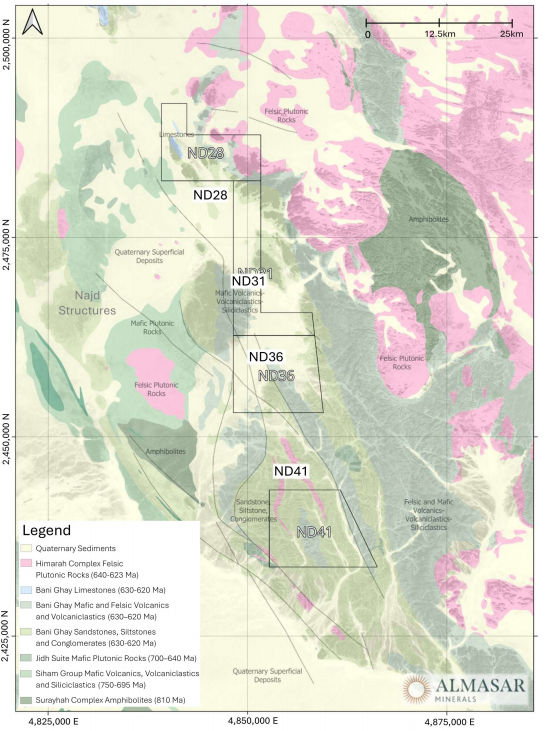
Figure 2 :Geology of Exploration Blocks ND28, ND31, ND36 (Independent Technical Assessment Report, 2026)
The exploration concept includes orogenic gold and intrusion-related magmatic-hydrothermal systems, a broad family that can include porphyry, epithermal, skarn, manto and intrusion-related gold mineralisation.
ND41 sits in the same broader metallogenic belt. Reconnaissance has identified structural fabrics, quartz and carbonate veining, and epidote-rich alteration within porphyritic volcanic and subvolcanic rocks. These are geological ingredients capable of justifying more work, but the independent geologist makes clear that no deposit-scale intrusive centre or diagnostic mineralised system has been confirmed.
NS142 sits farther north in the Nuqrah-As Safra belt. It is considered conceptually prospective for orogenic gold and VMS-style copper-gold mineralisation within volcanic and volcaniclastic rocks cut by faults and dykes.
Vision 2030 – Opening the Arabian Shield
Saudi Arabia’s Vision 2030 is doing considerably more than encouraging mineral exploration. The Kingdom wants mining to become the third pillar of its economy, alongside oil and gas and petrochemicals, as part of a deliberate strategy to diversify away from its historic dependence on hydrocarbons. Saudi authorities now estimate the country has around US$2.5 trillion of mineral resource potential, much of it within the underexplored Arabian Shield.
To bring that potential into the investment market, Saudi Arabia has introduced a new Mining Investment Law, streamlined exploration licensing, released extensive government geological and geophysical datasets, opened the industry to 100% foreign-owned companies, and introduced financial incentives designed to reduce the cost and risk of exploration. The government is also progressively releasing large areas through competitive exploration licence rounds and supporting early-stage explorers through its Mining Exploration Enablement Program.
Importantly, Almasar Minerals is not arriving in isolation. Australian-listed explorers are increasingly moving into Saudi Arabia as the reforms begin attracting the same exploration capital and expertise that have traditionally flowed into jurisdictions such as Western Australia, Africa and Canada. Peako Ltd (ASX: PKO) is building a Saudi gold strategy around six projects covering about 862 square kilometres in the Central Arabian Gold Region; Sierra Nevada Gold (ASX: SNX) has established a Saudi subsidiary and is advancing its As Safra copper-gold project; while Metal Bank Ltd (ASX: MBK) has been pursuing copper and critical minerals through its Saudi joint venture, including the 427-square-kilometre Wadi al Junah copper-zinc-gold-silver project.
What makes Almasar different, however, is the way it has entered the Australian market. Rather than an existing ASX company subsequently acquiring Saudi assets, Almasar has come to market through a front-door IPO built around Saudi Arabian exploration assets. That makes its successful A$12 million raising and ASX listing particularly interesting: it suggests Saudi Arabia is moving beyond being simply an emerging exploration destination and is beginning to attract dedicated companies capable of raising Australian equity capital around the Saudi opportunity itself.
What Has Actually Been Found?
The independent technical assessment reports no Mineral Resources, no Ore Reserves and no asset valuation. It describes the mineralisation potential as conceptual and based largely on geological setting, regional analogues and limited exploration results (Figure 3).

Figure 3: Regional geology of the arabican sheild (Source: IPO Prospectus)
At NS142, public records identify two gossanous occurrences in volcanic and volcaniclastic rocks, with gold recorded as a minor commodity. Historic drill collars were also observed during site reconnaissance, carrying identifiers and indicated depths of approximately 200 to 213 metres.
However, no drill logs, assays, collar tables or technical reports are available. The original operator and purpose of the drilling are unknown. Those collars demonstrate that someone drilled the ground; they do not demonstrate what the drilling found.
Almasar's soil work at NS142 has outlined multi-element enrichment, including arsenic and antimony with local gold and copper responses. These patterns may help direct follow-up work towards structurally focused hydrothermal systems. They are exploration vectors rather than evidence of an economic discovery.
Across ND28 and ND36, a limited historical Ma'aden dataset contains 99 reconnaissance soil samples. Gold values ranged from 0.01 to 2.8 parts per billion, while the broader results showed weak copper-gold-silver responses. The independent report says these data do not define a coherent, high-amplitude anomaly, and Almasar places no reliance on them.
No verified historical drill collars were identified within ND28, ND31, ND36 or ND41.
At ND41, possible historical trenching, quartz veining and strong local epidote alteration provide reasons to conduct modern fieldwork. They do not yet establish mineralisation.
This distinction is central to the IPO.
Almasar has secured a potentially interesting geological position, but it still has to convert regional prospectivity into ranked targets, convert targets into drill intersections, and then determine whether any intersection belongs to a system with scale and grade.
There are several value-creating steps ahead. There are also several points at which the geological thesis can fail.
Where the Money Goes
With the proceeds, the company aims to execute the following for two years after listing.
Table 2: Use of funds
Use of funds | Minimum raise | Maximum raise |
Exploration and development | A$4.479m | A$7.936m |
Salaries | A$1.120m | A$1.122m |
Consultants | A$0.492m | A$0.492m |
Field and central office costs | A$0.269m | A$0.270m |
Working capital | A$1.105m | A$1.497m |
Offer costs | A$0.805m | A$0.953m |
Total available funds | A$8.270m | A$12.270m |
At the minimum raise, 54.16 per cent of available funds is directed to exploration and development. At the maximum, this rises to 64.68 per cent.
The exploration budget is staged deliberately.
Table 3: Exploration Budget
Exploration activity | Minimum raise | Maximum raise |
Remote sensing | A$0.175m | A$0.310m |
Mapping | A$0.426m | A$0.755m |
Surface geochemistry | A$0.381m | A$0.675m |
Geophysics | A$0.431m | A$0.765m |
Drilling | A$2.189m | A$3.877m |
Assays | A$0.877m | A$1.554m |
Total exploration | A$4.479m | A$7.936m |
Drilling is the largest component, but most of it is budgeted for the second year. Under the minimum case, only A$350,000 of the A$2.189 million drilling budget sits in Year 1. Under the maximum case, Year 1 drilling is A$618,000 of a total A$3.877 million.
The first phase is primarily about building the target pipeline through remote sensing, mapping, surface sampling and geophysics. More substantial drilling follows only if that work produces targets with sufficient geological, geochemical and geophysical support.
That is technically sensible for early-stage ground. It also means investors should not assume the entire portfolio will be drilled immediately after listing.
Who Is Running Almasar?
The strength of the Almasar proposition is probably most visible in its leadership team.
Dr Brock Salier, Chief Executive Officer and Managing Director, combines geology with resource capital markets. The prospectus says he was a founder and co-owner of Sprott Capital Partners/SCP Resource Finance, where he was involved in more than C$5 billion of capital raisings across more than 110 equity placements in the five years to 2023. Earlier roles included Rio Tinto, Accenture and GMP Europe.
Christoph Naudé, Executive Director and Chief Operating Officer, has worked across investment banking, structured credit and natural-resources projects in frontier markets. He is based in Riyadh, giving the company operational presence in Saudi Arabia rather than managing the portfolio entirely from Perth.
Dr John Mair, Independent Non-Executive Chairman, brings more than two decades of geology and mining-company leadership, including previous responsibility for advancing the Kvanefjeld rare-earth project in Greenland.
Dr Christian Grainger, Independent Non-Executive Director, has more than 25 years of field experience and was a co-founder of Collective Mining and Cordoba Minerals. His background also includes Continental Gold, which was acquired by Zijin Mining, and work across major gold and copper systems in Latin America.
Aaron Bertolatti, Non-Executive Director and Company Secretary, contributes ASX governance, accounting and corporate compliance experience.
The board and management team collectively hold 38.55 million shares, representing 33.53 per cent of the company at the minimum subscription or 28.56 per cent at the maximum.
That creates meaningful alignment, but it also concentrates influence. Dr Salier alone is expected to hold 22.40 per cent at the minimum raise or 19.08 per cent at the maximum.
Approximately 47.44 million existing shares are expected to be restricted under ASX escrow arrangements, including approximately 46.38 million shares for 24 months and 1.05 million shares for 12 months. None of the IPO shares is expected to be restricted.
Financial Position and Future Funding
Almasar is pre-revenue and loss-making.
The Australian parent recorded a loss of A$59,614 and net liabilities of A$59,613 for the short period from incorporation to 31 December 2025. The underlying Abu Dhabi holding group recorded a loss of AED2.95 million for the year ended 31 December 2025, reflecting staff, consulting, exploration, travel and establishment costs.
After the IPO adjustments, pro forma net assets are approximately is A$12.16 million.
The funding is expected to cover approximately two years. Because Almasar has no operating revenue, further financing will be required if the company is to continue exploration beyond that program or accelerate a discovery.
This is normal for an early-stage explorer, but it should remain part of the investment calculation. Success can require more capital just as easily as failure. A promising discovery generally increases the amount of drilling required before a resource can be defined.
Samso Concluding Comments
What makes Almasar Minerals interesting to Samso is that there are really two stories developing at the same time.
The first is the corporate story. Almasar has become the first Saudi Arabia-focused exploration company to complete a conventional ASX IPO under the Kingdom’s modern mining framework. That is significant because it provides Australian investors with a direct entry point into Saudi Arabia’s increasingly ambitious mining strategy, rather than exposure being added later to an existing ASX company. The A$12 million maximum subscription and the positive first-day trading response suggest that investors have recognised that distinction.
The second story — and ultimately the more important one — is geological.
Almasar has five granted exploration licences covering approximately 419.8 square kilometres across geological belts considered prospective for gold and copper systems. But investors need to recognise exactly where the company sits on the exploration curve. There are currently no Mineral Resources, no Ore Reserves and no independently established asset valuation. The opportunity remains conceptual and has to be converted progressively from geological potential into targets, drilling and, hopefully, mineralised intersections.
This is where I think the Almasar proposition becomes more interesting.
At the IPO price, the company came to market with a market capitalisation of approximately A$27 million and around A$12.04 million of pro-forma cash, implying an enterprise value of roughly A$15 million. In simple terms, investors are currently placing that value on the Saudi portfolio, the management team and their ability to generate discoveries.
There is substance behind that proposition. The licences are granted, management has an in-country presence, the board brings significant geological and capital-markets experience, and almost A$7.94 million of the maximum funding scenario has been allocated to exploration and development over the initial program. Importantly, the company is not rushing immediately into a large drilling campaign. The first phase is designed to use remote sensing, mapping, geochemistry and geophysics to identify and rank targets before committing the larger drilling expenditure. For unexplored ground, that is a sensible approach.
Saudi Arabia’s Vision 2030 provides an attractive macro backdrop, and Almasar's front-door IPO may ultimately prove to be an important milestone in connecting Saudi mineral opportunities with Australian exploration capital. But a favourable jurisdiction, supportive government policy and an experienced management team cannot substitute for what needs to happen in the field.
For me, the milestones are therefore quite straightforward.
Show me the geochemistry. Show me the geophysics. Show me which targets survive the process. And then show me what the drilling discovers.
The market has already shown that it is prepared to give Almasar the opportunity.
Now the geology needs to do the talking.
Cover photo: ISS036-E-48651 - View of Saudi Arabia, Earth Science and Remote Sensing Unit, Lyndon B. Johnson Space Center. Public domain, via Wikimedia Commons (https://commons.wikimedia.org/wiki/File:ISS036-E-48651_-_View_of_Saudi_Arabia.jpg)
The Samso Way – Seek the Research
Here at Samso, we pride ourselves on delivering content for investors that is independent and informed by over three decades of experience in the industry. Our content is well-researched and is only created if I see merit in discussing the company's story.
Our mission is simple: cut through the noise and spotlight what matters—genuine stories, grounded insights, and real opportunity.
Our content is well-researched and is only created if the team sees merit in discussing the company or concept. Investors can explore our three core platforms:
There may be numerous paths to success in investing, but the common thread among successful individuals is that they remain committed to making informed decisions. Equip yourself with the right knowledge and tools, and you will be well on your way to achieving your financial goals.
Most importantly, investors need to be absolutely diligent in understanding their own risk-reward tolerance and capabilities. Never bite off more than you can chew. As they say, Rome wasn’t built in a day, and the Great Wall stood because it took centuries to complete.
The Samso Philosophy:
Stay curious. Stay sharp. And remember—digging deeper always uncovers the real value.
In Life, there is no such thing as a Free Lunch.
Never bite off more than you can chew is my parting comment.
Happy Investing, and the only four-letter word you need to know is DYOR.
To support our independent work, please head over to our Support Page and give us a helping hand in any of the ways listed. This is a new initiative for the Samso Platform, and it was always the concept of Samso when we started this journey in 2018.
Disclaimer
The information or opinions provided herein do not constitute investment advice, an offer, or solicitation to subscribe for, purchase, or sell the investment product(s) mentioned herein. It does not take into consideration, nor have any regard to your specific investment objectives, financial situation, risk profile, tax position and particular, or unique needs and constraints.
Samso is a trusted platform that equips dedicated investors with up-to-date industry knowledge and insights from top CEOs and thought leaders. By staying informed on business advancements and market trends, investors can enhance their financial decisions through a combination of expert guidance and their own research.

Samso News | www.samso.com.au | An Investor Lens on ASX-Listed Companies

Comments