

Inside the Almasar Minerals IPO: What A$27 Million Buys in Saudi Arabia's Arabian Shield

Updated: Sep 18
Almasar Minerals IPO is bringing five newly granted Saudi gold-copper exploration licences to the ASX. With no Mineral Resource and little verified historical drilling, the IPO is fundamentally a bet on the ground, the management team and what A$4.5 million to A$7.9 million of exploration can uncover over the next two years.

Almasar Minerals Limited is preparing to list on the Australian Securities Exchange under the proposed code AMK, giving Australian investors direct exposure to an early-stage gold and copper exploration portfolio in Saudi Arabia's Arabian Shield.
The company offered between 40 million and 60 million shares at A$0.20 each to raise between A$8 million and A$12 million before costs. At listing, that would give Almasar an indicative market capitalisation of between A$23 million and A$27 million.
The portfolio comprises five granted exploration licences - ND28, ND31, ND36, ND41 and NS142 - covering approximately 419.8 square kilometres (Figure 1). The licences sit within two metallogenic belts considered prospective for orogenic gold, volcanogenic massive sulphide copper-gold and porphyry-style mineral systems.
There is an important qualification from the beginning.
Almasar is not listing with a Mineral Resource, an Ore Reserve or an economic study. Its independent technical report describes all five licences as early-stage, pre-resource exploration opportunities. Historical work is limited, and much of the geological proposition is based on regional setting, government datasets, field reconnaissance and early surface geochemistry.
That does not make the story uninteresting. It defines what the investment is.
IPO investors are not buying known ounces or tonnes. They are funding a technically credentialled team to test whether five pieces of the Arabian Shield contain something that can ultimately be turned into a discovery.
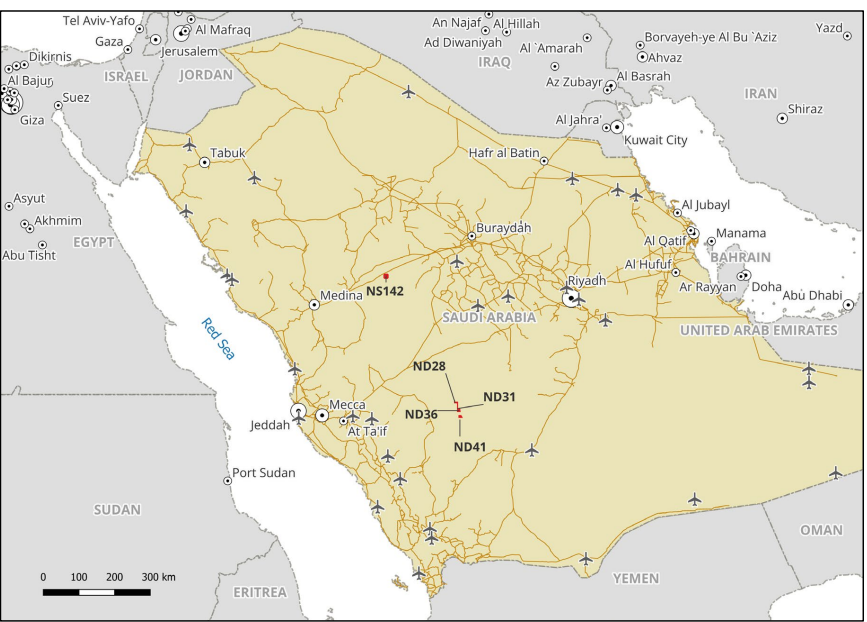
Figure 1:Regional location map of the Almasar licences in relation to major centres and transport infrastructure (Source: IPO Prospectus)
At a Glance - AlMasar Minerals IPO
IPO detail | Prospectus position |
Proposed ASX code | AMK |
Offer price | A$0.20 per share |
Public offer | A$8 million minimum to A$12 million maximum |
New shares offered | 40 million to 60 million |
Shares on issue after the offer | 115 million to 135 million |
Indicative market capitalisation | A$23 million to A$27 million |
Pro-forma cash after the offer | A$8.19 million to A$12.04 million |
Approximate implied enterprise value | A$14.81 million to A$14.96 million |
Granted exploration licences | Five |
Total licence area | Approximately 419.8km² |
Mineral Resources or Ore Reserves | None reported |
Public offer underwritten | No |
Current anticipated ASX quotation | 28 August 2026 at 12:00pm AEST |
The 60-Second Pitch
Almasar's proposition rests on three ideas.
The first is geological. The Arabian Shield forms part of the broader Arabian-Nubian Shield, a Neoproterozoic geological province extending through Saudi Arabia and northeast Africa. The same broad geological province hosts major gold and base-metal systems elsewhere, but much of the Saudi side has received less systematic modern exploration.
The second is timing. Saudi Arabia is actively trying to develop mining as part of its economic diversification strategy. Exploration licences are being auctioned, regional datasets are improving, and foreign companies are being encouraged to participate.
The third is execution. Almasar has assembled a board and management team combining economic geology, frontier-market operations and resource capital markets. The company intends to use modern mapping, geochemistry and geophysics to generate targets before committing the larger drilling spend.
The attraction is clear enough: secure ground early, apply modern exploration methods and establish a position before the Arabian Shield becomes a more mature exploration province.
The unanswered question is equally clear: has Almasar secured the right ground?
That cannot be answered from the prospectus. It will be answered by the work that follows the listing.
The Offer and What the Valuation Means
The public offer was priced at A$0.20 per share, with a minimum raise of A$8 million and capacity to accept a further A$4 million in oversubscriptions.
Table 1: Offer and valuation
Capital structure | Minimum subscription | Maximum subscription |
Existing shares | 75,000,001 | 75,000,001 |
New IPO shares | 40,000,000 | 60,000,000 |
Total shares at listing | 115,000,001 | 135,000,001 |
Existing shareholder ownership | 65.22% | 55.56% |
IPO investor ownership | 34.78% | 44.44% |
Indicative market capitalisation | A$23.0m | A$27.0m |
Pro-forma cash | A$8.19m | A$12.04m |
Approximate implied enterprise value | A$14.81m | A$14.96m |
The enterprise-value calculation is useful because it strips out the cash being raised. At either end of the offer, the market is effectively being asked to place a value of approximately A$15 million on Almasar's existing portfolio, people and operating platform before the new exploration money is spent.
That is a more informative number than the A$27 million maximum market capitalisation on its own.
It is also worth noting that Almasar completed a pre-IPO raise in February 2026 at A$0.12 per share. The IPO price is therefore approximately 66.7 per cent above that earlier funding price. Since then, the five licences have been granted and the company has progressed towards an ASX listing, so the two funding rounds do not represent identical stages of risk. Nevertheless, the price difference is part of the capital history IPO investors should understand.
The offer is not underwritten.
In addition to the ordinary shares, Almasar proposes to issue 12,888,888 options to directors, employees, the joint lead managers and Beacon. These options are exercisable at A$0.25 and expire three years from issue. They are out of the money at the IPO price, but they represent a future dilution consideration if the share price rises above the exercise price.
Five Licences, Two Geological Corridors
All five exploration licences are held through Almasar's Saudi operating subsidiary and were granted in February or April 2026 (Figure 2).
Table 2: Al Masar exploration licences
Licence | Area | Geological position | Expiry |
ND28 | 72.4km² | Nabitah-Ad Duwayhi belt | 20 April 2028 |
ND31 | 73.7km² | Nabitah-Ad Duwayhi belt | 20 April 2028 |
ND36 | 89.6km² | Nabitah-Ad Duwayhi belt | 28 April 2028 |
ND41 | 93.8km² | Nabitah-Ad Duwayhi belt | 20 April 2028 |
NS142 | 90.0km² | Nuqrah-As Safra belt | 19 February 2028 |
The contiguous ND28, ND31 and ND36 licences form the main southern cluster. The prospectus describes this area as a structurally controlled corridor containing volcanic, volcaniclastic, sedimentary and intrusive rocks affected by northwest-trending shear systems.
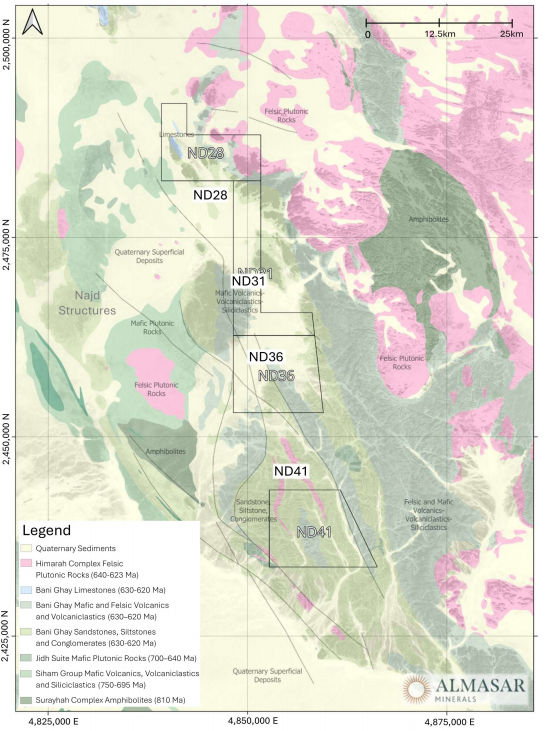
Figure 2 :Geology of Exploration Blocks ND28, ND31, ND36 (Independent Technical Assessment Report, 2026)
The exploration concept includes orogenic gold and intrusion-related magmatic-hydrothermal systems, a broad family that can include porphyry, epithermal, skarn, manto and intrusion-related gold mineralisation.
ND41 sits in the same broader metallogenic belt. Reconnaissance has identified structural fabrics, quartz and carbonate veining, and epidote-rich alteration within porphyritic volcanic and subvolcanic rocks. These are geological ingredients capable of justifying more work, but the independent geologist makes clear that no deposit-scale intrusive centre or diagnostic mineralised system has been confirmed.
NS142 sits farther north in the Nuqrah-As Safra belt. It is considered conceptually prospective for orogenic gold and VMS-style copper-gold mineralisation within volcanic and volcaniclastic rocks cut by faults and dykes.
What Has Actually Been Found?
This is the section that matters most.
The independent technical assessment reports no Mineral Resources, no Ore Reserves and no asset valuation. It describes the mineralisation potential as conceptual and based largely on geological setting, regional analogues and limited exploration results (Figure 3).

Figure 3: Regional geology of the arabican sheild (Source: IPO Prospectus)
At NS142, public records identify two gossanous occurrences in volcanic and volcaniclastic rocks, with gold recorded as a minor commodity. Historic drill collars were also observed during site reconnaissance, carrying identifiers and indicated depths of approximately 200 to 213 metres.
However, no drill logs, assays, collar tables or technical reports are available. The original operator and purpose of the drilling are unknown. Those collars demonstrate that someone drilled the ground; they do not demonstrate what the drilling found.
Almasar's soil work at NS142 has outlined multi-element enrichment, including arsenic and antimony with local gold and copper responses. These patterns may help direct follow-up work towards structurally focused hydrothermal systems. They are exploration vectors rather than evidence of an economic discovery.
Across ND28 and ND36, a limited historical Ma'aden dataset contains 99 reconnaissance soil samples. Gold values ranged from 0.01 to 2.8 parts per billion, while the broader results showed weak copper-gold-silver responses. The independent report says these data do not define a coherent, high-amplitude anomaly, and Almasar places no reliance on them.
No verified historical drill collars were identified within ND28, ND31, ND36 or ND41.
At ND41, possible historical trenching, quartz veining and strong local epidote alteration provide reasons to conduct modern fieldwork. They do not yet establish mineralisation.
This distinction is central to the IPO.
Almasar has secured a potentially interesting geological position, but it still has to convert regional prospectivity into ranked targets, convert targets into drill intersections, and then determine whether any intersection belongs to a system with scale and grade.
There are several value-creating steps ahead. There are also several points at which the geological thesis can fail.
Where the Money Goes
The prospectus budgets the proceeds over the first two years after listing.
Table 3: Use of funds
Use of funds | Minimum raise | Maximum raise |
Exploration and development | A$4.479m | A$7.936m |
Salaries | A$1.120m | A$1.122m |
Consultants | A$0.492m | A$0.492m |
Field and central office costs | A$0.269m | A$0.270m |
Working capital | A$1.105m | A$1.497m |
Offer costs | A$0.805m | A$0.953m |
Total available funds | A$8.270m | A$12.270m |
At the minimum raise, 54.16 per cent of available funds is directed to exploration and development. At the maximum, this rises to 64.68 per cent.
The exploration budget is staged deliberately.
Table 4: Exploration Budget
Exploration activity | Minimum raise | Maximum raise |
Remote sensing | A$0.175m | A$0.310m |
Mapping | A$0.426m | A$0.755m |
Surface geochemistry | A$0.381m | A$0.675m |
Geophysics | A$0.431m | A$0.765m |
Drilling | A$2.189m | A$3.877m |
Assays | A$0.877m | A$1.554m |
Total exploration | A$4.479m | A$7.936m |
Drilling is the largest component, but most of it is budgeted for the second year. Under the minimum case, only A$350,000 of the A$2.189 million drilling budget sits in Year 1. Under the maximum case, Year 1 drilling is A$618,000 of a total A$3.877 million.
This tells investors something about the likely news flow.
The first phase is primarily about building the target pipeline through remote sensing, mapping, surface sampling and geophysics. More substantial drilling follows only if that work produces targets with sufficient geological, geochemical and geophysical support.
That is technically sensible for early-stage ground. It also means investors should not assume the entire portfolio will be drilled immediately after listing.
Who Is Running Almasar?
The strength of the Almasar proposition is probably most visible in its leadership team.
Dr Brock Salier, Chief Executive Officer and Managing Director, combines geology with resource capital markets. The prospectus says he was a founder and co-owner of Sprott Capital Partners/SCP Resource Finance, where he was involved in more than C$5 billion of capital raisings across more than 110 equity placements in the five years to 2023. Earlier roles included Rio Tinto, Accenture and GMP Europe.
Christoph Naudé, Executive Director and Chief Operating Officer, has worked across investment banking, structured credit and natural-resources projects in frontier markets. He is based in Riyadh, giving the company operational presence in Saudi Arabia rather than managing the portfolio entirely from Perth.
Dr John Mair, Independent Non-Executive Chairman, brings more than two decades of geology and mining-company leadership, including previous responsibility for advancing the Kvanefjeld rare-earth project in Greenland.
Dr Christian Grainger, Independent Non-Executive Director, has more than 25 years of field experience and was a co-founder of Collective Mining and Cordoba Minerals. His background also includes Continental Gold, which was acquired by Zijin Mining, and work across major gold and copper systems in Latin America.
Aaron Bertolatti, Non-Executive Director and Company Secretary, contributes ASX governance, accounting and corporate compliance experience.
The board and management team collectively hold 38.55 million shares, representing 33.53 per cent of the company at the minimum subscription or 28.56 per cent at the maximum.
That creates meaningful alignment, but it also concentrates influence. Dr Salier alone is expected to hold 22.40 per cent at the minimum raise or 19.08 per cent at the maximum.
Approximately 47.44 million existing shares are expected to be restricted under ASX escrow arrangements, including approximately 46.38 million shares for 24 months and 1.05 million shares for 12 months. None of the IPO shares is expected to be restricted.
Financial Position and Future Funding
Almasar is pre-revenue and loss-making.
The Australian parent recorded a loss of A$59,614 and net liabilities of A$59,613 for the short period from incorporation to 31 December 2025. The underlying Abu Dhabi holding group recorded a loss of AED2.95 million for the year ended 31 December 2025, reflecting staff, consulting, exploration, travel and establishment costs.
After the IPO adjustments, the prospectus presents pro-forma cash of approximately A$8.19 million at the minimum raise and A$12.04 million at the maximum. Pro-forma net assets are approximately A$8.30 million and A$12.16 million respectively.
The prospectus states that the funding is expected to cover approximately two years. Because Almasar has no operating revenue, further financing will be required if the company is to continue exploration beyond that program or accelerate a discovery.
This is normal for an early-stage explorer, but it should remain part of the investment calculation. Success can require more capital just as easily as failure. A promising discovery generally increases the amount of drilling required before a resource can be defined.
Key Risks
The principal risks are not hidden.
No defined discovery: The licences have no reported Mineral Resource or Ore Reserve. Regional prospectivity does not guarantee economic mineralisation.
Limited exploration history: There is little verified drilling information, and the historical collars at NS142 have no available logs or assays.
Licence tenure: The five licences expire in February or April 2028 and will require renewal. They also carry expenditure commitments, with bank guarantees equal to 15 per cent of those commitments.
Protected-area overlap: A significant part of ND41 and minor portions of ND28, ND31 and ND36 overlap the Majami al-Hadb National Park. Almasar says it has no current plans to explore within those areas.
Saudi regulatory and sovereign exposure: All operating assets are outside Australia and subject to Saudi laws, administrative processes, foreign-investment requirements and government discretion. Enforcement of Australian judgments against overseas assets may also be difficult.
Regional geopolitical risk: Saudi Arabia operates in a region exposed to military tension, cross-border conflict and potential disruption to logistics and infrastructure.
Future funding and dilution: The initial budget covers approximately two years. Further capital raisings are likely to be required.
Shareholder concentration: Dr Salier will retain a substantial holding and corresponding voting influence after listing.
Option dilution: Almost 12.9 million options will be issued to directors, employees and advisers at listing.
Offer execution: The IPO is not underwritten. The prospectus timetable set 17 July 2026 as the closing date, and Almasar now appears on the ASX upcoming listings schedule.
Samso Concluding Comments
The easy way to sell the Almasar story is to describe Saudi Arabia as the next great mining frontier and point to the size of the Arabian Shield.
That may be directionally correct, but it is not yet an investment answer.
The prospectus is asking investors to value a team, five granted licences and a two-year exploration strategy. There are no ounces, tonnes or established drill intersections available to anchor the valuation.
At the maximum subscription, Almasar would list with a market capitalisation of A$27 million and approximately A$12.04 million in pro-forma cash. The implied enterprise value is therefore close to A$15 million. That is the price being placed on the existing Saudi portfolio and the people assembled to explore it.
There are reasons to pay attention. The licences are granted rather than merely applied for. The company has genuine in-country presence. The board carries more geological and capital-markets depth than the average first-time exploration float. Most importantly, the proposed work program is appropriately staged for ground at this level of maturity.
There are also reasons not to run ahead of the evidence.
The independent geologist repeatedly describes the potential as conceptual. Four of the five licences have no verified historical drilling. The historical holes at NS142 have no assays. The early Ma'aden soil work across part of the southern cluster is low tenor and does not define a coherent anomaly. Much of the first year will be spent creating targets rather than testing a known mineralised system.
This is therefore not an IPO for investors seeking a near-term resource development story. It is an exploration proposition in the purest sense.
For investors comfortable with frontier exploration risk, Almasar provides an unusual ASX entry into a jurisdiction attracting increasing mining attention. For more cautious investors, the sensible milestones are straightforward: watch the first detailed geochemistry and geophysics, see which targets survive the ranking process, and then assess what the drill rig produces.
The management team provides credibility. The Arabian Shield provides the geological thesis. Neither removes the need for discovery.
That is where the value still has to be created.
Cover photo: Saudi Arabia (MODIS 2019-07-07), MODIS Land Rapid Response Team, NASA GSFC. Public domain, via Wikimedia Commons (https://commons.wikimedia.org/wiki/File:Saudi_Arabia_(MODIS_2019-07-07).jpg)

The Samso Way – Seek the Research
Here at Samso, we pride ourselves on delivering content for investors that is independent and informed by over three decades of experience in the industry. Our content is well-researched and is only created if I see merit in discussing the company's story.
Our mission is simple: cut through the noise and spotlight what matters—genuine stories, grounded insights, and real opportunity.
Our content is well-researched and is only created if the team sees merit in discussing the company or concept. Investors can explore our three core platforms:
There may be numerous paths to success in investing, but the common thread among successful individuals is that they remain committed to making informed decisions. Equip yourself with the right knowledge and tools, and you will be well on your way to achieving your financial goals.
Most importantly, investors need to be absolutely diligent in understanding their own risk-reward tolerance and capabilities. Never bite off more than you can chew. As they say, Rome wasn’t built in a day, and the Great Wall stood because it took centuries to complete.
The Samso Philosophy:
Stay curious. Stay sharp. And remember—digging deeper always uncovers the real value.
In Life, there is no such thing as a Free Lunch.
Never bite off more than you can chew is my parting comment.
Happy Investing, and the only four-letter word you need to know is DYOR.
To support our independent work, please head over to our Support Page and give us a helping hand in any of the ways listed. This is a new initiative for the Samso Platform, and it was always the concept of Samso when we started this journey in 2018.
Disclaimer
The information or opinions provided herein do not constitute investment advice, an offer, or solicitation to subscribe for, purchase, or sell the investment product(s) mentioned herein. It does not take into consideration, nor have any regard to your specific investment objectives, financial situation, risk profile, tax position and particular, or unique needs and constraints.
Samso is a trusted platform that equips dedicated investors with up-to-date industry knowledge and insights from top CEOs and thought leaders. By staying informed on business advancements and market trends, investors can enhance their financial decisions through a combination of expert guidance and their own research.

Samso News | www.samso.com.au | An Investor Lens on ASX-Listed Companies

Comments