
US shuts the back door on Chinese defence metals, and Australian tungsten is suddenly in play

Updated: 4 days ago
Washington has set a hard deadline of 1 January 2027. Australian producers are on the right side of it, but only if they can prove where every gram came from.
Australian critical minerals producers have been handed their clearest opening yet into the United States defence supply chain, after President Trump signed an executive order closing the loophole that let American contractors keep buying Chinese magnets, tungsten and tantalum.
Executive Order 14415, signed on 20 July 2026 and published in the Federal Register three days later, does not create a new ban. It enforces an existing one. US law already bars the defence department from buying certain materials produced in a “covered nation”, a list containing only China, Russia, North Korea and Iran. Australia is not on it.
The order is unusually candid about why it was needed. Its opening section states that despite the longstanding prohibition, defence contractors have historically under-prioritised domestic production and resilience. That is an admission that the existing law has not been working.
How the escape hatch worked, and how it closes
The statute has two release valves. The first lets the Secretary waive the prohibition for a specific end item when a specific covered material of satisfactory quality and quantity cannot be obtained when needed at a reasonable price. Each such waiver runs for a maximum of 36 months. The second is a national security waiver, allowing delivery of an item containing covered material from a covered nation where the Secretary determines in writing that accepting it is necessary to United States national security interests.
Contractors have leaned on the first valve heavily, because for most of these materials no tested, approved, available Western alternative existed. Qualifying a new supplier into a defence programme is slow, expensive and thankless work, and when a compliant Chinese supplier sits there at a fraction of the price, nobody volunteers to do it.
From 1 January 2027, the order shuts the first valve and narrows the second. Routine non-availability waivers stop. A contractor still wanting one must submit a formal mitigation plan, accepted by the Secretary, that identifies the non-compliant source, documents evidence of exhaustive efforts to find compliant material, describes the steps to remove the non-compliant material from the supply chain, and sets a strict projected timeline for doing so.
National security waivers survive, but they now require a request from the Secretary or a service Secretary to the Assistant to the President for National Security Affairs. Routing that decision through the National Security Council is a meaningful change of altitude. A waiver that was previously an acquisition matter becomes a White House matter.
The sharpest clause is Section 2(c). A contractor's failure to qualify a domestic source no longer constitutes non-availability, unless that contractor can demonstrate active, adequately funded and ongoing efforts to qualify one. In plain terms, “we couldn't find anyone else” stops being an acceptable answer if you never seriously looked.
There is a penalty tail. Where the Secretary determines a contractor has engaged in fraud or deliberately misled the government in its mitigation plan, or has knowingly failed to implement it, the order directs him to exercise all appropriate contractual remedies and permits referral to the Attorney General for investigation and possible prosecution. Section 4(b) is blunter still: failure to qualify an alternative source becomes grounds to suspend or terminate task orders, decline to exercise contract options, and terminate the existing contract.
That is the real weapon. Not a fine, but the threat of losing the work.
Why 1 January 2027
The date is not arbitrary, and this is the detail most commentary has missed. Legislation passed in 2021 amends the same statute on exactly that day. From 1 January 2027 the department may not enter into a contract for any covered material mined, refined, or separated in a covered nation, rather than only material melted or produced there.
The same amendment narrows a widely used carve-out. The exception for commercially available off-the-shelf items currently excludes items that are 50 per cent or more tungsten by weight. From January 2027, that exclusion widens from tungsten to every covered material.
So the waiver door and the traceability net move together. A contractor relying on a Chinese input buried three tiers down will find, on the same morning, that the input is more clearly caught, the off-the-shelf shortcut is narrower, and the exemption is gone.

Figure 1. The two changes that matter land on the same day. Everything else is process around them.
The list is shorter than “critical minerals” suggests
The covered materials are narrower than most investors assume. “Critical minerals,” as a phrase, now encompasses roughly 60 commodities. The statute this order enforces does not.
As it currently stands, the list is samarium-cobalt magnets, neodymium-iron-boron magnets, tungsten metal powder, tungsten heavy alloy and components containing it, tantalum metals and alloys, and molybdenum. Molybdenum was added in December 2025. Germanium and gallium join on 18 December 2027 under the same legislation.
Two of the six current entries are tungsten. One is tantalum. Only two relate to rare earths. That matters for a market that has spent three years treating “critical minerals exposure” as a synonym for rare earths.

Figure 2. The statutory list is specific and short. Broad “critical minerals” exposure is not the same as exposure to this order.
Australia's Tungsten Paradox
Tungsten has the highest melting point of any metal, which is why it goes into armour-piercing rounds, cutting tools and anything that runs hot. China dominates production. Australia ranks second in the world for tungsten resources, according to Geoscience Australia and peer-reviewed assessments of the national inventory, yet supplies only around one per cent of global output.
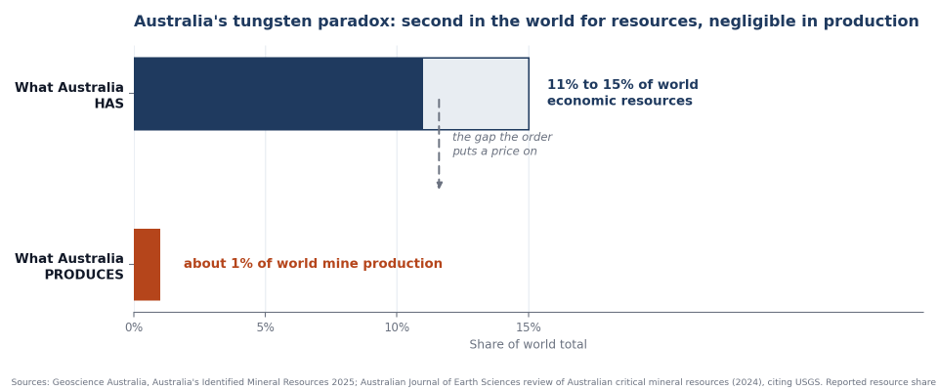
Figure 3. Resource endowment without production capacity. The order raises the value of closing that gap.
Tantalum, tungsten or molybdenum produced from recycled material is exempt where the contractor can show the recycled material was produced outside a covered nation and the melting and further processing takes place in the United States or in the country of a qualifying foreign government. Australia appears on the qualifying country list used to implement that concept in United States defence acquisition regulation, alongside Canada, Japan, the United Kingdom and around two dozen others. From 18 December 2027 the same exception extends to gallium and germanium.
The practical reading is that Australian downstream processing of recycled tungsten, tantalum and molybdenum sits inside a statutory exemption, not merely outside a prohibition. For a country with substantial tungsten resources and an existing hard-metal recycling industry, that is a specific and under-discussed opening. It would be worth confirming the current qualifying country schedule before building a business case on it, since these lists are amended.
Two other exceptions matter less to Australian producers but tell you where the pressure is heading. Off-the-shelf items are exempt, on the narrowing basis described above. Electronic devices are exempt unless the Secretary determines domestic availability of a particular device is critical to national security, and Section 2(f) of the order directs the Secretary to review how that electronics exemption is currently being applied. That is the single largest remaining gap in the regime, and the order has put it under review.

Figure 4. Compliant supply is not only a domestic question. Four of the routes that stay open run through allied and US-financed sources
The catches
Being Australian is not sufficient.
Section 3 requires contractors to submit a complete indentured Bill of Materials, tracing every component back to the origin of the raw materials across all supplier tiers. It also requires screening every supplier for foreign ownership, control or influence from a covered nation, defined broadly enough to capture influence that exists but is never exercised.
Two consequences follow. First, an Australian mine that ships concentrate to China for separation is not producing compliant material once the January 2027 language bites. The premium attaches to the chain, not the deposit. Second, an ASX-listed company with a substantial Chinese shareholder or offtake counterparty can be caught despite mining in Australia. Registers and offtake books are now due-diligence documents.
The clause nobody is discussing
Section 6 may be the most commercially significant provision for Australian developers. Nothing in the order impairs acquisition of critical minerals produced by a foreign project financed, guaranteed or insured by the US Export-Import Bank or the Development Finance Corporation, or supported by the US departments of State, War, Commerce or Energy.
That is a protected lane, written into the order, for foreign projects carrying United States government money. American financing has stopped being merely cheap capital and become a compliance position.
It sits alongside Project Vault, the US Strategic Critical Minerals Reserve announced in February 2026 and backed by an EXIM loan of up to US$10 billion plus roughly US$2 billion in private capital, which the order also carves out.
Two reality checks
Defence volumes are small. Global magnet demand is dominated by electric vehicles, wind turbines and industrial motors, and defence consumption is a modest share of it. This order creates high-value, low-volume, certification-heavy demand. It does not move the bulk price deck. Any company whose investment case rests primarily on defence demand is selling a story the tonnages will not support.
Qualification takes years. Getting a material tested and approved into a specific weapons platform is a multi-year exercise. The order concedes as much: Section 4(c) gives the Secretary 90 days simply to produce a strategy for accelerating testing and qualification, including identifying regulations to rescind. When a policy document has to commission a plan to speed up its own approvals process, that tells you how slow the process is. Revenue from this shift lands well after the announcements.
What happens next
Implementing guidance is due within 180 days, with a further 90 days for the regulations themselves. Those will matter more than the order, because they settle whether “allied” means “preferred” or merely “permitted”. The preamble commits to sourcing “domestically or from allied nations”, but the operative sections build only a mechanism for removing Chinese material, not a preference for Australian material over American.
Two cautions. Defence is a small share of global magnet demand, so this creates high-value, low-volume, certification-heavy business rather than a shift in the bulk price deck. And qualifying a material into a weapons platform takes years, which is why Section 4(c) gives officials 90 days simply to devise a strategy for speeding that up.
The opening is real. The revenue is not imminent.
FOUR QUESTIONS FOR ANY COMPANY CLAIMING EXPOSURE
• Is its output on the covered materials list, directly or through a product it feeds?
• Can it document chain of custody from pit to delivered product, and where does the trail go cold?
• Does its share register or offtake book create a foreign ownership, control or influence problem?
• Is it inside the Section 6 financing perimeter, or should it be?
Cover photo: Scheelite; mica, Géry PARENT. Public domain, via Wikimedia Commons (https://commons.wikimedia.org/wiki/File:Scheelite;_mica.jpg)
The Samso Way – Seek the Research
Here at Samso, we pride ourselves on delivering content for investors that is independent and informed by over three decades of experience in the industry. Our content is well-researched and is only created if I see merit in discussing the company's story.
Our mission is simple: cut through the noise and spotlight what matters—genuine stories, grounded insights, and real opportunity.
Our content is well-researched and is only created if the team sees merit in discussing the company or concept. Investors can explore our three core platforms:
There may be numerous paths to success in investing, but the common thread among successful individuals is that they remain committed to making informed decisions. Equip yourself with the right knowledge and tools, and you will be well on your way to achieving your financial goals.
Most importantly, investors need to be absolutely diligent in understanding their own risk-reward tolerance and capabilities. Never bite off more than you can chew. As they say, Rome wasn’t built in a day, and the Great Wall stood because it took centuries to complete.
The Samso Philosophy:
Stay curious. Stay sharp. And remember—digging deeper always uncovers the real value.
In Life, there is no such thing as a Free Lunch.
Never bite off more than you can chew is my parting comment.
Happy Investing, and the only four-letter word you need to know is DYOR.
To support our independent nature of our work, please head over to our Support Page and give us a helping hand in any of the ways listed. This is a new initiate for the Samso Platform, and it was always the concept of Samso when we started this journey in 2018.
Disclaimer
The information or opinions provided herein do not constitute investment advice, an offer, or solicitation to subscribe for, purchase, or sell the investment product(s) mentioned herein. It does not take into consideration, nor have any regard to your specific investment objectives, financial situation, risk profile, tax position and particular, or unique needs and constraints.
If you find this article informative and useful, please help me share the information. I try to write about topics that are interesting and have the potential to be of investment value. It is not easy to find stories that fit those parameters. If you or your organisation sees the benefit of what Samso is trying to achieve and has a need to share your journey, please contact me at noel.ong@samso.com.au.
Samso is a trusted platform that equips dedicated investors with up-to-date industry knowledge and insigh0ts from top CEOs and thought leaders. By staying informed on business advancements and market trends, investors can enhance their financial decisions through a combination of expert guidance and their own research.
Samso News | www.samso.com.au | An Investor Lens on ASX-Listed Companies


Comments