

Twelve on the Watchlist: value left behind in the gold price correction?

Updated: 1 day ago

The gold price has fallen roughly 28% from its January 2026 record high, and the share prices of small gold companies have fallen even harder. This Insight walks through twelve ASX-listed gold small-caps, one by one, in plain language. For each company we ask two simple questions. Does the project stack up as a real, money-making mine? And does the company look like the kind of business a bigger gold miner would want to buy? The evidence suggests the sell-off has been applied to strong and weak companies alike. In my experience, conditions like these have usually preceded the strongest recoveries.
Samso Insights | Research | Investors | Samso Market Strategy |
WHAT THIS PIECE COVERS Gold fell 28 per cent. Gold shares fell a great deal further. One table, twelve companies, each on its own announcements. The new producers, who poured gold while their shares fell. Whether these companies were really marked down, and on what. The company builds the mine, or somebody buys the company. The milestones happened. The share prices have not caught up. |
1.00 · THE SETUP
Gold Price fell 28%. Gold shares fell much further.
Gold peaked at about US$5,597 an ounce on 29 January 2026. By mid-July 2026 it was trading around US$4,000 to US$4,100, a fall of roughly 28%, although the price is still about 20% higher than it was a year ago. The main reason for the fall is favoired to be caused by gloabal interest rate uncertainty. Fresh conflict between the US and Iran has pushed oil prices up, markets now expect the US Federal Reserve to raise rates rather than cut them, and higher interest rates generally make gold, which pays no interest, less attractive to hold, theoritically.
Now the part that matters for Australian gold companies. Australian miners sell their gold in Australian dollars, and in our currency the price is still remarkably high, and ain mid July, that is roughly A$5,700 per ounce, as of 19th July 2026. That figure moves every day, so check a live price before relying on it. Why does it matter? Because the cost of digging up an ounce of gold at most of the projects in this note sits somewhere between about A$1,400 and A$3,400. Even after the correction, the profit margin per ounce remains very large by historical standards. Every mine plan discussed below was designed and tested using a gold price of A$5,000 to A$6,000 an ounce or lower, which means every one of them still works at today's price.
Since January, investors have sold ASX gold companies far harder than the metal itself fell. On 23 March 2026 alone, a sector-wide sell-off reduced some of these share prices by more than 10% in a single day, with no bad news from the companies themselves. By June, gold shares were trading as if the gold price had collapsed, when in reality it was still above US$4,000.

FIGURE 1 · The gold price over the last 24 months: weekly closing prices of COMEX front-month gold futures in US$ per ounce, July 2024 to 14 July 2026. The rise through 2025, the peak in early 2026 and the fall back toward US$4,000 are all visible. Weekly closes understate the extremes; the intraday record was about US$5,597 on 29 January 2026. Source: Yahoo Finance price history, accessed 14 July 2026. Verify against a live price feed.
That gap between what the companies have actually achieved and what their share prices say is the subject of this note. When nervous investors sell "gold" as a category, they sell everything. Companies that spent the past year raising money, finishing mine studies, winning approvals and pouring their first gold are sold down alongside companies that achieved nothing.
Our July note argued the gold price is settling into a base, not collapsing. If that is right, the discounted small-cap end of the ASX offers the greatest leverage to a recovery.

Samso take · why a watchlist, why now The twelve companies below come from a working watchlist rather than a quantitative screen. They cover the whole life cycle of a gold company, from early-stage explorers still drilling holes through to brand-new producers that poured their first gold bar this year (Figure 2). What they share is this: each one delivered a real, verifiable milestone during the exact months the market was marking them down. That gap between delivery and share price is where patient investors have historically built their best positions. It is also where larger gold companies, which have been acquiring ASX gold developers since 2024, look for acquisitions. |
1.50 · BEFORE WE START
How to read the numbers in this note
Mining has its own language, and it can make simple ideas sound complicated. Below is a plain-English guide to every term used in this note. If you read nothing else in this section, read the first three entries.
Ounces (oz, koz, Moz) Gold is measured in troy ounces. "koz" means thousand ounces and "Moz" means million ounces. A Mineral Resource of 1Moz means geologists estimate about a million ounces of gold sit in the ground, worth roughly A$6 billion at today's price before the very large cost of getting it out. Grade (g/t) How much gold each tonne of rock contains, in grams per tonne. Around 1g/t is low-grade (you need to move a lot of rock), 2 to 3g/t is solid, 4g/t and above is high-grade, and anything over about 10g/t is exceptional. Higher grade generally means more profit per truckload. Mineral Resource: inferred, indicated, measured An estimate of the gold in the ground, prepared under the JORC Code, the Australian reporting standard. The three categories describe confidence. Inferred is the rough first estimate, indicated means enough drilling has been done to plan a mine around it, and measured is the highest confidence. Banks and buyers pay far more attention to indicated and measured ounces. Scoping study → PFS → DFS The three levels of study that assess whether a mine would be profitable, in increasing detail and cost. A scoping study is the first rough sketch. A Pre-Feasibility Study (PFS) is a serious engineering estimate. A Definitive (or Bankable) Feasibility Study (DFS) is detailed enough for banks to lend against. NPV (net present value) The headline number from a mine study: all the future profit the mine is expected to make, converted into today's dollars, because a dollar earned in ten years is worth less than one earned now. The small subscript, such as NPV8, is the discount rate used in that conversion. A rough rule of thumb: if a company's entire sharemarket value sits well below its project's NPV, the market is either doubting the study or ignoring it. Note that "pre-tax" NPVs look bigger than "post-tax" ones, and this note flags which is which. IRR (internal rate of return) The project's annual rate of return on the money invested to build it. Anything above about 25% is considered attractive. Several projects here report over 70%, which is exceptional and reflects today's high gold price. AISC (all-in sustaining cost) The most honest cost measure: roughly what it costs, all things included, to produce one ounce. If AISC is A$3,000 and gold sells for A$6,000, the miner keeps about A$3,000 per ounce before tax and growth spending. Toll milling / toll treatment Paying to process your ore through someone else's plant instead of building your own. Building a processing plant costs hundreds of millions of dollars, so toll milling lets a small company start earning gold revenue quickly and cheaply. The trade-off is paying fees and depending on someone else's schedule. Capex, placement, SPP, FID Capex is the money needed to build the mine. A placement is a share sale to big investors to raise cash, and an SPP (share purchase plan) is the version offered to existing everyday shareholders. FID, the final investment decision, is the board formally saying "we are building it." Market capitalisation The sharemarket's total price tag on the company: share price multiplied by the number of shares. Comparing market cap with project NPV, cash in the bank, or ounces in the ground is how investors judge whether a stock looks cheap or expensive. |
2.00 · THE TWELVE
One table, twelve stories
The table below (Table 1) summarises each company using its own ASX announcements, with dates given in each profile in Section 3. Treat every number as approximate and check it against the original announcement before acting on it. Resource estimates, study results and funding details are exactly as the companies reported them. Share prices and company valuations change daily, which is why there is no market-value column here. Each profile in Section 3 instead includes a 24-month share price chart, so the rise to the early-2026 high and the fall since can be seen directly.
TABLE 1 · The twelve watchlist companies, summarised in plain language from their own ASX announcements. Every study value quoted in this note was calculated by the company at a gold price lower than today's, an important point we return to in Section 4. Source: company ASX announcements; Samso compilation. Verify all figures against the original releases.


FIGURE 2 · The watchlist spans the full life cycle of a gold company, from explorer to producer. That spread matters, because recoveries rarely lift all stages at once. Producers usually recover first and explorers last. Source: Samso framework; company disclosures.
3.00 · COMPANY BY COMPANY
The new producers: they poured gold while their shares fell
Three of the twelve produced their first gold during the very months the gold price was falling, an unlucky accident of timing that has limited the market response to the milestone. For a small company, the first gold pour marks the transition from development story to operating business.
ASX: WWI West Wits Mining: a new producer in the Witwatersrand BasinQala Shallows, near Johannesburg, South Africa · 7.24 million oz at 4.0g/t West Wits is restarting mining in the Witwatersrand Basin, the goldfield beneath Johannesburg that has produced more gold than anywhere else on Earth. On 17 March 2026 the company poured its first gold, making Qala Shallows the first new underground gold mine built in South Africa in more than fifteen years. Its ore is processed at neighbouring giant Sibanye-Stillwater's plant under a toll milling arrangement (see the guide above), so West Wits did not need to build its own. The numbers behind it are substantial: a gold estimate of 7.24 million ounces at a healthy 4.0g/t grade, upgraded 44% in February 2026, and a completed mine study valuing the project at US$500 million after tax. That valuation was calculated at a gold price of US$2,850/oz, which is about US$1,150 below today's price. In June 2026 two major South African banks, Absa and Nedbank, signed off a ZAR1.115 billion loan package (very roughly A$95m) that fully funds the build-up toward the target of around 70,000 ounces a year from late 2028. A study on expanding to around 200,000 ounces a year, called Project 200, is due around the end of July 2026.  Is it a real mine? Yes, and the strongest proof is that two big banks put their own money behind it. The risk now is the ramp-up. The gold grade coming out of the ground must rise toward 3g/t as mining moves into the richer ore zones, and South African projects always trade at a discount with Australian investors because of the country's political and power-supply history. Takeover appeal: a 7.2-million-ounce deposit next door to Sibanye, already using Sibanye's plant, is an obvious fit for its giant neighbour. The bank funding reduces the pressure to sell, because West Wits no longer needs a buyer to fund development. |
ASX: CEL Challenger Gold: first gold, a US$1.1 billion study, and Peter Marrone joining the boardHualilan, San Juan province, Argentina · 2.8 million oz (gold-equivalent), plus projects in Ecuador Challenger illustrates the pattern described in this note. The shares reportedly fell about 48% in the six months to May 2026. In that same window the company started mining, poured its first gold in June 2026 (about 500oz of gold and 6,000oz of silver from the first batch of ore, processed through neighbour Austral Gold's plant). The compnay then published a study on the full-scale mine showing a value of roughly US$1.1 billion after tax at a US$3,500/oz gold price, with a build cost of about US$232m and steady production of 135,000 ounces a year. In May the company raised A$85 million at 12 cents a share, led by Peter Marrone, the founder of Yamana Gold, who invested roughly A$10m of his own money and will become chairman, bringing Yamana's former operations chief with him. A 20-for-1 share consolidation is planned, which changes the share price but not the company's value. Challenger also holds a separate 4.5-million-ounce project in Ecuador, right beside a deposit that China's CMOC recently bought, and the market currently gives it almost nothing for that.  Is it a real mine? The sequencing is the notable feature. The small-scale processing deal brings in cash now, without borrowing or issuing more shares, while the big mine study is finished. The discount is Argentina itself, meaning currency and political risk, though San Juan is that country's most mining-friendly province. Takeover appeal: when one of the industry's most respected mine builders personally buys in and takes the chairman's seat while the shares sit near their lows, it indicates that experienced industry figures assess the asset as worth substantially more than the current price. Whether Challenger ends up as acquirer or target, that positioning occurred before any share price recovery. |
ASX: WGR Western Gold Resources: a small, near-term toll-mining operationGold Duke, near Wiluna, WA · 277,000oz Western Gold's plan is straightforward: mine ore from four small, already-approved open pits and truck it 46km to someone else's plant for processing. The board formally approved mining in December 2025, a decision that briefly sent the shares to a four-year high, after drilling 35,000m of closely spaced holes to confirm exactly where the gold sits. This "grade control" drilling reduces the risk of the mined ore differing from the plan. Funding needed only a modest A$6.75m share sale plus an arrangement where the mining contractor defers part of its fees. The company's own numbers for this first stage point to about 42,800 ounces of production, generating an estimated cash surplus of roughly A$109.7m. That is a large figure relative to the company's small size, though it assumes the Australian-dollar gold price stays high and everything runs to plan. Site works began in early 2026 with first gold targeted for around mid-2026, and readers should check the company's latest quarterly report to confirm timing. 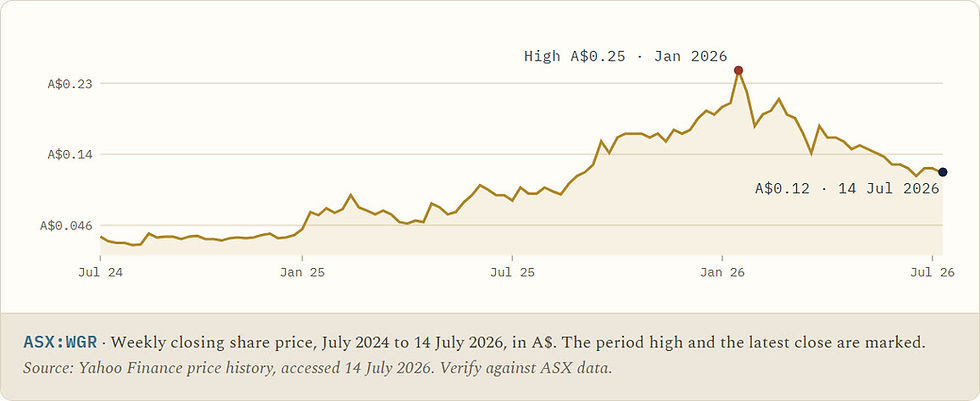 Is it a real mine? Yes, but a small and unforgiving one. At this scale a single problem, whether the ore carries less gold than expected or the plant runs late, can remove much of the profit. The heavy up-front drilling may provide some form of insurance. Takeover appeal: at 277,000oz, Gold Duke is more likely to be bought as extra plant feed by a bigger Wiluna-district player than as a company-making prize. That outcome would still deliver value to shareholders, provided mining confirms the estimated gold. |
The funded builders: money in the bank, processing plants on the way
In WA's goldfields, ownership of a processing plant separates small toll-treatment operators from substantial mining businesses. Paying to use another company's plant works, but the fees and scheduling limits reduce profits. The three companies below raised, between them, well over half a billion dollars during the sell-off to build or refurbish their own plants. Their share prices received little benefit.
ASX: BTR Brightstar Resources: fully funded to build its own plantLaverton–Menzies and Sandstone regions, WA · more than 4 million oz in total Brightstar already earns gold revenue from two small underground mines, with its ore bought and processed by larger neighbour Genesis Minerals. The planned development is larger. Its January 2026 mine study, a full bank-quality DFS, maps out a Brightstar-owned processing plant at Laverton producing about 75,000 ounces a year, worth A$606m before tax at an assumed gold price of A$6,000/oz. That assumption is below today's price, and the study says the plant would pay for itself in about 17 months. Crucially, the money is already raised: roughly A$383 million in total, made up of about A$193m from share sales (including an offer to everyday shareholders that proved so popular it was upsized) plus a US$120m bond. Construction was slated to begin mid-2026 with first gold from the new plant targeted for mid-2027. Behind that sits a second act at Sandstone, where Brightstar has bought up neighbouring companies to assemble 2.4 million ounces, most of it shallow and cheap to mine, with the first serious study due around September 2026. The company's stated ambition is 200,000 ounces a year across both hubs. The share price was sold down to about 30 cents in the 23 March sector rout, a near-12% fall in one day with no company news, while an independent research firm published valuations several times higher. That is one firm's opinion rather than a market consensus, but it gives a measure of the gap.  Is it a real mine? This is one of the most complete packages on the ASX at its size: gold in the ground with high confidence, a finished bank-grade study, permits, all the money, and revenue already coming in. What remains is execution, which means building the plant on time and on budget. What is an overhanging issue is the market feels that the grades may be a problem to come in "lower" gold pricing and rising costs. Takeover appeal: Brightstar has been the one doing the buying so far. Even so, a fully funded, 4-million-ounce, two-region gold business trading well below the value of just one of its projects is exactly the maths that attracted takeover bids for De Grey, Spartan and Gold Road. It could end up as buyer and target at the same time. |
ASX: MRT Maritana Minerals: converting a nickel plant into a gold plantBlack Swan plant and several gold deposits around Kalgoorlie, WA · ~1.9 million oz Regular Samso readers know this one. We covered it as Horizon Minerals and again after its April 2026 rename. The plan is straightforward: instead of spending years and hundreds of millions building a new processing plant, Maritana bought an existing nickel plant (Black Swan, just outside Kalgoorlie, connected to grid power and sealed roads) and is converting it to process gold. The mine study around that plan points to about 102,000 ounces a year for an initial five years, worth roughly A$631m before tax at an assumed A$5,500/oz gold price. The money is done, for now. A A$175m share placement in February 2026 plus a shareholder offer left about A$114m cash and no debt in March. While the plant is converted, existing small-scale mining continues to generate revenue, and drilling at the old Burbanks mine has returned very high grades, including one interval of 4.2 metres at 42g/t with a slice at 127g/t. Remember from the guide that 4g/t counts as high-grade. First gold through Black Swan is targeted for late 2026. In mid-April the sharemarket valued the whole company at about A$333m, roughly half the study's stated project value, for a business that is funded and already earning.  Is it a real mine? The numbers are strong, with the honest caveats we have flagged before. Its production cost of about A$3,353 an ounce is comfortable while gold is above A$6,000, but it leaves less cushion than lower-cost peers if the price falls, and converting a nickel plant to gold is a substantial engineering task. Takeover appeal: a permitted, grid-connected processing plant near Kalgoorlie is genuinely scarce, since companies wait years for approvals to build one. Comparable plants have historically attracted corporate buyers when the share market has not valued them. |
ASX: TGM Theta Gold Mines: building a mine in a historic South African goldfieldTGME Project, Pilgrim's Rest, South Africa · 6.1 million oz Theta is reviving a cluster of historic gold mines around the old town of Pilgrim's Rest, north-east of Johannesburg. Its updated mine study (3 February 2026) describes a 13-year operation producing about 871,000 ounces in total at a strong grade of 4.28g/t, generating A$1.4 billion of free cash and worth A$689m after tax. All of that was calculated at a gold price of US$2,884/oz, barely 70% of today's price. Construction is underway with more than 140 people on site, and first gold is targeted for early 2027. The funding was completed in June 2026 through a US$90m bond plus final share placements, including roughly US$15.6m from an investment group associated with Chengtun Mining, a multi-billion-dollar Chinese-listed miner. Open conversations has linked possible future deals together. Beyond stage one sit more than forty historic mines and a further 3.6 million ounces, supporting a long-term ambition of 160,000 ounces a year.  Is it a real mine? The high grade and shallow, walk-in tunnel access (no expensive deep shafts) are real advantages. The risks are the standard South African set: layered permitting, the requirement that local empowerment partners hold 26% of the operating companies, and restarting a district that has not operated at scale in living memory. Takeover appeal: a strategic Chinese miner taking a position on the register during construction indicates corporate interest in the asset. Watch whether Chengtun's stake grows. |
The study-stage developers: the homework is done, the decision comes next
ASX: BGD Barton Gold: large early cash margins from the starter pitsTunkillia and Tarcoola, outback South Australia · 2.2 million oz gold plus 3.1 million oz silver Barton's Tunkillia project is a big, bulk-mining story. The gold grade is modest at 0.87g/t on average, but there is a lot of it, and the key detail is that the first pits to be mined are much richer than the average. The company's May 2025 study sketched a mine producing about 120,000 ounces of gold a year plus silver, worth roughly A$1.4 billion before tax, with the first two pits alone modelled to generate about A$1.3 billion of operating cash in just the first 27 months. That was calculated at A$5,000/oz, now, not so well below today's price. The work in 2026 has been about turning that sketch into a bankable plan. The drilling program was expanded to about 40,000m in June after early results suggested more gold at better grades inside the planned pits. According to the company, specialist drilling for engineering and processing data has been running since April, the formal Pre-Feasibility Study is due before the end of 2026, and a mining licence application and funding talks follow in 2027. Two potential extras the simple comparisons miss: Barton owns the only gold processing plant in its region, and it has made a promising high-grade silver discovery called Tolmer that it is now drilling. Similarly, the market consensus point to a long drive to the Challenger MIll and the old phrase, "Grade Is King", especially in a lowering of the gold price.  Is it a real mine? Plausibly, on scale and those rich starter pits. A 120,000-ounce-a-year mine costs serious money to build, however, and that financing hill still lies ahead after the study. The end-2026 PFS is the key document. Takeover appeal: South Australia's gold country has barely been consolidated, and a 2.2-million-ounce deposit plus the region's only plant is the natural centrepiece. Realistically, Barton is more likely to be bought at the study stage than to build alone, and that may be the strategy. |
ASX: PGL Pilbara Gold: 2.1 million ounces of easy-to-process ore in the PilbaraMt York, the Pilbara, WA (plus Roe Hills near Kalgoorlie) · 2.1 million oz Formerly Kairos Minerals, the company renamed itself Pilbara Gold in April 2026 to match its main asset: Mt York, a 2.1-million-ounce deposit that was partly mined in the 1990s. Two things make it attractive. First, the ore is "free-milling", meaning the gold comes out easily with standard, cheap processing and none of the complex treatment some ores demand. Second, the mineralisation runs continuously for 4.2km inside a single planned pit. An initial study in late 2024 pointed to a conventional open-pit operation, and 2026 is the year of the serious work: about 50,000m of drilling to grow the deposit and lift confidence before a Pre-Feasibility Study, plus first-time gold estimates at its second project near Kalgoorlie. The shares were caught in the sector's June selling despite no bad news from the company, a pattern that recurs throughout this note.  Is it a real mine? Possibly, after this year's drilling. The easy processing and existing Pilbara roads and services help, but the deposit needs more high-confidence ounces before a build decision could stand up. Samso is sceptical at this stage as the project had every chance to have been at this stage several yuears ago, priro to the recent gold price hike. THe lack of devotion to it under current management makes me feel that there are some deposit issues. What is great for PGL is the rising gold price. Takeover appeal: the Pilbara has already produced the template, with De Grey's Hemi discovery taken over by Northern Star for billions. A growing deposit of over 2 million ounces in the same region is precisely what mid-sized acquirers screen for. |
ASX: SMS Star Minerals: a very small, near-term toll-mining planTumblegum South, near Meekatharra, WA · small deposit, approval-ready Star Minerals holds a very small, approval-ready gold deposit that the company plans to mine in a short campaign, trucking the ore to a nearby third-party plant for processing. Approvals, agreements and early site work have been reported through late 2025 and 2026, and market commentary has noted renewed speculative interest as first mining approaches. We deliberately quote fewer numbers here. The deposit is modest and the economics are of the short-campaign kind, so readers should take scale and profit expectations directly from the company's own announcements rather than from any second-hand summary, including this one.  Is it a real mine? A real but tiny one. A short toll-milling campaign can produce meaningful cash next to a very small company value at today's gold price, but there is no margin for error. One batch of ore grading below plan, or a processing delay, changes the whole outcome. Takeover appeal: realistically a small bolt-on acquisition for a larger Meekatharra-region miner rather than a target in its own right. Its location in the Meekatharra district, which it shares with Great Boulder below, is the relevant factor. |
The explorers: drilling through the downturn
ASX: GBR Great Boulder Resources: a million ounces beside existing processing plantsSide Well, right beside Meekatharra, WA (plus the newly acquired Peak Hill) · 1.02 million oz at 2.0g/t In December 2025 Great Boulder's Side Well project reached 1.02 million ounces. The quality matters as much as the quantity. Some 61% of those ounces are in the higher-confidence "indicated" category that mine plans are built on, about 90% sit shallow enough for open-pit mining (the cheap kind), and the main Mulga Bill deposit contains a rich core of 441,000oz at 5.3g/t. Drilling since then has returned exceptionally high grades, including a March 2026 interval of 1.93 metres at 574 grams per tonne with a section at 4,434g/t. Mining lease applications are lodged, the company reported about A$12m in the bank at 1 March, and in mid-2026 it agreed to buy the neighbouring Peak Hill project, funded by a roughly A$40m share raising. Location is the other key point: Side Well is directly beside Meekatharra's established processing plants, owned by companies that require ongoing ore supply.  Is it a real mine? Not yet, and deliberately so. The strategy appear to be one of growing the deposit until either a development decision or a takeover offer becomes the logical outcome. The A$40m raising dilutes existing holders, and that is the price of the Peak Hill option. Takeover appeal: a million-plus ounces, high confidence, shallow, high-grade, sitting beside operating plants. This matches the profile of recent WA gold takeover targets. The Peak Hill purchase indicates management intends to be the acquirer, although either outcome remains possible. |
ASX: AKA Aureka: growing both ounces and grade in VictoriaIrvine (Stawell district) and Comstock (St Arnaud), western Victoria · ~455,000oz in total Aureka, the renamed Navarre Minerals, has done something most juniors never manage: it has grown its gold ounces and its grade at the same time. Usually, adding ounces means adding lower-grade material around the edges, and the average grade drifts down. A mid-2026 update lifted the company's total estimate 26% to about 455,000oz, with the flagship Irvine deposit rising to 398,000oz at 2.59g/t, up from 2.43g/t, after a new geological interpretation of a structure called the Tenacity Fault. The company achieved that from only about 5,000m of drilling, which is remarkably efficient. Recent months added a new drill target 900m from the existing deposit and an experienced recruit in Dr Barry Murphy, whose targeting work helped Predictive Discovery find a 5.5-million-ounce deposit in Africa. The near-term option is Comstock, an old open-pit mine at St Arnaud where a mid-2026 concept study outlined a fast, cheap restart using the existing pit ramp and a nearby third-party plant. Two honest caveats apply. All of Aureka's ounces are still in the lowest-confidence "inferred" category, and processing tests have not been done, though the 5-million-ounce Stawell Gold Mine, 16km up the road, has processed the same style of ore for decades.  Is it a real mine? Comstock could become a small, self-funding starter operation while Irvine grows toward the company's stated million-ounce ambition. Upgrading resource confidence and completing processing tests are the outstanding homework. Takeover appeal: Victoria's established gold operators, including Stawell's owners just up the corridor, permanently need ore close to their plants. At the roughly 10-cent share level reported in June, this optionality looks cheaply priced relative to the geology. |
ASX: GA8 GoldArc Resources: an early-stage explorer in the Leonora districtMt Stirling and surrounds, Leonora district, WA · ~200,000oz at 1.82g/t GoldArc, rebranded from Asra Minerals in September 2025 alongside a share consolidation and a A$3.2m raising, is the earliest-stage company here: about 200,000oz across a large ground position around Leonora, one of the busiest and most frequently transacted gold districts in WA. The 2026 drilling news has been genuinely encouraging, with a high-grade gold system confirmed at the Eclipse prospect in April, followed weeks later by bonanza-grade results along a 5km trend called Niagara. The shares traded around 6 cents in early July. Investors should recognise what this is: high-risk discovery investing. The existing 200,000oz is too small to build anything on, and the investment case rests on one of these new prospects turning into something much bigger.  Is it a real mine? Not at this size. A deposit of 200,000oz is plant feed for a neighbour, not a mine of its own. Takeover appeal: the real asset is the land, positioned between Leonora's active acquirers. A genuine discovery at Eclipse or Niagara would likely draw corporate interest almost immediately. Without one, the company depends on share markets that are currently very tough on explorers. |
4.00 · THE DISCOUNT QUESTION
Have these companies really been marked down? Yes, and mostly without discrimination.
Exact share-price falls for each company change daily and belong in a live spreadsheet, not a published note, so pull up the charts yourself. But the documented markers through this correction tell one consistent story, in three parts.
1. The selling was about "gold", not about these companies. Brightstar fell nearly 12% in one session (23 March 2026) in a sell-off explicitly attributed to the gold sector, in the same quarter it finished raising A$383m. Pilbara Gold was sold down in June with, on public information, nothing wrong at the company. Challenger fell roughly 48% over six months while becoming a gold producer. When fully funded builders and brand-new producers fall alongside explorers that have found nothing yet, the market is selling the category rather than judging the businesses.
2. The share prices now sit below the studies' own assumptions. Every mine study quoted in this note was calculated at a gold price below today's: Theta used US$2,884/oz, West Wits US$2,850, Challenger US$3,500, Brightstar A$6,000, Maritana A$5,500 and Barton A$5,000, against a mid-July spot price around US$4,000 to US$4,100, or roughly A$6,000 and above. The project economics published in those studies therefore remain valid at current prices. What has changed is the share prices, which in some cases have fallen below the values the studies support. Maritana is the clearest documented example: in April the market valued the company at about A$333m, roughly half the A$631m pre-tax value stated in its own funded project study.
3. Institutional and strategic capital continued to flow in. During the same months the shares were being sold, Brightstar raised about A$383m, Maritana about A$180m, and Challenger A$85m in a placement led by Peter Marrone. Theta closed roughly US$186m of equity plus a US$90m bond, with a strategic Chinese miner subscribing. West Wits signed a ZAR1.115bn debt package with two major banks, and Great Boulder raised about A$40m to fund an acquisition. Institutions, banks and strategic investors committed capital at prices the broader share market was rejecting. The two views cannot both be correct.
The bear case · read this before the bull case Sometimes a discount is deserved. If gold breaks below the US$3,800 to US$4,000 floor our July note argued for, the Australian-dollar cushion shrinks, and the higher-cost operations on this list (those producing at roughly A$2,850 to A$3,350 an ounce) lose their profit margin fastest. Mine builders can exceed their budgets, since construction costs in WA have been rising for years, and every "first gold in 2026 or 2027" date above is a forecast, not a fact. The South African and Argentine projects carry country risk that studies do not capture. The explorers at the bottom of the list are spending cash into a market that currently punishes companies for issuing new shares. Readers wnating to invest like "Professionals" should manage this end of the market with position sizing, holding small positions in several names rather than a large position in one. |
Samso take · the pattern beneath the twelve This watchlist shows one pattern repeated twelve times: companies that used the 2024–2025 gold boom to permanently reduce their risk by raising money, winning permits, buying plants and pouring first gold, and were then re-priced as if none of it happened, because the sellers were trading the gold chart rather than the companies. In thirty years of gold cycles, that specific set-up, with milestones going up while the share price goes down, has been the most reliable precursor to the next re-rating, provided the gold price itself settles rather than collapses. Our companion note argues it settles. |
5.00 · TWO PATHS TO VALUE
Two ways shareholders win: the company builds a mine, or someone buys the company
Since 2024, the big end of the ASX gold sector has been answering cheap developer prices the direct way, by buying the companies. De Grey was taken over by Northern Star, Spartan by Ramelius, Gold Road by Gold Fields, Magnetic by Genesis, and brokers count the 2026 deal tally in the billions. The buyers in this cycle have consistently paid for four things: plenty of ounces in a good mining district, high-confidence resources, closeness to an existing processing plant, and funded near-term production. Here is how the twelve map against those tests.
TABLE 2 · Samso's qualitative reading of each company's two possible wins, and the upcoming event that forces the market to decide. These are opinions built from public disclosures, not predictions that any takeover will happen. Source: Samso framework; company ASX announcements.

For the two audiences of this note If you already hold these shares and are asking where the value went, anchor on the milestone record rather than the share price. In every case above, the company is objectively further along than it was at the January gold peak: better funded, better permitted, closer to real cash flow, while trading at or below January's prices. If you are considering buying ahead of a potential gold recovery, think of the list as ordered by risk. The producers and funded builders (WWI, BTR, MRT, TGM and CEL) come with business cases already stress-tested below today's gold price. The study-stage names (BGD and PGL) offer bigger upside but still have to find their construction money. The explorers (GBR, AKA and GA8) and micro-developers (WGR and SMS) carry the highest risk and the highest potential return, and positions should be sized accordingly. Note: GBR may be unfaily positioned in the lowest rank. If there was going to be a dark horse, my money is on GBR. None of this is a recommendation; it is a framework for comparison. |
6.00 · CLOSING THE LOOP
The milestones happened. The share prices haven't caught up.
Our July gold note concluded that the metal may have the potential to be settling into a base around US$4,100 to US$4,300, held up by central banks that are still buying, and that settling phases historically reward funded, near-term gold developers with one of two prizes: a re-rating as they pour first gold, or a takeover at a premium.
This company note is the practical application of that idea. Twelve businesses, and twelve trails of ASX announcements documenting money raised, studies finished, permits granted and gold poured, set against a share market that has priced them as proxies for the falling gold price. Gaps of this kind have historically closed in one of two ways.
Either the gold price recovers and the sector re-rates, or the corporate buyers step in and arbitrage the discount, exactly as they did with De Grey, Spartan and Gold Road at smaller discounts than exist today. Both outcomes favour patient holders of the stronger companies. Neither requires a higher gold price, because none of these business cases assumes one.
What to watch from here Five dials for this watchlist. First, first-gold confirmations: WGR (mid-2026), MRT (late 2026), BTR and TGM (2027). Each is a clear pass-or-fail event that materially reduces risk. Second, the study calendar: Barton's PFS (end-2026), Brightstar's Sandstone study (Sep quarter 2026), and West Wits' expansion study (~Jul 2026). Third, strategic investors on the registers: Chengtun at Theta and the Marrone syndicate at Challenger, because increases in these stakes are a stronger signal than company presentations. Fourth, takeover announcements anywhere in ASX gold, since each transaction shows what the industry is willing to pay for discounted ounces. And fifth, the gold price at the US$4,000 line, which determines how long the above may take to play out. |
References & Sources
All company figures come from the companies' own ASX announcements and the secondary sources below, as published at the dates shown. Share prices, company valuations and study figures change constantly and must be checked against each company's official ASX releases before any investment decision. Where this note says "approximately" or "roughly", take it literally.
Trading Economics. Gold: ~US$4,001/oz on 13 July 2026; down 7.15% over the month, up 19.7% year on year; US–Iran escalation and ~70% priced probability of a September Fed rate rise (accessed 13–14 Jul 2026).
Forbes Advisor / APMEX. Record gold high ~US$5,597 on 29 January 2026.
Aureka Limited (ASX:AKA). Resource upgrade to ~455koz (Jun 2026, via Stocks Down Under coverage); "Drilling Continues to Bolster Confidence in Stawell Corridor Prospectivity" (3 Feb 2026); drone magnetics and Dr B. Murphy appointment (5 Jun 2026, via Kalkine); Walkers Pit / Comstock concept study and prospecting licence application (Jun–Jul 2026, via Bulls N' Bears); FY2025 Annual Report (26 Sep 2025); Independent Investment Research initiation (Apr 2026).
Barton Gold Holdings (ASX:BGD). "Expansion of Tunkillia Phase 2 Upgrade Drilling" (15 Jun 2026); "Dual Rigs Commence Tunkillia Diamond Drilling" (22 Apr 2026); Tolmer drilling (18 May 2026); Tunkillia Optimised Scoping Study (5 May 2025); JORC resource statement (8 Sep 2025).
Brightstar Resources (ASX:BTR). Goldfields DFS 2.0 (Jan 2026); SPP upsize/completion and funding summary (Feb–Mar 2026 releases incl. 3 Mar 2026); Menzies resource growth (11 Dec 2025); Lord Byron resource upgrade (12 Jan 2026); East Coast Research report; Kalkine note on the 23 Mar 2026 sector sell-off (share ~A$0.30, down 11.8%).
Challenger Gold (ASX:CEL). First gold pour at Casposo (Jun 2026, via Medianet); A$85m placement, Marrone/Bouchard appointments and PFS (May 2026, via Motley Fool AU, Grafa, Kalkine); A$30m placement (Oct 2025); Hualilan resource of 2.8Moz gold-equivalent (company website).
GoldArc Resources (ASX:GA8). Rebranding from Asra Minerals, 10:1 consolidation, A$3.2m placement (17 Sep 2025); "High-Grade Gold System Confirmed at Eclipse" (7 Apr 2026); "Bonanza Gold Grades Confirmed across 5km Niagara Trend" (28 Apr 2026); ~200koz global resource (Stockhead profile); share ~A$0.06 (7 Jul 2026, stockanalysis.com).
Great Boulder Resources (ASX:GBR). Side Well resource of 1.02Moz (Dec 2025, via mining.com.au); high-grade Mulga Bill results incl. 1.93m @ 574g/t (Mar 2026, via MarketOpen); Peak Hill acquisition and ~A$40m raising; quotation of 145.5m new shares (13 May 2026).
Maritana Minerals (ASX:MRT, formerly Horizon Minerals). Black Swan study metrics, A$175m placement, A$114.1m cash (Feb–Apr 2026); Burbanks Phase 1 results and Phase 2 program (4 & 14 May 2026); name change effective 13 Apr 2026; prior Samso Insights coverage (samso.com.au).
Pilbara Gold (ASX:PGL, formerly Kairos Minerals). Mt York 2.1Moz within an A$5,500/oz pit shell; Nov 2024 scoping study; 50,000m 2026 program toward a PFS; Roe Hills maiden-resource target (Listcorp/company materials); name change Apr 2026.
Star Minerals (ASX:SMS). Tumblegum South development-ready status, toll-treatment strategy, approvals and site preparation (company materials via INN, Morningstar, Market Index; Kalkine commentary Jun 2026).
Theta Gold Mines (ASX:TGM). Revised Feasibility Study (3 Feb 2026): 13.1-year mine life, A$689m post-tax value, A$1.4bn free cash; "TGM Secures US$90 Million Bond Issue" (12 Jun 2026); final equity placement to Golden Asian Investment Group / Chengtun Mining (Jun 2026); construction updates (company website; Stockhead profile).
Western Gold Resources (ASX:WGR). "Decision to Mine - Gold Duke Project" (Dec 2025); updated 277koz resource and Stage 1 scoping metrics (Jan 2026, via TipRanks summary); Bowerbird production bore and site establishment (Apr 2026); first gold targeted Q2 2026 (Stockhead, May 2026).
West Wits Mining (ASX:WWI). First gold pour at Ezulwini (17 Mar 2026); 7.24Moz resource upgrade (+44%, Feb 2026); ZAR1.115bn finance package with Absa/Nedbank executed (Jun 2026); Qala Shallows DFS metrics; Project 200 study timing (Crux Investor, Jun 2026; mining.com.au).
Yahoo Finance price history. Weekly closing prices for the twelve ASX tickers and COMEX gold futures, 24 months to 14 July 2026, used for the price charts in this note (accessed 14 Jul 2026).
Samso Insights. "The Gold Question: pathways & ASX equity implications" (June 2026) and "The Big Consolidation" (July 2026): gold price framework, consolidation thesis and takeover context (De Grey/Spartan/Gold Road/Genesis; Canaccord deal tallies via Stockhead).
Cover photo: Gold panning on Jack Wade Creek (24785190007), BLM Alaska. Public domain, via Wikimedia Commons (https://commons.wikimedia.org/wiki/File:Gold_panning_on_Jack_Wade_Creek_(24785190007).jpg). Reproduced photograph, shown faded under a navy overlay on the article thumbnail.

The Samso Way – Seek the Research
Here at Samso, we pride ourselves on delivering content for investors that is independent and informed by over three decades of experience in the industry. Our content is well-researched and is only created if I see merit in discussing the company's story.
Our mission is simple: cut through the noise and spotlight what matters—genuine stories, grounded insights, and real opportunity.
Our content is well-researched and is only created if the team sees merit in discussing the company or concept. Investors can explore our three core platforms:
There may be numerous paths to success in investing, but the common thread among successful individuals is that they remain committed to making informed decisions. Equip yourself with the right knowledge and tools, and you will be well on your way to achieving your financial goals.
Most importantly, investors need to be absolutely diligent in understanding their own risk-reward tolerance and capabilities. Never bite off more than you can chew. As they say, Rome wasn’t built in a day, and the Great Wall stood because it took centuries to complete.
The Samso Philosophy:
Stay curious. Stay sharp. And remember—digging deeper always uncovers the real value.
In Life, there is no such thing as a Free Lunch.
Never bite off more than you can chew is my parting comment.
Happy Investing, and the only four-letter word you need to know is DYOR.
To support our independent nature of our work, please head over to our Support Page and give us a helping hand in any of the ways listed. This is a new initiate for the Samso Platform, and it was always the concept of Samso when we started this journey in 2018.
Disclaimer
The information or opinions provided herein do not constitute investment advice, an offer, or solicitation to subscribe for, purchase, or sell the investment product(s) mentioned herein. It does not take into consideration, nor have any regard to your specific investment objectives, financial situation, risk profile, tax position and particular, or unique needs and constraints.
Samso is a trusted platform that equips dedicated investors with up-to-date industry knowledge and insigh0ts from top CEOs and thought leaders. By staying informed on business advancements and market trends, investors can enhance their financial decisions through a combination of expert guidance and their own research.
Samso Insights | www.samso.com.au | An Investor Lens on ASX-Listed Companies

Comments