
Tusker Minerals Limited (ASX: TSK)


Abstract
Tusker Minerals (ASX: TSK) has put a 2.1 to 2.6 billion tonne JORC Exploration Target in front of the market on the Douala Basin in coastal Cameroon, containing an indicative 7 to 8 million tonnes of rutile within roughly 40 kilometres of a deep water port. It is a genuinely large number on ground that has barely been drilled. It is also conceptual by definition, and the company says so.
Two things need correcting before anyone reads the grade. First, a figure of 0.03 to 0.05 per cent rutile is circulating in the public domain and it is wrong by a factor of ten. The announced grade is 0.3 to 0.35 per cent, and we show the evidence for that in Section 3. Second, 70 per cent of the heavy mineral content is kyanite, which the company assigns no value and has not tested. Strip it out and the 2.1 to 2.3 per cent heavy mineral headline is closer to about 0.6 per cent of minerals anyone currently pays for.
On our own comparison, the modelled grade is about a third of Sovereign Metals' Kasiya and sits at or barely above the cut off grade Sierra Rutile used in its own audited resource statements. What that means for economics is not something anyone can settle yet. The company has no mineral resource on any asset, no metallurgical testwork anywhere in the portfolio, and its flagship Cameroon tenure is still under application rather than granted.
The reason to keep watching is narrow and real. Seven reconnaissance auger holes returned 0.33 to 0.76 per cent rutile, two to two and a half times the modelled target grade, and they sit outside the target footprint. Either the target understates the deposit or those holes are the good bits. Nobody knows yet.
Funding is the near term issue. A$1.35 million of cash at 30 June 2026 against roughly A$5.1 million of annual all in spending, with the gap meant to be closed by the sale of the Malawi subsidiary to AuKing Mining for up to A$4.85 million. That transaction is binding but not complete, with a long stop date of 30 September 2026. The last equity raise was at 30 cents. The shares are at 7.3 cents.
This company's re-rating has already happened. DY6 rose about 475 per cent through 2025 and roughly 78 per cent of that has been given back. Our call is Watch and DYOR, and the event we are watching is the maiden JORC Mineral Resource at Douala Basin. Note the company's six to nine month guidance covers the exploration work that tests the target, not the resource itself, and it says no assurance can be given that a resource will be defined.
Contents
Tusker Minerals Snapshot
This is a living document and the share price will have moved. All market data is as at 27 August 2026 unless stated otherwise. Shares on issue and the option and performance right counts are taken from the company's ASX filings of 20 and 27 August 2026.
Metric | Value |
Share price | A$0.073 (ASX, 27 August 2026) |
Market capitalisation | About A$8.16 million |
Shares on issue | 111,759,425 (ASX filing, 27 August 2026) |
Cash | A$1.35 million at 30 June 2026 (Appendix 5B) |
52 week range | A$0.062 to A$0.345 |
One year return | About negative 76 per cent |
Options and performance rights | 66,096,796 options and 23,675,000 performance rights, about 1.8 times the share register |
Last equity raise | September 2025, at A$0.30 |
JORC Mineral Resources | None on any asset |
Broker coverage | None identified |
Substantial holders, from the last lodged notices, all of which pre-date the August 2026 issue of new shares. Orwellian Investments and Bridge The Gap Trading Pty Ltd, 12.40 per cent, 22 September 2025. Elias Pungong Prombo Pupesie, 7.96 per cent, 30 December 2025. Zhenshi Group (HK) Heshi Composite Materials Co Limited, 7.67 per cent, 22 September 2025. Matthew Vincent Horgan, 6.68 per cent, 30 December 2025. Zhenshi Group was a A$1.5 million cornerstone investor in the 2023 IPO.
Share price context. This is a stock that has already run and already given it back. DY6 Metals rose roughly 475 per cent through 2025 on the Cameroon rutile acquisition, reaching a market capitalisation of about A$17 million. It listed in June 2023 at 20 cents, raised at 30 cents twice in 2025, and last traded at 7.3 cents. The 52 week high of A$0.345 and the low of A$0.062 both sit inside the last twelve months. A five bagger from here would be the second one, after the first was given back. |
1 Why We Are Doing a Full Workup on This One
I have been following this company since it was DY6 Metals. Samso has published on it eight times in fourteen months, which is one of the longest continuous threads we have on a single stock. I sat down with Cliff Fitzhenry for Coffee with Samso in September 2025, when the Cameroon rutile story was new and almost nobody on the ASX was looking at it.
In October 2025 I wrote that a genuine discovery at Tundulu could put this company somewhere near A$100 million. It did not happen. The shares went from about A$15 million of market capitalisation in July 2025, up hard through the second half of that year, and back down to about A$8 million today. Tundulu has since been sold.
This is where the Samso research workup comes into play. When you have been on a story through a full round trip, you either walk away from it or you go back and do the deepest piece of work you know how to do. This company has changed what it is twice in three years. It has just sold assets to add non-dilutionary funds for the existing projects. In addition, the recent news from management has put a big number for its valuation on the ground, which has not had modern systematic exploration activities.
So the question this workup answers is not whether the Douala Basin is big. The company has told us it is big. The question is whether what is in it is worth anything, and whether this team can prove it before the money runs out.
2 The Company and The Story
Tusker Minerals Limited is a Perth registered explorer with rutile and heavy mineral sands ground in Cameroon, and one retained rutile project in northern Malawi. It listed on 29 June 2023 as DY6 Metals Limited after a A$7 million IPO at 20 cents. Shareholders approved the name change at the November 2025 annual general meeting, and the ticker moved from DY6 to TSK on 1 December 2025.
The words you need before we go further
Rutile is the highest grade natural form of titanium dioxide, at 95 per cent TiO2 or better. Titanium is not sold as ore. It is sold as feedstock, graded by how much titanium dioxide it carries, and rutile sits at the top of that ladder because nature has already done the upgrading. Ilmenite, at 30 to 60 per cent TiO2, is the cheap and abundant workhorse and makes up the great bulk of the market.
Heavy mineral sands, or HMS, is the deposit style. Heavy minerals are the dense fraction of a sand or a weathered soil. The important thing, and it matters a great deal in this piece, is that only some of those heavy minerals are worth money.
Saprolite is deeply weathered rock that sits above fresh bedrock. It is soft. That is why this style of deposit can often be dug without blasting, which is the whole cost argument behind projects like Sovereign Metals' Kasiya in Malawi.
An Exploration Target is not a Mineral Resource. Under the JORC Code it is a conceptual estimate of what might be there. The Code requires the company to state that there has been insufficient exploration to estimate a Mineral Resource, and that it is uncertain whether further exploration will result in one. Tusker has stated exactly that. Every number in this workup that comes from the Douala Basin target carries that qualification.
The strategy as it actually is
The stated strategy is titanium feedstock in Cameroon, funded by selling the Malawi rare earths portfolio. That is a fair description of where the company is pointed today. It is not a complete description of how it got there.
The record reads like this. It listed in June 2023 as a Malawi heavy rare earths and niobium explorer with Machinga as the flagship. In August 2023 it hired Lloyd Kaiser as chief executive, a genuine development hire with ten years at Arafura Rare Earths in offtake and engineering roles on Nolans Bore. In April 2025 it acquired two Cameroon rutile and heavy mineral sands companies and the story became titanium. In July 2025 Kaiser left and Cliff Fitzhenry, an exploration geologist, became chief executive. In January 2026 the company announced a strategic review to unlock value from its Malawi rare earth and gallium assets. Between April and August 2026 it sold Tundulu, then agreed to sell Machinga, then restructured that into the sale of the entire Malawian subsidiary.
The review has now been executed almost in full. What emerges is a Cameroon rutile explorer with a Malawi remnant. Whether a reader calls that focus or drift is a fair question, and we come back to it in Section 8.
Capital structure

The share count is small for a company that has been issuing paper, and there has been no consolidation. The April 2026 bonus loyalty option issue was one option for every seven shares held. Five million shares were then issued on 19 August 2026 as part consideration for Yaounde West, on conversion of vendor performance rights, with a further 2,142 shares issued at the same time. The figure above is taken from the company's own cessation notices lodged on 27 August 2026 rather than from a vendor data feed. Several widely used market data services still carry 106.76 million shares and a market capitalisation near A$7.8 million, because they have not picked up the August issue.
Options and rights
This is the part of the capital structure that is easy to miss, and it is larger than the share register.

So against 111,759,425 shares on issue there are 66,096,796 options and 23,675,000 performance rights. On a fully diluted basis that is roughly 201.5 million securities, close to 1.8 times the current share register.
Most of it is a long way out of the money at 7.3 cents. The 21,900,000 TSKAP options struck at 60 cents would need an eightfold move before they matter. But 26,409,362 TSKAN options are struck at 8 cents and run to January 2029, which is roughly a tenth of a cent above the current price. Those are, for practical purposes, at the money.
We are not going to tell a reader what that means for the share price, because we do not know. What we will say is that anyone modelling a re-rating here should model it on a share count well above 111.8 million, and that the performance rights in particular need to be understood before the dilution is treated as theoretical.
Funding, stated honestly
There are two defensible readings of the runway and they are far apart.
On the Appendix 5B convention, which counts operating outflow only, A$1.35 million divided by A$263,000 gives about five quarters. That reading flatters the company, because exploration spending sits in the investing line for Tusker and is therefore excluded from the calculation.
Including exploration, all in spending across the twelve months to June 2026 was roughly A$5.1 million. On that basis A$1.35 million is about one quarter of activity.
The gap is meant to be closed by asset sale proceeds rather than a placement. That is management's own framing, described as non dilutive funding. It is worth noting that there has been no cash raise since September 2025, eleven months, and that the last two raises were both done at 30 cents against a 7.3 cent share price today. A raise from here would be heavily dilutive, which is precisely why the asset sales matter as much as they do.
The Malawi divestment
Two separate transactions, same buyer, AuKing Mining (ASX: AKN).
Tundulu, announced 17 April 2026, up to A$5.55 million. A$50,000 non refundable deposit for 40 day exclusivity, A$1.0 million cash at completion, A$2.2 million in staged deferred cash, A$1.25 million in AuKing shares and A$1.0 million in performance rights tied to resource milestones. AuKing funded it with a A$3 million raise. This transaction has completed and AuKing is drilling the project. Tusker shares rose 43.8 per cent on the day of announcement.
Green Exploration Limited, announced 18 August 2026, up to A$4.85 million. This is a binding share sale agreement over 100 per cent of Tusker's Malawian subsidiary, which holds Machinga, Ngala Hill, Salambidwe and Karonga. It replaces an earlier agreement of 3 August 2026 over Machinga alone, which was for up to A$4 million. Anyone still quoting A$4 million is quoting a superseded deal.

The Mzimba rutile licences transfer out of Green Exploration before completion and are retained. Conditions precedent include regulatory, governmental and shareholder approvals, AuKing shareholder approval for the scrip component, and ASX confirmation that the acquisition does not require re-compliance with listing rule Chapters 1, 2 and 11. Malawi’s mining regulator must approve the licence transfers.
The long stop date is 30 September 2026 and the transaction had not completed as at the date of this workup. That is a month away and it is the near term thing to watch.
Across both deals the headline consideration is up to A$10.4 million against a market capitalisation of about A$8.2 million. Before anyone gets excited about that comparison, most of it is deferred, in scrip, or contingent on milestones that depend on AuKing’s own drilling success rather than anything Tusker controls.
3 The Assets
A correction to the public record. Before we discuss grade, a number in circulation needs fixing. A reader who searches for the Douala Basin rutile grade will find 0.03 to 0.05 per cent. That figure is wrong by a factor of ten. It appears to be a decimal point error in one trade publication and it has been repeated from there. The grade Tusker announced on 14 July 2026, and carried unchanged into the amended announcement of 17 July 2026, is 0.3 to 0.35 per cent rutile. We are not asking anyone to take our word for it. The evidence is set out below. |

Four sources agree. One does not. The arithmetic inside the announcement settles which is right, and it does so twice.
Cross check one. The announcement reports 7 to 8 million tonnes of contained rutile inside 2.1 to 2.6 billion tonnes of material. Divide one by the other and you get 0.27 to 0.38 per cent rutile. At 0.03 to 0.05 per cent, that same tonnage would contain 0.6 to 1.3 million tonnes of rutile, not 7 to 8 million tonnes.
Cross check two. The announcement reports total heavy minerals of 2.1 to 2.3 per cent, of which rutile is 15 per cent of the mineral assemblage. Multiply those together and you get 0.32 to 0.35 per cent rutile. That matches the announced figure. It does not match 0.03 per cent.
Both checks land in the same place. This cuts in the company's favour, and we want to be even handed about saying so. If you were carrying the wrong number, the deposit is ten times better than you thought it was. It also means the grade is high enough to be worth arguing about properly, which is what the rest of this section does. A tenth of a per cent would not have been worth the argument.
3.1 Douala Basin heavy mineral sands project, Cameroon

Figure 1. Map of Cameroon showing Tusker Minerals Central Rutile Project in green, and the Douala Basin Project in blue, encompassing +11,000km2 of highly prospective tenure. (Reproduced from Tusker Minerals, Amended Announcement, Douala Basin Exploration Target, ASX, 17 July 2026. The figure is unchanged from the 14 July original. Caption is the company’s own.)
This is the reason for the workup. Tusker holds 100 per cent through the acquisition of Rhino Resources Ltd, announced 25 April 2025. The tenure is 2,580 square kilometres of coastal ground, three granted exploration licences plus three valid applications, and it incorporates what was previously called the Missole Project.
On infrastructure, the announcement states the project is located within approximately 40 kilometres of the Port of Douala, and its map draws indicative logistics catchment zones at 25 kilometres and 50 kilometres. Those are the figures to use. That is genuinely good, and better than most large African mineral sands projects.

Figure 2. Douala Basin Project tenure relative to the Port of Douala, showing indicative 25 km and 50 km logistics catchment zones and the Project’s strategic proximity to critical export infrastructure. (Reproduced from Tusker Minerals, Amended Announcement, Douala Basin Exploration Target, ASX, 17 July 2026. The figure is unchanged from the 14 July original. Caption is the company’s own.)


Figure 3. Diwong South Exploration Target showing modelled THM distribution on the left and rutile as a percentage of THM on the right. (Reproduced from Tusker Minerals, Amended Announcement, Douala Basin Exploration Target, ASX, 17 July 2026. The figure is unchanged from the 14 July original. Caption is the company’s own.)
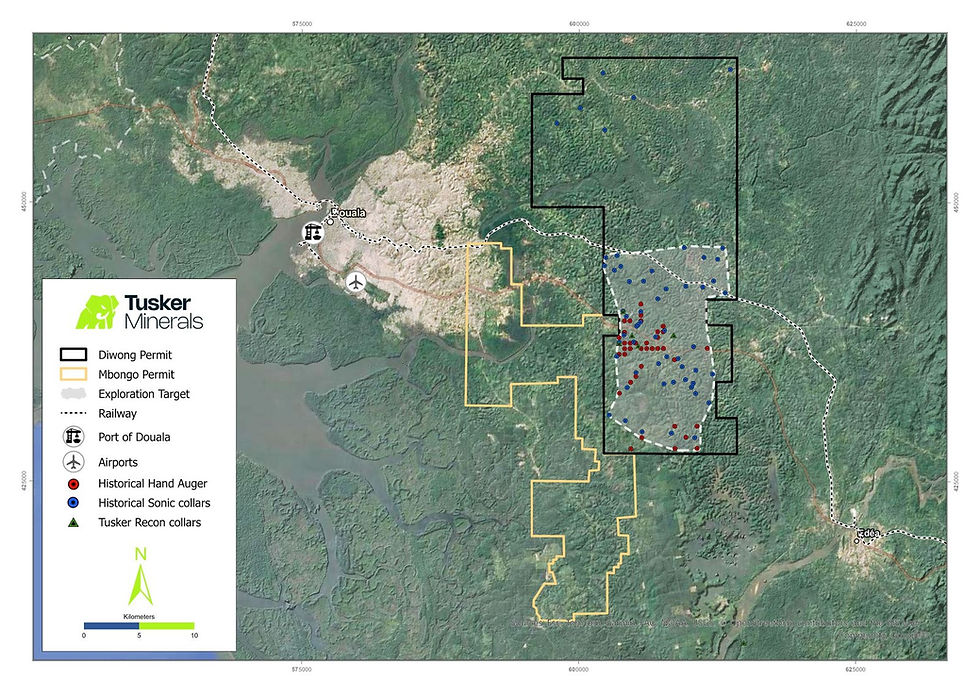
Figure 4. Diwong South Exploration Target extent within Tusker’s broader project tenure, highlighting the footprint of the current multi-billion-tonne target. (Reproduced from Tusker Minerals, Amended Announcement, Douala Basin Exploration Target, ASX, 17 July 2026. The figure is unchanged from the 14 July original. Caption is the company’s own.)
The potential quantity and grade of the Exploration Target reported in this announcement is conceptual in nature. There has been insufficient exploration to estimate a Mineral Resource, and it is uncertain if further exploration will result in the estimation of a Mineral Resource.
That statement is the company's own, and it is mandatory under the JORC Code. It is reproduced here because it tends to get lost under the word “billion”, and it is the sentence that tells a reader what an Exploration Target is.
The announcement is also specific about what the estimate is missing, and this is worth quoting because companies do not always spell it out. The stated limitations are incomplete historic assay support in parts of the dataset, the absence of project specific density data, conceptual vertical model constraints, and limited metallurgical data. Density matters more than it sounds. Without it, a tonnage figure rests on an assumed conversion from volume to mass.
3.2 What is actually in the rock
The 2.1 to 2.3 per cent heavy mineral grade is not 2.1 to 2.3 per cent of saleable product, and the difference is the whole of this section.


Figure 5. What is in the Douala Basin heavy mineral fraction. Kyanite is seventy per cent of it, and the company has assigned it no value pending testwork and market assessment. (Samso Research Media House.)
Seventy per cent of the heavy mineral content is kyanite. This is Samso analysis of what that means, and we want to be clear it is ours, built from the company’s own disclosed numbers rather than handed to us.
Kyanite is an aluminium silicate used mainly in refractories, which are the heat resistant linings inside furnaces. It is a real mineral with a real market. It is not, by the mineral sands industry’s own definition, a valuable heavy mineral. The standard industry primer, Greg Jones's "Mineral Sands: An Overview of the Industry" written for the AusIMM, defines the valuable heavy minerals as ilmenite, leucoxene, rutile and zircon, and classifies kyanite, staurolite and garnet outside that group. Jones wrote it while he was at Iluka Resources, and he is the Competent Person on this exploration target. We are not arguing against the company’s expert. We are quoting him.
The company itself assigns kyanite no value, and it is careful about this. The announcement references kyanite product specifications from Kyanite Mining Corporation and the USGS Mineral Commodity Summaries 2026, then states plainly that no assumption is made that Douala material would achieve comparable product specifications, recoveries or pricing. It says recovery, product quality and commercial potential all remain subject to further testwork and market assessment. That is a fair disclosure and we are not arguing with it.
The market size is the harder constraint. Global production of the whole kyanite, andalusite and sillimanite group runs at roughly 470,000 tonnes a year, at a United States price of about US$420 a tonne. Tusker’s exploration target implies something in the order of 34 to 39 million tonnes of contained kyanite. Even a modest operation would swamp that market many times over, and this is a bulk, low value, high freight product that would need to be shipped out of West Africa.
So the arithmetic that follows is ours. If the kyanite turns out not to be saleable, the 2.1 to 2.3 per cent heavy mineral headline is closer to about 0.6 per cent of heavy minerals that anyone currently pays for, being rutile at 15 per cent, zircon at 3 per cent and ilmenite at 9 per cent of the assemblage, which is 27 per cent of 2.1 to 2.3, or 0.57 to 0.62 per cent. On that scenario the kyanite is process load rather than product, mass that has to be mined, hauled and separated for no revenue. We are not asserting that outcome. We are saying it is the scenario a reader should hold in mind until testwork says otherwise, because nothing published so far rules it in or out.
Testwork has not been done. A kyanite product specification and a named buyer would change the picture materially, and it is one of the things we are watching for. The narrow point we will make is this. Nobody should read the headline heavy mineral grade as though the whole of it is currently saleable, because on the company’s own disclosure that has not been established yet.
3.3 The drilling, and the part of the story that is genuinely interesting


Figure 6. Diwong South Exploration Target showing selected historical sonic and hand-auger intercepts together with Tusker reconnaissance auger results. (Reproduced from Tusker Minerals, Amended Announcement, Douala Basin Exploration Target, ASX, 17 July 2026. The figure is unchanged from the 14 July original. Caption is the company’s own.)
Two observations matter here, and they pull in opposite directions.
The first is that these holes are running well above the modelled target grade. The best of them is more than twice it. They also sit outside the Diwong South target footprint. The chief executive has made this point directly. In the 17 July 2026 announcement Cliff Fitzhenry said, "The Douala Basin Exploration Target is a game-changing milestone for Tusker, establishing genuine multi-billion-tonne scale within a shallow, infrastructure-advantaged rutile-zircon system." The announcement then says the target covers only a portion of one licence while reconnaissance drilling is already identifying materially higher grade near surface zones. The scale claim is fair on the company's own numbers. What the quote does not say, and could not yet, is anything about grade continuity, because seven auger holes cannot establish it. If the reconnaissance grades hold up over area, the target as modelled understates what is there, and the bull case rests almost entirely on this.
The second is that seven hand auger holes across 2,580 square kilometres is not a data set. A 75 millimetre auger to a few metres depth is the cheapest reconnaissance tool there is. It is the right tool for this stage and we are not criticising its use. It simply cannot tell you whether a grade is continuous, and continuity is the whole question.
Historical drilling by Eramet, the French mining group, gives some comfort on thickness. Sixty sonic holes for 1,080 metres and 39 hand auger holes returned intervals including 10 metres at 5.0 per cent total heavy minerals from surface, 12 metres at 4.7 per cent from surface, and 18 metres at 3.7 per cent from surface ending in mineralisation. Those are heavy mineral grades, not rutile grades. Historical drilling bottomed out at roughly 18 to 24 metres.
There is no published metallurgical testwork on the Douala Basin. No recovery figures, no product specification, no payability work. For a heavy mineral sands project that is a significant hole, because recovery and product quality are what turn a grade into revenue. The company has built its own heavy mineral sands laboratory in Yaounde, which is a sensible and unusually practical step for a company this size.
On timing, read the company’s words carefully, because the amended announcement of 17 July 2026 is more careful than the original. It sets out a programme of exploration activities designed to test the exploration target, being infill and extensional drilling, density and metallurgical work, and updated geological and block modelling. Those activities are targeted for completion within approximately six to nine months, subject to drilling outcomes, permitting and assay turnaround. The company then says that successful outcomes would provide a stronger basis for estimating a maiden resource, and that no assurance can be given that a Mineral Resource will be defined, or that any part of the exploration target will be converted into one. Six to nine months is the timeline for the work, not a timeline for a resource. Anyone reading it as the latter is reading something the company did not say.
3.4 Central Rutile Project, Cameroon
The nominal flagship by area, and the one with the deepest history. The area figures in the company’s own materials range from 2,140 square kilometres in April 2025 to 5,901 in July 2025 to about 8,780 on the current project page and about 7,500 on the homepage. We use approximately 7,500 square kilometres across 21 exploration permits and note the inconsistency rather than pretending it is not there.
All of those permits are applications, not grants. That is a material point and it belongs in any assessment of this company.
The geology is residual and eluvial rutile hosted in saprolite over kyanite bearing mica schist and garnet paragneiss. Graphite appears with depth as oxidation decreases, which is the same association Sovereign Metals reports at Kasiya. The ground borders Lion Rock Minerals’ Minta project. The area produced 15,000 tonnes of high purity rutile between 1935 and 1955, when Cameroon was the world’s third largest rutile producer.
Reported assays from the September 2025 programme include 8.7 per cent heavy minerals including 0.6 per cent rutile over the first 2.25 metres, 5.29 per cent heavy minerals including 0.78 per cent rutile over the first 3.5 metres, and individual occurrences at 1.57 and 2.1 per cent rutile. There is no exploration target and no mineral resource. Assays from the most recent programme were still outstanding as at 20 August 2026.
3.5 Mzimba, Malawi, and Yaounde West, Cameroon
Mzimba is the only Malawi ground Tusker keeps. A 710 square kilometre licence package in northern Malawi, of which about 50 square kilometres has been tested. Forty one soil and rock chip samples returned a peak of 1.88 per cent TiO2, with 11 of 41 samples above 1 per cent. X ray diffraction confirmed the titanium occurs predominantly as rutile with minor anatase and no detectable ilmenite, which is the commercially preferable outcome.
One qualification is essential. These are percentages of titanium dioxide in surface soil and rock chip samples. They are not drill intercepts and they are not in situ rutile grades over a mining width. They cannot be laid alongside Douala’s 0.3 to 0.35 per cent or Kasiya’s 1 per cent without saying so, and any comparison that does lay them side by side is misleading. There has been no drilling at Mzimba.
Yaounde West is seven exploration permits acquired in September 2025 for A$1.5 million plus shares. Its attraction is that it covers the only historically recorded area of residual rutile mining in Cameroon. There is no drilling, no assay, no target and no resource. Five million vendor performance rights remain outstanding, contingent on the licences being granted, and no grant has been announced.
4 The Commodity Backdrop
4.1 Why rutile is a different market from titanium

Two end markets sit on top of that ladder and they behave nothing like each other. Pigment is about 95 per cent of demand, the white in paint, plastics and paper, and it is a housing and construction cycle business rather than a growth story. Titanium metal is about 5 per cent, going into aerospace, defence and medical use, and it is where the strategic story lives.
One more distinction decides whether rutile demand actually grows. The chloride pigment process, used by Western producers, needs high grade feedstock. The sulphate process, mostly Chinese, runs on cheap ilmenite. High grade feedstock demand therefore tracks chloride pigment share, not total pigment demand.
4.2 The supply argument, which is real

This is the table that matters. World rutile is a market of roughly 450,000 tonnes a year. Ilmenite is 9.4 million tonnes. Four countries make up about 91 per cent of rutile supply. It is a small, concentrated market, and small concentrated markets move hard when something goes wrong in them.
Several things have gone wrong at once. Base Resources’ Kwale mine in Kenya closed in December 2024 on reserve depletion, which is why Kenya drops from 41,000 tonnes to nothing. Iluka produced 10,600 tonnes of rutile in the June 2026 quarter, down from 29,900 tonnes in the December 2025 quarter, and has kept both of its synthetic rutile kilns idle. Rio Tinto approved US$473 million for Zulti South at Richards Bay in March 2026 but was explicit that the project is not about expansion, since it replaces declining production from Zulti North.
And Sierra Rutile, the world’s largest natural rutile mine, was taken private by Leonoil and delisted from the ASX on 3 October 2024. There has been no public operational disclosure since September 2024. The single largest source of natural rutile on earth is now an opaque private asset with no reporting obligation. Anyone modelling this market is working from USGS estimates, not from disclosure.
4.3 What the prices actually say
The price data does not support the promotional version of this story.
Iluka’s realised rutile price was US$1,254 a tonne across the first half of 2026, against US$1,216 a tonne for the 2025 financial year. That is broadly flat. There is no price spike in the data.
Ilmenite is worse. Kenmare’s realised ilmenite price for the first half of 2026 was US$203 a tonne, down 29 per cent year on year, which Kenmare attributes to increased Chinese domestic supply and African imports.
The one clearly strengthening price in the complex is zircon. Iluka has contracted a US$215 a tonne increase for the September 2026 quarter, taking it to US$1,760. Tronox reported zircon revenue up 43 per cent year on year and said supply remained constrained across the industry. Zircon is 3 per cent of Tusker’s assemblage.
On demand, 2025 was weak and 2026 is an early and uneven recovery. Tronox reported titanium dioxide volumes up 18 per cent year on year in the June 2026 quarter, the highest since mid 2022, with pricing flat year on year and up 5 per cent sequentially. Iluka reported improving pigment operating rates but said feedstock purchasing activity remains cautious and that housing and construction demand continues to be mixed. Its kilns are still idle. That is the honest read. Pigment volumes are recovering, prices are only just moving, and feedstock demand is lagging both.
4.4 The forecast everybody quotes, and what it is worth
The number in every rutile presentation is TZMI’s, that rutile demand from the titanium metals industry will grow about 3 per cent a year over the next decade while global supply declines about 7 per cent a year.
We have been unable to verify that forecast at source. It reaches the public domain through investor facing media citing TZMI, and TZMI’s own studies are behind a paywall. We could not obtain the publication date of the underlying work. Wood Mackenzie and Project Blue rutile forecasts could not be sourced at all.
So we say it plainly. There is no publicly verifiable, dated, quantified third party forecast of a rutile supply gap. The structural argument is real in direction, because Kwale is gone, Sierra Rutile is opaque and Richards Bay is sustaining rather than growing. The number that everybody repeats is not something a reader can check.
And there is counter arithmetic that belongs in the same breath. Sovereign Metals’ Kasiya, at 222,000 tonnes a year of rutile, would be roughly half of current total world rutile production. One project could close the deficit on its own. A market this small can be re-supplied quickly, and that is as true a statement as the scarcity argument.
4.5 Cameroon
The 2023 Mining Code, with implementing decrees enacted in November 2024, governs the sector. An exploration permit requires a mining agreement with the State. An industrial mining licence runs twenty years initially.
The fiscal terms carry the headline risk. The State takes up to 10 per cent of share capital free and non dilutable, and may increase that to 35 per cent by mutual consent. The State’s production share for non precious minerals is set at 2 to 15 per cent, and the code does not fix the rate. It is negotiated. That is a very wide band and an unquantified cost for any explorer that gets as far as a mining agreement. Add a local capacity building levy of 0.5 to 1 per cent of turnover, a sector development fund and a site restoration fund, plus local content rules reserving 95 per cent of unskilled positions for nationals.
On stability, we will not soften this. Paul Biya, aged 92 and in power since 1982, was declared winner of the October 2025 election with 53.66 per cent of the vote. The opposition candidate rejected the result and both men claimed victory. Protests followed across several cities. The death toll is disputed at between 16 and 48 depending on whose count you take, with more than 200 arrests. Ghost town protests in early November 2025 disrupted regional trade, with Douala port delays estimated at more than US$18 million a day. As at January 2026 the assessment from independent observers was that the crisis is far from resolved. Succession risk under a 93 year old president who began another seven year term in late 2025 is the dominant jurisdiction risk here and it is not one that can be modelled.
Against that, Cameroon is trying. Mining is about 1 per cent of GDP today and the government has set a target of mining revenue overtaking oil, with several projects in commissioning including Minim Martap bauxite. In August 2026 it suspended an entire class of semi mechanised gold permits pending compliance and referred 137 illegal operators to court. A regulator willing to do that is either reassuring or alarming, depending entirely on which side of the licence you are standing.
4.6 Malawi
The Mines and Minerals Act of 2023 sets a 5 per cent royalty on gross revenue and 30 per cent corporate tax. The resource rent tax is effectively suspended, with one mining development agreement describing it in its own text as not fit for purpose, and no replacement legislation had been enacted as at April 2026. Government equity is negotiated rather than statutory, with a 10 per cent non diluting interest as the precedent.
Malawi’s statutory terms are materially lighter than Cameroon’s. They are also set by unpublished, individually negotiated agreements with no recorded parliamentary scrutiny, and a suspended windfall tax that could be legislated back at any time. Neither country is a low risk jurisdiction. They are risky in different ways, and a reader should not assume the Malawi remnant is the safe part of the portfolio.
4.7 A word about jurisdiction risk in Africa
Before anyone uses the word Cameroon as a one word dismissal, it is worth saying something about jurisdiction risk on that continent generally, because the way it is usually handled in Australian small cap commentary is not much use to an investor.
Africa has decades of mining progress behind it, and jurisdiction issues have been part of that entire history. They are not new, they are not confined to any one country, and they have not stopped mines being built. What they have in common is that they are an unknown factor. They can go left or they can go right. That is true of political images anywhere, and it is always not what it looks like and what it seems.
The evidence in this very piece runs both ways, which is the point.
Sierra Leone hosts the world’s largest natural rutile mine and has done for decades, through a civil war and everything that followed. Kenya’s Kwale mine ran from 2013 until December 2024 and then closed because the ore ran out, not because the country did anything to it. Mozambique has Kenmare at Moma, South Africa has Richards Bay, and Rio Tinto has just committed US$473 million to extend it to 2050. In Malawi, Rio Tinto holds close to a fifth of Sovereign Metals. These are not fringe operators taking wild risks. They are among the largest mining companies on earth choosing to be there.
And it goes the other way too. In late July 2026 an International Chamber of Commerce tribunal awarded Sundance Resources Limited and its Cameroonian subsidiary Cam Iron SA approximately US$616 million in damages, interest and costs against the Republic of Cameroon, over Cameroon’s conduct in relation to the Mbalam iron ore project. Sundance’s own statement of the findings is that Cameroon breached its legal obligations to the two companies in relation to their investment, and breached the arbitration agreement by failing to comply with an emergency order issued against it in March 2022.
Two things belong beside that, because the case is not the one sided warning it first appears to be. A separate tribunal dismissed Sundance’s parallel claim against the Republic of Congo in January 2026, in full, on a claim of US$8.8 billion. And the Cameroon award remains unpaid. Sundance has said that if Cameroon does not comply voluntarily, enforcement proceedings will be needed. Its litigation funder has said publicly that the matter remains subject to significant litigation and collection risk. Sundance itself was removed from the ASX official list in December 2020 after two years of suspension.
That is the whole shape of jurisdiction risk in one case. A company can be right, can be found to be right, and can still be a long way from being paid. It is also a reminder that the process exists at all, and that a state can be held to it.
So we are not going to tell a reader that Cameroon is fine, and we are not going to tell them it is hopeless. Neither statement would be honest and neither would be useful. What we will say is that jurisdiction risk in Africa is real, is permanent, is unknowable in direction, and has never by itself been a reason not to look. It is a reason to size a position accordingly and to expect the unexpected in both directions. Anybody who tells you they know which way a political situation on that continent will turn is telling you something they cannot know.
5 Where This Sits Against Its Peers
We are on Track B, and we say so up front. No scoping study, no pre-feasibility study, no definitive feasibility study, and no JORC Mineral Resource exists on any Tusker asset. Under our own rules that means no valuation, no price and no per share range appear anywhere in this workup. What follows is relative positioning and a map of what would establish value.
The comparison below is Samso’s own. We built it from published JORC resource and reserve statements, feasibility study announcements and market data, each cited with its date. Tusker has not endorsed it and did not supply it. One qualification governs every line. Tusker’s Douala Basin figure is a JORC Exploration Target, which is conceptual. Every other project in these tables carries a reported Mineral Resource or Ore Reserve and several are operating mines. Tusker will look cheap on any ratio for exactly that reason, and a reader who takes the ratio without the qualification will reach the wrong conclusion.
5.1 Grade, like for like


Figure 7. In situ rutile grade, Douala Basin against its peers. The Douala Basin bar is a JORC Exploration Target, which is conceptual. Every other bar is a reported Mineral Resource or Ore Reserve. (Samso Research Media House.)
Three readings, and we will give all three.
Against Kasiya, Douala is about a third of the grade. Kasiya also carries 0.95 per cent graphite in its Mineral Resource as a second revenue stream. Douala’s second stream is kyanite, which has no assigned value.
Against Sierra Rutile, Douala sits at or barely above the cut off. Sierra Rutile reported its mineral resources at cut off grades of 0.25 to 0.50 per cent rutile and its resource grades ran 0.55 to 1.60 per cent. A deposit averaging 0.30 to 0.35 per cent would, at Sierra Rutile’s own reporting cut offs, be marginal material rather than the payable core. That is the sharpest benchmark available and it comes from an audited resource statement.
Against Kwale, Douala is about half the rutile grade. Kwale ran at 0.65 per cent rutile inside a 4.89 per cent heavy mineral ore where ilmenite and zircon carried substantial additional revenue. Douala’s heavy mineral grade is nominally lower and its payable fraction is lower again.
5.2 Douala against the large heavy mineral sands projects
Comparisons of Douala Basin against the world’s large rutile and heavy mineral sands projects are circulating. We have rebuilt that comparison from each company’s current resource and reserve statements rather than repeating the figures in circulation, because several of those figures are superseded and one is not supported by a JORC table at all.
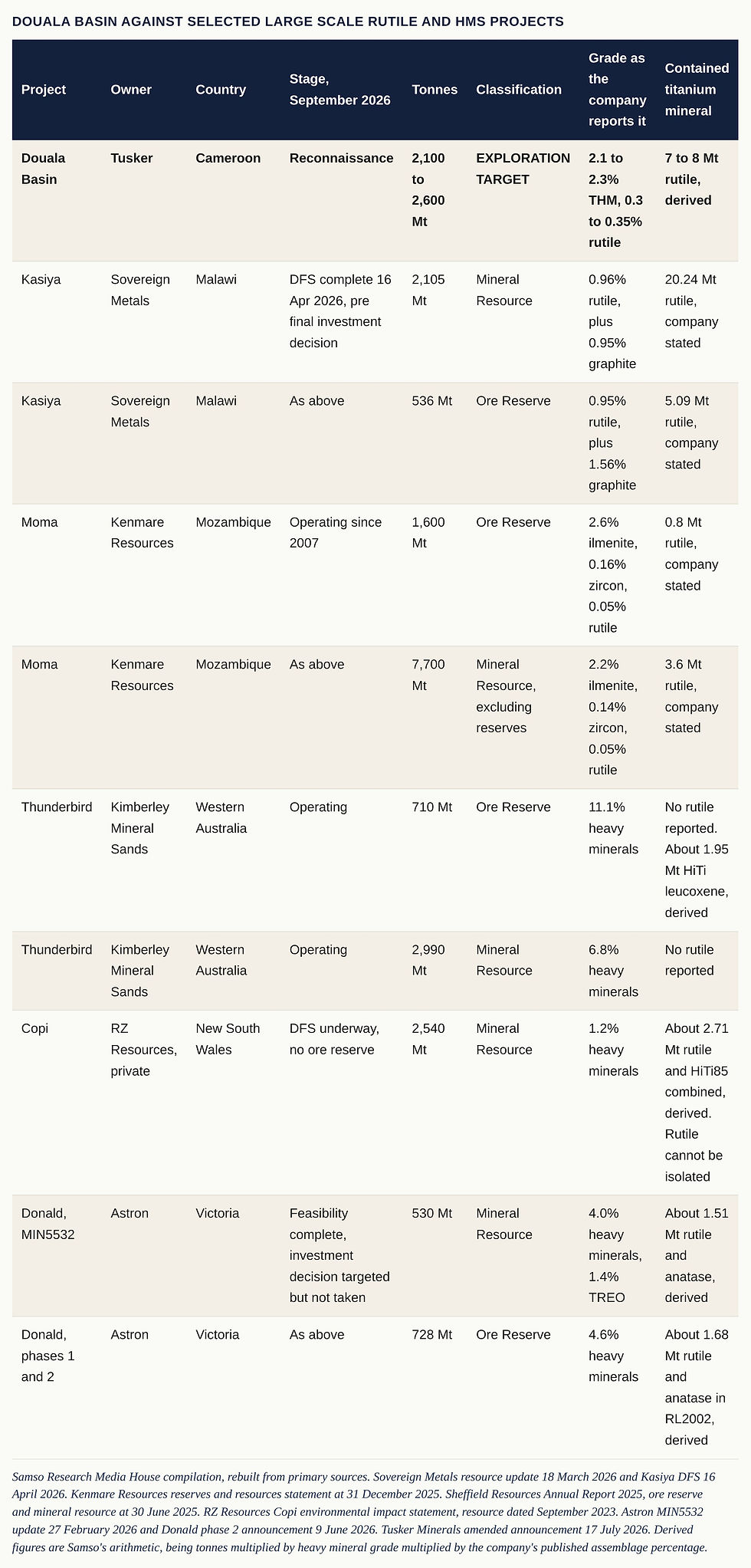
What the table actually shows, and what it cannot
The classification column is the one to read first. Douala is the only exploration target in the set. Every other line is a reported Mineral Resource or Ore Reserve, and four of them belong to projects that are either operating or through feasibility. That is not a like for like comparison and no amount of arranging the rows makes it one.
The category mismatch inside the table matters as much as the one at the top. Kasiya carries 20.24 Mt of contained rutile in its Mineral Resource and 5.09 Mt in its Ore Reserve. That is a fourfold difference for the same deposit, and it is the difference between what is in the ground and what the company has committed to mining. Moma reports its resource excluding reserves, so the two lines add rather than overlap. Copi has no ore reserve at all. Any single number comparison across these projects is choosing between incompatible categories.
The most useful thing in the table is the last column, and it is not the tonnage. Of the six projects, only three report a rutile grade as rutile. Sovereign does, and rutile is the product. Kenmare does, at 0.05 per cent, and rutile is under one per cent of what Moma actually ships. Tusker’s rutile figure is derived from a modelled assemblage rather than measured. Thunderbird reports no rutile at all, only HiTi leucoxene. Copi reports rutile combined with HiTi85 and cannot be split. Donald reports rutile combined with anatase.
So the honest reading is this. On tonnage, Douala sits in the same range as Kasiya, Copi and Donald, and that is real. On grade, it is roughly a third of Kasiya and it is the only figure in the column that is conceptual. And on the assemblage, it is one of the few in the set where a rutile number exists at all, which cuts in the company’s favour, and it has not been drilled out, which does not.
5.3 The comparison that is harsher, and fairer
A mineral sands operation is paid for what it recovers, not for what it digs. So the more useful measure is the in situ grade of minerals someone will actually buy.

Samso Research Media House calculation, using each company’s published assemblage percentages applied to its published heavy mineral grade. Douala’s saleable fraction is taken as rutile at 15 per cent plus zircon at 3 per cent of total heavy minerals, excluding kyanite and ilmenite. Working shown so a reader can check it.

Figure 8. In situ valuable heavy minerals, being the fraction of the rock that has an established market. This is the comparison that decides whether a heavy mineral grade is worth anything. (Samso Research Media House.)
On this measure Douala sits at about half the grade of Kwale's residual reserve, which is the depleted tail of a mine that has already closed, and at about an eighth of Thunderbird and Ranobe.
5.4 A revenue test, with the assumptions named
This calculation is ours and its assumptions are ours. We show it because it is the most direct way to explain why grade matters so much in this business.
Kasiya at full production of 24 million tonnes a year would generate about US$725 million in annual revenue from rutile and graphite together, which is about US$30.20 per tonne of ore mined. Rutile alone is about US$15.45 per tonne of ore. Its operating cost, at US$450 per tonne of product, works out at about US$9.32 per tonne of ore.
Douala at the midpoint grade, rutile only, at the same rutile price, and assuming 80 per cent recovery, which is our assumption and is not sourced from any testwork, gives 2.56 kilograms of rutile per tonne of ore. At US$1,670 a tonne, which is the rutile price the Kasiya definitive feasibility study assumes, that is about US$4.28 per tonne of ore. At Iluka's realised US$1,254 a tonne from Section 4.3 it is about US$3.21.
So gross rutile revenue of US$3.21 to US$4.28 against a benchmark operating cost of US$9.32, before any capital at all. Zircon would add something. Kyanite has no verifiable price at this scale. Recovery may be better or worse than 80 per cent, because no testwork has been done.
We are not saying the project cannot work, and this calculation is not a verdict on it. It is a way of showing why grade decides everything in this business. Run at the modelled target grade with our assumptions, the rutile stream on its own does not clear a benchmark operating cost. Run it at the reconnaissance grades and the picture is different again. Which of those two the deposit actually is has not been established, and that is the open question, not a conclusion.
5.5 Where the market has it priced

The most instructive line in that table is Lion Rock. It holds Cameroon rutile ground adjacent to Tusker’s. It has no JORC resource and no exploration target at all. Its reconnaissance drilling averaged about 0.8 per cent in situ rutile across 107 test locations, which is roughly two and a half times Tusker’s modelled target grade. Tronox holds about 5 per cent of it. The market values it at about 8.5 times Tusker’s market capitalisation.
A reader can take that two ways. Either Tusker is cheap against the nearest thing to a direct peer, or the market has looked at both sets of grades and priced them accordingly. We think the grade difference explains most of the gap, and that the absence of any resource at either company explains why neither is worth more.
It is also worth noting that Tusker’s market capitalisation sits among generic African nano cap explorers rather than among rutile stories. MRG Metals, at a comparable market capitalisation, holds a reported 860 million tonne mineral resource in Mozambique. That is what the market currently thinks a conceptual target is worth.
5.6 On the possibility of a re-rating, and what usually happens
We do not publish price targets and we are not going to start here. But readers of small caps think in multiples of market capitalisation, so we will deal with it directly and with the evidence on both sides.
The precedents exist and two of them are in this exact commodity and country. Peak Minerals, now Lion Rock, rose about 430 per cent during 2025 to a market capitalisation of roughly A$134 million on the Minta rutile discovery, with no resource and no exploration target at the time. Sovereign Metals went from about US$25 million in 2019 to about US$110 million in 2020 and about US$170 million in 2021 as Kasiya was defined, and it held that re-rating.
And DY6, which is this company, rose about 475 per cent through 2025 to a market capitalisation of about A$17 million on the Cameroon acquisition.
That last one is the point. Tusker’s re-rating already happened, and the share price has given back roughly 78 per cent of it from the high. The market capitalisation has fallen less, about half, because shares were issued on the way down. Lion Rock’s share price is down about 70 per cent over twelve months on the same basis. Anyone buying this today for a five bagger is counting on a second re-rating, because the first one has already happened and been given back.
The counterweight has to be stated with equal force, because most explorers do not do this. Strandline Resources went into administration in February 2025, into liquidation in August 2025, and was delisted, after building a mine on a A$150 million government backed facility. Walkabout Resources followed a similar path. Image Resources is down about 76 per cent and Sheffield about 72 per cent, and both are producers. MRG Metals declared a large high grade inferred resource in February 2022 and four and a half years later carries a A$10.5 million market capitalisation. And Sierra Rutile, the world’s largest natural rutile producer, was taken private at about A$76 million. Being the global number one in this commodity did not produce a re-rating. It produced an exit.
Across the names we surveyed for this workup, the scorecard is one sustained re-rating, two five baggers that gave back 70 to 78 per cent within about a year, two total losses, two producers down more than 70 per cent, and one large resource dormant for four years.
This is context for the call. It is not the call.
6 What Would Change Our Mind
What would make us more positive
Infill drilling that repeats the reconnaissance grades over area. This matters more than anything else on the list. The seven reconnaissance holes ran 0.33 to 0.76 per cent rutile across eight intervals, well above the 0.30 to 0.35 per cent modelled target, and they sit outside the target footprint. If systematic drilling turns that into a continuous higher grade zone, the whole assessment above changes, because the argument in Section 5 is against the modelled grade, not against the drilled one.
A maiden JORC Mineral Resource at Douala Basin. A resource with a meaningful Indicated component would move this company out of the conceptual category entirely and make every comparison in Section 5 a fair fight rather than a mismatch. Note the company has guided six to nine months for the exploration work, not for the resource, and has said no assurance can be given that a resource will be defined.
Metallurgical testwork showing good recovery and a saleable rutile specification. There is none. Any result at all is new information.
A kyanite product specification with a named buyer. This would reframe 70 per cent of the assemblage from waste to revenue and it is the highest leverage single item on the list.
Completion of the Green Exploration sale, on time. It funds the drilling without dilution at a record low share price.
Grant of the Central Rutile and Yaounde West permits. Turning applications into ground removes a risk most readers do not know is there.
The questions we cannot answer yet
What follows is not a bear case. We do not have enough to make one, and we are not going to build a verdict out of gaps in the record. These are the questions we would want answered before anyone treats this as more than a watch, set out with the facts we do have and an honest statement of where those facts stop.
Is the modelled grade the real grade? The target is modelled at 0.30 to 0.35 per cent rutile. The seven reconnaissance holes returned 0.33 to 0.76 per cent across eight intervals, and they sit outside the target area. Those two numbers describe different things and we cannot reconcile them from the outside. Systematic drilling will. Until it does, nobody knows which one describes the deposit, and that includes the company.
Does the kyanite have a market? Seventy per cent of the heavy mineral assemblage is kyanite, on the company’s own disclosure, and the company has said its recovery, product quality and commercial potential all remain subject to further testwork and market assessment. No testwork has been published. We have set out in Section 3 what the global kyanite market currently looks like and what the arithmetic implies if the kyanite is not saleable. We cannot tell a reader whether it is, because nobody has tested it.
Will the ground convert, and on what terms? Twenty one Central Rutile permits are applications rather than grants, and the Yaounde West licences had not been announced as granted at the time of writing. Cameroon’s code sets the State’s production share for non precious minerals at 2 to 15 per cent and leaves the rate to negotiation. We do not know when the permits convert or what they will cost when they do.
What happens in Cameroon next? A 93 year old president began a further seven year term in late 2025 after a disputed election, with deaths and arrests in the aftermath and no succession settled. We will not forecast that, and we would be sceptical of anyone who does. Section 4.7 sets out how we think about jurisdiction risk in Africa generally, which is that it is real, permanent, unknowable in direction, and has never by itself been a reason not to look. It sits underneath every asset in the Cameroon portfolio and each reader should size it to their own tolerance.
Does the funding arrive in time? Cash was A$1.35 million at 30 June 2026 against roughly A$5.1 million of all in spending over the prior twelve months. The Green Exploration sale to AuKing is binding but had not completed, with a long stop date of 30 September 2026. Whether it completes on time, and what the company does if it does not, are both unknown to us today.
What does the metallurgy say? There is no published metallurgical testwork on any Tusker asset. Not at Douala Basin, not at Central Rutile, not at Mzimba. Testwork commissioned at Tundulu in April 2025 was never reported on publicly. Recovery and product specification are what turn a grade into revenue, and we have nothing to work with on either.
Has the strategy settled? The company has changed what it is twice in three years and has sold or agreed to sell almost everything it listed with in 2023. Whether that reads as a company that found its focus or a company still looking for it is a fair question, and we do not think three years of history is enough to answer it either way.
Every one of those is answerable. None of them is answered today. That is the reason for the call in Section 8, and it is the whole reason for it.
The settling event
Of all of those questions, one event answers the one that matters most. The maiden JORC Mineral Resource at the Douala Basin project.
There is no date to put on it. The company has guided approximately six to nine months from July 2026 for the exploration activities that test the target, being drilling, density work, metallurgy and modelling, subject to permitting and assay turnaround. It has not guided a date for a resource, and it has said in terms that no assurance can be given that one will be defined. So the earliest a resource could realistically follow is some time after the first half of 2027, and it may not come at all. Assay results in the last two quarters have also run later than flagged.
The Green Exploration completion on 30 September 2026 is nearer and more binary, and it matters, but it settles whether Tusker can afford to keep going rather than whether the deposit is worth going after. That is why it sits in the watch list rather than under the call.
7 Management and the DNA Question
The question Samso always asks is whether the people running a company have taken something the whole way before. On this board the answer is narrow but not empty.

Plate 1. The Tusker Minerals board and senior technical team as at the time of writing. Daniel Smith, Myles Campion, John Kay, Dr Nannan He, Cliff Fitzhenry and Troth Saindi. Source. Portraits from the company website, tuskerminerals.com, About Tusker Minerals page, accessed 2 September 2026. Panel assembled by Samso.
Nobody on this board has taken a project to financing or production. Two people have taken one a long way, and neither did it as the accountable decision maker at Tusker’s level.
Cliff Fitzhenry, chief executive since July 2025. MSc and BSc Honours from the University of KwaZulu-Natal, registered professional natural scientist, based in South Africa. About twenty years of exploration, principally in Africa. He was senior geologist at Sovereign Metals leading in country exploration on Kasiya, which became the world’s largest natural rutile deposit. That is the strongest technical credential on the team and it is exactly on point, because the deposit style and the analogue are the same ones Tusker is chasing. The qualification is that he was the geologist, not the person who financed or developed it, and there is no evidence he has run a company through a resource, a study or a financing.
Daniel Smith, executive chairman since November 2022. A capital markets and governance professional who founded the Perth corporate services firm Minerva Corporate in 2013 and has been involved in more than a dozen listings across the ASX, AIM and NSX. He holds board or company secretarial roles at a number of other small caps. Across that record we found no instance of a project taken to resource, study, financing or production under his stewardship. Company formation, listing and board service across many small explorers at once is a real skill. It is not development experience, and readers should understand the difference.
Myles Campion, non executive director since March 2023. MSc from the Royal School of Mines, thirty years across exploration geology and fund management, including project geologist work at LionOre on the Emily Ann nickel mine. This is the one genuine credential of the type we are looking for. As executive chairman and chief executive of Europa Metals he took the Toral zinc, lead and silver project in Spain through a JORC resource, a resource upgrade and a scoping study.
We report the outcome as well, because that is the point of asking the question. Europa did not take Toral further. It sold the project to Denarius Metals in 2023, spent six months looking for a replacement asset, found candidates but did not secure funding for a reverse takeover, was suspended from AIM in May 2025 and resolved to return its assets to shareholders. That is a failure to finance rather than a governance failure, and it is directly relevant to a company whose plan requires funding a drill out.
John Kay, non executive director and company secretary. A corporate and commercial lawyer, co-founder of the advisory firm Arcadia Corporate, with seventeen years or more in equity capital markets and resources. Corporate function, no technical background, no development record.
Dr Nannan He, non executive director. PhD in geochemistry from Curtin, degrees from Hokkaido and Jilin universities, and manages an investment vehicle looking at exploration and resource projects. Technically qualified, but the role is investment rather than delivery. We note that Zhenshi Group, a Hong Kong composite materials group, was a A$1.5 million cornerstone investor at the 2023 IPO and remains a substantial holder. We could not source any employment or nominee relationship between Dr He and Zhenshi, and we are not asserting one.
Troth Saindi, exploration manager for Africa. MSc from the University of the Witwatersrand, registered competent person, and seventeen years spanning exploration through to production, including a decade as group geologist at Bushveld Minerals while it was an operating vanadium producer. Genuine production side exposure is rare on a team this size and it is a real positive.
The piece of history that answers the question best
In August 2023 the company hired Lloyd Kaiser as chief executive. He had ten years at Arafura Rare Earths, as general manager of sales and marketing negotiating rare earth offtakes and as general manager of technology and engineering on the Nolans Bore project. He was the one executive with downstream development and offtake experience. He was gone by July 2025, replaced by an exploration geologist, and the project he was hired to develop was agreed for sale in August 2026.
That is not a criticism of Cliff Fitzhenry, who is well suited to what this company now does. It is an observation about what this company decided it was. It went from trying to develop something to trying to find something. Those need different people and Tusker changed its people accordingly. Whether that was the right decision is exactly the argument this workup leaves open.
8 Samso Concluding Comments
SAMSO CALL: WATCH AND DYOR
The settling event we are watching is the maiden JORC Mineral Resource at the Douala Basin project.
There is a version of this story that is very easy to tell. A tiny company with an A$8 million market capitalisation is sitting on a multi billion tonne titanium target, within about 40 kilometres of a deep water port, in a country that produced high purity rutile eighty years ago and has barely been looked at since. The world’s largest rutile mine has been taken private and no longer reports. A producing mine in Kenya has closed. Nobody is building new supply. Tell it that way and you do not need a spreadsheet.
We do not think that version is dishonest. We think it is incomplete, and the missing part is not a counter-argument. It is a list of things nobody knows yet.
We do not know whether the modelled grade of 0.30 to 0.35 per cent or the reconnaissance grades of 0.33 to 0.76 per cent describe this deposit. We do not know whether the kyanite, which is seventy per cent of the assemblage, is product or waste, because it has not been tested. We do not know when the flagship permits convert from applications to grants, or on what fiscal terms. We do not know what the metallurgy says, anywhere in the portfolio, because none has been published. We do not know whether the Malawi sale completes by 30 September. And we will not pretend to know what happens next politically in Cameroon.
Set against that, the thing that keeps us interested is small but it is real. The seven reconnaissance holes came in at up to two and a half times the modelled grade, and they were drilled outside the target area. Either the target understates the deposit or those holes are the good bits. Nobody knows yet, including the company, and that is precisely why it is worth watching rather than acting on.
So the call is Watch and DYOR. Not because the story is bad, and not because we are hedging. Because the single number this entire proposition rests on, the grade over area, has not been established. The work that tests it is guided at six to nine months. A resource, if one comes at all, sits somewhere beyond that, and the company has been careful not to promise it.
What we would say to a reader is this. If you already own it, the near term question is not the grade, because the grade will not be settled for months. It is whether the company can fund itself as far as the resource. Watch 30 September. If you do not own it and the scale is what draws you, understand that what you are buying today is a conceptual number rather than an established one, and that the nearest comparable in the same country, on better reconnaissance grades and with no resource either, has still lost about 70 per cent of its value this year. Make of that what you will. We are not going to tell you what it means.
Look at the facts. Take a balanced view. And then decide for yourself whether the drilling that comes next is worth waiting for.
9 Disclaimer
The information contained in this Samso Research workup is general in nature and does not take into account the objectives, financial situation or needs of any particular person. It is not financial product advice. Figures are drawn from public sources believed reliable at the stated dates and are not guaranteed. Market sensitive numbers change daily. Readers should seek professional advice before making any investment decision.
 The Samso Way – Seek the ResearchHere at Samso, we pride ourselves on delivering content for investors that is independent and informed by over three decades of experience in the industry. Our content is well-researched and is only created if I see merit in discussing the company's story. Our mission is simple. Cut through the noise and spotlight what matters. Genuine stories, grounded insights, and real opportunity. Investors can explore our four core platforms:
There may be numerous paths to success in investing, but the common thread among successful individuals is that they remain committed to making informed decisions. Equip yourself with the right knowledge and tools, and you will be well on your way to achieving your financial goals. The Samso Philosophy: Stay curious. Stay sharp. And remember, digging deeper always uncovers the real value. Happy Investing, and the only four-letter word you need to know is DYOR. DisclaimerThis Samso Research Workup is independent research commentary for general information only. Nothing in this document is financial product advice, and it does not take into account any reader’s objectives, financial situation or needs. Figures are drawn from public sources believed reliable at the stated dates but are not guaranteed. Market-sensitive numbers change daily. Samso or associated parties may hold positions in, or have commercial arrangements with, companies mentioned. Seek professional advice before making investment decisions. About SamsoSamso is a trusted platform that equips dedicated investors with up-to-date industry knowledge and insights from top CEOs and thought leaders. Samso Research | www.samso.com.au | An Investor Lens on ASX-Listed Companies |


Comments