

The Manganese Market, Where the Price Has Been, Where Demand Is Headed, and the Distance Left for the Explorers

Updated: 10 hours ago
Manganese has traded in a band for a decade while steelmakers quietly consumed almost all of it. A small, unproven battery-chemistry demand story is now attached to that steel story. On the ASX, a handful of companies sell the actual product and report the revenue. Most do not, yet, though selling the product has not meant an easy margin for everyone who does. One of the two producers covered here reported a manganese division earning barely 5% EBITDA margin over the past half, a reminder that scale alone is not the same as a good return. This Insight sets out the price history, the demand case, and the distance between the two groups, measured in tonnes sold and dollars earned rather than in resource estimates alone.

Samso Insights | Investor Education | Manganese - Bulk Commodity | Samso Investing Series |
Samso Research · Samso Insights · samso.com.au


1.00 —WHY MANGANESE COUNTS, AND WHO SUPPLIES IT
Manganese is a grey-white metal that does not occur naturally in pure form and is never mined on its own as a finished metal. It is mined as ore, refined into a ferroalloy, and added to almost every tonne of steel made anywhere in the world. According to the United States Geological Survey (USGS), more than 90% of manganese consumption goes into steelmaking, where it removes sulphur and oxygen impurities during the smelting process and adds strength and wear resistance to the finished alloy.
There is no substitute for manganese in steel production at any price the industry has tested. That single fact, more than any other, explains why the manganese market behaves the way it does. Demand tracks the global steel cycle closely, and supply is dominated by a small number of very large deposits.
Global manganese ore production in 2025 was concentrated in seven countries, on a manganese-content basis, per the USGS Mineral Commodity Summaries 2026. TABLE 01 sets out each country's tonnage side by side.

South Africa's Kalahari Manganese Field, in the country's Northern Cape province, and Gabon's Moanda district together account for roughly half of the world's mined tonnage. Australia's contribution comes almost entirely from a single deposit, Groote Eylandt, an island in the Northern Territory's Gulf of Carpentaria that is home to the Groote Eylandt Mining Company (GEMCO) operation.
FIG. 01 sets out this country-by-country production picture geographically and locates the named mine sites discussed through the rest of this piece.

FIG. 01 — World manganese ore production by country, 2025e, and the named mine sites discussed in this piece. Original Samso illustration of sourced data. Production figures from USGS, Mineral Commodity Summaries 2026 (manganese-content basis, 2025 estimate). Base map from Natural Earth.
An investor reading company announcements should keep this concentration in mind. A handful of deposits, controlled by a handful of companies, set the tonnage and cost curve for the whole seaborne market. Nothing an ASX-listed explorer does changes that curve until it is actually shipping ore at a scale large enough to register against those numbers, which for most of the companies covered in Section 6 of this piece is still some years away.
2.00 —TEN YEARS OF PRICE
FIG. 02 tracks the annual average 44% Mn CIF China price, the industry's standard reference point, across the ten years from 2016 to 2025. That price is manganese ore assaying 44% manganese content, delivered Cost, Insurance and Freight (CIF) to a Chinese port, and quoted in US dollars per dry metric tonne unit (US$/dmtu), where one dmtu equals 1% manganese content in one dry tonne of ore.
The data for 2016 to 2024 comes from USGS Minerals Yearbook and Mineral Commodity Summaries editions, which in turn report figures compiled by CRU Group. The 2025 figure is USGS's own estimate and is not yet a finalised annual number.

FIG. 02 — 44% Mn CIF China ore price, annual average, 2016 to 2025. Original Samso illustration of sourced data. Sourced from USGS Minerals Yearbook (Manganese), 2018 and 2023 editions, and USGS Mineral Commodity Summaries, 2025 and 2026 editions. 2025 figure is a USGS estimate. Overlaid with the reported 2024 intra-year trading range, Fastmarkets high-grade manganese ore index, CIF Tianjin, as reported by Fastmarkets (a separate, higher-frequency index not directly comparable to the USGS annual average).
Read as a ten-year run, the price has moved in a band roughly between US$4.34 and US$7.16/dmtu on the USGS annual-average series, with no clear sustained trend up or down. It opened the period at US$4.34/dmtu in 2016, climbed through 2017 and 2018 to a decade high of US$7.16/dmtu, then gave almost all of that gain back by 2020 as global steel demand weakened.
It has spent most of the years since inside a narrower band around US$4.50 to US$6.00/dmtu, with the USGS estimate for 2025 sitting at the lower end of that range, US$4.50/dmtu.
The one point that departs from this picture is 2024, and it is worth explaining why the chart shows it differently from the other years. The USGS annual-average figure for 2024, US$5.53/dmtu, sits comfortably inside the ten-year band. But a separate, more frequently updated index published by Fastmarkets, tracking high-grade manganese ore delivered CIF Tianjin, reported an intra-year trading range across 2024 of roughly US$3.91 to US$9.01/dmtu, a swing of more than double from low to high within a single calendar year.
The two figures are not directly comparable, because the USGS number is an annual average smoothing the whole year, while the Fastmarkets figure captures the peaks and troughs of a market that saw a genuine supply scare in 2024, when flooding damaged rail infrastructure serving South Africa's Northern Cape mining region and disrupted shipments from one of the world's two largest supply regions.
Prices spiked sharply on the disruption and fell back once shipments normalised. Investors reading a single annual-average price point risk missing how volatile the underlying trading conditions actually were.
The South African rail disruption was not the only supply loss that year. GEMCO, the Groote Eylandt operation that supplies almost all of Australia's manganese and is covered in detail in Section 5, suspended operations entirely in March 2024 after Tropical Cyclone Megan brought close to 600 millimetres of rain over a single weekend and damaged the wharf the mine uses to load ore for export.
South32, GEMCO's majority owner and operator, did not resume export sales from the site until 19 May 2025, following a wharf rebuild the company says involved more than 317,000 hours of work and the removal of close to 1,700 tonnes of steel and concrete debris from the seabed. Sales were not expected to return to normalised rates until the 2026 financial year.
For more than a year, the market lost one of the two operations discussed in this piece that ship manganese ore at genuinely large scale, at the same time as the South African rail network was constrained.
South32 gave its own view of where the price goes from here in a May 2026 investor presentation, telling the market it expects the long-term price to be set by higher-cost, marginal South African supply that is progressively moving underground over time. That is a company's own forward-looking view, not an independent forecast, and South32 has an obvious interest in a constructive pricing outlook given its own exposure to the commodity, but it is worth weighing against the decade-long price band in FIG. 02 all the same.
3.00 —WHERE DEMAND IS HEADED
The starting point for any manganese demand forecast is steel, because steel is where the demand already sits. Global crude steel production, tracked by the World Steel Association (worldsteel), grew from 1,626 million tonnes in 2015 to a peak of 1,963 million tonnes in 2021, before easing back to 1,849 million tonnes in 2025, plotted in FIG. 03a. That is a market that has grown over the decade but is not growing in a straight line, and it is the single largest driver of manganese demand by a wide margin.

FIG. 03 — (a) World crude steel production, 2015 to 2025. (b) Manganese ore end-use split, 2024. Original Samso illustration of sourced data. Steel data sourced from World Steel Association, World Steel in Figures 2026. End-use split sourced from International Manganese Institute (IMnI), 2024 Annual Review, ore-consumption basis. The USGS states steel's global share as "more than 90%," while the two industry bodies use different underlying bases for the calculation, which is why the figures differ.
On the International Manganese Institute's own figures, set out in FIG. 03b, steel alloys accounted for roughly 96% of manganese ore consumption in 2024, with battery materials at roughly 3% and agriculture (manganese is also a micronutrient used in fertiliser) at roughly 1%. The USGS states the steel share more simply as "more than 90%" of global manganese use. The two bodies calculate the split on slightly different bases, which is why the numbers are not identical, but both agree the story is overwhelmingly a steel story today.
The demand narrative that is newer, and that gets far more attention in investor presentations than its current 3% share of the market would suggest, is battery-grade manganese. High-purity manganese sulphate monohydrate (HPMSM) is a refined manganese chemical used to make cathode material for lithium manganese iron phosphate (LMFP) batteries, a lower-cost electric-vehicle battery chemistry that some manufacturers are pursuing as an alternative to nickel-cobalt-manganese (NCM) chemistries.
Several of the ASX-listed companies covered later in this piece, most notably Firebird Metals, are explicitly targeting this HPMSM market rather than the traditional ore-and-alloy trade. It is not only small explorers making that bet. South32, the diversified major discussed at length in Section 5 for its GEMCO ore business, is also developing an early-stage battery-grade manganese deposit of its own, at a project unrelated to GEMCO, and Section 5 covers what that project is and is not yet.

4.00 —AUSTRALIA'S OWN MANGANESE GEOGRAPHY
Australia's manganese production is smaller than South Africa's or Gabon's in absolute terms, but it is genuine production, not a resource story. Two operations account for essentially all of the country's current mined tonnage.
GEMCO, on Groote Eylandt in the Northern Territory's Gulf of Carpentaria, is majority-owned and operated by South32 and is one of the largest manganese mines in the world by tonnage. Bootu Creek, in the Barkly region of the Northern Territory and owned by OM Holdings, was a working mine until December 2021 and has been on care and maintenance since. PLATE 01 shows part of the site today, and Section 5 covers what that means for OM Holdings' current business in detail.

PLATE 01 — The GoGo and Xhosa waste rock dumps at Bootu Creek, looking south east, photographed during rehabilitation works. Reproduced from OM Holdings Limited, Annual Report 2025 (year ended 31 December 2025), "Bootu Creek Mine Operational Review," Figure 4, page 21.
Beyond these two, Western Australia's Pilbara region hosts the bulk of the country's manganese exploration and development activity, discussed company by company in Section 6. Element 25's Butcherbird project, Firebird Metals' Oakover project, Black Canyon's Balfour Manganese Field and Wandanya project, and Accelerate Resources' Woodie Woodie North project all sit within a few hundred kilometres of one another in the same broad geological province.
This province is distinct from and unrelated to the older, established Woodie Woodie mine operated by a separate company, Consolidated Minerals (ConsMin). FIG. 04 maps these Northern Territory and Western Australian sites together.

FIG. 04 — Australia's manganese producers and developers, Northern Territory and Western Australia Pilbara sites discussed in this piece. Original Samso illustration of sourced data. Site positions on this map are schematic and may not reflect each deposit's exact location. WA Pilbara sites are positioned from company-disclosed distances and bearings from Newman and Marble Bar (see References), not survey-grade coordinates. Site locations compiled from company ASX announcements and project pages cited in Sections 5 and 6.
5.00 —THE PRODUCERS, SELLING THE PRODUCT
Three ASX-listed names are covered here because each one currently converts manganese into reported revenue, though the way each does so differs enough that lumping them together as "producers" without qualification would flatten an important distinction. TABLE 02 summarises the three companies side by side, and the paragraphs below explain the differences the table alone cannot show.
South32 Limited (ASX: S32) is a diversified major miner, and manganese is one of several commodities in its portfolio rather than its sole focus. Its Australia Manganese division, built around GEMCO, produced 3,031 thousand wet metric tonnes (kwmt) and sold 3,598 kwmt in the year to 30 June 2026, at an average realised price of US$4.23/dmtu FOB, per the company's June 2026 quarterly report.
South32 also holds an equity interest in South Africa Manganese. Across the six months to 31 December 2025, the combined Manganese segment (Australia and South Africa) reported underlying revenue of US$473 million, of which Australia Manganese contributed US$306 million at an EBITDA (earnings before interest, tax, depreciation and amortisation) of US$107 million, and South Africa Manganese contributed US$167 million at a considerably thinner EBITDA of US$8 million.
Manganese is a meaningful but not dominant slice of a group that reported US$4,008 million in total underlying revenue for the same half. South32's market capitalisation was approximately A$17.46 billion as at 1 July 2026.
Those FY26 Australia Manganese figures describe a mine recovering from an extended shutdown, not a steady multi-year run rate, and Section 2 sets out why. GEMCO was shut entirely between the cyclone damage of March 2024 and the resumption of export sales on 19 May 2025, so FY26 is the first full financial year of the ramp back towards normal shipping volumes, and South32's own cost-analysis disclosure attributes part of the half-on-half increase in the group's cost base directly to Australia Manganese "returning to normalised production rates."
South32 also holds a second, much smaller manganese asset with nothing to do with GEMCO or the ore-and-alloy trade described elsewhere in this piece. Clark, part of the company's Hermosa project in Arizona, is described by South32 as a co-located battery-grade manganese deposit with demonstrated capability to produce HPMSM for North American customers. PLATE 08 shows the Clark exploration site, where an exploration decline (an underground access tunnel driven for sampling and study purposes, not yet a production mine) was completed in the June 2026 quarter.
Clark remains at an early stage relative to GEMCO, with no production, Ore Reserve or production-start timeline yet disclosed, but its existence is a reminder that even the industry's most conventional ore producers are positioning for the battery-demand story from Section 3, not only the ASX-listed explorers.
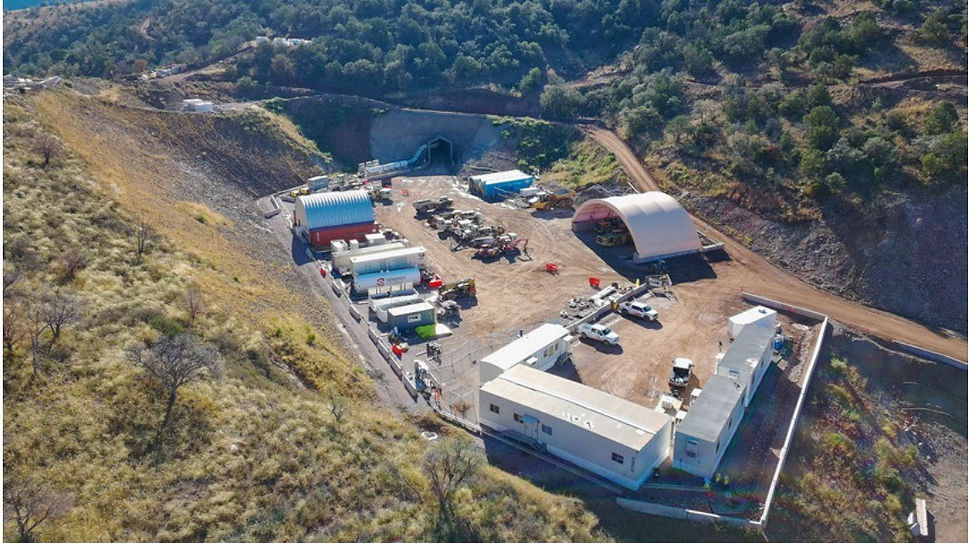
PLATE 08 — The Clark deposit exploration site at South32's Hermosa project, Arizona, described by the company as a co-located battery-grade manganese deposit. Reproduced from South32 Limited, "2026 Half Year Financial Results," investor presentation, 12 February 2026, page 27.
Jupiter Mines Limited (ASX: JMS) is a more direct manganese play, but its own financial statements can mislead an investor who does not read the structure carefully. Jupiter holds a 49.9% beneficial interest in the operating entity behind the Tshipi Borwa mine in South Africa's Kalahari Manganese Field, one of the largest and lowest-cost manganese operations in the world.
Tshipi itself, on a 100% basis, produced 966,183 tonnes and sold 943,740 tonnes in the June 2026 quarter, generating quarterly EBITDA of A$34.2 million and net profit after tax of A$21.4 million at an average FOB cash cost of production of US$2.48/dmtu, a genuinely low cost base.
But Tshipi is equity-accounted rather than consolidated into Jupiter's own accounts, so Jupiter's own reported parent-company revenue is comparatively small, A$4.3 million for the six months to 31 December 2025, mostly marketing-fee income from handling Jupiter's 49.9% marketing share of Tshipi's output (A$9.3 million for the full 2026 financial year). An investor reading only Jupiter's headline revenue line without understanding this structure would badly understate the scale of the underlying operation Jupiter is exposed to.
Jupiter's market capitalisation was approximately A$521 million as at 31 July 2026. PLATE 02 shows the mine's location and its rail and port links to the coast.

PLATE 02 — Tshipi Manganese Mine, regional rail lines and port locations, and other mines of the Kalahari Manganese Field (inset). Reproduced from Jupiter Mines Limited, Q4 FY2026 Quarterly Activities Report, 31 July 2026, Figure 1, page 7.
OM Holdings Limited (ASX: OMH) is the case that most needs unpacking, because on the surface it looks like a manganese miner and, in practice, it no longer is one. OMH's Bootu Creek mine in the Northern Territory has been on care and maintenance since January 2022, and a 2024 to 2025 trial to reprocess Bootu Creek's low-grade stockpiles through an on-site plant achieved only partial success (30 to 33% manganese content against a 35% target) before the site was returned to care and maintenance again in 2025.
OMH's FY2025 annual report shows the company exported just 10,546 tonnes of manganese product that year, drawn down from existing stockpiles rather than fresh mining, a fraction of the 191,696 tonnes it exported in FY2022 and the 697,328 tonnes it exported in FY2021.
OMH's current business is overwhelmingly a smelting and trading operation, not a mining one. Its Sarawak, Malaysia ferroalloy smelter produced 191,087 tonnes of ferrosilicon and 311,791 tonnes of manganese alloys in FY2025 at 95.9% average furnace utilisation, and the company's FY2025 group revenue of US$636.3 million was generated almost entirely through its Marketing & Trading segment (US$535.5 million) and Smelting segment (US$100.7 million), with essentially no external revenue booked to the Mining segment.
OMH also fully exited its remaining stake in Tshipi during this period, selling its 26% interest in Ntsimbintle Mining Pty Ltd (representing an effective interest of roughly 13% in Tshipi Borwa) to Exxaro Resources for approximately ZAR 1.86 billion, a transaction that completed on 27 February 2026.
OMH's market capitalisation was approximately A$168 million as at 13 July 2026. PLATE 03 shows the Samalaju smelter in operation, the business that now accounts for almost all of OMH's revenue.

PLATE 03 — The stoking process at the Samalaju ferroalloy smelting complex, Sarawak, Malaysia. Reproduced from OM Holdings Limited, Annual Report 2025, "Processing and Smelting Operational Review: Samalaju Smelting Complex," page 14.


6.00 —THE EXPLORERS, THE DISTANCE STILL TO TRAVEL
None of the four companies in this section currently generate meaningful revenue from selling manganese. Each is at a different stage of the path from exploration to production, and the differences between those stages, set out in TABLE 03, are the point of this section.
Element 25 Limited (ASX: E25) is the most advanced of the four, and does not fit neatly into either the producer or explorer category. It has a trading history. Its Butcherbird project in the WA Pilbara generated real, if modest and loss-making, manganese sales in the recent past, A$1.88 million in revenue in FY2025 against A$5.36 million in cost of sales, down sharply from A$13.3 million in revenue the prior year, as its small-scale legacy operations wound down. PLATE 06 shows ore being loaded during that Stage 1 pilot phase.

PLATE 06 — Manganese ore loadout during Stage 1 pilot operations at Butcherbird. Reproduced from Element 25 Limited, "Building a Global Manganese Business," Investor Update presentation, July 2026, page 7.
The company is now building a much larger operation. A January 2025 Feasibility Study underpins a stated Ore Reserve of 101.4 million tonnes at 10.4% manganese (10.54 million tonnes of contained manganese), targeting production of 1.1 million tonnes per annum over an 18-plus year mine life.
Construction is underway, backed by an approved A$50 million debt facility from the Northern Australia Infrastructure Facility (NAIF), with commissioning targeted for the first quarter of 2027. PLATE 07 shows the logwasher, the first major item of processing equipment for the expanded plant, having arrived at the Port of Fremantle by the time of the company's July 2026 investor presentation.

PLATE 07 — The logwasher, the first main item of the Butcherbird Expansion Project's process plant, arriving at the Port of Fremantle after shipment from its German manufacturer. Reproduced from Element 25 Limited, "Building a Global Manganese Business," Investor Update presentation, July 2026, page 10.
On 3 August 2026, Element 25 announced a binding, take-or-pay offtake agreement with OM Materials (S) Pte Ltd, a subsidiary of OM Holdings, the same company discussed in Section 5, covering 100% of the manganese concentrate to be produced from the expanded operation for an initial five-year term with an option to extend for a further five years.
The agreement gives Element 25 a contracted buyer for the expanded project's output on market-linked pricing, though it remains subject to conditions precedent, including board approval and the NAIF project financing becoming unconditional. Element 25's market capitalisation was approximately A$75 million as at 13 July 2026.
Firebird Metals Limited (ASX: FRB) holds the Oakover project in the WA Pilbara and is explicitly pursuing the battery-chemistry demand story described in Section 3, aiming to build a vertically integrated business from ore through to HPMSM (battery-grade manganese sulphate). Its JORC Mineral Resource, last upgraded in March 2023, stands at 176.65 million tonnes at 9.9% manganese, including 105.78 million tonnes in the higher-confidence Indicated category.
The company completed a Scoping Study on the Oakover deposit's DMS concentrate in August 2023. A later study, reported in May 2024, covered a proposed downstream plant in China that would convert manganese ore into battery-grade manganese sulphate, with a projected capital cost of US$83.5 million for a first-stage capacity of 50,000 tonnes a year of manganese sulphate plus 10,000 tonnes a year of manganese tetraoxide.
That later study addresses the China processing plant rather than mine development at Oakover itself, and Samso found no evidence of a Pre-Feasibility or Definitive Feasibility Study covering the Oakover deposit as at the time of writing. Firebird has no current manganese sales revenue. Its market capitalisation was approximately A$31 million as at 24 July 2026.
Black Canyon Limited (ASX: BCA) holds the largest resource base of the four, spread across roughly 2,000 square kilometres of tenure in the Pilbara. Its Balfour Manganese Field carries a stated Mineral Resource, as at October 2025, of 315 million tonnes at 10.5% manganese (33.1 million tonnes of contained manganese).
That resource splits across several sub-deposits, including KR1 and KR2 (a combined 104 million tonnes at 10.3% manganese), Flanagan Bore (171 million tonnes at 10.3% manganese) and Balfour East and Damsite (40 million tonnes, entirely in the lower-confidence Inferred category, at 11.9% manganese).
Black Canyon completed a Scoping Study covering the KR1 and KR2 deposits in July 2024, modelling a 16-year mine plan and putting total project capital expenditure at approximately A$84 million, a figure the company itself named as a funding requirement well above its current market capitalisation of approximately A$50 to A$63 million (the range reflects two data points from different dates in mid-2026).
Samso found no evidence of a subsequent Pre-Feasibility or Definitive Feasibility Study for Black Canyon's manganese projects as at the time of writing. Black Canyon has no current manganese sales revenue. PLATE 04 shows the company's own site layout for the KR1 and KR2 deposits, the most advanced part of the Balfour field.

PLATE 04 — Proposed site layout for the KR1 and KR2 deposits, tenement E46/1383, Balfour Manganese Field. Reproduced from Black Canyon Limited, Balfour Manganese Field project page, blackcanyon.com.au, accessed August 2026.
Accelerate Resources Limited (ASX: AX8) is the earliest-stage of the four and the smallest by market capitalisation, approximately A$7 million as at 31 July 2026. Its Woodie Woodie North project in the Pilbara, unrelated to the established Woodie Woodie mine operated by a separate company, carries an Inferred Mineral Resource of just 1.2 million tonnes at 19.1% manganese, a comparatively high grade.
The project also carries a non-JORC Exploration Target of 5.3 to 10.7 million tonnes at 10 to 19% manganese, a figure that under the JORC Code is explicitly not a resource estimate and should not be treated as one.
Recent rock-chip sampling has returned assays as high as 59.3% manganese from surface targets the company describes as untested by drilling. Accelerate Resources has no current manganese sales revenue and no Scoping Study, Pre-Feasibility Study or Definitive Feasibility Study on this project. PLATE 05, the company's own tenement map, marks its distance from the older, unrelated Woodie Woodie mine to the south.

PLATE 05 — Woodie Woodie North Manganese Project tenement map, East Pilbara, showing the manganese corridor and, to the south, Consolidated Minerals' unrelated, established Woodie Woodie mine. Reproduced from Accelerate Resources Limited, Woodie Woodie North Manganese Project page, ax8.com.au, Figure 1, accessed August 2026.

7.00 —THE GAP, MEASURED
Set the two groups side by side and the gap is not a matter of degree, it is a difference in kind. South32's Australia Manganese division alone sold 3.6 million tonnes of ore in a year. Jupiter Mines' Tshipi interest sold nearly a million tonnes in a single quarter.
Between them, the explorers and developers covered in Section 6 sold effectively zero tonnes of manganese in the same period, Element 25's small legacy sales aside. The revenue gap follows the same pattern, hundreds of millions of dollars a year at South32's Manganese segment, tens of millions at Jupiter Mines' underlying Tshipi interest, and, for the four explorers combined, a rounding error, set out measure by measure in TABLE 04.

None of this means the explorers are wrongly priced, or that the producers are the only sensible way to gain exposure to manganese. A resource in the ground that a company has not yet mined carries genuine optionality. If the price moves, if a study proves the economics up, or if a partner or a debt facility de-risks the funding, an explorer's share price can move a great deal faster than a large diversified producer's.
Element 25's move from a struggling small-scale miner to a funded, under-construction 1.1Mtpa project inside two years is exactly that kind of re-rating in progress. Its 3 August 2026 binding offtake agreement with OM Materials is the latest step in that de-risking, giving lenders a contracted buyer to point to before construction is even complete.
But optionality is not revenue, and a JORC Mineral Resource, however large the tonnage, is not a sale.


References & sources
Figures marked VERIFIED were read by Samso directly from the primary source document listed. Figures marked AS REPORTED were sourced from a secondary source (a data aggregator, a news service, or a regulatory-filing mirror) that Samso was not able to independently cross-check against the primary company document. The secondary source is named in each case. Manganese-market-wide figures (world production, price history, steel demand, end-use split) are credited to the named industry bodies (USGS, worldsteel, IMnI) throughout. FIG. 01 to FIG. 04 are original Samso illustrations built from the sourced data listed in each caption, not reproductions of a single published chart. PLATE 01 to PLATE 08 are real photographs and maps reproduced directly from the named company document or company website, each credited to its document, figure number and page, or accessed date, in its own caption, and none has been redrawn or altered by Samso beyond cropping to isolate the figure.
USGS, "Mineral Commodity Summaries 2026: Manganese," US Geological Survey, February 2026. VERIFIED
USGS, "Mineral Commodity Summaries 2025: Manganese," US Geological Survey, 2025. VERIFIED
USGS, "Minerals Yearbook: Manganese," 2018 and 2023 editions, US Geological Survey. VERIFIED
Fastmarkets, high-grade manganese ore index, CIF Tianjin, 2024 trading range as reported. AS REPORTED
World Steel Association, "World Steel in Figures 2026." VERIFIED
International Manganese Institute (IMnI), "2024 Annual Review," manganese ore end-use split. VERIFIED
South32 Limited, "Quarterly Report: June 2026," 20 July 2026, distributed via Investegate (RNS regulatory mirror). AS REPORTED
South32 Limited, "2026 Half Year Financial Results," investor presentation, 12 February 2026, including the Clark deposit exploration site photograph (page 27), reproduced as PLATE 08. VERIFIED
South32 Limited, "Strategy and Business Update," investor presentation, 12 May 2026. VERIFIED
South32 Limited, "Export sales resume at GEMCO," company news release, south32.net, 19 May 2025. VERIFIED
Engineering News, "South32 suspends operations at Groote Eylandt," 18 March 2024. AS REPORTED
Jupiter Mines Limited, "Q4 FY2026 Quarterly Activities Report," 31 July 2026, including Figure 1 (page 7), reproduced as PLATE 02. VERIFIED
Jupiter Mines Limited, "Interim Financial Report and Appendix 4D," 27 February 2026, as reported by TipRanks. AS REPORTED
OM Holdings Limited, "Annual Report 2025" (year ended 31 December 2025), lodged with ASX 22 April 2026, including Figure 4 (page 21), reproduced as PLATE 01, and the Samalaju smelting complex photograph (page 14), reproduced as PLATE 03. VERIFIED
Element 25 Limited, "Annual Report" (year ended 30 June 2025), lodged with ASX 25 September 2025. VERIFIED
Element 25 Limited, "Building a Global Manganese Business," Investor Update presentation, July 2026, including the Stage 1 pilot ore loadout photograph (page 7), reproduced as PLATE 06, and the Fremantle logwasher arrival photograph (page 10), reproduced as PLATE 07. VERIFIED
Element 25 Limited, "Element 25 Signs Long-Term Binding Manganese Offtake Agreement with OM Materials," ASX announcement, 3 August 2026. VERIFIED
Firebird Metals Limited, "Firebird Grows Oakover Indicated Resource," ASX announcement, 23 March 2023. VERIFIED
Firebird Metals Limited, manganese sulphate downstream processing feasibility study, reported on or about 14 to 15 May 2024, as covered by Proactive Investors and INN Investing News Network. Samso could not confirm the exact ASX lodgement date with certainty. AS REPORTED
Black Canyon Limited, "KR1 and KR2 Scoping Study" and supporting investor presentation, ASX announcement, 1 July 2024, including the A$84.1 million total project capital expenditure estimate. VERIFIED
Black Canyon Limited, Mineral Resources and Ore Reserves statement, blackcanyon.com.au, as at October 2025. AS REPORTED
Black Canyon Limited, Balfour Manganese Field project page, blackcanyon.com.au, KR1 and KR2 proposed site layout map, accessed August 2026, reproduced as PLATE 04. AS REPORTED
Balfour Downs Station location and distances from Newman and Nullagine, Wikipedia, accessed August 2026, cross-checked against Black Canyon's own Balfour Manganese Field project page. AS REPORTED
Firebird Metals Limited, Oakover Project page, firebirdmetals.com.au, and Mining.com.au, "Firebird Metals grows indicated mineral resource by 80% at Oakover Project in WA," for the project's distance from Newman. AS REPORTED
Accelerate Resources Limited, Woodie Woodie North project summary, ax8.com.au, resource dated November 2023, exploration updates to January 2026. AS REPORTED
Accelerate Resources Limited, Woodie Woodie North Manganese Project page, ax8.com.au, Figure 1 tenement map, accessed August 2026, reproduced as PLATE 05. AS REPORTED
Accelerate Resources Limited, MarketScreener release, "Woodie Woodie North Manganese Corridor Created in East Pilbara," for the project's distance from Marble Bar and the existing Woodie Woodie mine. AS REPORTED
Element 25 Limited, nsenergybusiness.com project profile, for Butcherbird's distance from Newman. AS REPORTED
stockanalysis.com, market capitalisation data for S32, JMS, OMH, E25, FRB, BCA and AX8, various dates July 2026 as cited in text. AS REPORTED
Cover photo: Pyrolusite (GeoDIL number - 42), Shannon Heinle. CC0, via Wikimedia Commons (https://commons.wikimedia.org/wiki/File:Pyrolusite_(GeoDIL_number_-_42).jpg). Reproduced photograph, shown faded under a navy overlay on the article thumbnail.

Comments