
Parbo Resources (ASX: PRB) IPO: A$5 Million to Drill Gold and Copper Targets Near Meekatharra

Parbo Resources Limited is preparing for an ASX listing with an A$5 million offer to fund gold and copper exploration near Meekatharra.

Samso News | Gold and Copper Exploration | IPO Review | ASX Listings |
The company's program brings together concealed greenstone targets at Mount Padbury and a return to shallow mineralisation in the Bryah Basin, where much of the historical drilling left deeper targets untested.
The offer comprises 25 million shares at A$0.20 each, implying an undiluted market capitalisation of A$12.83 million.
New Murchison Gold has committed A$1 million to the IPO after investing the same amount before the offer, positioning it to hold approximately 17.54% on admission.
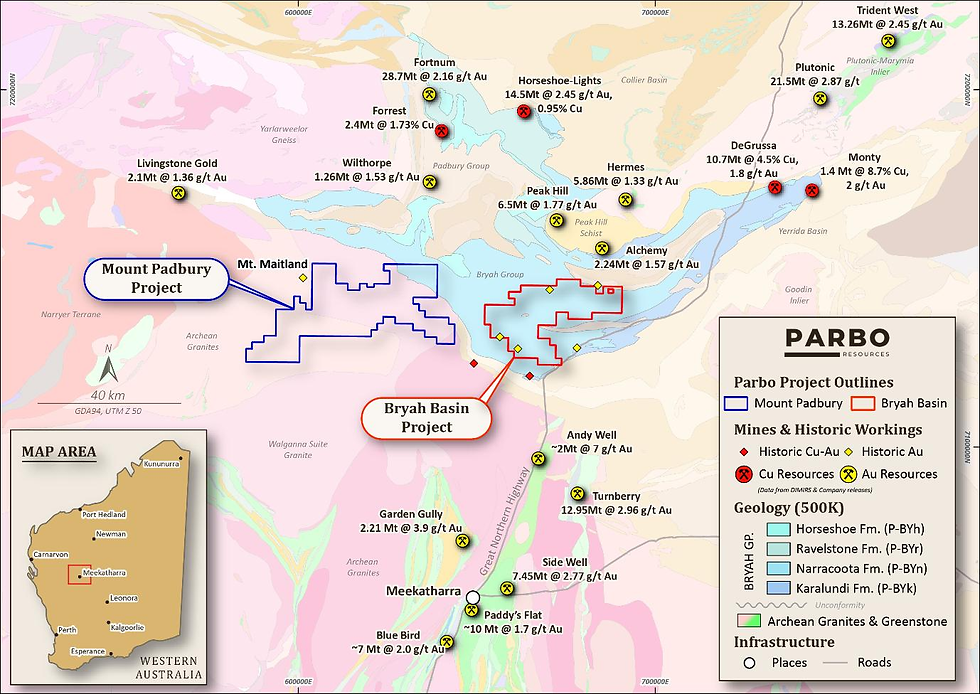
Parbo has assembled approximately 1,226 square kilometres across granted licences and applications (FIGURE 01). Neither project has a reported Mineral Resource.
The immediate task is to establish whether the geological interpretations developed from mapping, geophysics and historical data are supported by drilling.
Leeuwin Wealth is lead manager and underwriter to the fully underwritten offer.
The prospectus scheduled the offer to close on 27 August 2026 and the quotation to begin on 22 September 2026.
THE SOURCE DOCUMENTS This piece is built on the Parbo Resources Limited Prospectus dated 5 August 2026 and the company's Investor Presentation of August 2026. The prospectus is available from the company's prospectus page, which asks the reader to confirm Australian residency before it opens, and the investor presentation is a direct download from the same site. The offer closed on 27 August 2026, so this is a review ahead of quotation rather than an open offer. The ASX upcoming floats and listings page carries the listing details. |
A NOTE ON THE VOCABULARY Exploration carries its own shorthand. Greenstone, gravity inversion, aircore, reverse circulation, diamond tail, downhole interval, VMS, the two kinds of royalty and the corporate terms used further down are all explained in plain English in the vocabulary box at the back of this piece. |
The offer and where the money goes
IPO details | Terms in the prospectus |
Proposed ASX code | PRB |
Offer price and gross proceeds | A$0.20 per share; A$5 million |
Shares on admission | 64,150,000 |
Implied market capitalisation | A$12.83 million, undiluted at the offer price |
New Murchison Gold holding | 11,250,000 shares; approximately 17.54% |
Options and performance rights on admission | 7,207,500 options; 6,350,850 performance rights |
TABLE 01 The Offer. Offer particulars as set out in the Parbo Resources Prospectus dated 5 August 2026.
The A$5 million raising sits alongside A$2.05 million in existing cash at the prospectus date, giving Parbo a proposed A$7.05 million funding base before offer costs (TABLE 01). Its two-year budget allocates A$4.95 million, or approximately 70%, to exploration across the two projects (TABLE 02).
Proposed use over two years | A$ |
Mount Padbury exploration | 2,935,000 |
Bryah Basin exploration | 2,016,200 |
Directors' and management fees | 905,600 |
Working capital | 533,200 |
Offer costs | 660,000 |
Total | 7,050,000 |
TABLE 02 Use of funds. Proposed use of funds over two years, as set out in the Parbo Resources Prospectus dated 5 August 2026.
Exploration expenditure includes access, heritage, technical staff, field support and surveys. Drilling and assays account for A$3.27 million of the budget. A further A$460,000 in awarded WA Exploration Incentive Scheme funding is excluded from the exploration figures above, comprising A$230,000 for each project.
The board considers the proposed funding sufficient for approximately two years of planned activity. Successful exploration would still require further capital to define a resource and assess development.

Mount Padbury tests the concealed greenstone interpretation
Mount Padbury lies approximately 80 kilometres northwest of Meekatharra. Its eight tenements cover about 765 square kilometres, comprising 408 square kilometres of granted exploration licences and 357 square kilometres of applications.
The company interprets an extension of the Mt Maitland Greenstone Belt beneath cover and granite, with a possible continuation of the broader Plutonic–Marymia structure.
Ground gravity surveying and three-dimensional modelling have identified the Oddjob, Goldfinger and Golden Eye targets (FIGURE 02). These are interpreted geological bodies whose composition and gold potential still need to be tested.

Earlier drilling was limited and did not adequately test these targets. Parbo proposes approximately 18,000 metres of aircore drilling across Oddjob and Goldfinger to investigate a five-kilometre corridor. A deeper hole at Oddjob is planned with an approximately 200-metre reverse-circulation pre-collar and a 600-metre diamond tail.
At Golden Eye, the programme includes approximately 2,300 metres of reverse-circulation drilling, with one hole extended by a 600-metre diamond tail. The work is intended to test the rock sequence and structural interpretation before follow-up exploration is committed. References to Plutonic describe the geological model being tested, rather than a demonstrated deposit size.
Bryah Basin returns to incomplete exploration
The Bryah Basin project covers approximately 461 square kilometres around 70 kilometres north-northeast of Meekatharra. Nine granted licences account for 309 square kilometres, with four applications covering another 152 square kilometres. Parbo is targeting both structurally controlled gold and volcanogenic massive sulphide copper-gold mineralisation.
More than 3,000 historical auger, aircore and rotary air blast holes are recorded across the tenure. The prospectus describes much of this work as shallow reconnaissance that rarely reached fresh bedrock and was commonly assayed only for gold. Modern mapping has identified a more varied volcanic and sedimentary sequence, providing the basis for renewed testing at Brians Mill, Narracoota and Durack Well (FIGURE 03).

At Brians Mill, the presentation reports historical hole NAC001 returning 6 metres at 2.35 g/t gold from 17 metres. Durack Well hole HDR0041 returned 25 metres at 0.5 g/t gold from 48 metres to the end of the hole. At Narracoota, MPY80 returned 12 metres at 0.1% copper from 24 metres. These are reported downhole intervals from historical work, not established true widths.
The copper grades are modest, and the DeGrussa and Monty comparisons remain exploration analogues. Parbo's proposed work will test whether the shallow results are associated with more substantial mineralisation at depth and whether the mapped geological contacts provide suitable hosts.
The first drilling program
Parbo intends to begin drilling at Brians Mill around listing, using aircore drilling and follow-up reverse-circulation work to test extensions to known gold mineralisation. At Narracoota, the EIS award supports seven holes totalling approximately 1,800 metres within a broader programme. The proposed sequence then carries exploration at both projects through to June 2027, with follow-up work dependent on results (FIGURE 04).


The people and the share structure
Ben Auld chairs the company, with Tim Campbell as chief executive and Peter Langworthy and Neil Rose as non-executive directors. Jordan Griffiths is exploration manager. Auld's background includes founding mining consultancy Mining Plus; Campbell brings geology and mine-management experience. Langworthy has held exploration, development and board roles across several ASX resources companies, while Rose's experience is in finance and investment structuring.
New Murchison Gold's proposed 17.54% interest makes it a substantial shareholder. Its pre-IPO investment bought 6.25 million shares at A$0.16, with a further five million shares committed at the IPO price. That investment does not establish a processing arrangement or development pathway for either project.
The proposed 6.35 million performance rights vest against share-price, drilling, resource and pre-feasibility milestones. Parbo also intends to offer one free loyalty option for every two shares held around three months after admission, exercisable at A$0.30 and expiring three years from issue. That separate offer is not assured. Options and rights represent potential dilution beyond the 64.15 million shares proposed on listing.
The risks that belong in the assessment
Parbo is an early-stage explorer with no operating revenue and no reported Mineral Resource, Ore Reserve or formal Exploration Target at either project. The principal uncertainty is whether drilling will identify mineralisation with sufficient grade, continuity and scale to justify further expenditure. Its half-year financial report to 31 December 2025 also included a material uncertainty relating to going concern; the IPO is intended to fund the next stage of activity.
The quoted landholding includes nine pending applications, and the prospectus identifies renewal and transfer matters on parts of the tenure. Exploration also depends on heritage, access and regulatory approvals. These conditions matter to the timing and scope of the programme.
Royalties are another part of the project economics. Certain Mount Padbury tenements carry a 2.5% gross-revenue royalty to Amity, whose ownership includes interests associated with Auld and Rose. Bryah tenements carry a 2% net-smelter-return royalty to Dingo, with an additional 1.5% applying to specified licences. One of those additional royalties is payable to Omni GeoX, an entity controlled by Langworthy. These obligations would need to be included in any eventual development assessment.

Samso Concluding Comments
What interests me about Parbo is the opportunity to see two different exploration questions tested within the same programme. At Mount Padbury, the early drilling should tell us whether the interpreted greenstones are present beneath cover and whether they contain evidence of a gold system. In the Bryah Basin, the task is to improve on historical work that identified mineralisation but often stopped short of properly testing the host rocks and structures.
I would give the most weight to how those first results change the geological understanding. A useful programme should explain what was intersected, how it compares with the model and why the next hole belongs where it is planned. That will make the company's progress easier to assess than the regional deposit comparisons in the presentation.
The proposed exploration allocation gives Parbo room to undertake that work, and New Murchison Gold's investment is a relevant part of the corporate story. At an implied A$12.83 million market capitalisation, however, the assessment still rests on targets whose economic significance has yet to be established. For me, the first drilling and the discipline of the follow-up programme will determine how this IPO story develops.
THE VOCABULARY, IN PLAIN ENGLISH Greenstone belt A band of ancient volcanic and sedimentary rock inside older granite country. Most of Western Australia's gold comes from greenstone belts, which is why an explorer wants to know whether one continues beneath cover. Under cover Rock hidden beneath younger sediment, sand or soil, so it cannot be mapped at surface. Geophysics is used to see it, and drilling is the only way to confirm what is there. Gravity survey and inversion A survey that measures tiny differences in the pull of gravity across the ground. Denser rock, such as greenstone, pulls slightly harder than granite. Inversion is the computer modelling that turns those readings into a three-dimensional picture of where the denser bodies are. The picture is an interpretation until a drill hole confirms it. Magnetic image A map of how magnetic the rocks are, usually flown from an aircraft. It shows faults, folds and rock boundaries that are invisible at surface. Aircore drilling A low-cost, fast drilling method for shallow work through soil and weathered rock. It usually stops when it reaches hard, fresh rock. Good for a first pass over a large area. Reverse circulation, RC A drilling method that delivers rock chips to surface through the drill rods. It reaches deeper and harder rock than aircore and gives a more reliable sample. A pre-collar is an RC hole drilled first so a diamond drill can take over at depth. Diamond tail The deeper part of a hole drilled with a diamond-tipped bit that cuts a solid core of rock. Slower and dearer, but it shows the geology in full. Rotary air blast and auger Older shallow drilling methods used in historical reconnaissance. Both rarely reach fresh rock, which is why the prospectus describes the earlier Bryah Basin work as incomplete. Downhole interval and true width A drill result such as 6 metres at 2.35 g/t gold is measured along the hole. If the hole cuts the mineralisation at an angle, the true thickness of the zone is less than the interval reported. g/t Grams per tonne, the standard measure of gold grade. One gram per tonne is one part in a million. Volcanogenic massive sulphide, VMS A style of copper, gold and zinc deposit formed by hot fluids on an ancient sea floor. DeGrussa and Monty in the Bryah Basin are the local examples the presentation compares against. Mineral Resource A tonnage and grade estimate reported under the JORC Code, the Australian reporting standard, and signed off by a Competent Person. Parbo has none yet at either project, and that is the normal position for a company at this stage. Exploration Target A formal JORC statement of the possible size and grade of something not yet drilled out. It is not a resource and the prospectus does not report one. Exploration Incentive Scheme, EIS A Western Australian government programme that co-funds part of the cost of drilling in under-explored ground. Awarded, in Parbo's case, at A$230,000 for each project. Fully underwritten The lead manager has agreed to take up any shares the public does not buy, so the company is assured of the A$5 million. Undiluted market capitalisation The share price multiplied by the shares on issue at listing, ignoring options and performance rights that could later convert into more shares. Performance rights and loyalty options Performance rights convert into shares if set milestones are met. Loyalty options are a separate offer of the right to buy shares at a fixed price later. Both can add to the share count. Going concern An accounting term. A material uncertainty about going concern means the accounts flagged, at that date, a significant doubt about whether the company could fund itself for the next twelve months without new money. The IPO is intended to remove that uncertainty. Gross-revenue and net-smelter-return royalties A share of any future production paid to a third party. A gross-revenue royalty is taken from sales before costs. A net-smelter-return royalty is taken after smelting and refining charges. Both reduce what a mine would earn for shareholders. |
 The Samso Way – Seek the ResearchHere at Samso, we pride ourselves on delivering content for investors that is independent and informed by over three decades of experience in the industry. Our content is well-researched and is only created if I see merit in discussing the company's story. Our mission is simple. Cut through the noise and spotlight what matters. Genuine stories, grounded insights, and real opportunity. Investors can explore our four core platforms:
There may be numerous paths to success in investing, but the common thread among successful individuals is that they remain committed to making informed decisions. Equip yourself with the right knowledge and tools, and you will be well on your way to achieving your financial goals. Most importantly, investors need to be absolutely diligent in understanding their own risk-reward tolerance and capabilities. Never bite off more than you can chew. As they say, Rome wasn't built in a day, and the Great Wall stood because it took centuries to complete. The Samso Philosophy: Stay curious. Stay sharp. And remember, digging deeper always uncovers the real value. In Life, there is no such thing as a Free Lunch. Never bite off more than you can chew is my parting comment. Happy Investing, and the only four-letter word you need to know is DYOR. To support our independent work, please head over to our Support Page and give us a helping hand in any of the ways listed. This is a new initiative for the Samso Platform, and it was always the concept of Samso when we started this journey in 2018. DisclaimerThe information or opinions provided herein do not constitute investment advice, an offer, or solicitation to subscribe for, purchase, or sell the investment product(s) mentioned herein. It does not take into consideration, nor have any regard to your specific investment objectives, financial situation, risk profile, tax position and particular, or unique needs and constraints. About SamsoSamso is a trusted platform that equips dedicated investors with up-to-date industry knowledge and insights from top CEOs and thought leaders. By staying informed on business advancements and market trends, investors can enhance their financial decisions through a combination of expert guidance and their own research. Coffee with Samso, Samso Insights, Samso News and Samso Research are four ways into the same work. Interviews, long-form research, short takes on announcements and company-specific studies. Every one of them is about how to think about investing rather than what to buy. Samso News | www.samso.com.au | An Investor Lens on ASX-Listed Companies Samso News is independent research commentary for general information only. Nothing in this article is financial product advice, and it does not take into account any reader's objectives, financial situation or needs. Figures are drawn from public sources believed reliable at the stated dates but are not guaranteed. Market-sensitive numbers change daily. Samso or associated parties may hold positions in, or have commercial arrangements with, companies mentioned. Seek professional advice before making investment decisions. © Samso 2026 · samso.com.au |



Comments