
Ordell Minerals Limited (ASX: ORD)


Abstract
Ordell Minerals is a two-year-old ASX-listed gold explorer with one asset that matters, the Barimaia Gold Project near Mount Magnet in the Murchison district of Western Australia, in which it holds 80.3 per cent. It has no Mineral Resource, no reserve and no revenue. It has told the market it expects to publish a maiden Mineral Resource Estimate for the McNabs East prospect in the December 2026 quarter.
What makes the company worth a full workup is the combination of a defined near-term event and a share price that has stopped anticipating it. Ordell traded at A$1.06 within the past twelve months and closed at A$0.475 on 2 September 2026, giving a market capitalisation of about A$35.9 million against A$8.2 million of cash at 30 June 2026 and no debt. Over the same period the gold price has been high by any recent standard, at about A$6,110 an ounce on 2 September 2026, although it is not at a record and sits roughly a fifth below its January 2026 peak.
The geological case is real and it has been mined. Ramelius Resources' Eridanus deposit, about 6km to the north-west, is a producing open pit hosted in granodiorite with a Mineral Resource of 24Mt at 1.7g/t gold for 1.3 million ounces and, on Ordell's own account, more than 300,000 ounces already extracted. Ordell is drilling the same host rock along more than 7km of strike. Its metallurgical testwork returned gold extractions above 95 per cent after 48 hours at a 106 micron grind, with 35 to 40 per cent of the gold recoverable by gravity alone, which removes one of the standard ways a project like this fails.
What is unproven is everything that follows from that. There is no resource, so there is no size, no grade and no strip ratio. The headline high-grade intercepts are short and nuggety and will be top-cut in any resource estimate. Reported intervals are downhole lengths, not true widths. The open pit is a stated potential rather than a study. And the near-term development case depends on treating ore in a third party's plant, an arrangement nobody has announced and for which we found no evidence of a discussion.
The next two quarters resolve most of this. Ordell has about 14,000m of drilling underway, of which roughly 10,000m is infill reverse circulation drilling designed specifically to confirm continuity ahead of the resource estimate. Infill drilling that reproduces wide-spaced grades is a materially different result from infill drilling that does not, and it is the single test that matters between now and December. Assume a capital raising during 2027, because the current burn rate cannot be read off the June quarter.
The Samso Call is TIME TO LOOK AT TAKING A POSITION. The evidence Ordell has published is sufficient to justify a resource estimate. It is not yet sufficient to tell anyone how big that resource will be. The call describes attention, not action, and this workup contains no valuation and no price target.
Contents
Ordell Minerals Limited - Snapshot
This is a living document. Prices and market data below are as at 2 September 2026 and will have moved.
Item | Detail |
Share price | A$0.475 (ASX close, 2 September 2026) |
52-week range | A$0.345 to A$1.060 |
Market capitalisation | ~A$35.9 million (undiluted). Samso calculation: 75.6 million shares at A$0.475 |
Shares on issue | 75.6 million |
Options and performance rights | 20.4 million (unquoted) |
Cash | A$8.2 million (30 June 2026) |
Debt | Nil |
Enterprise value | ~A$27.7 million. Samso arithmetic, market capitalisation less cash at 30 June 2026 |
Flagship asset | Barimaia Gold Project, Murchison, WA (80.3%) |
Other assets | Goodia and Fisher South, WA (100% each) |
Mineral Resource | None reported |
Next catalyst | Maiden Mineral Resource Estimate, December 2026 quarter |
Drilling underway | ~14,000m, August to September 2026 |
Broker coverage | None identified as at 2 September 2026 |
Substantial holders, from the holders' own Form 604 notices lodged with the ASX. Genesis Minerals Limited 7.96% (6,000,000 shares, notice of 25 May 2026). MJF and FLD Fowler and Canning View Super 5.64% (4,250,000 shares, notice of 25 May 2026). Cremorne Capital as responsible entity for the Lowell Resources Fund 7.62% (4,692,393 shares) at its last notice of 31 July 2025, which is stale and has since been diluted by an amount no notice states. Board and management about 9.0% per Ordell's June 2026 quarterly.
1 Why This Company Warrants a Full Workup
Disclosure of interest. Samso Research Media House holds a small shareholding in Ordell Minerals Limited. This workup was not commissioned by Ordell and Samso has not been paid by the company to produce it. The holding is stated here, at the front, rather than only in the disclaimer at the end, so that a reader can weigh it before reading the argument rather than after.
Ordell Minerals is a gold explorer with no resource, no reserve, no revenue and one project that matters. On the ordinary reading of those facts it is one of the several hundred small explorers listed on the ASX, and there is no obvious reason to spend a day on it.
There are three reasons we did.
The first is that Ordell has put a maiden Mineral Resource Estimate on the calendar. The company has told the market it expects to complete one for the McNabs East prospect in the December 2026 quarter. A Mineral Resource Estimate, or MRE, is the first formal count of how much metal a company believes it has in the ground, reported under the JORC Code so that it can be compared with anyone else's. Ordell has never had one. Everything the company owns today is a set of drill holes and an interpretation. In the next few months that becomes a number, and the market will either agree with the story the drill holes have been telling or it will not.
The second is the neighbour. Barimaia sits next to Ramelius Resources' Mt Magnet operation in the Murchison district of Western Australia. About 6km to the north-west is Eridanus, a producing open pit with a Mineral Resource of 24Mt at 1.7g/t gold for 1.3 million ounces. Ordell states that more than 300,000 ounces have already been mined from it, a figure that appears in Ordell's quarterly rather than on Ramelius' own Eridanus page. Eridanus is not a typical Mt Magnet deposit. Most gold at Mt Magnet sits in narrow, high-grade quartz lodes. Eridanus sits in a granodiorite, which is a coarse-grained intrusive rock, and the gold is spread through a stockwork of small veins rather than concentrated in one structure. That makes it a bulk-tonnage deposit, meaning lower grade over far more rock. Ordell is drilling the same rock type, on the same district scale, a short distance away.
The third is that the market has stopped paying for the story. Ordell traded at A$1.06 within the past year. It closed at A$0.475 on 2 September 2026. Over the same window the gold price has been high by any recent standard, at about A$6,110 an ounce on 2 September 2026, although it is not at a record and Section 10 sets out why. A gold explorer whose share price has more than halved in an environment like that is either being correctly marked down or is being ignored. Both are worth understanding, and they lead to different conclusions.
This workup sets out what Ordell has actually released, what that evidence supports, what it does not support, and what the maiden MRE has to show for the current story to hold. It is not a valuation and it does not contain a price target. Samso does not publish either. Figure 1 is the ground the whole argument rests on.

Figure 1. Drilling at the Barimaia Gold Project, looking north-west. Source: Ordell Minerals investor presentation, 25 August 2026, cover slide.
2 The Numbers
Ordell listed on the ASX on 19 July 2024 after raising $6 million. Two years on, the corporate position is simple and there is very little to untangle.
Table 1. Ordell Minerals corporate snapshot
Share price and market data as at the close on 2 September 2026. Balance sheet and share count as reported by the company at 30 June 2026, with the share count cross-checked against the August 2026 investor presentation. This is a living document and the share price will have moved by the time you read it.

Sources: Ordell Minerals, June 2026 Quarterly Activities Report and Appendix 5B, 30 July 2026. Ordell Minerals investor presentation, 25 August 2026. ASX market data, 2 September 2026.
Three things in that table do the work.
The 80.3 per cent. Barimaia is a joint venture and Ordell has earned 80.3 per cent of it, not all of it. Every ounce the maiden MRE reports will be a 100 per cent project figure, because that is how JORC resources are reported. Ordell's economic share of those ounces is four fifths. That is not a criticism, it is an arithmetic step readers should do themselves and one that is easy to skip when a headline resource lands.
The cash. A$8.2 million at 30 June 2026 is a genuine balance, and it came from a A$7 million placement completed in the June quarter. The company's own Appendix 5B put estimated quarters of funding available at 5.0, calculated on the June quarter's outgoings of A$1.64 million. That calculation is now out of date in a specific and predictable way. Ordell has since started a 14,000m drilling program. Roughly 20,000m will be completed between May and September 2026. Exploration spending in the June quarter, when about 5,000m was drilled, was A$1.473 million. A quarter carrying two to three times that metreage will not cost A$1.473 million. Readers should assume the burn rate steps up sharply in the September and December quarters and should not carry the 5.0 quarters figure forward.
The placement price. The May 2026 raising was done at A$0.63, a 7.4 per cent discount to the previous close of A$0.68 and a 16.5 per cent discount to the 15-day volume weighted average price of A$0.754. Institutional and sophisticated investors paid A$0.63 in May. The stock closed at A$0.475 on 2 September. Anyone who took that placement is currently underwater by about a quarter. That is a fact about market appetite, not a judgement about the asset, and it cuts both ways. It says professional money was willing to fund the drilling four months ago. It also says the market has re-rated the story downwards since.
What the company is spending money on
The June 2026 quarter is a fair sample. Exploration and evaluation absorbed A$1,473,000. Employee costs were A$98,000 and administration and corporate costs were A$106,000. Payments to related parties, being the Managing Director's remuneration and non-executive director fees, totalled A$105,000 for the quarter.
That is a lean structure. Roughly 88 cents in every dollar of operating outflow went into the ground. For a company of this size that ratio is at the good end of what the ASX small end of town produces, and it is worth stating plainly because the opposite pattern is common enough to be worth checking for.
One item deserves a note. Ordell's prospectus of 28 May 2024 allocated A$2,263,100 to exploration of Barimaia. Actual spending on Barimaia from admission to 30 June 2026 was A$5,708,000. Administration costs were budgeted at A$1,390,000 and actual spending was A$1,926,000. Goodia was budgeted A$1,136,000 and has absorbed A$360,000. The company has, in short, put far more into its flagship than it told the market at IPO it would, and correspondingly less into the second project. Investors can read that as focus or as drift depending on temperament. We read it as focus, because the extra money was funded by later raisings rather than taken from the original pool, and because the drilling results at Barimaia are the reason the money moved.
3 The Asset, and What Is Actually There
Barimaia sits near Mount Magnet, about 550km north-east of Perth, in the Murchison district of Western Australia. It is a Tier 1 jurisdiction in the plain sense of the phrase. Title is secure, the roads exist, the skills exist, and there are several operating gold processing plants within trucking distance. Figure 2 shows how crowded that neighbourhood is, and Figure 3 shows how close Ordell sits to the largest operator in it.
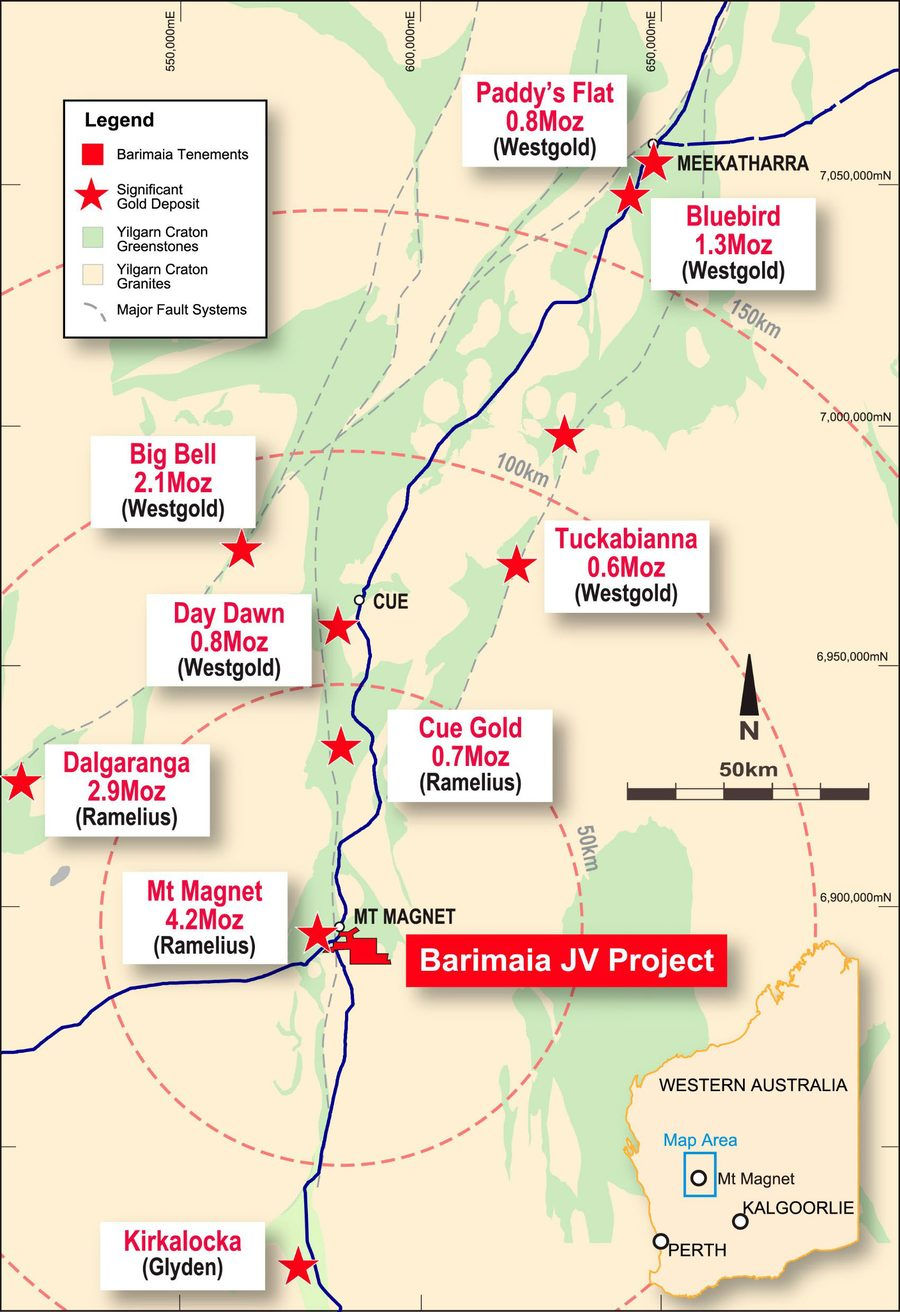
Figure 2. Barimaia in its district. The red star marks the project. Every labelled deposit within the 100km ring is an existing gold resource held by Ramelius Resources, Westgold or Glyden. Source: Ordell Minerals, June 2026 Quarterly Activities Report, 30 July 2026, Figure 1.
The company holds two mining leases, an exploration licence and a spread of prospecting licences across the project, with three further prospecting licences added during the June 2026 quarter. Those three, referred to as the Wanbanna tenements, cost A$40,000 in cash and A$40,000 in Ordell shares, being about 58,737 shares issued at A$0.681. A deferred payment of A$250,000 becomes due to the vendor, Wanbanna Pty Ltd, if Ordell announces a JORC compliant Mineral Resource of more than 25,000 ounces of gold on those tenements. Ordell can settle that in cash or shares at its election. It is a small, sensibly structured deal, and the deferred trigger is set low enough that it will bind if the ground works at all.
The geology, in plain terms
The rocks at Barimaia are Archaean, which is the geological eon running from about 4.0 to 2.5 billion years ago. The greenstone belts of the Murchison were laid down within that eon, at about 2.7 to 3.0 billion years, and they belong to the Yilgarn Craton, the block of ancient crust that hosts most of Western Australia's gold. Within that block, gold in the Murchison is usually found in shear zones, which are bands of rock deformed and altered by movement, and in quartz lodes.
Barimaia is being explored for a different target. The host rock Ordell is chasing is granodiorite, which crystallised from magma that pushed up into the older greenstone sequence and cooled at depth rather than erupting. Ordell has mapped and drilled a mineralised intrusive system with more than 7km of strike, which is the length of the target measured along its trend. The named prospects along that trend are McNabs, McNabs East, The Furnace and, on the newly acquired ground, untested extensions. Figure 3 puts that ground against Ramelius' holding.

Figure 3. Barimaia against the Ramelius Mt Magnet ground. The orange outline is Ordell's project, the blue outlines are Ramelius tenements, and the black arrow measures 7.5km across the project, and the red dashed ellipse below it is the target zone through McNabs, McNabs East and The Furnace. Eridanus is labelled at upper left. Source: Ordell Minerals investor presentation, 25 August 2026, slide 4.
The alteration at McNabs East is described by the company as sericite and pyrite dominant, with gold associated with bismuth, molybdenum, selenium, tellurium, tungsten, lead and silver. Mineralisation sits in quartz and pyrite extension veins with gentle north and south dips, and in biotite, carbonate and pyrite fracture veins dipping steeply south. Foliation dips moderately to the south. The company interprets the position of mineralisation as possibly influenced by steeply dipping, roughly east to west striking brittle to ductile faults.
None of that description is unusual for an intrusion-related gold system and none of it is a proof of size. What it does establish is that Ordell has a coherent geological model rather than a scatter of hits. The elements associated with the gold, the vein sets and the alteration are consistent between prospects and between drilling programs. That matters when the maiden MRE is built, because a resource estimate is only as good as the geological model that controls the wireframes.
4 The Drilling Record, Tested
Three drilling methods appear throughout this section and they are not interchangeable. Aircore is shallow and cheap. It samples the weathered top of the bedrock. It is used to find targets, not to define them. Reverse circulation, or RC, uses a hammer to produce rock chips and is the workhorse for defining a shallow deposit. Diamond drilling cuts a solid core of rock, costs the most, and is the only one of the three that lets a geologist measure structure, orientation and true width directly. Ordell's maiden resource will rest mainly on RC drilling, with diamond holes providing the structural control.
Ordell has drilled about 55,000m since listing in July 2024. Roughly 20,000m of that will have been completed in the five months from May to September 2026. This is a company that drills.
Michael Fowler, Ordell's Managing Director, set out the order of priorities himself when the program was announced.
"Given our growing confidence in the continuity and robustness of the mineralisation at McNabs East within the Main Zone and Northern Zone, our immediate priority now is to complete the in-fill drilling required to deliver a maiden Mineral Resource Estimate in the December 2026 Quarter. This will, in turn, provide us with the foundation to assess the potential for a near-term development opportunity at Barimaia."Michael Fowler, Managing Director, Ordell Minerals, ASX release, "Major 14,000m Resource Drilling and Exploration Program Underway at Barimaia Gold Project, WA", 17 August 2026.
Read that carefully and it is a statement about confidence in continuity, not about grade. The rest of this section tests whether the published drilling supports it.
The results below are the ones the company itself puts forward as significant, taken from its own releases. We have grouped them by the announcement that carried them so that readers can see how the story built rather than seeing a single flattering list.
Table 2. Selected drill intercepts at McNabs East and The Furnace
Intercepts as reported by Ordell Minerals, grouped by the announcement that first carried them. Downhole intervals, not true widths. The company has not published true width estimates for most of these intercepts, so the actual thickness of mineralisation is unknown and will in most cases be less than the figure shown. "g/t Au" means grams of gold per tonne of rock.

Sources: Ordell Minerals ASX releases, "Major 14,000m Resource Drilling and Exploration Program Underway at Barimaia Gold Project, WA", 17 August 2026. June 2026 Quarterly Activities Report, 30 July 2026. investor presentation, 25 August 2026, slides 5 to 9.
Reading that table honestly
Two features of the McNabs East data set should shape how anyone reads it.
The first is that the very high grades are concentrated in very short intervals. A 2m intercept at 92.20g/t gold containing 1m at 182.3g/t is a striking number. It is also a single metre of rock. Gold that behaves this way is described as nuggety, meaning it is distributed unevenly at a fine scale rather than being spread through the rock. Nuggety gold is harder to estimate, because a single sample can pull an average a long way. Resource estimators handle this by capping high grades, a process called top-cutting. Investors who anchor on the headline high-grade hits and then see a maiden resource reported at an average grade of 1.5 to 2.5 grams should not be surprised. The estimation process is designed to produce exactly that outcome.
The second is that the intercepts are downhole lengths, not true widths. Ordell reports mineralisation dipping moderately to the south and holes drilled to test it. Without true width figures, the reported 22.7m and 29m intervals cannot be read as 22.7m and 29m of rock thickness. The company has not published a true width conversion for most of these results. This is normal industry practice at this stage and it is not a criticism. It is a caution, and it is the caution most often ignored by retail readers. Figure 4 is the plan view of what has been drilled so far.

Figure 4. The McNabs East drill plan as at August 2026. Coloured dots are gram-metre intercepts, which is grade multiplied by width, so larger and redder dots carry more metal. The Main Zone, Northern Zone and The Furnace are labelled, along with the target zones between them. Source: Ordell Minerals ASX release, 17 August 2026, Figure 1.
What the plan view shows, and what the numbers on their own do not, is that the mineralisation is not a single tight shoot. It is a broad corridor of intercepts running roughly east across more than 1km at McNabs East, with a separate cluster at The Furnace about 1km further east again, and a gap in between that Ordell is now drilling. The density of results in the Main Zone is high. The density at The Furnace is very low, because it has only had a first pass. Figure 5 is the section through the Main Zone.
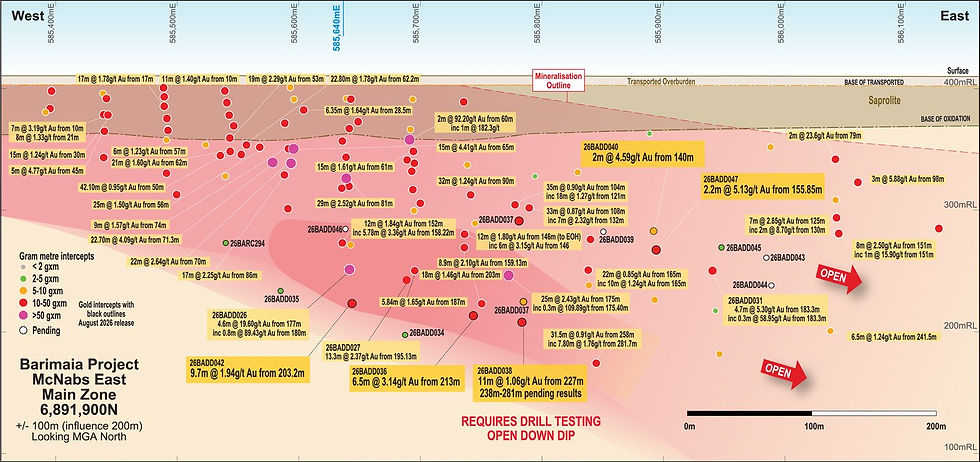
Figure 5. Long section through the McNabs East Main Zone at 6,891,900N, looking north. The pink shading is the interpreted mineralisation outline. The red arrows on the right mark where the system is open and untested. Source: Ordell Minerals ASX release, 17 August 2026, Figure 2.
The section is the more useful picture. It shows near-surface mineralisation from roughly 10m below surface, which is what makes open pit mining a reasonable thing to test for. It also shows the system continuing to the east and to depth. One caution on reading it. This is a longitudinal section, meaning it is cut along the strike of the body rather than across it, so what it displays cleanly is plunge, the direction the ore shoot rakes within its own plane. Ordell's figure marks the same arrows as open down dip. Because the mineralisation dips moderately south, into the page, true down-dip continuity is only properly tested on cross sections cut at right angles to this one, and the company has published fewer of those.
Hole 26BADD038 returned 11.0m at 1.06g/t gold from 227m to the end of sampling. That phrase means the assayed interval ended in mineralised rock, not that the hole did. The hole continued, and Ordell has stated that results from 238m to 281m are pending. The distinction matters, because a hole that ends in mineralisation and a hole whose assays simply have not come back yet are different pieces of evidence.
"Open" is one of the most overused words in exploration. Here it is doing real work, and it also carries a cost. A system that is open at 230m depth is a system whose eastern extensions are unlikely to be mined by open pit. Depth extensions are good news for the total size of the system and largely irrelevant to the near-term development case that Ordell is building the maiden MRE to support. Those are two different stories and they should not be blended.
5 The Science Tested
The Samso research method requires that the geological claim underneath an exploration story be checked against the published science rather than accepted from the company. Ordell's claim, reduced to a sentence, is that gold in the Murchison can sit in granitoid intrusions and that Barimaia's granodiorite is therefore a legitimate target.
That claim has a peer-reviewed foundation and it is older than the company.
"In the Archaean Murchison Province of Western Australia, granitoid batholiths and plutons that intruded into the ca. 2.7–2.8 Ga and ca. 3.0 Ga greenstone belts can be divided into three major suites... gold mineralisation in the Murchison Province was temporally and spatially associated with Suite II I-type granitoids in the northeastern part of the province."Wang, L.G., McNaughton, N.J. and Groves, D.I., 1993. "An overview of the relationship between granitoid intrusions and gold mineralisation in the Archaean Murchison Province, Western Australia", Mineralium Deposita, volume 28, pages 482 to 494.
So the model is real. Gold and granitoids in the Murchison have a documented spatial and temporal relationship in the academic literature going back more than thirty years.
Two qualifications are needed, and we would rather state them than let the citation do more work than it can carry.
The first is that Wang and co-authors tie the gold to Suite II, which they classify as I-type trondhjemite and tonalite bodies. Ramelius describes the Eridanus host as a granodiorite. Whether the Eridanus Granodiorite maps onto Wang's Suite II or onto their Suite I monzogranite and granodiorite suite is not something we could establish from published sources.
We are not asserting the correspondence, and we would go a step further. On a strict reading, the suite the paper favours for gold is not the rock type Ramelius names at Eridanus. So the literature supports the general model of intrusion-associated gold in this province. It does not specifically endorse granodiorite as the favoured host. The qualification that cuts the other way is that field names for intrusive rocks are approximate. A body logged as granodiorite in the field can classify as a tonalite or trondhjemite once it is properly analysed, and nobody has published that analysis for either deposit.
The second is more useful. The strongest evidence for the model is not the paper. It is Eridanus itself. Ramelius describes it in its own words.
"Mineralisation at Eridanus occurs as stockwork veins concentrated within the east-west orientated Eridanus Granodiorite, which has intruded into felsic aphyric to porphyritic intrusive rocks."Ramelius Resources, Eridanus project page, rameliusresources.com.au, accessed 2 September 2026.
Ramelius also notes that this bulk-tonnage style distinguishes Eridanus from the higher-grade lode deposits found elsewhere in the Mt Magnet field. That is the point. A 1.3 million ounce granodiorite-hosted deposit is in production 6km away. The model is not theoretical in this district. It has been mined.
What this does and does not establish is worth being precise about. It establishes that the target type exists at economic scale in this specific belt. It does not establish that Barimaia contains one. Proximity to a deposit and sharing a host rock type are the reasons to drill, not evidence of what the drilling will find. The intercepts in Section 4 are the evidence, and they are sufficient to justify a resource estimate. They are not yet sufficient to establish scale.
6 Metallurgy and the Development Path
Metallurgy is where a lot of gold stories quietly fail, and it is usually tested far too late. Ordell tested it early, and the results are the strongest single piece of technical evidence the company has released.
Table 3. McNabs East metallurgical testwork results
Cyanide leach testwork on representative samples of transition and fresh rock from McNabs East, completed by independent laboratory ALS Metallurgy Pty Ltd. "P80" is the grind size at which 80 per cent of the material passes the stated screen, measured in microns. A finer grind costs more power. "Extraction" is the percentage of contained gold recovered into solution after the stated leach time.

Source: Ordell Minerals investor presentation, 25 August 2026, Appendix 2, reporting testwork completed by ALS Metallurgy Pty Ltd. Originally released to the ASX on 24 July 2025 as "Excellent Metallurgical Results Returned From McNabs East Prospect".
Four things in that table matter and none of them are marketing.
Extraction above 95 per cent after 48 hours at a relatively coarse 106 micron grind means the gold does not need to be ground fine to be recovered. At 24 hours the fresh sample sits just under that mark, at 94.6 per cent, so the 95 per cent figure is a 48-hour number and should be quoted as one. Comminution, meaning crushing and grinding, is typically the largest single power consumer in a gold plant, so a coarser grind is a direct saving on operating cost.
Gravity recoverable gold of 34.9 to 40.8 per cent across the four tests, a range Ordell itself states as 35 to 40 per cent, means a third to two fifths of the metal can be caught by density alone, before any chemistry, which reduces reagent consumption. Laboratory gravity recoverable gold is a theoretical maximum and a plant will realise less of it, so treat that range as an upper bound rather than a design figure. Cyanide and lime consumption came in below 0.4kg per tonne, which is low. And the Bond ball mill work index, a standard hardness measure, was 10.8kWh per tonne for transition material and 13.8kWh per tonne for fresh, both in the moderate range.
Taken together the description that fits is "free milling", meaning the gold is not locked inside sulphide minerals or otherwise refractory. Free milling ore can go through a conventional crush, grind and carbon-in-leach circuit. There are hundreds of those in Western Australia, including several within trucking distance of Barimaia.
There are two honest caveats and the second is the more important one.
The first is sample size. This is four leach tests on two rock types from one prospect, on head grades of 1.03 and 1.63g/t. It is early-stage testwork done properly, not a metallurgical program supporting a feasibility study.
The second is that the samples were transition and fresh material only. No oxide was tested. Oxide is the fully weathered rock at the top of the profile, and in an open pit it is the first material mined. Ordell's own shallow intercepts start about 10m below surface, which puts a meaningful part of the near-surface mineralisation in exactly the zone that has not been through a leach test. Oxide ore usually leaches well and often better than fresh rock, so this is a gap rather than a warning. It is still a gap, and it is the obvious next piece of testwork.
What the testwork does is remove a common way for a project like this to die. It does not, on its own, prove anything about the size or the economics of a future operation.
Why the metallurgy matters more here than usual
Ordell's stated strategy has two prongs. One is to fast-track a potential near-term development opportunity underpinned by the maiden MRE. The other is to keep growing the system through extensional and discovery drilling.
The near-term development prong is only credible for a company with A$8.2 million in the bank if the ore can be treated in someone else's plant. For a sense of the capital involved, Ramelius is spending about A$223 million to expand a plant it already owns. Building one from nothing is not on the table for a company of Ordell's size. Trucking ore to an existing plant is.
Here we need to be careful, because this is the point where commentary on companies like Ordell usually gets ahead of the facts.
Ramelius has never publicly said it will buy or toll treat third-party ore from the Murchison. We looked. We did not find such a statement, and readers should not assume one exists. What is documented is that Ramelius is spending about A$223 million expanding the Mt Magnet processing plant from 1.9Mtpa to 4.3Mtpa, with the two circuits targeted for operational readiness by September 2027. What is also documented is that the practice exists in the district. Westgold has an arrangement to process ore containing roughly 140,000 ounces over two and a half years for New Murchison Gold through its Bluebird plant.
So the defensible statement is this. There is expanding mill capacity in the district, there is an established precedent for third-party ore processing in the Murchison, and gold prices are high enough that trucking ore over meaningful distances can work. There is no agreement, no discussion and no commitment involving Ordell that has been made public. Anyone building a case on a Ramelius ore purchase is building it on inference.
7 The Eridanus Analogue, and Where It Stops
The comparison to Eridanus is the centre of the Ordell story and it is used, correctly, by the company itself. Michael Fowler has framed the strategy as trying to "find an Eridanus" by systematically drilling over 2.5km of strike.
Set out plainly, here is what the two have in common and where the comparison ends.
Table 4. Barimaia and Eridanus compared
A like-for-like comparison of the two deposits on the points that matter to an investor. Eridanus figures are Ramelius Resources' reported Mineral Resource. Barimaia has no reported Mineral Resource, so the corresponding cells state what is and is not known rather than a figure.

Sources: Ramelius Resources ASX release, "Resources and Reserves Statement", 1 October 2025, as cited by Ordell Minerals. Ramelius Resources Eridanus and Mt Magnet Hub project pages, accessed 2 September 2026. Ordell Minerals June 2026 Quarterly Activities Report, 30 July 2026.
The left column is a mine. The right column is a drilling program. Everything in the middle of that table is the work Ordell has yet to do, and the maiden MRE is the first of those steps, not the last.
We would put the analogue this way. Eridanus tells you the target type is real and economic in this belt. It does not tell you Barimaia is one, it does not tell you how big Barimaia will be, and it does not tell you whether Barimaia's grade will support the same open pit economics. Companies use analogues because they compress a complicated geological argument into one memorable comparison. That compression is legitimate as a reason to explore. It becomes misleading the moment it is treated as a forecast.
8 Comparables
Ordell has no resource, which makes conventional peer comparison awkward. The honest approach is to show where similar companies sit and let readers do the arithmetic themselves. Samso publishes no valuations and no price targets, and we are not going to derive an implied value for Ordell from this table. The table is context, not a conclusion.
Table 5. Ordell and six comparable ASX-listed gold companies
A set chosen for comparable stage and geography rather than comparable size. Every market capitalisation comes from a single reading of the ASX company data feed at 06:06 AWST on 4 September 2026, reflecting the close on 3 September 2026. That is one day later than the 2 September close the rest of this workup is built on, so Ordell appears here at A$0.495 rather than the A$0.475 used in the snapshot. Resource figures are each company's most recent published JORC estimate, with the date given. Two of these companies are no longer straightforward comparables and are marked as such.

Sources: market capitalisations from the ASX company data feed, one reading at 06:06 AWST on 4 September 2026. Great Boulder Resources, "1 million ounce high-grade gold resource at Side Well", 18 December 2025, and "Quarterly Activities Report", 31 July 2026, for Peak Hill. Torque Metals, "MRE Update, Paris Gold Deposit", 7 July 2026, and the Aston Minerals merger announcement of 28 January 2025 for Edleston. Saturn Metals, "Apollo Hill Gold Resource Jumps By 590,000 Ounces to 2.83Moz", 3 June 2026, and "Positive Apollo Hill Pre-Feasibility Study and Maiden Ore Reserve", 17 December 2025. Caprice Resources, "Murchison Project Gold Exploration Target, Amended", 21 November 2024. Santa Fe Minerals, "Quarterly Activities and Cashflow Report", 31 July 2026. Western Gold Resources, "Gold Duke Project, Mineral Resource Statement", 20 August 2026. Ordell Minerals ASX market data.
One caution on the market capitalisation column. The ASX feed's market capitalisation does not reconcile to the feed's own reported share count for six of these seven companies. Torque Metals is the only one where price multiplied by shares gives the stated figure exactly. We do not know whether the feed prices a different share class or reads at a different moment, so the figures above are reported as the feed publishes them and are not our own arithmetic. Ordell's snapshot figure in Section 2 is our arithmetic and is labelled as such there. The two will not agree exactly, and that is why.
Figure 6 draws the same table, because the shape of it is the argument.

Figure 6. The same set as Table 5, drawn. Ordell is the orange bar. The italic column on the right is each company's reported JORC resource, which is what the market is being asked to pay for. Ordell is one of three companies shown with no resource at all. All market capitalisations are from one reading on 4 September 2026, so unlike the earlier version of this chart the comparison is same-day. Samso Research Media House, built from the sources in Table 5.
Three observations, offered as observations rather than as a case.
Ordell sits near the bottom of this group on market capitalisation and at the lowest end on resource, because it has none. That is internally consistent. A company without a resource trading below companies with one is not an anomaly requiring explanation.
The genuine like-for-like comparison is narrower than it first appears. Of the six other companies, Santa Fe Minerals is no longer a Western Australian gold story at all. It bought the Eburnea project in Côte d'Ivoire from Turaco Gold in July 2025, and its March and June 2026 quarterly reports record that work at Challa in the Murchison was limited to desktop studies in both periods. The page title on its own announcements page reads "ASX Listed Shell". Caprice Resources is the closest true comparable, in the Murchison, with no resource, drilling hard, and holding granted mining leases. Ordell and Caprice are the two companies here being asked the same question at the same time, and Caprice carries roughly twice Ordell's market capitalisation.
The spread between Great Boulder at roughly A$191 million and Torque Metals at roughly A$134 million is a caution against simple ounce counting, and it is more instructive than it first looks. Great Boulder holds 1.5 million ounces across two Western Australian projects. Torque holds 351,000 ounces in Western Australia and a further 1.5 million ounces at Edleston in Ontario, at about 1.0g/t. So the gap in market capitalisation is not simply an ounce gap, although the two sets of ounces are not equivalent, and Torque's larger parcel is lower grade and on another continent.
Grade, depth, metallurgy, ownership percentage, tenure and permitting all move the number, and an ounce in one deposit is not an ounce in another. We flag this because the temptation, once Ordell publishes a resource, will be to divide market capitalisation by ounces and reach a conclusion. That arithmetic is easy and frequently wrong.
One caution on this whole section. We could not find a credible published benchmark study of dollars per resource ounce for Western Australian gold juniors current to 2026. Any multiple a reader constructs from the table above is their own calculation, not an industry standard, and it should be treated that way.
9 Where Ordell Sits, on Five Measures
Table 5 compares what these companies own. It does not compare what stands between them and a mine. This section does that, across five measures, and it is built from each company's own filings rather than from our impression of them. The fifth measure is a judgement and is treated as one.
A note on what this section is not. Ranking seven companies by which is most likely to make an economic discovery would be a valuation dressed as geology, and Samso does not publish those. What follows sets out the evidence each company has produced and what each one still has to prove. Readers who want a ranking will have to build it themselves, which is the point.
Table 6. Five measures across the comparable set
Market capitalisations as in Table 5. Stage is the furthest point each company has formally reached, not what it hopes to reach. Jurisdiction risk covers tenure, native title and permitting as each company has disclosed them, rather than country risk, which for six of the seven is the same.

Sources as listed for Table 5, plus Great Boulder Resources, "Ironbark scoping study highlights robust mining opportunity", 17 July 2025. Torque Metals, "June 2026 Quarterly Activities Report", 27 July 2026. Saturn Metals, "Native Title Mining Agreement Signed for the Apollo Hill Gold Project, WA", 15 May 2026, and "Key Apollo Hill Mining Lease Granted", 21 July 2026. Caprice Resources, "Caprice Commences Transformational 50,000m Drill Campaign", 23 March 2026, and "Vadrians Gold System Extended Along Strike and At Depth", 25 August 2026. Santa Fe Minerals, "Quarterly Activities and Cashflow Report", 30 April 2026. Western Gold Resources, "Commencement of Expanded Scoping Study", 31 July 2026.
What the first four measures show
Two of these companies are not really explorers. Saturn Metals has an Ore Reserve, a completed pre-feasibility study and a definitive study running, and Western Gold Resources has taken a formal Decision to Mine with its mining proposals approved. Comparing Ordell to either on market capitalisation compares a company that has not yet counted its metal with companies that have costed extracting it.
Two more are ahead of Ordell on resource but not on permitting. Great Boulder has 1.5 million ounces across two projects and a market capitalisation five times Ordell's, but all three of its Side Well mining leases are still applications, its native title agreement is still under negotiation, and it has no binding arrangement to process Side Well ore. Torque Metals has 351,000 ounces in Western Australia and, on its own description, no study of any kind. Ounces in the ground and a path to mining them are different assets, and the market does not always price them differently.
That leaves Caprice Resources as the one company here being asked the same question as Ordell at the same time, and Santa Fe Minerals as a company that has left the comparison without the table noticing.
On commodity the set is uniform, and that is the point of it. Six of the seven are gold companies in Western Australia, which is what makes the comparison worth making at all. Where a company carries something else, it is minor and the company treats it as such.
On jurisdiction the differences are real but they are not country differences. Every one of these projects except Santa Fe's active ground sits in Western Australia, which is about as settled a mining jurisdiction as exists. The differences are at the tenement.
Ordell owns 80.3 per cent of its flagship, so a fifth of anything it finds belongs to someone else. Great Boulder is in the same position and it is worth saying so, because most of the Side Well deposits are 75 per cent owned under one joint venture agreement and Golden Bracelet 80 per cent under another, while the resource is quoted on a 100 per cent basis. Western Gold does not hold its tenements at all. They belong to GWR Group, and Western Gold works them under a deed of co-operation with a royalty back to the holder. Great Boulder's leases are applications. Caprice and Ordell both hold granted mining leases, which is the cleanest position in the table.

Figure 7. The first four measures, drawn. A filled circle means the company has formally reached that stage and said so in its own filings. Ordell, Caprice and Santa Fe have reached only the first. Nobody in this set has reached all five. Western Gold holds mining approvals and a Decision to Mine without ever having declared an Ore Reserve, and Saturn has the Ore Reserve but not the approvals, so both of those rows have a gap in them. Samso Research Media House, built from the sources in Table 5 and Table 6.
The fifth measure, geological potential for an economic discovery
This is where the comparison stops being arithmetic. What follows is each company's geological case as its own drilling supports it, and the specific thing that would have to be true for that case to become a mine.
Ordell. The strongest analogue in the set. Ramelius Resources' Eridanus pit sits about 6km to the north-west, in granodiorite, with a Mineral Resource of 24Mt at 1.7g/t for 1.3 million ounces. Ordell is drilling the same host rock along more than 7km of strike, and its metallurgy returned better than 95 per cent extraction after 48 hours at a 106 micron grind, with 35 to 40 per cent recoverable by gravity alone. What has to be true is continuity at close spacing, and that is exactly what the current infill programme tests.
The unresolved problem for Ordell, set out in Section 14, is that the infill grid stops at about 60m to 90m vertical while the celebrated deep intercepts sit at 137m to 227m downhole in angled holes, so the separation is indicative rather than exact. Either way the higher-confidence part of the maiden estimate will be shallow and comparatively low grade.
Great Boulder Resources. The largest reported endowment in the set after Saturn, and a high-grade one at 2.0g/t. The geology is well described, with two intersecting lode sets at Mulga Bill where structural blowouts produce the thick high-grade intervals, and the deposit is open in all directions with a step-out hole 430m below surface returning 1.93m at 574g/t. The constraint is not geological. Thirty-nine per cent of the ounces are Inferred, none is Measured, the only economic study covers 79,000 ounces of the million, and the metallurgy is proven on one deposit out of six.
Torque Metals. Narrow orogenic lodes of 1m to 10m, averaging 2m to 5m, at the project Torque renamed Ritz in August 2026, in the Kalgoorlie Terrane beside the Boulder-Lefroy Shear Zone, with free-milling metallurgy at approximately 96 per cent. The company discloses a nugget effect of 20 to 40 per cent, and two holes at the HHH deposit show what that means in practice. One reverse circulation hole returned 11m at 456g/t. A diamond hole collared about 3m away returned 7.9m at 1.37g/t. Grade continuity, not grade, is the question here, and the resource grade has already fallen from 4.3g/t to 3.8g/t as drilling tightened the model.
Saturn Metals. The most advanced case and the one that depends least on further discovery. Apollo Hill is 2.83 million ounces at 0.51g/t, a bulk-tonnage deposit whose entire economics rest on cheap mining at a 2.39 to 1 strip ratio feeding a heap leach. Column tests averaged about 78 per cent at an 8mm crush, and the pre-feasibility study carries 73.7 per cent over a 160-day leach at operational scale. At 0.47g/t reserve grade there is very little margin for a recovery shortfall, and heap leaching is, in the company's own words, less frequently used in Western Australia, which it flags as a schedule risk across a long list of approvals still to come. This is an engineering and approvals question now, not an exploration one.
Caprice Resources. The nearest thing to Ordell in the table, and the higher-grade headline result of the two. Vadrians runs more than 1,000m of strike to at least 400m depth and is open, hosted in banded iron formation, with one intercept first reported as 22m at 66.2g/t from 42m on two-metre composites and since restated, on one-metre splits, as 19m at 124.7g/t from 42m. The company estimates true widths at 60 to 70 per cent of downhole length and says plainly that the host lithology of its best hole is not yet clearly resolved. It has no resource, its Exploration Target predates the discovery that matters, and it is drilling scissor holes to work out the orientation of its own best intercept.
Santa Fe Minerals. On the Western Australian ground there is little to assess, because almost no work is being done. Auger sampling returned peak values of 256 parts per billion gold, which is anomalism rather than mineralisation, and the best historic drill result the company reports at Golden Girls is 3.74g/t. Its stated next step is target-specific aircore drilling, and the last two quarterly reports record desktop studies instead. The active exploration is in Côte d'Ivoire, where the best historical intercept is 26m at 4.82g/t at Satama. Of its Bouake North ground the company says drilling is not yet sufficient to establish continuity of individual mineralised zones, which is a fair description of the whole portfolio.
Western Gold Resources. The most complete small deposit and the most constrained. Gold Duke is 277,000 ounces, entirely oxide, at 1.8g/t, in narrow banded iron formation lodes averaging 2m to 2.4m at Eagle. The Competent Person's own words are that the mineralisation is nuggety, exhibits short continuity ranges, and that this short-range variability and the uncertainty that goes with it will be defining factors for the Gold Duke deposits. Grade continuity is not known to exceed 60m.
The resource is capped by an economic pit shell rather than by geology, with published pit designs reaching between about 27m and 60m, nothing below the base of oxidation has been metallurgically tested, and the grade fell from 2.1g/t to 1.8g/t when the company drilled it more densely. Denser drilling lowering the grade is the risk every pre-resource company in this table carries, and Western Gold is the one that has already demonstrated it.
The one comparison worth carrying forward. Two companies in this table have published a lower grade after more work. Western Gold's Gold Duke estimate went from 2.1g/t to 1.8g/t over a year in which it drilled 33,980m on 5m by 10m spacing, although the company attributes the fall to an updated geological interpretation, revised classification and the inclusion of additional material rather than to the drilling density itself. Torque's Paris deposit fell from 4.3g/t to 3.8g/t when tighter domaining was applied. Neither is a failure, and neither is evidence about Ordell. What they show is that a grade published from wide-spaced holes is a working number, and that the direction of travel when a deposit is examined more closely is often downward. That is worth holding in mind between now and the December quarter, and it is not a prediction.
10 The Market Behind the Metal
Gold is the whole macro case here, so it deserves accuracy rather than enthusiasm.
As at 2 September 2026 gold traded at about US$4,388 an ounce, up roughly 23 per cent over twelve months. In Australian dollars the price was about A$6,110 an ounce, with Ordell's own website quoting A$6,125 the same day. The two sources agree closely enough to use either.
Now the correction that most commentary written this week will get wrong. The Australian dollar gold price is not at a record. It peaked in January 2026, fell to a low around A$5,680 an ounce in mid-July 2026, and has recovered since. The current price sits roughly a fifth below that January high. We have seen the January peak quoted at two materially different levels by two different sources and we are not going to print a figure we cannot stand behind. The direction and the timing are reliable. The peak number is not.
The twelve-month gain in Australian dollars, at about 12 per cent, is also smaller than the US dollar gain of about 23 per cent, because the Australian dollar has appreciated over the period. Australian gold producers earn in Australian dollars, so that gap matters to them and, eventually, to anyone hoping to sell them a deposit.
What this means for Ordell is straightforward. The gold price is high in absolute terms and has been for long enough to change corporate behaviour. Mills are being expanded. Ore is being trucked further than it used to be. Producers are looking for feed. That environment is favourable for a company with an undeveloped deposit next to a growing plant.
It is also an environment that is already priced. A A$6,100 gold price is not news, and it did not stop Ordell falling from A$1.06 to A$0.475. Investors who expect a strong gold price to carry an explorer's share price on its own have the last eight months of Ordell's chart as evidence against them.
11 Goodia and Fisher South
Ordell owns two other projects outright. Both are early. Neither is the reason to look at the company today, and we would be doing readers a disservice by inflating them.
Goodia
Goodia sits about 15km west of Norseman, in a different part of the Yilgarn from Barimaia, with more than 30km of prospective greenstone. Ordell has completed soil geochemical sampling over 10km of strike, collecting 909 samples in the May 2026 program alone at line spacings of 200m, 400m and 800m, with sample points 50m to 100m apart along each line. Thirteen rock chip samples were also collected.
The sampling has defined extensive surface gold anomalism along the eastern margin of the Goodia Dome, with anomalous zones up to 1.8km long and open ended. These sit south of three earlier anomalies, GD1 to GD3, reported in November 2025. First-pass aircore drilling is planned to test them.
A soil anomaly is a pattern of slightly elevated gold in surface material. It is a reason to drill and nothing more. Ordell has not drilled Goodia. Until it does, the honest description of Goodia is a well-defined set of untested targets on ground the company owns entirely.
Fisher South
Fisher South is 400km north of Kalgoorlie in the Laverton district, about 40km along strike from Emerald Resources' Dingo Range project. Ordell completed a 59-hole aircore program for 2,717m on a very wide 1,600m by 200m grid in the June 2026 quarter. Holes averaged 46m deep and the objective was to understand stratigraphy and regolith under transported cover, not to find a deposit.
The best gold result was 14m at 150 parts per billion gold from 45m in hole 26FSAC021, at the northern end of a gold anomaly defined by an earlier explorer's auger drilling in 2011 that extends over 1.6km to the south. To be clear about scale, 150 parts per billion is 0.15 grams per tonne, which is roughly a tenth of the grade at Eridanus. It is an anomaly, not an intercept.
The more interesting result may be the tungsten. Bottom-of-hole samples on the western side of the drilled area returned 1m at 1,718 parts per million tungsten in hole 26FSAC059 and 1m at 200 parts per million in 26FSAC053. Ordell states that further work is required to understand the source and significance of this. We agree, and we would add that a single strongly anomalous tungsten sample in a first-pass regolith program is a long way from anything, however unusual the number looks.
A note on the source documents. Ordell's 2 July 2026 announcement contains two small internal inconsistencies worth recording. The text describes 13 rock chip samples while the accompanying table lists 15 sample identifiers, one of them unassayed. The text gives the aircore hole depth range as 24m to 84m while the collar table lists one hole at 20m. We report both as published. Reconciling them is a matter for the company, and neither affects the substance of the result.
12 Management Weighed
The single most striking thing about Ordell's board is that it is largely the Genesis Minerals team, reassembled.
Table 7. Ordell Minerals board and management
Roles and the verifiable career history behind each. Shareholdings are those disclosed in the FY2025 Annual Report and will have changed. Where a claim commonly made about a director could not be verified from a primary source, it is left out rather than repeated.

Sources: Ordell Minerals board page, ordellminerals.com.au, accessed 2 September 2026. Ordell Minerals FY2025 Annual Report. Perseus Mining announcement, 22 July 2026. Evolution Mining director appointment announcement, effective 1 February 2014. Competent Person statements in Ordell ASX releases of 2 July 2026, 30 July 2026 and 17 August 2026.
What the record supports
Fowler's Genesis history is the most directly relevant item on the board. Genesis acquired Barimaia in 2015, on the basis that its geology resembled the Ulysses deposit, and later let it become a lower priority. Fowler ran Genesis at the time. When Ordell was formed, it bought Barimaia from Genesis, and Genesis took shares as part of the consideration. The man now drilling the project is the man who bought it for Genesis in the first place. On his own account the reason he came back to it is straightforward. He has described Barimaia as "highly prospective" and said it "warrants a lot more work". That is a stated view rather than a demonstrated one, but it is at least his own, on the record, about an asset he has known for a decade.
That is a genuine signal and we would rate it highly. It is not the same as a track record of discovery. Growing a resource from 0.12Moz to more than 2Moz at Ulysses is a real achievement in resource growth. It is a different skill from finding a deposit where none was known, and readers should hold the distinction.
McKeith's presence is the corporate signal. A current Lead Independent Director of Evolution Mining and a newly appointed director of Perseus does not need to chair a A$36 million explorer. He has also chaired Genesis. The pattern across this board is people who have already done the small-company-to-real-company transition once, together.
What we are not saying
Board quality is the most over-weighted variable in small resources analysis. A good board improves the odds of a company handling a discovery well. It does not put gold in the ground. The Ordell board is better than average for a company of this size, and if the drilling does not deliver, that will not save it.
We also want to record what we could not verify. It is frequently written that Tommy McKeith led teams to several significant gold discoveries. We could not find a primary source naming any of them. We are not repeating the claim as fact.
Michael Fowler's Competent Person status is confirmed by the JORC statements in Ordell's own announcements, where he is named as a Member of the AusIMM, a Director and a shareholder. That combination is disclosed and compliant, and it is also worth readers noticing. The person signing off on the exploration results is an executive director and a substantial shareholder in the company reporting them. This is entirely normal in junior exploration and entirely legal. It is still a structure where independence rests on the individual rather than on the arrangement.
13 The Register, the Escrow and the Share Price
Ordell's share register is tight and that is a double-edged feature.
Table 8. Substantial holders and capital structure
Share counts are as disclosed by Ordell Minerals at 30 June 2026. The substantial holdings are taken from the holders' own Form 604 notices lodged with the ASX, which we have read, rather than from the company's summary or from a data aggregator. The dates of those notices are given in the table, because two of the three are current and one is not.

Source: Ordell Minerals, June 2026 Quarterly Activities Report, 30 July 2026, Corporate section.
A 75.5 million share register is small. That is what makes Ordell a leveraged exposure to its own drill results, and it is what the company means when it calls itself tightly held and highly leveraged. The same feature makes the stock thin. A small register with limited institutional depth moves a long way on modest volume in both directions, and the 52-week range of A$0.345 to A$1.060 is that fact drawn as a chart.
Two items on the register need to be read carefully.
The Genesis holding is not a strategic endorsement. Genesis Minerals came onto the register because it sold Barimaia to Ordell and took shares as part of the price. Ordell's FY2025 Annual Report records 6,800,000 shares valued at $1,360,000 and 2,000,000 options issued to acquire the project from Genesis during the IPO process. So the position began as vendor scrip. What has happened to it since is more interesting than that, and it needed the notices to see.
On 18 March 2026 Genesis exercised 2,000,000 options at 30 cents, paying $600,000 in cash, which took it from 4,000,000 shares and 6.5 per cent to 6,000,000 shares and 9.37 per cent. On 22 May 2026 it did not take part in Ordell's placement, and the same 6,000,000 shares were diluted back to 7.96 per cent. Read together, that is a holder taking up options it already had rather than one building a position, and then declining to follow the next raising. It is a decision, not passive legacy scrip, and it is also not accumulation.
Genesis operates at Leonora and Laverton and has no Murchison asset. Reading the Genesis holding as evidence that a producer is positioning itself around Barimaia is a misreading. If a producer were to have a natural geographic interest in this ground, it would be Ramelius, whose pit and mill are next door, and Ramelius does not appear on the register.
The Lowell figure is out of date and there is no newer one. Cremorne Capital, as responsible entity for the Lowell Resources Fund, last lodged a notice on 31 July 2025 showing 4,692,393 shares and 7.62 per cent. It has lodged nothing since. Between that date and now, Genesis exercised options in March and Ordell issued shares in the May placement, both of which enlarged the register. Unless Lowell has bought, its percentage today is lower than 7.62 per cent. No notice states what it is, and we are not going to calculate a figure and present it as a holding.
The escrow has rolled off. Six million shares came out of 24-month IPO escrow on 19 July 2026, and Ordell lodged a release of securities from escrow notice on 9 July 2026. That is about 8 per cent of the register becoming free to trade in a stock with limited liquidity. Whether it has been sold, we do not know. It is a supply factor sitting behind a share price that has drifted since July, and it is worth naming rather than reaching for a story about sentiment.
The price itself
Ordell peaked near A$1.00 in late January and early February 2026, on the back of the January announcement of shallow, high-grade gold at McNabs East including what the company described as a bonanza grade hit. It has fallen through the year since, with a secondary peak in May around the placement, and has spent recent months in a band roughly between A$0.45 and A$0.55.
Three explanations are available and they are not mutually exclusive. The stock ran hard on a single very high-grade intercept and gave that back as subsequent results proved good but not exceptional. The Australian dollar gold price fell about a fifth from its own January peak, taking the sector with it. And the escrow release added stock into a thin market in July.
What we would not conclude is that the market has passed judgement on the maiden MRE. There is no resource to judge yet. What the price does say is that the market is not currently paying in advance for one, which is a different observation and, for anyone forming a view before the resource lands, a more useful one.
14 What Has To Go Right, and What Can Go Wrong
What has to go right
The maiden MRE has to arrive in the December 2026 quarter and it has to be big enough and shallow enough to support a mining study.
The drill spacing tells you what kind of resource it will be. In the Main Zone, Ordell is tightening to 25m between sections and 20m between holes along each section, over 350m of strike, to about 90m vertical. In the Northern Zone the spacing is wider at 40m between sections and 40m or 20m along them, over 835m of strike, to about 60m vertical.
The JORC Code prescribes no spacing for any confidence category, and classification is the Competent Person's judgement rather than a rule. As a general matter, though, the tighter Main Zone grid is the sort of spacing that can support Indicated material in a deposit of this style, and the wider Northern Zone grid is more likely to support Inferred. Only Indicated and Measured material can be converted into an Ore Reserve, so the Main Zone is where a mining study would have to be built. Figure 9 shows where those holes are going.
The point most readers will miss. That infill drilling stops at about 60m to 90m below surface. The deep high-grade intercepts, including 4.6m at 19.60g/t from 177m and 13.3m at 2.37g/t from 195.1m, sit two to three times deeper than the grid that is being drilled to support the estimate. They are extensional and discovery results, not maiden resource feed. Whatever the maiden MRE reports, its higher-confidence material will be shallow and comparatively low grade, and the deep high-grade zones will either sit in a low-confidence category or fall outside the estimate entirely. Anyone anchoring on the 19.60g/t number and expecting the resource grade to reflect it has misread which part of the deposit is being counted. Figure 8 shows the separation.
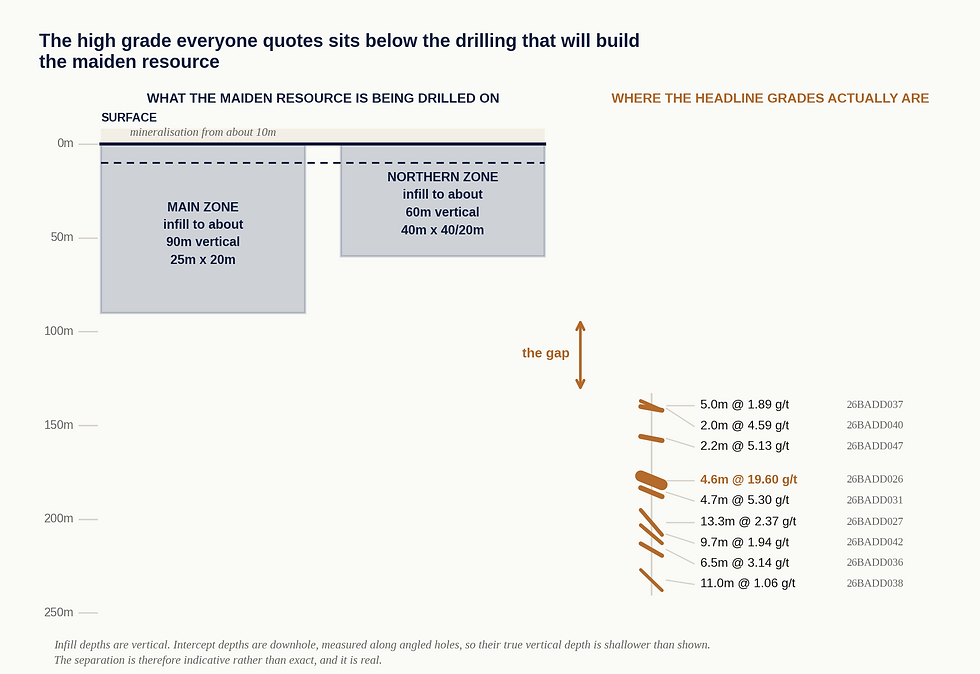
Figure 8. The same point as a picture. The shaded boxes are the depth the resource infill drilling actually reaches. The orange marks are the deep intercepts Ordell has reported, including the 4.6m at 19.60g/t that is quoted more than any other number in this story. They sit two to three times deeper than the grid being drilled to support the maiden estimate. Note the caveat printed on the figure. Infill depths are vertical, intercept depths are downhole along angled holes, so the separation shown is indicative rather than exact. Samso Research Media House, built from Ordell Minerals ASX releases of 29 April, 30 July and 17 August 2026.

Figure 9. The infill drilling planned for August and September 2026. Blue squares are proposed reverse circulation holes. The tighter the spacing, the higher the confidence class a resource estimator can assign. Source: Ordell Minerals ASX release, 17 August 2026, Figure 6.
Grade continuity has to hold at that tighter spacing. This is the real test of the program and it is the one investors most often skip past. Wide-spaced drilling that finds high grades and infill drilling that confirms them are two different results, and the second is much harder to achieve. Ordell's own stated objective for the Main Zone drilling is "to confirm continuity of mineralisation, particularly higher-grade zones identified to date". That is the company naming the risk itself, which we would rather see than not.
And a processing route has to emerge. A resource without a plant is an asset held for someone else's benefit until a deal is done.
What can go wrong
The resource comes in smaller or lower grade than the drill headlines imply. This is the most likely bad outcome. It would be a re-rating rather than a failure. Nuggety high-grade intercepts get top-cut. Downhole widths become true widths. Ounces in a resource are always fewer than the sum of the excitement that preceded them.
Two words in that paragraph do a lot of work, so here is what they mean.
Top-cut, also called grade capping. Gold is unevenly distributed, and a deposit like McNabs East throws up the occasional extreme assay. Ordell has reported 1m at 182.3g/t and 0.8m at 89.43g/t. When a geologist builds a resource model, each drill sample is used to estimate the grade of the rock around it. If a single 182g/t sample were allowed to do that unchecked, it would push a very high grade across a large volume of rock that almost certainly does not contain it. So the estimator replaces the extreme values with a lower ceiling before estimating. That is the top-cut.
The consequence for a reader is simple. The average grade in the reported resource will be lower than the average of the raw drill results, sometimes materially lower, and that is not the company being conservative. It is standard practice and a resource that did not do it would be the one to worry about.
True width. A drill hole almost never meets a mineralised zone at right angles. It cuts through at an angle, so the length of the intersection measured down the hole is longer than the actual thickness of the zone. That real thickness, measured square to the body, is the true width. A 22.7m intercept reported down the hole could be a body considerably narrower than 22.7m, and how much narrower depends on the angle, which depends on the geometry.
Every intercept quoted in this workup is a downhole length, because that is what Ordell has published. True widths are not yet known, and they will be, because a resource model has to work in real thickness rather than in drill metres. Again this is normal reporting, not a company failing. It is a reason not to picture the deposit as thick as the intercepts sound.
The company has to raise money on a soft share price. Ordell had A$8.2 million at 30 June and is spending it fast on a 14,000m program. Its own Appendix 5B estimate of 5.0 quarters of funding was calculated on a quarter with a third of the current drilling rate. A raise during 2027 should be treated as the base case, not the downside case. Whether it is done at A$0.475 or at a post-resource price is the question, and the answer is not in the company's control.
The 80.3 per cent gets forgotten. Ordell's share of any Barimaia resource is four fifths. The remaining interest sits with the joint venture partner.
The open pit turns out to be smaller than it sounds, or does not stand up at all. Ordell has drilled shallow mineralisation from about 10m below surface and describes it as having potential to be extracted by open pit. Nobody has yet tested that with a pit optimisation, which is the engineering exercise that works out how much waste rock has to be moved to reach the ore and whether the result makes money at a given gold price. No pit optimisation has been published, no strip ratio has been published, and no mining study has been completed. The word "potential" is doing all the work in that sentence.
Gold falls. The Australian dollar gold price has already fallen about a fifth from its January 2026 peak. There is no reason to assume it has stopped.
The other projects absorb attention. Goodia and Fisher South are 100 per cent owned, which makes them tempting. Barimaia is 80.3 per cent owned and is the only asset near a resource. Spending on the two early projects while the flagship needs infill drilling would be a strategic error. There is no evidence Ordell is making it. The prospectus comparison in Section 2 shows the opposite pattern, and Figure 10 is what that spending buys on the ground.

Figure 10. Reverse circulation drilling at the McNabs East Main Zone in May 2026, with the town of Mount Magnet on the horizon. The proximity in this photograph is the practical argument for Barimaia. Source: Ordell Minerals ASX release, "Ordell Expands Prospective Footprint at Barimaia Gold Project, WA", 20 May 2026, Figure 3.
15 What Would Change Our View
We would rather commit in advance to what we are watching than explain afterwards why the outcome fitted the thesis.
Things that would strengthen the case. A maiden Mineral Resource delivered in the December 2026 quarter as promised. A substantial share of that resource classified as Indicated rather than Inferred. An average grade at or above about 1.5g/t across a shallow, contiguous body. Infill results that confirm the higher-grade zones rather than diluting them. Any announced arrangement, at any stage, with an owner of processing capacity. Assays from the pending holes, including 26BADD038 below 238m, that extend the system without moving it deeper than a pit can reach.
Things that would weaken it. The MRE slipping out of the December quarter without a clear reason. A resource dominated by Inferred material. Infill drilling that fails to reproduce the grades from wide-spaced holes. A capital raising at a discount to the current price before the resource is published. A pit optimisation, when one appears, showing a strip ratio that makes the shallow material uneconomic. Any material change to the 80.3 per cent joint venture interest.
Things we would ignore. Single very high-grade intercepts. Soil anomalies at Goodia. Tungsten at Fisher South. Gold price commentary. None of these will decide whether Ordell works.
16 Samso Concluding Comments
Ordell Minerals is an exploration company doing the ordinary work of exploration well, at a moment when the market has stopped paying attention to it.
The case for looking now is a timing case rather than a value case. Ordell has spent two years drilling and has put the first formal count of what it has found on the calendar for the December 2026 quarter. Between now and then the company will publish infill assays, and after that a resource. That is a defined sequence of events with a defined end point, on a stock that has already given back most of what it gained in January. Investors who wait for the resource will be reading the same news as everybody else on the day it lands. Investors who look now are looking at a company where the evidence is already public and the conclusion is not yet drawn.
What supports that timing. A deposit of the same style, in the same host rock, is being mined 6km away, which is as close to a working analogue as an explorer gets. The metallurgy was tested early and came back free milling, with extraction above 95 per cent after 48 hours at a relatively coarse grind, which removes one of the standard ways a project like this dies. The drilling is systematic rather than opportunistic, and the sections show a body that starts near surface and continues. The balance sheet is unlevered and the register is tight. The board has done this before, together, at Genesis, and the Managing Director is drilling a project he bought once already and never thought was finished.
What argues against it. There is no resource, so there is nothing to value and nothing we would value if there were. The company owns 80.3 per cent of the asset, not all of it. The high-grade intercepts are nuggety and short, and the resource will be top-cut. The intervals are downhole lengths and true widths are unknown. A capital raising during 2027 should be assumed. The open pit is a stated potential, not a study. And the only processing solution that makes near-term development plausible depends on an arrangement with a third party that nobody has announced. We searched Ramelius' ASX announcements, its Mt Magnet Hub and Eridanus project pages and Ordell's own announcements on 2 September 2026, and found no reference to ore purchase or toll treatment between the two companies. Absence of a public reference is not proof that no conversation exists, and it is all we can report.
On balance the Samso Call is TIME TO LOOK AT TAKING A POSITION. That call describes attention, not action. It says the sequence of events between now and the December quarter is worth watching closely and that the work required to form a view is worth doing now rather than after the announcement. It is not a recommendation to buy, it does not carry a price, and it does not carry a valuation. Samso publishes neither.
The thing we would say to anyone reading this before the maiden resource lands is the thing this piece has tried to say throughout. The evidence Ordell has published is good enough to justify a resource estimate. It is not yet good enough to tell you how big that resource will be. Those are different sentences, and a great deal of money in the junior gold sector is lost by people who read the first one and hear the second.
17 Disclaimer
The information contained on this website is the writer's personal opinion and is provided to you for information only and is not intended to or nor will it create/induce the creation of any binding legal relations. There may be a conflict of interest present with commercial arrangements with companies and/or stock held. Samso or an associate may receive a commission for funds raised. The information or opinions provided herein do not constitute investment advice, an offer or solicitation to subscribe for, purchase or sell the investment product(s) mentioned herein. It does not take into consideration, nor have any regard to your specific investment objectives, financial situation, risk profile, tax position and particular, or unique needs and constraints. Accordingly, no warranty whatsoever is given, and no liability whatsoever is accepted for any loss arising, whether directly or indirectly as a result of this information. Investments are subject to investment risks, including possible loss of the principal amount invested. The value of the product and the income from them may fall as well as rise. You may wish to seek advice from an independent financial adviser before committing to purchase or invest in the investment product(s) mentioned herein.
 The Samso Way – Seek the ResearchHere at Samso, we pride ourselves on delivering content for investors that is independent and informed by over three decades of experience in the industry. Our content is well-researched and is only created if I see merit in discussing the company's story. Our mission is simple. Cut through the noise and spotlight what matters. Genuine stories, grounded insights, and real opportunity. Investors can explore our four core platforms:
There may be numerous paths to success in investing, but the common thread among successful individuals is that they remain committed to making informed decisions. Equip yourself with the right knowledge and tools, and you will be well on your way to achieving your financial goals. The Samso Philosophy: Stay curious. Stay sharp. And remember, digging deeper always uncovers the real value. Happy Investing, and the only four-letter word you need to know is DYOR. DisclaimerDisclosure of interest. Samso Research Media House holds a small shareholding in Ordell Minerals Limited (ASX: ORD). This workup was not commissioned by Ordell Minerals and Samso received no payment from the company for producing it. This Samso Research Workup is independent research commentary for general information only. Nothing in this document is financial product advice, and it does not take into account any reader's objectives, financial situation or needs. Figures are drawn from public sources believed reliable at the stated dates but are not guaranteed; market-sensitive numbers change daily. Seek professional advice before making investment decisions. About SamsoSamso is a trusted platform that equips dedicated investors with up-to-date industry knowledge and insights from top CEOs and thought leaders. Samso Research | www.samso.com.au | An Investor Lens on ASX-Listed Companies |


Comments