
AI and Dementia: How Artificial Intelligence Is Changing Diagnosis, Care and Early Detection

Updated: 1 day ago
Dementia is one of those global health issues that quietly grows in the background until it becomes impossible to ignore. It does not carry the drama of a sudden outbreak or the headlines of a breakthrough cancer drug, but its impact is profound. It affects memory, judgement, independence and identity. It affects families as much as patients. It changes the economics of healthcare systems. Most importantly, it grows with age, which means ageing societies around the world are facing a challenge that is structural, not temporary.
The World Health Organization estimates that more than 55 million people live with dementia globally, with nearly 10 million new cases every year. It is now one of the leading causes of disability and dependency among older people worldwide.

Figure 1: Application of AI in the healthcare scene is now a norm with an influx of technologies and strategies to utilise the age of Scientific Intelligence. (source: Phillips)
There is now enough coverage on AI working in the healthcare providing the very essence of productivity, chatbots, software automation and market hype. When we talk about AI, I don't feel that is still in one particular field of business. There is now no doubt in 2026 that Ai is in every conceivable business globally.
The use of AI for the management of Dementia is not about replacing doctors or neurologists. It is being developed to help detect disease earlier, improve diagnostic accuracy, support carers and make healthcare systems more efficient.
Personally, the use of AI may still be inefficient in the field of dementia as I don't think that the actual diagnosis of dementia is set in stone yet. There are theories out there but I am yet to be convinced. Lets see what the research tells us.
Why Dementia Is So Difficult to Diagnose
One of the realities often overlooked by the public is that dementia is not a single disease. It is a syndrome caused by multiple underlying conditions. The most common cause is Alzheimer’s disease, but vascular dementia, Lewy body dementia, frontotemporal dementia and mixed pathologies are also common.
That complexity matters.
![Figure 2: Survival probability differed across primary etiologic diagnoses of dementia types. (source: [2])](https://static.wixstatic.com/media/8d6c37_e17d978200a64d0cab0140bf32c74b71~mv2.jpg/v1/fill/w_953,h_543,al_c,q_85,enc_avif,quality_auto/8d6c37_e17d978200a64d0cab0140bf32c74b71~mv2.jpg)
Figure 2: Survival probability differed across primary etiologic diagnoses of dementia types. (source: [2])
Two people can present with similar memory problems yet have different underlying causes. One may respond to certain treatments, another may not. One may progress slowly, another rapidly. This is why diagnosis can take months, involve specialist referrals, imaging, cognitive testing, blood work and family history.
Hence, it is very easy to understand that in many countries, there are simply not enough specialists to manage the growing demand.
This creates a gap between what medicine knows and what healthcare systems can deliver.
That gap is where AI is beginning to work.
AI as a Diagnostic Assistant, Not a Replacement
A landmark 2024 study published in Nature Medicine [1], developed an AI system trained on multimodal patient data to distinguish between multiple dementia causes. The system used combinations of medical history, cognitive testing, imaging and other available information.
The significance was not just accuracy. The model was able to work with incomplete data sets, which reflects real-world medicine where every patient does not arrive with perfect records.
Researchers also found that when neurologists used the AI system alongside their own judgement, diagnostic accuracy improved materially versus clinicians working alone.
What this study may represent here is that the human touch is still critical as every person that shows some signs of dementia is different. Real world situations will show that the age and the severity of the symptoms will vary greatly.
Another study in 2024 which was published in Communications Medicine [2], developed machine-learning models to predict dementia patient mortality. The results showed that it may be possible to predict whether a patient diagnosed with dementia will survive or die within 1, 3, 5, or 10 years. The study found that the prediction models can work well across patients from different parts of the US and across patients with different types of dementia.
In the study [2], results showed that regardless of whether or not dementia patients suffered from cancer or heart conditions, global CDR (Global Clinical Dementia Rating) score remained significantly associated with mortality, suggesting that even among dementia patients with comorbidities (i.e., other causes of death such as cancer and cardiovascular disease), dementia-related causes are likely still the dominating factors of mortality (Figure 3)
.
![Figure 3: To illustrate the relationship between dementia severity and survival, we performed a survival analysis based on global clinical dementia rating (CDR) scores (Fig. 1C). The overall median survival time in global CDR score at 0 was not reached, with 5- and 7-year survival rates of 93.7% and 90.1%, respectively. The overall median survival time in global CDR scores at 1, 2, and 3 was 141.8 months (95% CI 128.8–NA), 75.0 months (95% CI 69.0–81.0), 27.3 months (95% CI 25.3–29.3), respectively. With increasing global CDR score, which represents more severe cognitive impairment, patients generally showed worse outcomes. (source: [2])](https://static.wixstatic.com/media/8d6c37_884cdbc2167a4babbd79218ac98b5ba1~mv2.jpg/v1/fill/w_931,h_538,al_c,q_85,enc_avif,quality_auto/8d6c37_884cdbc2167a4babbd79218ac98b5ba1~mv2.jpg)
Figure 3: To illustrate the relationship between dementia severity and survival, we performed a survival analysis based on global clinical dementia rating (CDR) scores (Fig. 1C). The overall median survival time in global CDR score at 0 was not reached, with 5- and 7-year survival rates of 93.7% and 90.1%, respectively. The overall median survival time in global CDR scores at 1, 2, and 3 was 141.8 months (95% CI 128.8–NA), 75.0 months (95% CI 69.0–81.0), 27.3 months (95% CI 25.3–29.3), respectively. With increasing global CDR score, which represents more severe cognitive impairment, patients generally showed worse outcomes. (source: [2])
Ultimately, the study [2] revealed that machine-learning models have utility in predicting dementia patient mortality at various survival-time thresholds. Parsimonious models (a statistical or machine learning model that achieves the best balance between predictive power and simplicity, using the fewest possible predictor variables to explain a phenomenon. It follows the principle of Occam's razor, favoring simple models over complex ones to avoid overfitting, improve interpretability, and ensure the model generalizes well to new data.) can be developed when limited clinical features are available, and dementia type-specific models can be used for distinguishing heterogeneous patient populations. If cross-validated and carefully implemented at the primary care level, such predictive models can improve personalized care of dementia.
What this study highlighted was that the key predictive factor was a memory test, which is already used to diagnose and stage dementia. The ability of these models to identify dementia patients at a heightened risk of mortality could aid clinical practices, potentially allowing for earlier interventions and tailored treatment strategies to improve patient outcomes.
Again, this is still telling us that the use of AI is assisting rather than replacing traditional healthcare practices. From personal experiences, dementia has yet shown why there is an increasing diagnosis rate recently. I feel the use of AI with its ability to churn through data and compare and contrast will help highlight any trends that could be used as a predictive tool in the future.
The Value of Earlier Detection
Dementia care has historically been reactive. Families notice symptoms late. Doctors assess when decline is visible. By then, progression may already be advanced.
AI may help shift the timeline earlier.
Researchers are now using machine learning models to analyse subtle patterns in:
speech changes
writing behaviour
gait and movement
retinal scans
MRI patterns
electronic health records
cognitive test trends over time
For example, recent research in Nature Portfolio showed AI systems using retinal imaging could identify early Alzheimer’s disease and mild cognitive impairment using non-invasive eye scans. The logic is simple: the retina can reflect vascular and neurological changes linked to the brain.
This matters because cheaper, faster and scalable screening tools may allow earlier referral pathways.
In practical terms, that could mean years of extra planning time for patients and families.
Why This Matters Financially
The dementia story is not only medical. It is economic.
Late diagnosis often means crisis management: emergency admissions, carer burnout, accelerated residential care needs and higher hospital costs.
Earlier diagnosis can support:
medication management
home modifications
family planning
risk reduction strategies
structured care pathways
clinical trial recruitment
Governments know this. So do insurers and hospital systems.
If AI can improve earlier recognition at scale, it becomes an economic tool as much as a clinical one.
That usually attracts investment.
AI in Daily Dementia Care
Another area growing quietly is AI-enabled support tools for carers and aged care providers.
This includes systems that can monitor behavioural change, identify wandering risk, detect falls, optimise medication reminders and personalise communication prompts.
Generative AI may also help produce memory prompts, simplified conversations, multilingual support and caregiver training tools.
These uses may not be glamorous, but they are commercially relevant because they solve labour shortages in aged care and improve quality of life.
The Risks That Cannot Be Ignored
Medical AI must deal with privacy, consent and bias forma sample that is not the same as the typical medical data sample sets. Dementia patients will be vulnerable, and many lose decision-making capacity over time. Any system collecting voice data, movement data or medical history must meet a higher ethical standard.
There is also the issue of false positives. Telling someone they may be developing dementia when they are not can create psychological harm. Missing a real case can delay care. As the process is not about cure, one may say why is it important to diagnose it?
In a world that is fast demanding evidence due to the speed of broadcasting news, responsible deployment will be extremely cautious and this may delay outcomes.
Where Investors Should Look
For investors, the AI-dementia theme is broader than a single stock pick.
It can sit across several sectors:
diagnostic imaging companies
digital health software
hospital workflow providers
aged care technology platforms
wearable sensor businesses
pharmaceutical trial-enrolment platforms
cloud healthcare infrastructure
Some opportunities may not market themselves as dementia businesses at all. They may simply own enabling technologies that happen to solve dementia-related problems.
That is usually where markets are slowest to price value.
How Samso Sees the Story
The market often chases AI stories linked to advertising, social media or speculative software multiples. Those sectors may generate headlines, but healthcare creates stickier value when products work.
Have a look at Echo IQ Limited (ASX: EIQ). They are an AI company that is in the "medical" arena by providing a data-driven healthcare business building a scalable diagnostic platform anchored in real clinical need.
The main business for Echo IQ is in the cardiovascular diagnostics space, using artificial intelligence to analyse echocardiograms and assist physicians in identifying complex conditions such as aortic stenosis and heart failure.
Check out the Coffee with Samso with Echo IQ:
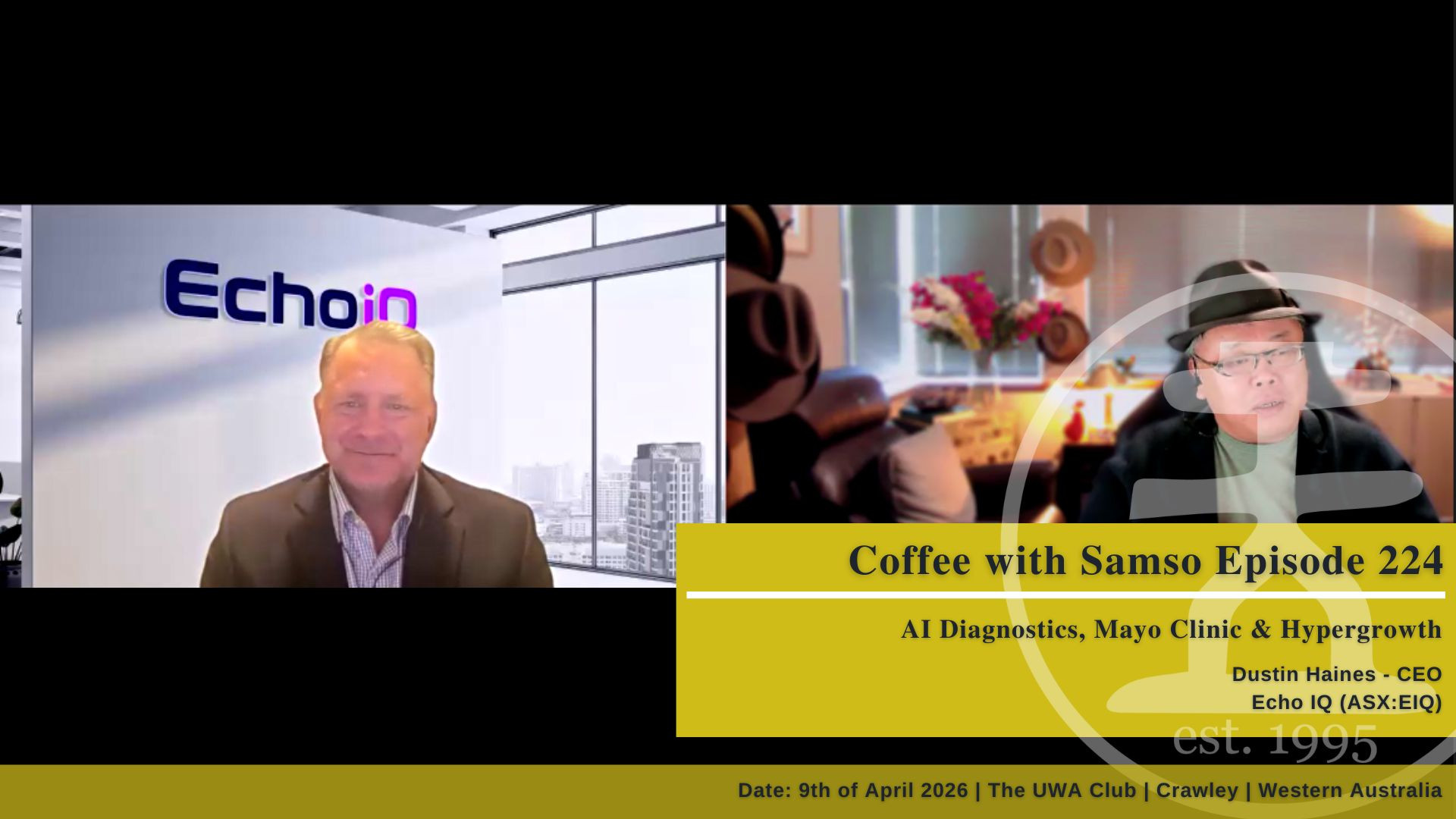
What investors need to look out for is to recognise a story that has a tool that can save clinician time, improves diagnosis and lowers system cost, customers tend to keep paying.
Dementia is also not cyclical. It is linked to demographics. Ageing populations in Australia, Japan, Europe, China and North America make this a long-duration structural theme.
That means the demand side of the equation is unlikely to disappear.
The harder question is which companies can turn useful science into scalable commercial products.
That is where investors need discipline.
Samso Concluding Thoughts
Artificial intelligence will not cure dementia. It may never “solve” dementia in the simple sense many headlines suggest but it will definitely do something equally important.
What AI is required to do is to help detect decline earlier and allow doctors to work faster and more accurately. What carers will want is to help them manage overwhelming workloads and governments will want to reduce cost pressures on healthcare systems already under strain.
For investors, look out for a story that is not dramatic but show a clear incremental, useful and valuable commodity that will make a difference to the stakeholders in the unfortunate world of dementia.
Finding a story that can solve someone's headache are the best investment stories of all.
Sources & References
Xue, C., Kowshik, S.S., Lteif, D. et al. AI-based differential diagnosis of dementia etiologies on multimodal data. Nat Med 30, 2977–2989 (2024). https://doi.org/10.1038/s41591-024-03118-z
Zhang, J., Song, L., Miller, Z. et al. Machine learning models identify predictive features of patient mortality across dementia types. Commun Med 4, 23 (2024). https://doi.org/10.1038/s43856-024-00437-7
Cover photo: 23 0048618 Convair Negative Image - Brain scan (53837199668), San Diego Air & Space Museum Archives. Public domain, via Wikimedia Commons (https://commons.wikimedia.org/wiki/File:23_0048618_Convair_Negative_Image_-_Brain_scan_(53837199668).jpg). Reproduced photograph, shown faded under a navy overlay on the article thumbnail.
The Samso Way – Seek the Research
Here at Samso, we pride ourselves on delivering content for investors that is independent and informed by over three decades of experience in the industry. Our content is well-researched and is only created if I see merit in discussing the company's story.
Our mission is simple: cut through the noise and spotlight what matters—genuine stories, grounded insights, and real opportunity.
Our content is well-researched and is only created if the team sees merit in discussing the company or concept. Investors can explore our three core platforms:
There may be numerous paths to success in investing, but the common thread among successful individuals is that they remain committed to making informed decisions. Equip yourself with the right knowledge and tools, and you will be well on your way to achieving your financial goals.
Most importantly, investors need to be absolutely diligent in understanding their own risk-reward tolerance and capabilities. Never bite off more than you can chew. As they say, Rome wasn’t built in a day, and the Great Wall stood because it took centuries to complete.
The Samso Philosophy:
Stay curious. Stay sharp. And remember—digging deeper always uncovers the real value.
In Life, there is no such thing as a Free Lunch.
Never bite off more than you can chew is my parting comment.
Happy Investing, and the only four-letter word you need to know is DYOR.
To support our independent nature of our work, please head over to our Support Page and give us a helping hand in any of the ways listed. This is a new initiate for the Samso Platform, and it was always the concept of Samso when we started this journey in 2018.
Disclaimer
The information or opinions provided herein do not constitute investment advice, an offer, or solicitation to subscribe for, purchase, or sell the investment product(s) mentioned herein. It does not take into consideration, nor have any regard to your specific investment objectives, financial situation, risk profile, tax position and particular, or unique needs and constraints.
Share to Grow: Your Bonus
Samso has just released an eBook: How to Add Value to your Share Portfolio
A lesson on geological models sought by mining companies that gives insight and an understanding of which portfolios are better - and potentially more lucrative – investments. Click here to download this eBook.

If you find this article informative and useful, please help me share the information. I try to write about topics that are interesting and have the potential to be of investment value. It is not easy to find stories that fit those parameters. If you or your organisation sees the benefit of what Samso is trying to achieve and has a need to share your journey, please contact me at noel.ong@samso.com.au.
Samso is a trusted platform that equips dedicated investors with up-to-date industry knowledge and insights from top CEOs and thought leaders. By staying informed on business advancements and market trends, investors can enhance their financial decisions through a combination of expert guidance and their own research.


Comments