SAMSO
INDEPENDENT RESEARCH MEDIA FOR THE ASX. DEPTH OVER HYPE.

Samso Search Results
Search this site
1101 results found with an empty search
- Innovation and Efficiency in Tourism & Airline Industry due to COVID-19
Rooster Talk Episode 6 with Andy Jiang Andy Jiang and I crossed paths about 10 years ago. I wanted to reach out to him to get his views on Tourism and the Airline industry as he has extensive experience in this sector. He was with Tourism Australia for 5 years and has since been working as a consultant within the same sector. Andy shares some great insight into what is happening now and the post-COVID-19 period. Andy Jiang is an independent consultant who enjoys developing new ideas and framing new perspectives to help businesses think differently. Prior to having his own adventure, Andy ran the China operation at Tourism Australia, responsible for growing China to become the largest inbound visitor market for Australia. Before that, Andy ran Deloitte’s China business unit in Australia, responsible for attracting strategic investments for energy, resources and agriculture projects. A Shanghai native from Texas, Andy is fluent in Mandarin, has a CFA designation, received MBA from INSEAD and loves trading foreign currency. PODCAST Disclaimer The information or opinions provided herein do not constitute investment advice, an offer or solicitation to subscribe for, purchase or sell the investment product(s) mentioned herein. It does not take into consideration, nor have any regard to your specific investment objectives, financial situation, risk profile, tax position and particular, or unique needs and constraints. Read full Disclaimer. www.samso.com.au If you find this article informative and useful, please help me share the information. I try and write about topics that are interesting and have the potential to be of investment value. It is not easy to find stories that fit those parameters. If you or your organisation see the benefit of what Samso is trying to achieve and have a need to share your journey, please contact me on noel.ong@samso.com.au. About Samso
- Compliance, Disclosure and Marketing in the ASX with COVID-19
Rooster Talk Episode 4 with Ivy Chen, Principal Consultant, CSA Global In this session of Rooster Talk, I am talking to Ivy Chen who is the Principal Consultant in CSA Global. Ivy comes with a wealth of knowledge in this industry and has worked for a good time with the Australian Securities & Investments Commission (ASIC). Ivy and I have had many conversations over the years about the whole issue or corporate compliance and continuous disclosure of companies in the ASX. I have found her to be a person with very practical advice to the complicated and important issue within the ASX listing rules. This is a very candid and informative conversation which was great fun. PODCAST Disclaimer The information or opinions provided herein do not constitute investment advice, an offer or solicitation to subscribe for, purchase or sell the investment product(s) mentioned herein. It does not take into consideration, nor have any regard to your specific investment objectives, financial situation, risk profile, tax position and particular, or unique needs and constraints. Read full Disclaimer. www.samso.com.au If you find this article informative and useful, please help me share the information. I try and write about topics that are interesting and have the potential to be of investment value. It is not easy to find stories that fit those parameters. If you or your organisation see the benefit of what Samso is trying to achieve and have a need to share your journey, please contact me on noel.ong@samso.com.au. About Samso
- GDP (Grossly Deceiving People)
Written by Adam Smith Shoe Ask anyone to share with you what they know about economics and chances are Gross Domestic Product (GDP) will get a mention. Ask an economist what is GDP in private, and you will hear that it is a lousy measure but better than nothing. GDP has been around long enough to provide relativity for analysts, commentators and joe-public alike. But it is still a lousy way to measure. Here’s why. I refer to the three letter GDP acronym as a measure that “Grossly Deceives People.” One and all sell it as THE measure of economic health to all and sundry. In reality, it is an easily gamed measure that incentivises poor choice and compounds mal-investment. Take Australia’s record 24+ years of uninterrupted positive GDP. Politicians in government spruik this as a miracle of fiscal government engineering. How long? Note how the line stays above zero after 1992 in the above chart. Peel back the GDP numbers, like most economic measures, and the miracle is how miraculous politicians have been in getting away with the GDP deceit. For the average person a good outcome is to be able to get on with life, contribute their bit, have some R&R in between, and accumulate some wealth. Pretty basic stuff. One would “think out loud” (sic.) that a quarter of a century of faultless positive GDP would translate into a citizens paradise. Surely a nation of utopian wonderment? Far from it, and the public is waking up to the GDP deceit; too late for many. Manipulating the GDP spin is easy. For example, as GDP goes up, so too goes up the nation’s wealth. Great! Take that growing wealth and divide by the population number means not so great for Australia. You see aggregates like GDP are deceitful unless pulled apart and put through comparative analysis. A stagnant population with upward GDP is a population where the benefits per-capita are going up. That’s a good thing; only that is not what happens in Australia. True, GDP has been positive for 25 years or so, but so too has net immigration. And the “net” of net migration dispersal across Australia is narrowed to two cities; Sydney and Melbourne. That means GDP for these population centres in NSW and Victoria is excellent, per-capita GDP, not so. Immigration is just another of the three card tricks in the GDP game. Add more people to a country, and you can add the new arrivals as a percentage directly to the GDP number. What? If GDP was stagnant at 0%, but you allow an influx of migrants, adding 1.5% to the population total, guess what? GDP goes from 0% to +1.5%. Clever isn’t it. Population growth through net positive internal population growth plus positive overseas migration to Australia has subsumed any clarity GDP measurements can provide business and the general public. Back out population stuffing from the GDP number and Australia looks like an ossified economy creeping to a halt. As I type this Australia’s population will reach 25 million souls; 30 years ahead of schedule. Thanks to bringing forward population growth to support the positive GDP narrative, GDP has remained upward, even though Government as a share of the economy now makes up 25% of activity. (Federal – ex-State and Local). Significant manufacturing is all but dead, but for a few outposts, if it wasn’t for extractive industries the whole economy would be transfer payments (welfare), government pork barreling infrastructure like roads, and not much else. What has Australia got to show for 25 years of continuous positive GDP? Infrastructure demand out-weighs the ability of government to deliver or indeed even fund it. One new person requires about $350,000 of immediate infrastructure. Yes, really. All these new souls have brought the miraculous GDP growth rate to a tipping point where growth can’t keep pace for per capita benefits to wash through. Combine the cost per person in new infrastructure demand and it the word Ponzi scheme comes to mind. GDP based on population stuffing ignores positive and negative “externalities”; a clever economists’ word to describe the unseen impacts of an outcome. Constant positive GDP has given rise, in concert with lower inflation, to cheap interest rates. The negative externality of cheap debt causes the maximalist behaviour in house owners; borrowing up to their eyeballs to “climb the property ladder”. Population stuffing has created demand for housing, add low-interest rates, and you get a housing boom, great if you are an existing owner, not so if you aspire to be one. For some, owning a home means moving State or relocating to regional centres far away from familiar family and friendship ties. Theoretically possible, but in an age of me, me, me, there’s little chance we will see wholesale migration out of the bulging State capital in NSW or Victoria any time soon. Positive GDP, great for housing but only if you can afford it. GDP masks productivity changes too. Australia’s productivity index is flattening out at 100. That’s terrible news; productivity should be the primary driver of positive GDP (The P is Product). A quarter of a century of comfortable economic conditions gives rise to inefficiency and idleness. Australia’s workers are going backwards in productivity, at a time when the machine age is encroaching on workers one and all. Not a healthy combination. Negative GDP means recession and recessions are aren’t they? Well, yes recessions are bad, Western Australia has been in one for four years, but thanks to seasonal adjustment revised numbers – another of the card tricks on offer. The data for WA GDP at a State level is massaged monthly so that no two following measures come out negative, thanks to revising the previous one every time the new one comes out. Don’t believe me? Check it out yourself. Laughable. The recession in WA has left households in negative equity territory, retail sales flat to negative and unemployment at around 6-7% depending on the workforce participation rate changes. Greater efficiency and less price gouging are positives for WA out of the four-year contraction in the State economy. Want a house built? Now is the time, the fat in the building industry is gone, gone, gone. For WA the GDP con has delivered a recessionary environment that encourages efficient allocation of resources. Not so in the East. Light rail in Sydney, road contract cancellations with billion-dollar penalties etc, the “other side” of the Federated States and Territories is living in an altered universe. Eventually, the GDP game will be up, no amount of population stuffing and gaming the system can keep it together. Jobs growth is another favourite. Politicians think politicians create jobs. No, they don’t, sorry for the truth syrup. But in taking the credit for the upside politicians must accept they also take the blame for any contraction too. Insofar as successive Governments have hung their shingle on positive GDP as a thing entirely of their making, any shift to the downside is their fault also. Dream on! But dreams, in this case, will come true, in the next term of Federal Government (3 years) the chances of a recession are pretty high. As such, the winner of the next election might turn out to be the loser if the public doesn’t buy the line that the recession was not their fault. The “Gross Deception of People” is about to get more deceptive. Watch this space. Disclaimer The information or opinions provided herein do not constitute investment advice, an offer or solicitation to subscribe for, purchase or sell the investment product(s) mentioned herein. It does not take into consideration, nor have any regard to your specific investment objectives, financial situation, risk profile, tax position and particular, or unique needs and constraints. Read full Disclaimer. www.samso.com.au If you find this article informative and useful, please help me share the information. I try and write about topics that are interesting and have the potential to be of investment value. It is not easy to find stories that fit those parameters. If you or your organisation see the benefit of what Samso is trying to achieve and have a need to share your journey, please contact me on noel.ong@samso.com.au. About Samso
- Grade is King… Or Is It?
This is an updated post from Sam Ulrich. The mining industry mantra “Grade is King” is often used, especially in the gold industry. But is it true? Do higher gold grades automatically mean lower costs, potentially higher profits and possibly better returns for investors? What sounds so simple in theory is not in reality. At the single mine scale, the grade is king holds true. All the costs of extracting the gold and sustaining the operation, known as the All-in Sustaining Cost (AISC) on a per ounce basis varies with gold grade, where at higher grades, AISC is lower and vice versa. But when collectively comparing the Australian gold industry as a whole, such a relationship is not transferable between deposits. For example, in the September 2016 quarter the Gwalia gold mine processed ore grading 10.00g/t producing 67,118oz of gold at an AISC of A$774/oz (US$587/oz) and the Mt Rawdon gold mine processed ore grading 0.99g/t producing 24,878oz of gold at an AISC of A$764/oz (US$579/oz). Both of these mines will be two of the lowest cost gold mines in the September 2016 quarter, and yet their grades are an order of magnitude different. Most mines in Australia will have gold grades between these two mines and will have AISC higher, than these two mines. Collectively as an industry “grade is king” does hold true at the ore processing stage, but not at the ore mining stage (Figure 1). Knowing this, additional geological factors other than grade must have an influence over the operating cost structure of the mining operation. The minable geometry of the orebody generally decides the mining method, which influences costs, what derives this minable geometry? Answer, structure, mineralisation style(s) and grade. These factors combined with scale (size of the orebody) determine the costs. A good way to get a feel for this is what is the average gold ounces per vertical metre. Differences obviously exist between open pit and underground operations and the operations that use both mining methods. Whenever you hear that a gold resource is of good grade and better than, ding, ding, ding projects/mines, ask the additional important questions, what is the underlying structure, mineralisation style, scale of the deposit and how many average gold ounces per vertical metre does that relate to? It is easy to pull out a so-called comparable selection of deposits to show a gold resource in good light with respect to grade, but it does not mean it is any good. For an excellent recent summary of the Australian and New Zealand gold industry for the 2016 June quarter check out. http://www.cet.edu.au/news-and-media/news/news-details/2016/09/02/ravensgate-cet-gold-operations-bulletin The author, Sam Ulrich is a consultant geologist with over 20 years’ experience, primarily in mineral exploration, resource development and mineral asset valuation in Australia and Asia. He is presently undertaking a PhD part-time at The University of Western Australia, investigating the geological controls on the operating cost structure of Australian and New Zealand gold mines. The aim is to link economics with geology to understand the drivers of competitive advantage between gold deposits. He is contactable at sam.ulrich@research.uwa.edu.au LinkedIn Profile https://www.linkedin.com/in/samulrich Disclaimer The information or opinions provided herein do not constitute investment advice, an offer or solicitation to subscribe for, purchase or sell the investment product(s) mentioned herein. It does not take into consideration, nor have any regard to your specific investment objectives, financial situation, risk profile, tax position and particular, or unique needs and constraints. Read full Disclaimer. www.samso.com.au If you find this article informative and useful, please help me share the information. I try and write about topics that are interesting and have the potential to be of investment value. It is not easy to find stories that fit those parameters. If you or your organisation see the benefit of what Samso is trying to achieve and have a need to share your journey, please contact me on noel.ong@samso.com.au. About Samso
- Mineral Exploration , An Essential process - Why do we do it ?
In 2009, I sought out to list a company on the ASX with the sole determination to discover the next gold mine or the next commodity mine. I looked at the market and decided that the best commodity is gold for the uncertainty and the fact that it has been over sold. The other was Uranium and that was because I believed that the cleanest and most efficient form of future energy is nuclear. Now, I was correct in predicting that the pricing of gold and uranium (Figure 1 and 2) would rise and the market will be there if you discovered the deposit. Now the fact that we could not find that deposit was the problem…… Although the uranium price did tank after Fukushima so technically, we could have found the deposit but the market was just not interested… :-). My story is not different to that of many explorers looking for a go, some come and go and some come and become monsters, such as Sirius Resources Limited (ASX:SIR), Sandfire Resources Limited (ASX:SFR; Figure 3), and maybe ………….. well nothing else really…….There are many other success stories but I cannot remember any significant discoveries that would fall into a “blind discovery” story, I am more than happy to accept the ones that have forgotten….. just a sign of old age….. I guess, Great Central Mines with Bronzewing and Jundee could well fall into that category but that is going back to the early 1990s. However, in my opinion, the Nova story is the most impressive and I am sure, every exploration geologist would like to write as his or her own. I for one, would have liked that to be my story, but it belongs to Mark Bennett and the Sirus team. The exploration process or sequence is pretty well captured by a article written by Brendan Jephcott in Linkedin. It is a well written article and gives the reader a good understanding of how it went from a grassroot exploration project to a major discovery that is worth every dollar spent in exploration. (https://www.linkedin.com/pulse/nova-bollinger-ni-cu-deposit-brief-history-brendan-jephcott-{e84228ce8c9f7001611629be1db85467cf541581cf1fd5424de0612b3249e3f5}E4{e84228ce8c9f7001611629be1db85467cf541581cf1fd5424de0612b3249e3f5}B8{e84228ce8c9f7001611629be1db85467cf541581cf1fd5424de0612b3249e3f5}81{e84228ce8c9f7001611629be1db85467cf541581cf1fd5424de0612b3249e3f5}E4{e84228ce8c9f7001611629be1db85467cf541581cf1fd5424de0612b3249e3f5}B8{e84228ce8c9f7001611629be1db85467cf541581cf1fd5424de0612b3249e3f5}81) A couple of YouTube videos of Mark Bennett is excellent for those that are interested. The presentation is made to the Australian Institute of Geoscientists so its a geological presentation. What is a good note is that in the Q and A part, you can pick up that the discovery is primarily a test and see method. His title of WHO DARE WIN is exactly what EXPLORATION is all about and that is why I loved the Nova story. Presentation of the discovery by Mark Bennett – https://www.youtube.com/watch?v=TIk3nCBtuC4 Q and A with Mark bennett after his presentation – https://www.youtube.com/watch?v=TGryOpjM2o8 Sandfire has a similar story but my point is that there has not been many major discoveries in recent time that is worth mentioning. There have been success stories where companies have extended mineralisation in old mined deposits or discovery of major deposits within the mineralsied zone. Probably the best is that of Trident Gold Mine which was discovered by Avoca Resources. It had a resource of over 900,000oz. The company discovered the deposit after near mine exploration. The other is the Invincible deposit discovered by Gold Fields Australia just south of “Kambalda Goldfields”, (http://diggersndealers.com.au/wp-content/uploads/2014/03/GoldfieldsDiggers-Dealers-Invincible-FINAL-for-DD-Presentation-Copy.pdf). The AUSIMM published a very interesting article in 2015 titled, ” Tackling the crisis in mineral exploration” https://www.ausimmbulletin.com/opinion/tackling-the-crisis-in-mineral-exploration/“ This is a very economic article on the merits of exploration and why exploration is very important, complicated and expensive. I would strongly recommend a good read as this will really caputre the real essence of why we need to explore. It makes a very interesting read and it highlights out the increasing cost of discoveries. I believe that the cost of discoveries are due to many factors such as greater depth, greater difficulties in finding deposits, greater cost of labour…etc However, the lack of discoveries is significant as that means the rate of replenishment is not being met and in many circumstances, the supply is going to be lacking behind demand. With this in mind, expenditure into exploration will need to increase in the near future and all the neglected advanced exploration projects will eventually demand value and those that sit on the sideline now will be regretting this lack of movement now. For those who wants to understand who I consider a modern day prospector who has made persistent prospecting a real success, have a look at this …… Mark was a prospector for almost 20 years before his first major win and that was the Bronzewing Gold deposit which he sold for about AUD150M. It was another 20 years before his next win and that was the Nova Nickel Deposit, and I think he sold his remaining share for a total win with Nova of about AUD600M+. https://www.youtube.com/watch?v=yABf8vBW6LA On a final note, this is what exploration is all about on a small sacle…. just for fun, watch this………. https://www.youtube.com/watch?v=QXahfkEia2g https://www.youtube.com/watch?v=wrz-Qf-WM-c Disclaimer The information or opinions provided herein do not constitute investment advice, an offer or solicitation to subscribe for, purchase or sell the investment product(s) mentioned herein. It does not take into consideration, nor have any regard to your specific investment objectives, financial situation, risk profile, tax position and particular, or unique needs and constraints. Read full Disclaimer. www.samso.com.au If you find this article informative and useful, please help me share the information. I try and write about topics that are interesting and have the potential to be of investment value. It is not easy to find stories that fit those parameters. If you or your organisation see the benefit of what Samso is trying to achieve and have a need to share your journey, please contact me on noel.ong@samso.com.au. About Samso
- The End of Outdated Resumes
This week I have decided to go off tangent and introduce an associate of mine who works and lives in the exciting city of Dubai. Maria Kanakrieh and I met in 2013 on one of my many investor relations trip and we have kept in touch sporadically. I was surprised to find out that Maria is now an IT guru with the launch of her own App. I was automatically intrigued with what is it and how she started this journey with multiple questions. So I invited Maria to share her thoughts on the journey and her App. Maria Kanakrieh began her career in a specialist marketing role, before shifting to a business development role which services all sizes of businesses in the Middle East. The positions allowed her to gain great relationships with many local and international companies ranging from SME to corporate. After joining the investment industry, Maria has been able to connect and coordinate opportunities ranging from oil and gas, confectioneries and mining. After a few years in the industry, Maria decided to pursue the entrepreneurship road where she is currently focusing on tech business ideas. The End of Outdated Resumes by Maria Kanakrieh Finding the right job might sound like a dream come true to many, whilst finding the right candidate – better yet, team player, is one of employers’ toughest jobs. They say, hire people smarter than you, hence why many dedicated much of their time and resources to go through hundreds if not thousands of resumes and dissect experiences of those beings, on a piece of paper! Fascinating stuff. LinkedIn has successfully been able to cater to the professional world and been one of the most used platforms to connect to potential candidates. They mastered the art of taking an outdated resume and plugging it on the web for easier access, plus added some pretty cool features to make it more social. Major thumbs up where simple creativity had put them on the map of superbly successful companies. The question is, is it not an outdated method? Aren’t many candidates losing their chance of being hired due to reasons such as not enough degrees because of money issues, or, not enough exposure to corporate companies because they did not attend elite schools and colleges, the list can go on. My co-founder (Laith Al Hassan) and I spent some time trying to figure out how we can begin our entrepreneurship journey with a cool business idea that would be useful. That is when some funny and crazy ideas started bouncing off during our brainstorming sessions. A shorter version of the story ends with us thinking about our close friends always asking us to hook them up with job openings. They were all great individuals; smart, presentable, hardworking – the whole package! Why were they unable to secure interviews from sending through their resumes? Because they were not even given a chance to show their personalities. They were only being judged by a piece of paper – that, let’s be real, sometimes includes information that is exaggerated and not interesting. It is, after all, a piece of paper. With social media’s popularity over the past few years, and peoples’ obsession with their smart phones and stalking – I mean, watching other peoples’ moves online, came the idea of our first business. Clipme – think about resume, in a clip form (and yes, it is pronounced similar to resume with the accent). Clipme is an app that allows anyone looking for a job, to upload a 20 second clip of themselves. One can simply pitch themselves and enjoy their 15 seconds of fame (hence why we went with ’20 seconds’ – close enough). Once their clip goes live, employers can simply scroll through the different categories of jobs and double tap on the clips of candidates they fancy to connect with. Sounds interesting? Would you like to know more? Check out www.clipmeintl.com Please feel free to contact Maria through www.clipmeintl.com or email me on noel.ong@samso.com.au and I will make the connection for you. Disclaimer The information or opinions provided herein do not constitute investment advice, an offer or solicitation to subscribe for, purchase or sell the investment product(s) mentioned herein. It does not take into consideration, nor have any regard to your specific investment objectives, financial situation, risk profile, tax position and particular, or unique needs and constraints. Read full Disclaimer. www.samso.com.au If you find this article informative and useful, please help me share the information. I try and write about topics that are interesting and have the potential to be of investment value. It is not easy to find stories that fit those parameters. If you or your organisation see the benefit of what Samso is trying to achieve and have a need to share your journey, please contact me on noel.ong@samso.com.au. About Samso
- Diamond Exploration - Webb Diamond Project, Australia
Coffee with Samso Episode 30 with Thomas Reddicliffe, GeoCrystal Limited In this episode I talk to diamond industry veteran Thomas Reddicliffe of GeoCrystal Limited, who currently works on the Webb Diamond Project. I was keen to interview Thomas because diamonds and diamond exploration have been missing from geological conversations for many years, although in that time there have been many good diamond discoveries. In fact, I have to go back as far as the mid-1990s to recall when diamond exploration was openly discussed. The current investment environment seems to be good for diamonds and Thomas was the ideal industry insider to ask about this. Webb Diamond Project is one of the most exciting diamond explorations of recent times, giving enough vectors to a potential source of diamond-bearing Kimberlites. However, although drilling has confirmed the presence of Kimberlites, the prize of these diamond-bearing Kimberlites is still elusive. Thomas didn’t disappoint in his information-filled conversation, with great insights into the ins and outs of diamond exploration. Key points of his interview include: A northern section of the Webb field contains “a tantalising spread” of microdiamonds, the best indicator of diamonds GeoCrystal has invested more than AUS$4 million so far in the project and would benefit from additional investment Many targets remain to be tested in the Webb field, which has ideal geology and mineral chemistry for diamonds, and optimism is high for discovery In fact, Thomas gave me so much information it was difficult to edit it all – so this is a longer-than-usual interview. I hope you find it an interesting object lesson in diamond exploration and its investment potential. PODCAST Disclaimer The information or opinions provided herein do not constitute investment advice, an offer or solicitation to subscribe for, purchase or sell the investment product(s) mentioned herein. It does not take into consideration, nor have any regard to your specific investment objectives, financial situation, risk profile, tax position and particular, or unique needs and constraints. Read full Disclaimer. www.samso.com.au If you find this article informative and useful, please help me share the information. I try and write about topics that are interesting and have the potential to be of investment value. It is not easy to find stories that fit those parameters. If you or your organisation see the benefit of what Samso is trying to achieve and have a need to share your journey, please contact me on noel.ong@samso.com.au. About Samso
- Mining Halloysite in South Australia
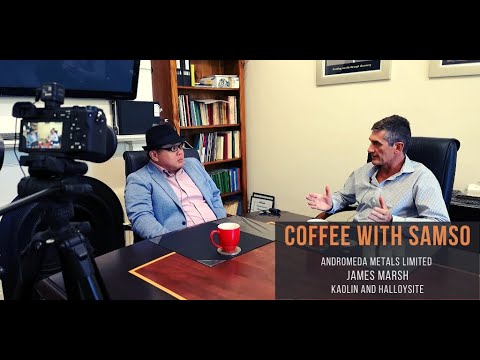
Coffee with Samso Episode 31 with James Marsh, Managing Director, Andromeda Metals Limited (ASX:ADN) This interview with James Marsh of Andromeda Metals Limited was important to me, because I consider Andromeda to be a unique beast in the mining jungle. It’s one of the very few companies that can confidently claim to be close to mining, despite using processes I’ve always considered simple. My opinion’s based on experience of working in the corporate mining sector over the past 15 years and becoming frustrated with the mentality of companies who mine deposits without feasibility studies or proper drill-out phases. They do this to satisfy investors by getting rewards as quickly as possible, but in all cases I know it’s ended in tears. In Andromeda’s case the timeframe is similar, though not as complicated as a typical mineral project. There’s an element of just digging up and sending it on the back of a truck – proper due diligence is there, but it really is almost that simple. James Marsh was able to shed light on Andromeda’s process and detail the company’s activities in the coming months. Highlights include: We’re switching from dry to wet process, which can give a massive boost to numbers The whole world is a potential market for us, we have interest from Europe, Asia and the Middle East We meet with the government regularly and they’re very happy with what we’re doing We have a government-funded project to research Halloysite use in high pressurised storage systems for hydrogen transport, a potentially huge market PODCAST Disclaimer The information or opinions provided herein do not constitute investment advice, an offer or solicitation to subscribe for, purchase or sell the investment product(s) mentioned herein. It does not take into consideration, nor have any regard to your specific investment objectives, financial situation, risk profile, tax position and particular, or unique needs and constraints. Read full Disclaimer. www.samso.com.au If you find this article informative and useful, please help me share the information. I try and write about topics that are interesting and have the potential to be of investment value. It is not easy to find stories that fit those parameters. If you or your organisation see the benefit of what Samso is trying to achieve and have a need to share your journey, please contact me on noel.ong@samso.com.au. About Samso
- Digital Media Distribution with Proactive
Coffee with Samso Episode 24 with Ian Mclelland, CEO, Proactive This episode of Coffee with Samso is all about Proactive. Ian Mclelland, who is the CEO of Proactive, was kind and brave enough to have a coffee with me. As most would know, the content that is produced by Samso is published by Proactive. So it was a great privilege to have a coffee with Ian, and learn first hand about Proactive. Surprisingly, the things that Ian had to say was very consistent with Samso. This comment was heartening as it means the views of Samso is current. The conversation was free-flowing, and I am sure you will find it engaging as well. Proactive Proactive enables companies and investors to connect intelligently. Proactive is one of the fastest-growing financial media portals in the world, providing breaking news, commentary and analysis on hundreds of listed companies and pre-IPO businesses across the globe, 24/7. And, uniquely, their renowned multi-media business is complemented by quality events management, smart investor relations delivery and a highly respected research offering. PODCAST Disclaimer The information or opinions provided herein do not constitute investment advice, an offer or solicitation to subscribe for, purchase or sell the investment product(s) mentioned herein. It does not take into consideration, nor have any regard to your specific investment objectives, financial situation, risk profile, tax position and particular, or unique needs and constraints. Read full Disclaimer. www.samso.com.au If you find this article informative and useful, please help me share the information. I try and write about topics that are interesting and have the potential to be of investment value. It is not easy to find stories that fit those parameters. If you or your organisation see the benefit of what Samso is trying to achieve and have a need to share your journey, please contact me on noel.ong@samso.com.au. About Samso
- The Halloysite and the Kaolin Industry - The Myth and Facts
Coffee with Samso Episode 27 with James Marsh, Andromeda Metals Limited (ASX: ADN) In my opinion, Andromeda Metals Limited (ASX: ADN) is one of those companies that have a story so simple the market cant understand. I spoke to James Marsh a few months ago after I published my article on their “clay” business – A simple business in mining Clay – Andromeda Metals Limited (ASX: ADN). In that conversation, I got my first insight into what could be driving the surge in the share price. I was not sure why a “clay” business could harvest all the market interest. I have known about the clay story for a while as there are a lot of known kaolin resources in Western Australia. These resources have never been successful due to logistics. James and I spoke for a while and we agreed to try and catch up for a Coffee with Samso one day. Well, that day has happened in the beautiful city of Adelaide. The conversation was very engaging and we had the longest ever Coffee with Samso. This is a testament to how effective it is to get a story out with the Coffee with Samso format. This is one of the most interesting conversations as I learnt a lot from James and the Kaolinite industry and how Halloysite is positioned in this market. What I can say is that Andromeda Metals has some very natural barriers to entry for new players. The company is very lucky to have someone who knows the end product market and at the same time have had over 30 years of experience with Halloysite. I don’t think these parameters are easily replicated… PODCAST Disclaimer The information or opinions provided herein do not constitute investment advice, an offer or solicitation to subscribe for, purchase or sell the investment product(s) mentioned herein. It does not take into consideration, nor have any regard to your specific investment objectives, financial situation, risk profile, tax position and particular, or unique needs and constraints. Read full Disclaimer. www.samso.com.au If you find this article informative and useful, please help me share the information. I try and write about topics that are interesting and have the potential to be of investment value. It is not easy to find stories that fit those parameters. If you or your organisation see the benefit of what Samso is trying to achieve and have a need to share your journey, please contact me on noel.ong@samso.com.au. About Samso
- Stocks In Play (SIP): Allowing Retail Traders to access real market sentiment
Coffee with Samso Episode 17 with Tony Cunningham and Arnaud Moret In this episode of Coffee with Samso, the conversation was all about Stocks In Play (SIP). SIP is an app and a website. Members can get free live data, news and research and theoretical trades that will allow them to compete with other traders. It is not about competition but collaborating with all traders to get a sense of market sentiment. Market sentiment underpinned by the information about where are the masses going is critical for punters. In today’s online trading environment, SIP provides an independent platform where traders can come and get third party information on the market. Most importantly is the ranking trading leaderboards where members can get “tips” to follow or DYOR. Historically, traders have been relying on Forums, but that has seen some reduction in importance. Today, social media platforms such as Twitter, Whatsapp, Facebook and Wechat have taken a lot of gloss from the old Forum platforms. Samso speaks to Tony Cunningham and Arnaud Moret about what is happening with SIP and what is in store for the future. We talk about the journey and the hurdles that were faced since the start of this story. PODCAST Disclaimer The information or opinions provided herein do not constitute investment advice, an offer or solicitation to subscribe for, purchase or sell the investment product(s) mentioned herein. It does not take into consideration, nor have any regard to your specific investment objectives, financial situation, risk profile, tax position and particular, or unique needs and constraints. Read full Disclaimer. www.samso.com.au If you find this article informative and useful, please help me share the information. I try and write about topics that are interesting and have the potential to be of investment value. It is not easy to find stories that fit those parameters. If you or your organisation see the benefit of what Samso is trying to achieve and have a need to share your journey, please contact me on noel.ong@samso.com.au. About Samso
- Solar Energy - Could we alter the Climate?
Recently, I have been looking at renewable energy applications, especially solar energy. I wondered what is the cost of applying solutions such as those large solar power farms ? Does it affect the environment, does it alter the climate? I know it sounds strange but like all physical matters, there is always a cost of doing business. Solar energy which is the most common of the renewable space is now the norm when talking about non fossil fuel applications. Wind power generation is the next biggest and is also very significant part of the renewable space especially in Europe. Has anyone thought about the possibility of all these changes to the natural equilibrium with habitat changes and land uses that may affect the ecosystem? Could we alter the climate that we are trying to save? The Renewable Infrastructure. Currently we have the following items that help us become green, Solar – solar farms are today growing rapidly and they are growing larger in size. Some of these farms can power up to 200,000 homes. Wind – Wind farms are now slowlly taking a larger role however, I do think that the visual impact and thier inefficiency may limit their purpose in the future. Hydro – This is old technology and it has a great impact on the environment and society. However, it si better than buring coal, or is it? Wave – A very new technology and the real impact is still unknown. There is a fifth component to that list which I consider is green but the general public would not consider it as a green alternative. That fifth element is Nuclear. In 2009, I found information showing that nuclear power has less carbon impact than any know “green” alternative power generation. However, at the 2019 International Business Conferrence, I heard a talk mentioned that that is no longer the case. There is now evedecnce that solar power is getting more efficent and cheaper which is why the use of solar power is growing in popularity. Footprint – Significant or Not ? According to a report entitled “Understanding future emissions from low-carbon power systems by integration of life-cycle assessment and integrated energy modelling”, which I found on www.nature.com, the conclusion was that it is not significant unless you talking about Hydro… 🙂 We find that cumulative emissions attributable to upscaling low-carbon power other than hydropower are small compared with direct sectoral fossil fuel emissions and the total carbon budget. Fully considering life-cycle greenhouse gas emissions has only modest effects on the scale and structure of power production in cost-optimal mitigation scenarios. The study took into consideration emmissions including from manufacture, construction and fuel supply. The study also included nuclear energy. It is obvious that fossil fuels are the main bad energy source, but comparatively, the use of Hydro and Bioenergy are also considered bad. For a climate protection scenario, we project life-cycle emissions from fossil fuel carbon capture and sequestration plants of 78–110gCO2eq kWh−1, compared with 3.5–12gCO2eq kWh−1 for nuclear, wind and solar power for 2050. Life-cycle emissions from hydropower and bioenergy are substantial (∼ 100 gCO2eq kWh−1), but highly uncertain. What surprised me was the significant differentce between, nuclear,wind and solar and that of hydropower and bioenergy. It one thing to say the economic efficientcy of the different power generation types, but I do think that the impact will be on the footprint. The argument against not having a mine operation becasue it harms the environment when you look at farming is one that I find facinating. The footprint of a typical mining operation makes is insignificant when compared to farming. This is the same when you look at solar or wind farms. The lack of Carbon Debt? When people talk about the carbon debt between types of renewable energy, I think the article above see to be a good answer. However, I do feel that people need to look at the longer term ramification of having these large solar and wind farms. The visual environmental impact needs to be considered. Its fine if you have a Sahara desert or a Gobi desert to put these panels. I would think that the large area that is required for these solar farms will cause damage to flora and fauna. In regards to wind energy, some of the wind turbines are huge. According to a report by CNBC, GE is building a turbine that is over 260m tall. It will have a capacity of 12 megawatts and 107m blades. According to GE, they will spend over USD4ooM developing and building over the next 5 years. The turbine will produce over 65GWh annually. That will power about 16,000 European households An article in www.sciencing.com published some very interesting facts, For example, environmental reports underestimated the number of desert tortoises that would be displaced by the Ivanpah Solar Generating System in California’s Mojave Desert. The same solar farm also came under scrutiny when an increasing number of bird deaths were reported on its premises. Many of their wings had been melted or burned off by heat from the solar farm’s mirrors. Being a geologist, we are always made to be the anti-environmentalist. When in fact,we are more protective of the environment. I have always thought that a solar farm is like tree logging, or land farming. You need to clear lots of land. We all know that the ecosystem is one that works hand in hand with all species that exist, so if you take one out, you are going to have an issue. A bit like losing an arm, or a kidney or a liver ? Sounds all very environmentall difficult but even a geologist thinks there must be an alternative :-). I am not saying that we dont have these alternative energy sources but what I am saying is that maybe having solar farms is very primitive? Should we be looking at better ways to use these solutions. Clean energy changing Climate This leads to the most interesting article I have read which glued together my pontification over this subject. The fact that a wind or solar farm could actually change the climate. The bad would be what we have just discussed, which is the habitat and wildlife issue. But there is research going on now that is trying to see if having a solar farm would trigger climate change. They are trying to discover if solar and wind farms may alter the movement of air to a degree that it could create more moisture and allow vegetation to grow where it was not possible. The study is made over the Sahara desert. In principle, this area would be ideally placed to house such a project, as it is sparsely populated and well placed to supply the growing energy demands of Europe, Africa and the Middle East. The researchers found that, when installed on a large enough scale, both wind and solar infrastructure would trigger feedback loops that bring more rainfall and promote the growth of vegetation in the desert. In a region that is already feeling the effects of global warming as the Sahara desert creeps further into the fertile lands bordering it, the scientists say the net effect would be surprisingly positive. If readers think that this is something out of Star Trek movie, the attraction of turning the Sahara desert from a non productive patch of dirt into a ocean of solar panels or wind turbines will happen. It is in breed in the human species to be greedy to make that happen. If that was to happen, the result of more rain, more green will happen. What we dont know is if that is a good thing or a bad thing. No doubt, the positives is that this ocean of solar and wind energy will create so much cheap and useful power to the region. It will change the whole region to productivity that the world will need to feed ourselves. There is a few articles on the reasons why wind and solar farms can bring significant climates changes to the Sahara desert. The one that I found had a clear explanation was that in www.theconversation.com. The Future? As technology becomes smarter and cheaper, there are now a series of panels that are made to line buildings in the big cities. They are classed as smart windows which transfer the sunlight that shines on them to energy. A company in Australia called ClearVue (ASX:CPV) has come up with a patented advanced glazing technology that sits within an activated interlayer sandwiched between two panes of glass. This kind of stuff makes good sense and if commercialised, it will be a big money spinner. Through the combination of special compound materials, the interlayer prevents heat and unwanted solar radiation (UV or Infrared) from penetrating the glass pane. This energy is then redirected to the edge of the glass for controlled distribution and harvesting through conventional PV solar cells, whilst allowing the natural visible wavelength light to pass through largely unaltered. — ClearVue Limited (ASX:CPV) There is a video on their website that gives a good explanation of the technology. Another form of smart windows is one that is made of perovskites. Windows with this material allow windows to be clear on cold days but turns them dark in the hot summer sun. Some groups have mentioned that they can harvest power like solar cells from the windows. Perovskites are materials made of a mix of elements with a particular crystalline structure, and solar cells made from them are nearly as efficient at converting sunlight to electricity as state-of-the-art silicon solar panels: The best ones convert more than 22 of the energy in sunlight to electricity, compared with 25 for silicon. By changing the perovskites’ elemental components, researchers can also control their transparency. What’s more, the starting materials for perovskites are far cheaper than existing solar cells. — www.sciencemag.org Recently, I have also been working on a wave technology concept. It is still in the early stage of commercialisation testing but I can still see a pretty big footprint too. It is smaller than the ones I have seen so at least that is working in the right direction. I have no idea what the solution is but I am sure there are very smart people out there that will have an answer. Conclusion The journey to have a greener energy solution is something that I am in favour. The reality is that the use fossil fuel will be around for probably two more generations and maybe more. In my opinion, the uptake of renewable energy will only accelerate if ggovernmentsforce the population to do adopt the changes. For example, in UK and I suppose most of the advanced countries in Europe, this is very evident and I can see some major changes. However, the point I am trying to highlight is that the human race is damn scared of being extinct. The rush to be green is really driven by the material greed and not the need to be morally green. History tells us that humans will eventually make a real mess of it because our so called “greenness” is rushed because we want the green bills. That's why we continually look back in history and see all the things that we could or should have done better. source: All photos ar sourced from Bing. Disclaimer The information or opinions provided herein do not constitute investment advice, an offer or solicitation to subscribe for, purchase or sell the investment product(s) mentioned herein. It does not take into consideration, nor have any regard to your specific investment objectives, financial situation, risk profile, tax position and particular, or unique needs and constraints. Read full Disclaimer. www.samso.com.au If you find this article informative and useful, please help me share the information. I try and write about topics that are interesting and have the potential to be of investment value. It is not easy to find stories that fit those parameters. If you or your organisation see the benefit of what Samso is trying to achieve and have a need to share your journey, please contact me on noel.ong@samso.com.au. About Samso