
Namibia A Forgotten Uranium Oasis

Updated: 6 days ago
When you look at uranium globally, there are only a handful of jurisdictions that consistently come up in serious conversations—Kazakhstan, Canada, Australia, and Namibia. Although Namibia is well known for its uranium endowment, surprisingly, it is not talked about much as a potential powerhouse.
It is pretty much a place where Paladin Energy Limited (ASX: PDN | TSX: PDN) made its mark and the name John Borshoff comes up when Namibia and Uranium was mentioned. It is also the famous company that the famous Rick Rule talks about making his multiple of bags betting on Paladin.
Here is a part of the Coffee with Samso I did with Rick Rule who recounts his investment in Paladin.
You can watch the whole Coffee with Samso here:
Mr Borshoff built Paladin from an unheralded gold explorer into a uranium producer worth as much as $4.2 billion in early 2007, as it prepared for first production from the Langer Heinrich mine in Namibia. Its shares was less than AUD $0.08 in April 2003 and peaked at $10.80 in April 2007 and that year valued Mr Borshoff’s Paladin stake at more than $200 million.
For me, that was when I first learnt of uranium in Namibia. What I am learning now is that we should be understanding not the scale of Namibia’s uranium endowment, but the concentration of world-class deposits within a single geological province.
What that means is that the Namibia Uranium story is more about the Gods gidt of a mineral system that kept on giving. Its like the Chocolate Factory that keeps delivering. Today, explorationists are all looking for that mineral system that is endowed and carry enough juice to deliver an "endless" gift of metal mineralisation.
The World Nuclear Association data reinforces this mineral system story in Namibia in Figure 1, which also highlights that the mineral system is not Uranium concentric, but a geological feasts that are common in other well know mineral systems like the Kalgoorlie Region, the Pilbara Iron Ore Province, the mega gold systems of the Tintina Province in the Yukon..etc.
Namibia is a powerhouse mining jurisdiction in its own right (Figure 1). There is nothing new about mining in the African coastal nation. It has its fair share of instability but like true form, economics will prevail over the human perversion to lust for power and greed.

Figure 1: Major Mines in Namibia. (source Chamber of Mines Annual Review 2024).
1.0 Namibian Uranium
Uranium was discovered in the Namib Desert in 1928, but significant interest in Rössing only emerged when intensive exploration began in the late 1950s. Rio Tinto identified numerous uranium occurrences and in 1966 acquired the rights to the low-grade Rössing deposit, located 65 km inland from Swakopmund.
Two other important deposits identified during early exploration were Trekkopje, a calcrete deposit 80 km northeast of Swakopmund and near Rössing, and Langer Heinrich, a calcrete deposit discovered in 1973 by Gencor, 80 km inland from Walvis Bay and 50 km southeast of Rössing.
Table 1: Known uranium deposits in Namibia
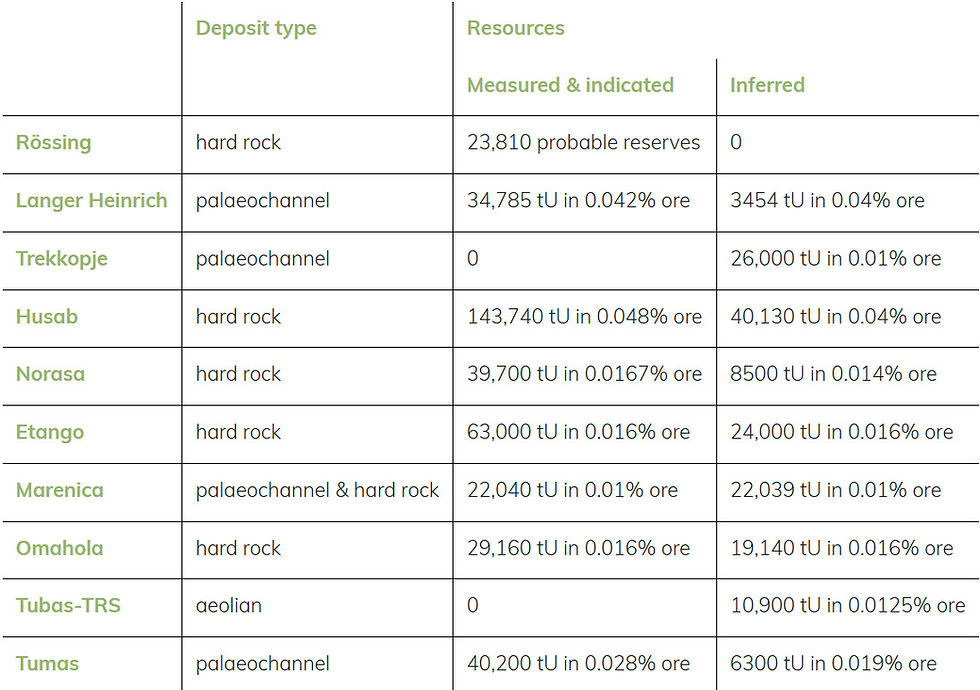
In April 2011, the Namibian government declared that its state-owned mineral exploration company, Epangelo Mining Ltd, would have exclusive control over new strategic mineral developments, including uranium.
However, this does not apply retroactively or equate to the nationalization of existing mines or leases. Both Paladin and Kalahari have expressed confidence that their assets are not at risk of expropriation.
Table 2: Namibian Uranium Production - tonnes U

In April 2012, Epangelo agreed to purchase a share of the Etango project and contribute a corresponding share of development costs. A task force was established in May 2010 by Epangelo and Russia's ARMZ, which briefly appeared to threaten existing developments, but the government provided strong reassurances at that time, which have since been upheld. New exploration licenses will be issued only to Epangelo, and others interested must negotiate farm-ins with it to become joint-venture partners.
From 2007 to 2010, a strategic environmental assessment was conducted over the entire uranium province inland from Swakopmund and Walvis Bay. This assessment covered the entire region and all the projects, resulting in the Strategic Environmental Management Plan, which was implemented in 2011 by the government and individual project companies.
2.0 Global Uranium Distribution – The Reality of Concentration

Figure 1A: Uranium Resources by Country 2021. (source: Mining Visuals)
Uranium, the fundamental fuel for nuclear energy, is hosted by a handful of nations globally (Figure 1A) which is now starting to regain market sentiment. The one and off again conversation for a mineral boom in the quest for the "yellowcake" is starting to gain momentum again. Hence, I would think that these relatively small group of countries that have been fortunate enough to be considered the land of uranium "Milk and Honey" is going to get more attention as the world turns from the heat of the gold rush.
2.10 The Beginning of the No-Carbon Emission Era - The Birth of Clean Energy
Five years ago, the slogan of "Evolution of A New Energy Boom" was being driven by the quest for global reduction in emission and a drive for a carbon-free future was being executed. Everything was about lithium and the critical minerals but the narrative forgot that renewable energy was not going to fuel cities and the giant industrial cities alone.
The tsunami of electrical vehicles and batteries was never the end story. What are you going to use to run base load power to the cities and the industrial cities making global consumption. A conversation that the general public was avoiding. Green activist was having their day in the sun but not realising the realities of base load power was going to be their long term disposition.
The source of what will ultimately be the most cost-efficient and least amount of carbon footprint, nuclear power will be a matter of time. Is it now? or are we going to have to spend more money before we realise our version of the invention of the fire and the wheel?
From a Samso perspective, this is not just a geological observation—it has clear geopolitical and economic implications. When a commodity critical to energy security is controlled by a handful of jurisdictions, the dynamics of supply become as important as the resource itself.
2.10 The Big Players – Where the Uranium Sits
2.11 Australia - The King
An interesting fact is that most people would not realise that approximately 28% of the world’s known uranium resources (1.68 million tonnes) is in Australia. That would make Australia, by far, the largest holder of uranium globally.
The reason for this is geological. Australia’s ancient cratonic architecture, which means the the geological setting, such as regions like the Pine Creek Orogen and the Gawler Craton. The Gods of geology have been good to Australia and created the conditions for uranium to accumulate over long geological timeframes. These are stable, old terrains, and that stability is often where you find large, preserved mineral systems.
What is interesting, however, is not just the size of the resource, but the fact that much of it remains undeveloped (this is mainly a political reason). Deposits such as Olympic Dam, Ranger Mine and Jabiluka Deposit highlight the scale, but policy settings and domestic energy choices have meant that Australia has effectively banked its uranium for the future.
2.12 Kazakhstan – The Production Powerhouse
Second in terms of resource share is Kazakhstan, holding around 13% of global uranium resources.
But this is where the story shifts. Kazakhstan is not just a resource holder—it is the largest uranium producer in the world, supplying close to half of global demand.
The geological model here is very different. Kazakhstan’s uranium is largely hosted in sandstone roll-front deposits, particularly within basins such as the Chu-Sarysu and Syrdarya. These deposits are ideally suited for in-situ recovery (ISR), which is a lower-cost and less invasive mining method.
Kazakhstan shows that how you mine is just as important as what you have. ISR has fundamentally changed the cost curve of uranium supply.
2.20 The Established Tier – Canada, Russia and Namibia
Rounding out the top five are Canada (10%), Russia (8%), and Namibia (8%).
These countries represent the core of global uranium supply, but each tells a very different geological story.
2.21 Canada – Grade is King
The Athabasca Basin hosts the highest-grade uranium deposits in the world. These are structurally controlled systems within ancient sandstones, and they redefine what “high grade” means in uranium.
2.22 Russia – Diversity and State Strategy
Russia’s uranium endowment spans both sandstone and hard rock systems. What stands out here is the state-backed approach to exploration and development, which ensures long-term supply security.
2.23 Namibia – Scale and Consistency
Namibia’s uranium story is different again. The country is characterised by large, low-grade deposits, typically mined via open-pit operations.
Namibia may not have the highest grades, but it has something equally important—scale and continuity of supply. In a tightening uranium market, that becomes a key advantage.
Beyond the Top Five – The Broader Picture
Africa as a whole plays a meaningful role in the uranium space. Countries such as Namibia, South Africa, and Niger collectively account for a significant portion of global resources, reinforcing the continent’s importance in future supply.
At the same time, there are emerging jurisdictions beginning to build relevance. Countries like Mongolia, Uzbekistan, and Ukraine each hold smaller shares, but they represent optional growth in the global uranium pipeline.
Table 3: Namibia vs Global Uranium Peers
Region | Style | Key Strength |
Kazakhstan | ISR | Lowest cost |
Canada (Athabasca) | High-grade | Premium grade |
Australia | Diverse | Large resource base |
Namibia | Alaskite + Calcrete | Scale + stability |
3.00 Why Namibia Is Where You Find Sleeping Uranium Tier-One Assets.
The uranium story for Namibia is still young, even with what seems like a long history. There are large geological provinces potentially hosting multiple deposit styles being supported by existing infrastructure. What this means is that the probablity of new discoveries within the country is still high.
What Namibia has that many "uranium" nations is there are three Tier-1 assets in country as we speak. As the narrative for nuclear power builds, the nation will be benefitting from its long history of large scale production.
Rossing Uranium Mine
One of the longest-running uranium mines globally
Historically operated by Rio Tinto
Now majority owned by Chinese interests
Classic alaskite-hosted system

Figure 2: Rossing Uranium mine. Figure 1: Uranium Resources by Country 2021. (source: Mining Visuals)
The Rossing Uranium Mine is located in the Erongo Region of Namibia, approximately 65 kilometres inland from the coastal town of Swakopmund (Figure 2A). This positioning is not incidental—it places Rossing within one of the most important uranium-producing districts globally.
![Figure 2A: Location of the Rössing Uranium mine in the central Namib Desert, Erongo Region, Namibia. (Rössing Uranium Limited, August 2007). (source: [4])](https://static.wixstatic.com/media/8d6c37_3c39df9935be454fa4308600c00dd15b~mv2.jpg/v1/fill/w_980,h_614,al_c,q_85,usm_0.66_1.00_0.01,enc_avif,quality_auto/8d6c37_3c39df9935be454fa4308600c00dd15b~mv2.jpg)
Figure 2A: Location of the Rössing Uranium mine in the central Namib Desert, Erongo Region, Namibia. (Rössing Uranium Limited, August 2007). (source: [4])
From a logistical perspective, the mine benefits from proximity to:
The deep-water port at Walvis Bay
Established road and power infrastructure
A long history of mining activity in the region
Infrastructure is often overlooked, but in bulk, low-grade systems like Rossing, it is critical to making the economics work.
Geologically, Rossing sits within the Damara Belt, a Proterozoic orogenic belt that has undergone multiple phases of deformation and intrusion. The uranium mineralisation is hosted in alaskite intrusions, which are leucocratic granitic bodies enriched in uranium (Figure 2B).

Figure 2B: Summary of the tectonic setting of the Rössing area: A. Position of the Pan-African Damaran orogen between the Congo and Kalahari cratons. B. Summary of major features of the Damaran orogen taken from Miller (2008), highlighting areas showing highest grade metamorphism—the wider Rössing area occupies a zone of high-temperature, low-pressure metamorphism (arrows on metamorphic zones denote direction of increasing metamorphism). Mineral fields associated with syn- to late-tectonic granites are labeled by principal commodity. C. Selected areas of uranium-rich leucogranites showing general association with the Neoproterozoic Khan Formation and extent of the mapped area discussed in the text. Abbreviations: Bt = biotite, CKZ = Central Kaoko zone, EKZ = Eastern Kaoko zone, nCZ = northern Central zone, NMZ = Northern margin zone, NP = Northern platform, NZ = Northern zone, OL = Okahandja lineament, OML = Omaruru lineament, sCZ = southern Central zone, Sil = sillimanite, SF = Southern Foreland, SKZ = Southern Kaoko zone, SMZ = Southern margin zone, SZ = Southern zone, WKZ = Western Kaoko zone, WL = Welwitschia lineament.
(source: Tim Gray; Judith Kinnaird; Justin Laberge; Alejandro Caballero, Skip Nav Destination, 2021 Uraniferous Leucogranites in the Rössing Area, Namibia: New Insights from Geologic Mapping and Airborne Hyperspectral Imagery. Economic Geology (2021) 116 (6): 1409–1434.)
This same geological setting underpins the broader Erongo uranium province, which includes:
Husab Uranium Mine
Langer Heinrich Mine
Trekkopje Project
The clustering of these large deposit lends to the thought that these large-scale mineral system is capable of generating multiple Tier-1 deposits.
Rossing is one of the longest-running uranium operations in the world, having commenced production in the mid-1970s. Historically operated by Rio Tinto, the mine is now majority owned by Chinese interests, reflecting the strategic importance of uranium supply.
Key operational features:
Large open-pit mining operation
Conventional crushing, grinding and processing
Long mine life supported by extensive resource base
Over its life, Rossing has been a cornerstone of global uranium supply, consistently contributing to the nuclear fuel market.
Rossing is not the highest-grade uranium deposit, nor is it the lowest-cost operation globally. What Rossing represents is the seed in Namibia creating the foundation asset within a globally significant uranium province.
Rossing showed the typical geological attributes of significant systems and that is:
Large, low-grade systems can be economic
Mineral systems matter more than individual deposits
Once infrastructure is established, a region can evolve into a cluster of world-class assets
Rossing to the namibian uranium story is what the discovery of Olympic Dam is to the Australian IOCG province in South Australia, It is like the discovery of gold in Coolgardie that led to the establishment of Kalgoorlie as the Eastern Goldfields of Western Australia.
Effectiovely, Rossing was the starting point of the Namibia uranium story. Everything that followed—Husab, Langer Heinrich, and beyond—sits on the shoulders of what Rossing proved.
Husab Uranium Mine
One of the largest uranium mines in the world
Owned by CGN Mining
Represents modern large-scale uranium development

Figure 3: Husab uranium mine. (source: Slr Consulting)
The Husab Uranium Mine is located in the Erongo Region of Namibia, approximately 60–70 kilometres from the coastal infrastructure hub of Swakopmund and within logistical reach of the deep-water port at Walvis Bay (Figure 3).
As mentioned previously, Husab is hosted within the Damara Belt, the same tectonic and intrusive setting that underpins Rossing. Uranium mineralisation is associated with alaskite intrusions, where uranium is disseminated through granitic bodies formed during Proterozoic tectonic events.
Husab is also an alaskite-hosted uranium deposit, but what differentiates it from Rossing is scale and continuity.

Figure 3A: Domes of the south central zone of Damara orogen belt and their associated primary uranium deposit. (a) Zonation of the Damara orogen belt (modified after Goscombe et al., 2005; Grotzinger et al., 2008); (b) sketch map of the southern central zone showing locations of significant uranium deposits (after Kinnaird et al., 2007).
According to a paper by Xu et. al 2025, three mineralization stages are believed to exist in the Husab uranium deposit: magmatic, hydrothermal alteration, and supergene leaching. Among them, the magmatic mineralization stage is the main stage, and uraninite is the most important uranium mineral.
The uranium minerals formed in this stage include monazite, zircon, and rutile. The uranium minerals in the hydrothermal alteration stage primarily comprise pitchblende and coffinite, while those in the supergene leaching stage include uranothorite, coffinite, boltwoodite, sodium boltwoodite, and uranophane.
Key characteristics:
Very large tonnage uranium system
Low to moderate grades typical of bulk deposits
Mineralisation hosted within extensive alaskite bodies
Amenable to large-scale open-pit mining
Husab is essentially a bigger, more modern expression of the Rossing-style system. It validates that the Erongo province is capable of generating multiple large deposits—not just one.
Husab is one of the largest uranium mines in the world, developed as a modern large-scale operation and currently owned by CGN Mining.
Key operational features:
Large open-pit mining operation
High-throughput processing plant
Designed for long-life, bulk production
Since commencing production in the mid-2010s, Husab has quickly become a major contributor to global uranium supply.
Operational Facts
The Husab project received a mining licence from Namibia's Ministry of Mines and Energy in November 2012 and a groundbreaking ceremony was held at the site in the Namib Desert the following April. The first blasting of rock took place in 2014. Construction of the mine is scheduled to be completed by the end of 2015, with production then planned to ramp up to 5770 tonnes of uranium per year by 2017.
The operation will be an open pit mine with an acid leach process plant on site. The Husab ore-body is claimed to be the third-largest uranium-only deposit in the world. With measured and indicated reserves of about 140,000 tonnes U, Husab is expected to operate for at least 20 years. The mine will comprise of two pits: the Zone 1 pit will be some 3km long, 1km wide and 412m deep; the Zone 2 pit will be about 2km long, 1.3 km wide and 377m deep.
Husab is majority owned by CGN subsidiary Taurus Minerals following its 2012 purchase of former owner Extract Resources. The project is being developed by Extract subsidiary Swakop Uranium, in which Namibian state-owned mining company Epangelo acquired a 10% stake in November 2012.
According to CGN, the Husab mine has sufficient reserves to supply enough uranium to power 20 GWe of nuclear capacity for almost 40 years.
CGN currently has a fleet of ten operating nuclear power reactors with a total installed capacity of 10.5 GWe. It has a further 14 units under construction with a combined capacity of 16.6 GWe.
Husab becomes the fourth uranium mine in operation in Namibia, the others being Rössing, Langer Heinrich and Trekkopje. China National Nuclear Corporation holds a 25% stake in Paladin's Langer Heinrich mine, entitling it to a corresponding share of the project's output.
Langer Heinrich Mine
The Langer Heinrich Mine sits in the Namib Desert, approximately 80 km east of Swakopmund and within the broader Erongo uranium province. This region is one of the most uranium-endowed terrains globally, hosting major operations such as Rössing Uranium Mine and Husab Mine.
From a geological perspective, Langer Heinrich is a calcrete-hosted uranium deposit, which is quite different from hard-rock uranium systems. Mineralisation occurs in paleochannel sediments, where uranium has been mobilised and reprecipitated in near-surface environments under arid conditions.
These deposits are typically:
Shallow
Laterally extensive
Amenable to open-pit mining
This style of mineralisation is characteristic of Namibia and is a key reason the country has become a globally significant uranium producer.
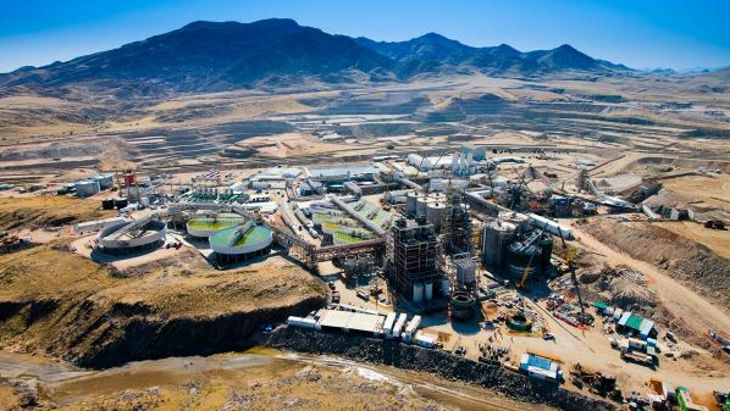
Figure 4: The Langer Heinrich mine. (source: World Nuclear News)
Ownership and Operational History
Langer Heinrich is owned and operated by Paladin Energy Ltd, a name well-known to uranium investors.
Key milestones:
2007: Commercial production commenced
2018: Operation placed on care and maintenance due to low uranium prices
2024: Restart achieved as uranium market conditions improved
The restart is an important signal for the uranium sector, reflecting stronger long-term demand expectations tied to nuclear energy’s role in decarbonisation.
Mining and Processing
Langer Heinrich is a conventional open-pit mining operation. The processing route is tailored to calcrete-hosted ore and differs from many hard-rock uranium mines.
Processing characteristics:
No blasting required (soft material)
Ore is scraped and trucked to the plant
Uranium is extracted via alkaline leaching
Final product is uranium oxide concentrate (U₃O₈)
This relatively simple mining method contributes to:
Lower operating complexity
Predictable production profiles
Scalability depending on uranium prices
Infrastructure Advantage
One of Namibia’s strengths—and something that often gets overlooked—is infrastructure. Langer Heinrich benefits from:
Proximity to the Port of Walvis Bay (export logistics)
Established road networks from Swakopmund
Access to power and water (critical in desert operations)
This is a key differentiator when compared to uranium projects in more remote or politically complex jurisdictions.
Production and Strategic Importance
At steady state, Langer Heinrich has historically produced around:
5–6 million pounds U₃O₈ per year (nameplate scale)
From a Samso perspective, what matters here is not just the number—it’s the consistency and scalability. Operations like Langer Heinrich provide:
Reliable supply into long-term contracts
Optionality to ramp production with price signals
Strategic leverage as nuclear demand grows
Trekkopje Uranium Project – A Low-Grade Giant Waiting for the Right Cycle
Location and Geological Context
The Trekkopje Uranium Project is located in the central N+amib Desert, approximately 70 km northeast of Swakopmund and within the same uranium-rich corridor that hosts Langer Heinrich Mine and Rössing Uranium Mine.
Geologically, Trekkopje is another example of a calcrete-hosted uranium system, formed in ancient palaeochannel environments under arid conditions. What sets Trekkopje apart is scale over grade.
Key geological characteristics:
Extremely large tonnage system
Very low uranium grades relative to global peers
Mineralisation spread across shallow, flat-lying sediments
From a Samso lens, this is classic Namibia—big systems formed by surface processes, not deep hard-rock mineralisation.
Ownership and Project Background
Trekkopje is owned by Orano (formerly Areva), one of the world’s major nuclear fuel players.
Key milestones:
2000s: Project advanced during the uranium bull market
2009–2012: Construction and early-stage production activities
Post-2012: Placed on care and maintenance due to weak uranium prices
Despite significant capital investment, the project has remained idle, highlighting a key theme—not all uranium deposits are equal in a low-price environment.
Mining and Processing Concept
Trekkopje was designed as a large-scale, low-grade bulk mining operation, relying on processing efficiency rather than grade.
Planned/implemented processing approach:
Surface mining (no drilling and blasting required)
Heap leaching using alkaline solutions
Designed to process very large volumes of ore
A major technical feature of Trekkopje is its reliance on heap leach technology, which is essential for making low-grade deposits viable.
However, this comes with trade-offs:
Requires significant water supply
High upfront capital intensity
Economics highly sensitive to uranium price
Infrastructure and Water Challenge
One of the defining features of Trekkopje is not just the geology—but the infrastructure solution required to make it work.
To support processing, the project involved:
Construction of a desalination plant on the coast near Wlotzkasbaken
Pipeline infrastructure to transport water inland
Integration with regional infrastructure networks
This highlights a critical Samso point:
In Namibia, water is often the limiting factor—not the ore.
Samso Concluding Comments
As the world currently struggles with the consequence of the conflict with Iran, we are yet again, forgetting that the rush for a green energy world is still not hitting the right notes, in my opinion. The concept of base load power is still not being addressed and in a place like Australia, there is still a lack of direction on what is required to achieve an independence of the the "dirt fuel". Lets not get into the conversation of can we get rid of the use of hydrocarbons as that is another big discussion.
Lets just do the easy discussion at this moment, are we going to keep increasing our energy cost and play the "renewable" energy game and ignore the environmental and social impact of creating power from renewable sources that many larger economies are now down-playing as an achievable target?
What is looking like a real scenario, and this is where investors on the ASX will want to start looking at is the path towards using nuclear energy. Provinces like Namibia are a unique beast in terms of their source of uranium. Geoscientists and stakeholders in creating mineral resource companies are well aware of finding the right location to set their marketing narrative. An investor who understands the need to be in the right location will already be aware that if you get something within the Damara Belt, the likely chance of finding uranium is going to be high.
However, as we all know, all mineral systems that are worth talking about have a large footprint. A valuable mining project is pretty much less than 5 sqkm and if you look at the mienral provinces globally, whether you are tlaking about urnaium, copper, gold or iron ore, they are always in the 100s and 100s of sqkm.
In my research for this Samso Insight, the most commonly piece of commentary I read was that there has been a lack of exploration outside the "known" deposits. hence, the likes of the Rossing and the Husabs have never been looked oat outside what was discovered and mined currently.
In my opinion, while the land of milk and honey for uranium may be Australia, the current political noise of "Anti-Uranium and Anti-Nuclear" will drive places like Namibia into the higher podium of the "Discover Uranium" status.
The current deposits we have discussed are world class in their own specifications, but the lack of interest and the lack of funding to make Namibia a world class destination for companies like Paladin is now no longer a secret. I am sure there are numerous companies taking positions, and that will make another good Samso Insight in the near future.
Reference:
World Nuclear Association (https://world-nuclear.org/)
Tim Gray; Judith Kinnaird; Justin Laberge; Alejandro Caballero, Skip Nav Destination, 2021 Uraniferous Leucogranites in the Rössing Area, Namibia: New Insights from Geologic Mapping and Airborne Hyperspectral Imagery. Economic Geology (2021) 116 (6): 1409–1434.)
Kai Xu, Guanglai Li, Huaifeng Zhang, Wenming Dong, Xiaodong Liu, Xiongjie Zhang, Bin Wu, Renbo Wang, 2025. Uranium and U-bearing minerals in the Husab uranium deposit in Namibia: Occurrence, composition, age, and implications for uranium mineralization process, Ore Geology Reviews,Volume 182.
BEN GOSCOMBE, DAVID GRAY, MARTIN HAND, Extrusional Tectonics in the Core of a Transpressional Orogen; the Kaoko Belt, Namibia, Journal of Petrology, Volume 46, Issue 6, June 2005, Pages 1203–1241
Wilde, A. Towards a Mineral Systems Model for Surficial Uranium Mineralization Based on Deposits in the Erongo District of Namibia. Minerals 2023, 13, 149. https://doi.org/10.3390/min13020149
Cover photo: Sossusvlei Dunes Namib, Vicartb. CC0, via Wikimedia Commons (https://commons.wikimedia.org/wiki/File:Sossusvlei_Dunes_Namib.jpg). Reproduced photograph, shown faded under a navy overlay on the article thumbnail.
The Samso Way – Seek the Research
Here at Samso, we pride ourselves on delivering content for investors that is independent and informed by over three decades of experience in the industry. Our content is well-researched and is only created if I see merit in discussing the company's story.
Our mission is simple: cut through the noise and spotlight what matters—genuine stories, grounded insights, and real opportunity.
Our content is well-researched and is only created if the team sees merit in discussing the company or concept. Investors can explore our three core platforms:
There may be numerous paths to success in investing, but the common thread among successful individuals is that they remain committed to making informed decisions. Equip yourself with the right knowledge and tools, and you will be well on your way to achieving your financial goals.
Most importantly, investors need to be absolutely diligent in understanding their own risk-reward tolerance and capabilities. Never bite off more than you can chew. As they say, Rome wasn’t built in a day, and the Great Wall stood because it took centuries to complete.
The Samso Philosophy:
Stay curious. Stay sharp. And remember—digging deeper always uncovers the real value.
In Life, there is no such thing as a Free Lunch.
Never bite off more than you can chew is my parting comment.
Happy Investing, and the only four-letter word you need to know is DYOR.
To support our independent nature of our work, please head over to our Support Page and give us a helping hand in any of the ways listed. This is a new initiate for the Samso Platform, and it was always the concept of Samso when we started this journey in 2018.
Disclaimer
The information or opinions provided herein do not constitute investment advice, an offer, or solicitation to subscribe for, purchase, or sell the investment product(s) mentioned herein. It does not take into consideration, nor have any regard to your specific investment objectives, financial situation, risk profile, tax position and particular, or unique needs and constraints.
Share to Grow: Your Bonus
Samso has just released an eBook: How to Add Value to your Share Portfolio
A lesson on geological models sought by mining companies that gives insight and an understanding of which portfolios are better - and potentially more lucrative – investments. Click here to download this eBook.

If you find this article informative and useful, please help me share the information. I try to write about topics that are interesting and have the potential to be of investment value. It is not easy to find stories that fit those parameters. If you or your organisation sees the benefit of what Samso is trying to achieve and has a need to share your journey, please contact me at noel.ong@samso.com.au.
Samso is a trusted platform that equips dedicated investors with up-to-date industry knowledge and insights from top CEOs and thought leaders. By staying informed on business advancements and market trends, investors can enhance their financial decisions through a combination of expert guidance and their own research.


Comments