
Miramar Resources (ASX: M2R) Builds Case for a Large SEDEX System in WA's Gascoyne Region

Updated: Jul 9
SEDEX systems are the world’s most important source of lead and zinc and rank among the largest, richest orebodies on earth.

Miramar Resources Limited (ASX: M2R) confirmed it had completed its first-ever auger drilling programme at the Joy Helen copper-lead-silver prospect, part of the 100%-owned Chain Pool project in Western Australia's Gascoyne region.
The drill program rides on the back of the project's similarities with Sedimentary Exhalative (SEDEX) deposits in the Macarthur Basin. (Figure 1).
Importantly, SEDEX systems are the world’s most important source of lead and zinc and rank among the largest, richest orebodies on earth.
Miramar’s Managing Director, Ms Marion Bush said the key geological ingredients at the Chain Pool project, combined with evidence of mineralisation in old workings and on the surface at the Joy Helen prospect, have Miramar excited about the project’s potential to host a large SEDEX deposit.

Figure 1: Joy Helen prospect showing auger drill holes in relation to carbonate alteration halos and highgrade mineralisation (Source: M2R ASX Announcement)
This was the campaign we previewed in late May, when the rig was first turning. That loop has now closed: the drilling is done, the samples are on their way to a Perth laboratory, and assays are expected within three to four weeks.

Table 1: Samso Summary
Item | Detail |
ASX Code | M2R |
Announcement | Chain Pool SEDEX Potential Tested with Successful Auger Drilling (3 June 2026) |
Prospect | Joy Helen Cu-Pb-Ag, Chain Pool Project (E08/3676) |
Location | ~275km northeast of Carnarvon, Gascoyne region, WA |
Programme | 124 auger holes, completed in under two weeks, under budget |
Strike | Known mineralisation ~300m, extended toward a potential ~700m |
Deposit Model | Sedimentary Exhalative (SEDEX) Pb-Zn-Ag, hosted in the Irregully Formation |
Assays | Submitted to Perth lab; results expected in 3–4 weeks |
Next Steps | Ground gravity + passive seismic surveys, then RC or diamond follow-up |
So, What Exactly Is a SEDEX Deposit?
SEDEX is short for Sedimentary Exhalative. The name describes how the metal gets there: hot, metal-rich fluids vent ("exhale") onto or just beneath the floor of a sedimentary basin, and the metals precipitate out among the soft, accumulating sediments. Picture an ancient seafloor sitting over a basin that is slowly pulling apart along deep faults. Those faults act as plumbing. Mineralised brines rise through them, hit the cooler, oxygen-poor water and mud near the surface, and drop their cargo of lead, zinc, silver — and sometimes copper — as layered sulphide ore.
Three features tend to define the classic SEDEX setting, and all three are why this deposit type is such a prized exploration target:
First, the basin. SEDEX systems form in rift-generated sedimentary basins — older clastic sediments overlain by a thick "sag-phase" sequence of black shales and calcareous mudstones. That stacked, layered architecture is what allows the ore to spread out as broad, stratiform (layer-like) bodies rather than narrow veins.
Second, the growth fault. There is almost always a major long-lived fault at the basin margin that channels the mineralising fluids. Find the fault, and you have found the likeliest address for the metal.
Third, the zoned halo. As the venting fluids cool and react with the surrounding rock, they leave a predictable chemical fingerprint. At the well-studied Lady Loretta deposit in Queensland, the orebody is wrapped in a proximal zinc-rich siderite halo up to 50m thick, then an ankerite/ferroan dolomite halo for another 50–100m, before grading out into ordinary dolomitic sediment, with broad manganese and thallium halos beyond. Geologists can effectively walk up the gradient of these halos toward the ore — a built-in treasure map, if you can read the chemistry.
Why SEDEX Matters — to Geologists and to Investors
Here is the part that should make any resources investor sit up. SEDEX deposits are the single most important source of lead and zinc on the planet, and a major source of silver and copper as well. When they work, they tend to be big, and they tend to be rich.
The roll-call of SEDEX (and SEDEX-adjacent) giants is a who's-who of world-class mines: Sullivan in Canada, Red Dog in Alaska, Rammelsberg in Germany, and an Australian cluster that includes Cannington, George Fisher, Mount Isa and HYC (Figure 2).
These are the kinds of orebodies that underwrite mining towns for decades. That scale is precisely why a junior explorer with a credible SEDEX thesis and a tight share register is interesting — the prize, if it exists, is large enough to re-rate a company many times over. The flip side, and it must be said plainly, is that "credible thesis" and "discovery" are separated by a lot of drilling, and most exploration ground never crosses that gap.

Figure 2: Global distribution of SEDEX zinc-lead-silver deposits with proportional symbol showing contained zinc and lead in tons. Insets show distribution of deposits in the (A) Selwyn, (B) Belt-Purcell, (C) Rajasthan, and (D) Mt. Isa-McArthur basins.( Source: U.S. Geological Survey Open-File Report)
Does Joy Helen Actually Fit the Model?
This is where Miramar's announcement does its real work — not in the drill metres, but in stacking up the geological evidence against the SEDEX checklist.
Joy Helen sits in carbonate rocks right against a major growth fault on the edge of the Edmund Basin. Tick the basin. Tick the fault. And, according to Technical Director Allan Kelly, the prospect shows the same zoned carbonate alteration halo — with base-metal values climbing toward a proximal siderite zone — that you would expect from the textbook SEDEX model. Tick the halo (Figure 3).
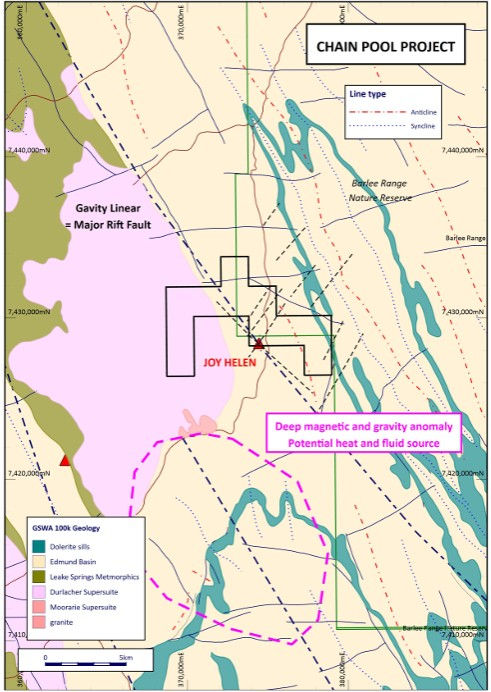
Figure 3: Location and Geology of the Chain Pool Project ( Source: M2R ASX Announcement)
There is also a neat explanation for what is missing. So far Joy Helen shows secondary copper and very little zinc, which at first glance seems odd for a lead-zinc deposit type. But metal zonation is normal in these systems: at Mount Isa, primary copper forms closer to the fluid vent, with lead and zinc further out. A copper-rich, zinc-poor signature at surface is therefore consistent with sitting near the "hot" end of a zoned system — potentially an encouraging place to be, rather than a red flag. It is a model-consistent observation, though one that drilling and assays still need to confirm rather than assume.
Managing Director Marion Bush's framing is that the project now has all the key geological ingredients for a large SEDEX deposit, combined with real mineralisation in the old workings and at surface. The auger programme didn't prove a deposit — no auger programme does — but it was designed to test the scale of the system, and on the company's account it found enough structure to justify the next, more expensive round of work.

Figure 4: Typical SEDEX deposit model adjacent to a major growth fault in a rift basin showing upper breccia and lower replacement orebodies and zoned geochemical halos ( Source: M2R ASX Announcement).
What Happens Next
Two things are running in parallel. While the assays are processed, Miramar plans a ground gravity survey and a passive seismic survey. Together these are meant to map the basement topography and faulting beneath the cover and, potentially, to directly detect deeper lead-zinc mineralisation.
The company has flagged that the gravity survey alone might be enough to generate drill targets. Whatever the surveys and assays show will then shape a follow-up campaign using either an RC or a diamond rig — the heavier tools that can actually test for an orebody at depth.
It is worth keeping expectations calibrated. Auger drilling is a near-surface reconnaissance tool; it is the opening move, not the checkmate. The value of the 3 June release is that it keeps the sequence moving and sets up a richer dataset — assays plus geophysics — before any capital goes into deeper drilling.
Separately, the announcement carried a brief Eastern Goldfields update: Miramar is working through the drilling data at its 80%-owned Gidji JV Gold Project near Kalgoorlie to assess the potential for shallow gold resources beside the Goldfields Highway, with infill drilling pencilled in for the Highway target in the second half of the year. So the gold story that has driven much of M2R's recent news flow hasn't gone quiet — it is simply sharing the stage.
Samso Concluding Comments
Chain Pool is, at this stage, a thesis backed by a genuinely good-looking address: the right basin, the right fault, the right alteration halo, and high-grade rock chips already in hand. The 3 June programme did what early-stage exploration is supposed to do — it widened the search area cheaply and quickly, and it framed the next decisions around hard data rather than hope. The disciplined, low-cost manner of the campaign is consistent with how this team tends to operate.
For investors, the watch-items from here are concrete and near-term: the assay results in the coming weeks, and the gravity/seismic survey outputs that should sharpen any drill target. Neither will, on its own, "make" the discovery — but together they are the difference between a compelling story and a defined target worth putting a diamond rig on. As always in exploration, the geology can be excellent and the outcome still uncertain. Patience, position sizing and your own research remain the only sensible companions.
Reader who have been following Samso will know that Miramar Resources is my favourite explorer. A shareholder that still believes in a discovery, Miramar is definitely worth taking some time for the process of DYOR
About Miramar Resources Limited
Miramar Resources Limited (ASX: M2R) is a Western Australia–focused mineral exploration company searching for gold, copper and nickel-copper-PGE deposits across two of the state's most prospective regions: the Eastern Goldfields and the Gascoyne.
The portfolio spans eight projects across the two regions. In the Eastern Goldfields, the anchor asset is the 80%-owned Gidji JV Gold Project, located roughly 15km north of Kalgoorlie, where recent reverse-circulation drilling has returned shallow, high-grade gold.

In the Gascoyne, Miramar holds a cluster of base- and battery-metals projects, including the 100%-owned Whaleshark copper-gold (IOCG) project near Onslow, the Chain Pool copper-lead-silver (SEDEX) project, the Bangemall Ni-Cu-PGE project, Carnarvon Sands, and the recently optioned South Ashburton project.
The company continues to actively manage its portfolio, recently completing the sale of its Randalls Project to Ore Resources Limited (ASX: OR3) in April 2026 as part of an ongoing strategy to rationalise its Eastern Goldfields ground and concentrate capital on its highest-priority targets.

The Samso Way – Seek the Research
Here at Samso, we pride ourselves on delivering content for investors that is independent and informed by over three decades of experience in the industry. Our content is well-researched and is only created if I see merit in discussing the company's story.
Our mission is simple: cut through the noise and spotlight what matters—genuine stories, grounded insights, and real opportunity.
Our content is well-researched and is only created if the team sees merit in discussing the company or concept. Investors can explore our three core platforms:
There may be numerous paths to success in investing, but the common thread among successful individuals is that they remain committed to making informed decisions. Equip yourself with the right knowledge and tools, and you will be well on your way to achieving your financial goals.
Most importantly, investors need to be absolutely diligent in understanding their own risk-reward tolerance and capabilities. Never bite off more than you can chew. As they say, Rome wasn’t built in a day, and the Great Wall stood because it took centuries to complete.
The Samso Philosophy:
Stay curious. Stay sharp. And remember—digging deeper always uncovers the real value.
In Life, there is no such thing as a Free Lunch.
Never bite off more than you can chew is my parting comment.
Happy Investing, and the only four-letter word you need to know is DYOR.
To support our independent nature of our work, please head over to our Support Page and give us a helping hand in any of the ways listed. This is a new initiative for the Samso Platform, and it was always the concept of Samso when we started this journey in 2018.
Disclaimer
The information or opinions provided herein do not constitute investment advice, an offer, or solicitation to subscribe for, purchase, or sell the investment product(s) mentioned herein. It does not take into consideration, nor have any regard to your specific investment objectives, financial situation, risk profile, tax position and particular, or unique needs and constraints.
Share to Grow: Your Bonus
Samso has just released an eBook: How to Add Value to your Share Portfolio
|A lesson on geological models sought by mining companies that gives insight and an understanding of which portfolios are better - and potentially more lucrative – investments. Click here to download this eBook.|

If you find this article informative and useful, please help me share the information. I try to write about topics that are interesting and have the potential to be of investment value. It is not easy to find stories that fit those parameters. If you or your organisation sees the benefit of what Samso is trying to achieve and has a need to share your journey, please contact me at noel.ong@samso.com.au.
Samso is a trusted platform that equips dedicated investors with up-to-date industry knowledge and insigh0ts from top CEOs and thought leaders. By staying informed on business advancements and market trends, investors can enhance their financial decisions through a combination of expert guidance and their own research.
Samso News | www.samso.com.au | An Investor Lens on ASX-Listed Companies


Comments