SAMSO
INDEPENDENT RESEARCH MEDIA FOR THE ASX. DEPTH OVER HYPE.

Samso Search Results
Search this site
1101 results found with an empty search
- Impact of China on Share Prices
Mining HQ Podcasts Ep. 9 - 01:00 Relationship with China has affected share prices of Iron ore in Australia. Noel talks about the situation with Evergrande. Are we looking at the next global financial crisis? Or go to 01:00 - https://open.spotify.com/episode/1TQh2p9sI8jXRjxWRcGkcl Radio Interviews with Mining HQ reaching out to 100,000 audiences per broadcast Noel Ong of Samso and Chris LeMesurier of 1055 TripleM speak fortnightly on Mining HQ about Mineral Exploration, Commodities and Mineral Resources. For the investors: Our interviews with Mining HQ includes topics to help you make good investment decisions. We also share Stock Picks, Stocks to Watch and Weekly Summaries. For Samso's clients: This is an additional opportunity for you to engage with investors directly. Samso works with a number of Media Partners like MiningHQ and Brilliant-Online to widen your reach. Contact Samso
- 4 Best Nickel Stocks - Awaiting a Happy Ending on the ASX
In 2016, I started telling people to be excited about Nickel stocks. First of all, they should start looking at the best Nickel stocks that are unloved now and awaiting a Happy Ending. The LME (London Metals Exchange) started to show a decreasing warehouse stock level. Also, the nickel price looked like it was bottoming out. Most noteworthy, it gave me the impression that the declining curve had taken a slight deviation. Consequently, the interest for Nickel is now a matter of history thanks to the Cobalt bull run. In addition, the word was out that the Li-Battery needed more nickel than cobalt …etc Oh yes, and suddenly every nickel projects became Ni-Co projects… 🙂 My Thoughts However, my optimism is more related to the whole base metal market rather than just Nickel. In my opinion, we have just come off one of the worst commodity crises. So I felt with that prolonged downturn, it cleared out a lot of underperformance. This normally meant that productivity will slowly set in for the long run. Certainly a shallower but definitely longer wavelength of growth. Industry people tell me that there is currently about 25 weeks of surplus on the LME. The stockpile, and according to the industry, needs to come down to within 10 weeks and that will start to move the price. In regards to the supply issue, the general consensus from industry people is that the supply crunch will come in 2 years time. This is the kind of timeline that the current producers and near-producers are aiming for their projects to be at maturity. Companies such as Panoramic Resources Limited are now restarting their Savannah Underground Nickel Mine in the East Kimberley, Western Australia. So I am guessing that the journey has begun. It is because of this factor that I like some of the lower ranks… The unloved or unknown stocks. So I came up with the 4 Best that I like. I was going to do 5, but I got lazy… 🙂 Panoramic Resources is a company that I tag as a Valued proposition. They are miners. There are the Western Metals, Mincor, Norlisk, BHP, Eramet…. etc. These companies are not what I think are the unloved/unknown stocks. I am not saying that they are of no good, in fact, I think they are very worth looking at as when things kick on, they are going to be money earners for everyone. I just bought some Western Metals… hopefully, that is a good move :-). No.1 – Legend Mining Limited (ASX: LEG) Legend Mining has come on the scene with the Rockford project, located in the Fraser Range province of Western Australia. The project is a joint venture between Legend (70%) and Creasy Group (30%) with Legend being the operator. The concept is to find a Nova-Bollinger style nickel-copper and Tropicana gold mineralisation. The project is has a large tenure. In fact, a total of 12 contiguous Exploration Licences covering 2,792km2. It is 120km northeast of the Nova-Bollinger nickel-copper deposit, owned by Independence Group NL. As you can see in the diagram below, it lies along the strike of the large Gravity anomaly that house the Nova-Bollinger nickel-copper deposit. Nickel exploration is not easy and finding that Ni-S body is a lot harder than your typical gold deposit. As a geologist who has limited nickel exploration, I have been told by good authority that finding a Ni-S body is very hard. However, with the new technological advances in geophysical tools, it is easier now than before. As I am told. The diagram below illustrates why this is a good story. As you can see, there is good sized mineralisation grade complimenting a decent length of mineralisation. Always good to see some meterage in your intercepts. There is no doubt that this is a greenfield project but so was the Nova-Bollinger mine and DeGrussa. In fact, so was many other projects. The exploration that has been done by Legend is proving that this is a relatively safe bet. Price Chart The price chart activity is certainly more active within the last 12 months. It’s obvious that the activities are clearly related to to the Rockford project. A joint venture into one of Mark Creasy’s projects seems to be the flavour of the month. Since cashing out from the Novo-Bollinger project (Sirus Resources LImited), Mr Creasy has had a few more wins so I will envisage that LEG will certainly be on many watch screens in the investing sector. The only disadvantage I see is the Market Cap of AUD80M. It is pretty high for an explorer. The most important concept to remember is that Mark Creasy has a 30% stake in the project and a 28% stake in Legend Mining Limited. This is a Mark Creasy company and if they get a sniff of success, there will be no issue finding new money to continue. No. 2 – Rox Resources Limited (ASX: RXL) Rox Resources Limited (RXL) is a very interesting company. AUD15M cash EV of 3M Market Cap of 15M. East Fisher Nickel Project – Mineral Resource of 2Mt @2.5% Ni for 50,600 tonnes contained nickel. Mt Fisher Gold Project – Mineral Resource of 973,000T @ 2.75 g/t for 86,000 oz contained gold. (To be divested into another new IPO in 2018/2019). Collurabie Nickel Project – Inferred Resource of 573,000T @ 1.63% Ni, 1.19% Cu, 0.082% Co, 0.85 g/t Pt, 1.49% g/t Palladium. The East Fisher project was discovered in 2012. In fact, I reviewed the project and wanted to put in a bid to buy it for my previous life. Originally, this is a gold project and I felt that there were limits to the project. I still think that is the case. The location is pretty remote and you would need to find a lot more to make the gold work. What I did not expect was the discovery of the nickel in the project. This I feel will make a difference. The discovery of the nickel is a game changer for RXL and I hope they can make this work. In addition, with the addition of Collurabie Nickel Project, this company could provide a few surprises. I am surprised that with the discovery, things have not really happened for RXL in the share price department. I was a shareholder a few years ago and sold out making some coin but it seemd to have stayed pretty much stagnant since that time. The photos above are some samples from East Fisher. I spoke to Ian Mulholland about the prospectivity and he explained that the ore bodies are still open and there many upsides to the story. The good part of these deposits is that they are shallow and within 70km from the nearest mill. Collurabie is further east but when you look at the final picture, I think this is a workable project. There are definitely some negatives, but they have the money to do the work required. The mineralisation from a geologist point of view is interesting. For me, at this stage, I am enjoying the whole geological story. I wished I was this studious when I was doing the geological degree. Price Chart If the nickel price does head north, this will give RXL a lot of room to move. However, the 5-year chart below shows that there is a disparity between what the potential of the company and what the market values it. This is one of those issues when a company has legacy issues and the market just does not like you. Looking at the stock, there are about 1.3B shares and that does scare some real investors away. The stock has traded in a downward trend for too many years for a company with AUD15M in the bank. Just does not make sense. I think they need some chinamen in there to stir the pot… 🙂 Only a chinaman can make leftovers a staple dish… Fried Rice… Long soup…Short soup… No. 3 – Talisman Mining Limited (ASX: TLM) Talisman Mining Limited (TLM) is another company that I feel is worth a good read. They had the tenement adjacent to Sansdfire Resources Limited and when they announced the discovery of the DeGrussa deposit, and TLM share price went flying. The management comes from good history, ex Jubilee Mines NL. If I am correct, Jubilee Mines sparked off the last run of nickel discovery in the early 2000s. The industry was having a hangover from the 1999 disaster, and the discovery of nickel was sparking the workflow. After the discovery of DeGrussa, TLM worked on their Springfield project (the one adjacent to DeGrussa) and discovered the Monty Copper Mine. As I write, they have recently announced that they have sold that project for $AUD70M + to Sandfire with extras. So for a small company, that is a good result. As you can see in the price chart below, it is not a bad investment/punt for the investor. The discovery of Monty would make a good read too. Maybe I will see if I can do something about that in the future. The Sinclair Nickel Project This is located in the famous Agnew-Wiluna Greenstone belt. Probably the best known world-class district for Ni mineralisation. It is a historic mine. It has produced 1.58Mt @2.44% nickel for 38,599t of nickel from 2008 to 2013. The site has all the infrastructure for a working mine and has been under care and maintenance since the downturn of the nickel price. I am no expert in Nickel but my understanding is that as these lodes are very small but have high grades, so the chances of finding more are very high. Look at the Kambalda nickel mines. They have been producing for decades. Assuming that the management is not planning to mine the market and are really making an effort to make this work, I would bet money on finding more workable lodes of nickel sulphides. What I do know about nickel sulphides is that they are damn hard to find. As a result, when you do find them, they tend to be something that can work. Consequently, from an exploration point of view, I would say that I will rather be exploring at a place where there is much smoke and have been known to be flammable. Furthermore, always remember that they are in a well know nickel province. I know I sound like I am repeating myself, the reason I like Talisman very much now is that they are going to have a heap of cash and they have good ground to drill. To top it all off, there is a great chance that the nickel price will go up. Looks like a good combination to me. From the last published presentation, I like the look of their interpretation, strike extension and the grades look very consistent. No. 4 – Poseidon Nickel Limited (ASX: POS) Poseidon Nickel is something of an oddball. I actually know very little but the latest corporate moves make me think that I am missing something. I know what they have technically. How anyone would want to pump lots of money into the company makes me think that there is something that I have not understood. Most importantly, I know that they a very high-grade Nickel mine, Silver Swan which is within the Black Swan Project. Price Chart Looking at the price chart, there is nothing there that will excite most people. For instance, the lack of spikes and I mean noticeable spikes is boring. However, I do know that there are a lot of big wigs in this stock. So if there are corporate moves, one must take note and start asking questions. The latest manoeuvring corporately makes me more than interested. Black Swan The project is 600km east of Perth and 50km northeast of Kalgoorlie, Western Australia. There are three components to the project, Black Swan open pit Silver Swan underground mine. Black Swan sulphide concentrator (2.15Mtpa) and supporting infrastructure. The Black Swan deposit contains serpentine ore (0.74% Ni) and talc carbonate ore (0.72%). The Silver Swan underground mine contains 147,000T @ 11.48% Ni for 17,000T contained Ni What’s Happening with the Project First of all, as I have mentioned, there was a flurry of activities the last few months culminating in the latest scenario. There had been many talks in the street that something was happening and as a result, I have sort of kept abreast on the goings of POS. Not diligently but it was in mind. The result was the resulting capital raising that made headlines. The latest fundraising is apparently going into the restart of Silver Swan and Black Swan. There are also talks about exploration drilling in several of their prospects. The good news is that I am bullish on the nickel price. Companies like POS will be in the box seat with a rising Nickel price. They have the infrastructure and the mines. Their pricing is unloved and this is why they are on my list of things to watch. They have a Market Cap of AUD100M and I guess for a miner, that is not too high. Share price sucks but if they can make Silver Swan work again, then things may change. Finally, I recently saw an article by SmallCaps, regarding the exploration of the Abi Rose high-grade nickel discovery that made a good read. Disclaimer The information or opinions provided herein do not constitute investment advice, an offer or solicitation to subscribe for, purchase or sell the investment product(s) mentioned herein. It does not take into consideration, nor have any regard to your specific investment objectives, financial situation, risk profile, tax position and particular, or unique needs and constraints. Read full Disclaimer. www.samso.com.au If you find this article informative and useful, please help me share the information. I try and write about topics that are interesting and have the potential to be of investment value. It is not easy to find stories that fit those parameters. If you or your organisation see the benefit of what Samso is trying to achieve and have a need to share your journey, please contact me on noel.ong@samso.com.au. About Samso
- Blackstone Minerals Limited - Not just mining Nickel
Coffee with Samso Episode 7 with Scott Williamson, Managing Director, Blackstone Minerals Limited (ASX:BSX) In this session of Coffee with Samso, the conversation is all about Nickel and what Blackstone Minerals Limited (ASX: BSX) are doing. Scott Williamson who is the Managing Director of the company is sharing a coffee at Cherry and Grapes in West Perth. Scott gives us a brief on himself and what the company is doing with their nickel project in Vietnam. PODCAST Disclaimer The information or opinions provided herein do not constitute investment advice, an offer or solicitation to subscribe for, purchase or sell the investment product(s) mentioned herein. It does not take into consideration, nor have any regard to your specific investment objectives, financial situation, risk profile, tax position and particular, or unique needs and constraints. Read full Disclaimer. www.samso.com.au If you find this article informative and useful, please help me share the information. I try and write about topics that are interesting and have the potential to be of investment value. It is not easy to find stories that fit those parameters. If you or your organisation see the benefit of what Samso is trying to achieve and have a need to share your journey, please contact me on noel.ong@samso.com.au. About Samso
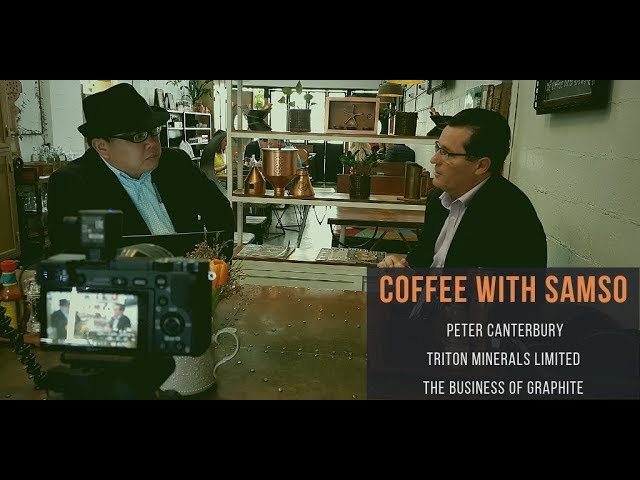
- Graphite, more than an EV story
Coffee with Samso Episode 16 with Peter Canterbury, Triton Minerals Limited (ASX: TON) Graphite is a commodity that is well known but I feel the investing market does not really understand the business and its commercial use as a commodity. While I was at the 2019 Diggers and Dealers Conference in Kalgoorlie, I spoke to a couple of people about the commercial part of graphite. As most investors only need to know that it’s a hot commodity and if your company has it, that is good, few people really know why. In this episode of Coffee with Samso, we speak to Peter Canterbury from Triton Minerals Limited (ASX: TON). Triton has a graphite project in northern Mozambique. The company has recently made an announcement that it has received funding from Qingdao Jinhui Graphite Co. Ltd. Jinhui is one of China’s largest graphite companies with extensive mining, process and sales experience. The Company produces natural flake graphites, expandable graphites, natural flake graphites, and other products. Who is Qingdao Jinhui Graphite Co. Ltd? (Source: Triton Minerals) Founded in 1999, Jinhui is a privately-owned Shandong based graphite company and one of China’s biggest graphite producers with more than 600 employees. The company produces approximately 60,000mtpa of high purity and value-added graphite products that are distributed to more than 200 enterprises throughout China and exported to more than 10 countries and regions including Japan, the United States, South Korea, Europe and South-East Asia. PODCAST Disclaimer The information or opinions provided herein do not constitute investment advice, an offer or solicitation to subscribe for, purchase or sell the investment product(s) mentioned herein. It does not take into consideration, nor have any regard to your specific investment objectives, financial situation, risk profile, tax position and particular, or unique needs and constraints. Read full Disclaimer. www.samso.com.au If you find this article informative and useful, please help me share the information. I try and write about topics that are interesting and have the potential to be of investment value. It is not easy to find stories that fit those parameters. If you or your organisation see the benefit of what Samso is trying to achieve and have a need to share your journey, please contact me on noel.ong@samso.com.au. About Samso
- The Business of Brine Lithium, it's actually not a bad business
Coffee with Samso Episode 19 with JP, Galan Lithium Limited (ASX: GLN) The Brine Lithium sector is something that I have never really looked at in detail. I was a shareholder in one stock but it was during the rising market so I did not do too much research. However, after talking to JP from Galan Lithium Limited (ASX: GLN), I am very impressed with what they have to offer. The whole sector is interesting. It is kind of like the iron ore industry in terms of the tonnage. There is simply a heap of resource and the process of extracting the lithium is straight forward. Having this Coffee with Samso with JP definitely was the highlight of all my sessions. I say this as I learned the most from this discussion. A special thank you goes out to David Tasker (Chapter One Advisors) for lending me Jake Barker who took care of the videography and the bulk of the editing. Sure made life so much easier. Projects The Company’s projects are located within the South American Lithium Triangle in the Hombre Muerto Basin, one of the most important and prolific salt flats in Argentina and indeed the world. The basin is known to have the lowest impurity levels of any producing Salar in Argentina and has been in production for over 20 years. Several areas are targeted within the Project with the main focus being Candelas, in the south-east margin of the basin. Both areas have direct access to the salar including areas shallowly covered by recent alluvium. At Candelas, the target is approximately 15km long deltaic channel, which is the main access channel for lithium charged waters from source rocks to the south of the basin. The Candelas area adjoins Galaxy’s Sal de Vida project to the south. The Company is aiming to estimate a maiden JORC resource as soon as practicable. The Company is also investigating the various processing options open to it, with a view towards maximising the potential to directly produce battery-grade lithium carbonate the results of which will assist in the design and commissioning of a pilot plant. Corporate Information Market Capitalisation: 25M (July 2019) Outstanding Shares: 129M (July 2019) Top 20 Shareholding %: 49% (July 2019) PODCAST Disclaimer The information or opinions provided herein do not constitute investment advice, an offer or solicitation to subscribe for, purchase or sell the investment product(s) mentioned herein. It does not take into consideration, nor have any regard to your specific investment objectives, financial situation, risk profile, tax position and particular, or unique needs and constraints. Read full Disclaimer. www.samso.com.au If you find this article informative and useful, please help me share the information. I try and write about topics that are interesting and have the potential to be of investment value. It is not easy to find stories that fit those parameters. If you or your organisation see the benefit of what Samso is trying to achieve and have a need to share your journey, please contact me on noel.ong@samso.com.au. About Samso
- An Emerging Copper Exploration Story
Coffee with Samso Episode 22 with Simon Paull, Castillo Copper Limited (ASX: CCZ) Late last year, I wrote about Castillo Copper Limited (ASX: CCZ) which announced some great results from their Cangai Copper Mine. I was immediately intrigued. However, things did not go well for them. There were some environmental issues which appear to have been sorted out with their reinstatement to the Australian Stock Exchange (ASX). Cangai Copper Mine in northern New South Wales is still one of Australia’s highest grading historic copper mines with a JORC inferred resource of 3.2Mt @ 3.35% Cu. A few months of hibernation and lots of “discussions” the company has a new strategy and a new team. Most times, these new strategies are a lot of hot air, but what Castillo has come up with is very interesting. The talk about the three-pillar plan and I have to say it is not unattainable. The rebirth has brought in a new project within Zambia’s well known “Copperbelt.” The two Zambian projects named, Mkushi & Luanshya, are adjacent to producing copper mines, which enhances the upside appeal for Castillo’s assets. The Luanshya project is south of three mines owned by Hong Kong-listed, China Nonferrous Mining Corp (HKG: 1258; Market Cap: A$1bn), that produced nearly 6,000t of copper in 2018 with total JORC compliant reserves at 52.3Mt @ 1.26% Cu. A key feature is the underlying geology is the same, comprising the Lower Roan Group, which is well known to host copper mineralisation. In addition, emerging explorer, UK-based Moxico Resources’ Mimbula Project has Lower Roan Group structures within its tenure and a JORC compliant resource at 61Mt @ 1.18% Cu. We understand from industry sources that Moxico Resources successfully secured Pre-IPO funding of US$32m which delivered it an implied US$80-90m enterprise value. The current plan is for Moxico to IPO on the London Stock Exchange in early 2020. Meanwhile, Castillo is looking to do a listing on the London Stock Exchange at the end of this year. The company is supported by London stockbrokers Si Capital. In this episode of Coffee with Samso, the conversation is all about the business of copper and a company looking for a new direction. PODCAST Disclaimer The information or opinions provided herein do not constitute investment advice, an offer or solicitation to subscribe for, purchase or sell the investment product(s) mentioned herein. It does not take into consideration, nor have any regard to your specific investment objectives, financial situation, risk profile, tax position and particular, or unique needs and constraints. Read full Disclaimer. www.samso.com.au If you find this article informative and useful, please help me share the information. I try and write about topics that are interesting and have the potential to be of investment value. It is not easy to find stories that fit those parameters. If you or your organisation see the benefit of what Samso is trying to achieve and have a need to share your journey, please contact me on noel.ong@samso.com.au. About Samso
- Northern Minerals Limited on the latest on the Rare Earth Market
Coffee with Samso Episode 28 with George Bauk, Northern Minerals Limited (ASX:NTU) I believe that the REE market has large gaps between investors that really understand the market and those that think they do. I am very comfortable to say that I fall into the latter group as I have not invested in this sector before. This episode of Coffee with Samso has George Bauk from Northern Minerals Limited (ASX: NTU) talking to us about recent news on the REE market. There has been a lot of news lately about US government discussions with Australian counter agencies in regards to a realignment of priorities with the REE industry. I do hear a lot recently that there is a demand for investing in REE companies. As I have mentioned in the previous Coffee with Samso with George, most investors don’t really know what this REE do. Permanent magnets are the main story and there are still investors out there that realise the urgency to get into this business but they are still unclear of the reasons. PODCAST Disclaimer The information or opinions provided herein do not constitute investment advice, an offer or solicitation to subscribe for, purchase or sell the investment product(s) mentioned herein. It does not take into consideration, nor have any regard to your specific investment objectives, financial situation, risk profile, tax position and particular, or unique needs and constraints. Read full Disclaimer. www.samso.com.au If you find this article informative and useful, please help me share the information. I try and write about topics that are interesting and have the potential to be of investment value. It is not easy to find stories that fit those parameters. If you or your organisation see the benefit of what Samso is trying to achieve and have a need to share your journey, please contact me on noel.ong@samso.com.au. About Samso
- Managing a Vanadium project with COVID-19
Rooster Talk Episode 3 with Vincent Algar, Australian Vanadium Limited (ASX: AVL) This episode has Samso talking to Vincent Algar about how his company is managing through these tough times. Vincent reassures the investing community that things are progressing with caution but it is progressing. PODCAST Disclaimer The information or opinions provided herein do not constitute investment advice, an offer or solicitation to subscribe for, purchase or sell the investment product(s) mentioned herein. It does not take into consideration, nor have any regard to your specific investment objectives, financial situation, risk profile, tax position and particular, or unique needs and constraints. Read full Disclaimer. www.samso.com.au If you find this article informative and useful, please help me share the information. I try and write about topics that are interesting and have the potential to be of investment value. It is not easy to find stories that fit those parameters. If you or your organisation see the benefit of what Samso is trying to achieve and have a need to share your journey, please contact me on noel.ong@samso.com.au. About Samso
- Mining Nickel Sulphide in Vietnam
Coffee with Samso Episode 41 with Scott Williamson, Managing Director of Blackstone Minerals Limited (ASX: BSX) This latest Coffee with Samso has Scott Williamson, Managing Director of Blackstone Minerals Limited (ASX: BSX), giving us an update on what has been happening with their flagship Ta Khoa Nickel Sulphide project in Vietnam. I have been watching the progress over the last 6 months and Scott has been busy getting a strategic partnership secured with EcoPro. EcoPro is a South Korea – based company engage in the battery and environment material business. EcoPro manufacture cathode active materials and precursors for Lithium-ion batteries. The partnership with EcoPro will secure the future of the project in delivering an end-user to the process of mining and delivering nickel to the EV industry. Blackstone Minerals Limited (ASX: BSX) is a company that is listed on the Australian Stock Exchange (ASX) which is exploring and mining nickel sulphide. The company has projects in Australia, Vietnam, and Canada. The Ta Khoa Nickel Project - Vietnam The Ta Khoa Nickel-PGE Project is located 160 km west of Hanoi in the Son La Province of Vietnam and includes an existing modern nickel mine built to Australian standards, which is currently under care and maintenance. The Ban Phuc nickel mine successfully operated as a mechanised underground nickel mine from 2013 to 2016. Previous project owners invested more than US$136m in the capital and generated US$213m in revenue during a 3.5-year period of falling nickel prices. The project was placed into care and maintenance in mid-2016 during some of the lowest nickel prices in the past 10 years. Existing infrastructure associated with the project includes an internationally-designed 450 ktpa processing plant connected to local hydro grid power with a fully-permitted tailings facility and a modern 250-person camp. My interest in Blackstone Minerals stems from the fact that investors seeking a position in the nickel sector should put BSX on their watchlist. The reason is that you are looking at a company that has a nickel mining operation that has an almost completed web of operation structures to mine and process nickel. The mine is located within the economic hub of South Korea, Japan, China and Vietnam/Indochina. This region will be the future of all Electrical Vehicle manufacturing in the coming future. Having an operational mine within the backyard of end-users will be advantageous. In the Coffee with Samso, we get to hear about the progress of the project and what path lay ahead in the coming months. Conclusions My thoughts after the conversation are that patience is the key as the end result will undoubtedly be bright. The demand and the certain shortage of supply will be the impetus of a rising nickel price. This will mean that the patient and astute investors will no doubt be smiling in time. Remember to subscribe to the Samso Media channel as well and click on the Like button as well. Feel free to leave any comments below. For further information about Coffee with Samso and Rooster, Talks visit: www.samso.com.au or contact noel.ong@samso.com.au PODCAST Disclaimer The information or opinions provided herein do not constitute investment advice, an offer or solicitation to subscribe for, purchase or sell the investment product(s) mentioned herein. It does not take into consideration, nor have any regard to your specific investment objectives, financial situation, risk profile, tax position and particular, or unique needs and constraints. Read full Disclaimer. www.samso.com.au If you find this article informative and useful, please help me share the information. I try and write about topics that are interesting and have the potential to be of investment value. It is not easy to find stories that fit those parameters. If you or your organisation see the benefit of what Samso is trying to achieve and have a need to share your journey, please contact me on noel.ong@samso.com.au. About Samso
- Discovery Time: Galileo drilling at their Fraser Range Nickel Project - Rooster Talk Episode 21
Galileo Mining is a resources company listed on the Australian Securities Exchange (ASX) under the code GAL and is exploring for base metals in south-east Western Australia. The company has a 100% ownership of its Norseman Project and has Joint Ventures with the Creasy Group over highly prospective tenements in the Fraser Range. The Norseman Project is located adjacent to the regional town of Norseman in an infrastructure-rich area of Western Australia. A bitumen highway runs parallel to the project area and is less than 10km from the Company’s current JORC cobalt-nickel resources. The Norseman Project includes numerous areas with potential for further cobalt discoveries as well as additional nickel and copper prospects. The Fraser Range Project covers two zones of the extensive Fraser Range geological belt. The Fraser Range is known for the world-class Nova nickel-copper-cobalt mine discovered by Sirius Resources in 2012. Galileo’s northern Fraser Range tenement is 80km from the operating Nova mine while the southern tenements are just 30km from the mine. Galileo is targeting Nova style nickel-copper-cobalt mineralisation in the Fraser Range and has a deep level of experience in the region. The company was originally privately owned by renowned prospector Mr Mark Creasy, and Galileo Managing Director Mr Brad Underwood spent eight years as General Manager of the Creasy Group’s exploration at the Fraser Range and at Norseman. Galileo Mining listed on the ASX in May 2018, raising $15 million in IPO funding. Mr Creasy continues to be the largest shareholder, controlling approximately 31 percent of the company. ASX-listed miner Independence Group (ASX: IGO) and Mineral Resources’ founder Chris Ellison are included within the Company’s top five largest shareholders. Galileo Key Milestones: 2003 – Registered as a private company wholly-owned by Mark Creasy 2004 – Acquired the Norseman project 2006 – Initial drilling conducted at Norseman 2017 – Maiden JORC Resource completed at Norseman 2018 – Acquired interest in the Fraser Range project 2018 – Launched on the ASX as a public company Since our first Coffee with Samso in May, Galileo has been very active in preparing for this moment of drilling targets. We speak of the "Truth Machine" being what all projects need or fear. In this case, I do believe that this will bring exciting times for shareholders. Brad Underwood has been preparing these projects with desktop surveys, geochemistry and geophysics. The obvious next step is to drill the targets identified. Brad tells us that there will be coming news for the next 6 months. Brad tells us about how the geophysics is clean, meaning that the country rocks are not compromising the results. Since preparing for the first Coffee with Samso with Brad, I have come to appreciate how unique this area is compared to your normal nickel project. When Brad talked about the unique metal composition, more copper, I think there are more discoveries left in the Fraser Range. I hope you find it an interesting object lesson in nickel exploration and its investment potential. PODCAST About Brad Underwood Brad Underwood is the Chairman and Managing Director of Galileo Mining. Mr Underwood is a geologist with over 18 years’ experience in exploration, prospecting and mining. He has been involved in copper, gold, nickel and cobalt discoveries and the development of numerous prospects over a variety of commodities. Disclaimer The information or opinions provided herein do not constitute investment advice, an offer or solicitation to subscribe for, purchase or sell the investment product(s) mentioned herein. It does not take into consideration, nor have any regard to your specific investment objectives, financial situation, risk profile, tax position and particular, or unique needs and constraints. Read full Disclaimer. www.samso.com.au If you find this article informative and useful, please help me share the information. I try and write about topics that are interesting and have the potential to be of investment value. It is not easy to find stories that fit those parameters. If you or your organisation see the benefit of what Samso is trying to achieve and have a need to share your journey, please contact me on noel.ong@samso.com.au. About Samso
- Making Nickel Mining in Vietnam a Reality: Blackstone Minerals Limited (BSX)
Rooster Talk Episode 26: A Margaret River Series August 2020 Featuring Scott Williamson of Blackstone Minerals Limited (ASX:BSX) Scott Williamson Managing Director of Blackstone Minerals Limited (Blackstone) tells us how things are going in Vietnam. I have been a fan of the Ta Khoa Nickel Copper PGE project from the start and the share price is also telling us that the market has the same thoughts. Blackstone is all about having a great project, fantastic exploration results and management delivering shareholders great value. Blackstone will deliver the only green nickel project that Elon Musk is asking from the market. The market is now slowly finding it out for themselves. About Blackstone Minerals Limited Blackstone Minerals Limited (ASX: BSX) is developing the district scale Ta Khoa Project in Northern Vietnam where the company is drilling out the large-scale Ban Phuc Nickel-PGE deposit. The Ta Khoa Nickel-PGE Project has existing modern mine infrastructure built to International Standards including a 450ktpa processing plant and permitted mine facilities. Blackstone also owns a large landholding at the Gold Bridge project within the BC porphyry belt in British Columbia, Canada with large scale drill targets prospective for high-grade gold-cobalt-copper mineralisation. In Australia, Blackstone is exploring for nickel and gold in the Eastern Goldfields and gold in the Pilbara region of Western Australia. Blackstone has a board and management team with a proven track record of mineral discovery and corporate success. Podcast About Scott Williamson Experienced Managing Director with a demonstrated history of working in the mining & metals industry. Skilled in Open Pit & Underground Mining, Corporate Finance, Investor Relations and Project Planning. A strong business development professional with equity capital markets experience graduated from West Australian School of Mines and Curtin University of Technology. Scott holds a WA First Class Mine Manager’s Certificate and is a member of the Australasian Institute of Mining and Metallurgy. Disclaimer The information or opinions provided herein do not constitute investment advice, an offer or solicitation to subscribe for, purchase or sell the investment product(s) mentioned herein. It does not take into consideration, nor have any regard to your specific investment objectives, financial situation, risk profile, tax position and particular, or unique needs and constraints. Read full Disclaimer. Share this Rooster Talk If you find this article informative and useful, please help me share the information. I try and write about topics that are interesting and have the potential to be of investment value. It is not easy to find stories that fit those parameters. If you or your organisation see the benefit of what Samso is trying to achieve and have a need to share your journey, please contact Samso. About Samso
- A New Copper Producer - An Overnight Success
Coffee with Samso Episode 69 with Barry Cahill, Executive Director of Cyprium Metals Limited (ASX:CYM) Cyprium Metals is now a copper producer having acquired the Nifty Copper Mine and Maroochydore Copper project. When I was preparing for this Coffee with Samso, Cyprium had a AUD20M market capitalisation. That same morning, Cyprium announced the acquisition which will make them a producer in 2022. What their market capitalisation will be after this move will become very clear in the coming week. I have been a copper bull for a long time and I am very interested in what this company can do with these projects. Barry Cahill comes from a strong history of making projects like this work and hearing him speak gives me the same confidence. He has a wealth of experience and this new challenge will see him working hard for the next few years. From what I can tell, the new story for Cyprium is going to make them a lone sailor in this sector of the copper market. I cannot think of another company that can produce metal in 18 months and with a large exploration potential. Barry Cahill shares with us his thoughts and passion on the path forward. PODCAST About Barry Cahill Executive Director Mr. Cahill is a mining engineer with over 30 years’ experience in exploration, operational mining and management. In particular, his experience covers management of project development and construction from exploration drilling through project funding, commissioning and development. He was the Managing Director of Finders Resources Limited from 2013 until its takeover in 2018. Mr. Cahill has previously been executive director of a number of public companies including operations director at Perilya Limited and Managing Director of Australian Mines Limited and Norseman Gold Plc. About Cyprium Metals Limited (ASX:CYM) Cyprium Metals Limited (ASX: CYM) is an ASX listed company with copper projects in Australia. The Company has a highly credentialed management team that is experienced in successfully developing sulphide heap leach copper projects in challenging locations. The Company’s strategy is to acquire, develop and operate mineral resource projects in Australia which are optimised by innovative processing solutions to produce copper metal on-site to maximise value. The Company has projects in the Murchison and Paterson regions of Western Australia that is host to a number of base metals deposits with copper and gold mineralisation. Paterson Copper Projects This portfolio of copper projects comprises the Nifty Copper Mine, Maroochydore Copper Project and Paterson Exploration Project. The Nifty Copper Mine (“Nifty”) is located on the western edge of the Great Sandy Desert in the north-eastern Pilbara region of Western Australia, approximately 330km southeast of Port Hedland. Nifty contains a 2012 JORC Mineral Resource of 732,200 tonnes of contained copper (i). Cyprium is focussed on a heap leach SX-EW operation to retreat the current heap leach pads as well as open pit oxide and transitional material. Studies will investigate the potential restart of the copper concentrator to treat open pit sulphide material. The Maroochydore deposit is located ~85km southeast of Nifty and includes a shallow 2012 JORC Mineral Resource of 486,000 tonnes of contained copper (ii). Aeris Resources Limited (ASX: AIS, formerly Straits Resources Limited) holds certain rights to “buy back up to 50%” into any proposed mine development in respect of the Maroochydore Project, subject to a payment of 3 times the exploration expenditure contribution that would have been required to maintain its interest in the project. An exploration earn-in joint venture has been entered into with IGO Limited on ~2,400km2 of the Paterson Exploration Project. Under the agreement, IGO is to sole fund $32 million of exploration activities over 6.5 years to earn a 70% interest in the Paterson Exploration Project, including a minimum expenditure of $11 million over the first 3.5 years. Upon earning a 70% interest, the Joint Venture will form and IGO will free-carry Paterson Copper to the completion of a pre-feasibility study (PFS) on a new mineral discovery. Murchison Copper-Gold Projects Cyprium has an 80% attributable interest in a joint venture with Musgrave Minerals Limited (ASX: MGV) at the Cue Copper-Gold Project, which is located ~20km to the east of Cue in Western Australia. Cyprium will free-carry the Cue Copper Project to the completion of a definitive feasibility study (DFS). The Cue Copper-Gold Project includes the Hollandaire Copper-Gold Mineral Resources of 51,500 tonnes contained copper (iii), which is open at depth. Metallurgical test-work has been undertaken to determine the optimal copper extraction methodology, which resulted in rapid leaching times (refer to 9 March 2020 CYM announcement, “Copper Metal Plated”, https://cypriummetals.com/copper-metal-plated/). The Nanadie Well Project is located ~650km northeast of Perth and ~75km southeast of Meekatharra in the Murchison District of Western Australia, within mining lease M51/887. The Cue and Nanadie Well Copper-Gold projects are included in an ongoing scoping study, to determine the parameters required to develop a copper project in the region, which provides direction for resource expansion work. (i) Refer to CYM ASX announcement dated 17 November 2021 “Updated Nifty Copper Mineral Resource Estimate” (ii) Refer to MLX ASX announcements: 10 March 2020, “Nifty Copper Mine Resource Update” and 18 August 2016, “Annual Update of Mineral Resources and Ore Reserves” (iii) Refer to CYM ASX announcement: 29 September 2020, “Hollandaire Copper-gold Mineral Resource Estimate” Disclaimer The information or opinions provided herein do not constitute investment advice, an offer or solicitation to subscribe for, purchase or sell the investment product(s) mentioned herein. It does not take into consideration, nor have any regard to your specific investment objectives, financial situation, risk profile, tax position and particular, or unique needs and constraints. Read full Disclaimer. Share to Grow: Your Bonus Samso has just released an eBook: How to Add Value to your Share Portfolio A lesson on geological models sought by mining companies that gives insight and an understanding of which portfolios are better - and potentially more lucrative – investments. Click here to download this eBook. If you find this article informative and useful, please help me share the information. I try and write about topics that are interesting and have the potential to be of investment value. It is not easy to find stories that fit those parameters. If you or your organisation see the benefit of what Samso is trying to achieve and have a need to share your journey, please contact me on noel.ong@samso.com.au. About Samso