


Rimfire Pacific Mining (ASX: RIM) - Murga Scandium Study Adds Column and Tank Leach Tests


Rimfire Pacific Mining (ASX: RIM) is testing whether the scandium at its Murga deposit in central New South Wales can be dissolved out of the rock at ordinary atmospheric pressure. On 28 September 2026 the company announced that the metallurgical study has grown from one type of test to three, running side by side [R1]. Results are due between October and November 2026. Samso's Insight on the scandium market covers the wider context. Samso has covered Rimfire since April 2026, and the earlier posts are listed after the Samso Concluding Comments.
THE SOURCE DOCUMENT Rimfire Pacific Mining Limited, "Rimfire accelerates Murga scandium pathway with expanded metallurgical study", ASX announcement, 28 September 2026, five pages, authorised for release by the Board. Read the announcement on the ASX platform [R1]. |
Announcement
Metallurgical testing is the laboratory work that shows whether a metal can be recovered from the rock, how much of it comes out, and how much acid, heat and time it takes. Rimfire has added column leach tests and agitated tank leach tests to the long-term bottle roll tests it started in June [R1] [R3]. The company says the data from all three will show whether scandium can be extracted from Murga's low-iron rock using atmospheric leaching. It describes this route as potentially less complex and less capital-intensive than the high-pressure route its neighbours are studying. The study is guided by Boyd Willis, Rimfire's Metallurgical Process Consultant and the Competent Person for the metallurgy [R1].
Murga is in the Fifield district, about 70 kilometres north-west of Parkes. It is next to Sunrise Energy Metals' (ASX: SRL) Syerston deposit and a short distance from Rio Tinto's Burra deposit (FIG. 01). Rimfire reports an Inferred Mineral Resource at Murga of 56.1 million tonnes at 138 parts per million scandium, at a 100 ppm cut-off, containing 11,900 tonnes of scandium oxide [R2]. Parts per million is grams per tonne, so each tonne of rock holds about 138 grams of scandium on average. Inferred is the lowest of the three confidence levels in the JORC Code, the Australian standard for reporting what is in the ground, and it rests on limited drilling.

Highlights
The study now runs three tests in parallel. They are long-term bottle roll leaching over 160 to 180 days, column leaching and agitated tank leaching [R1]. TABLE 01 sets them side by side.
The column tests are at Electric Metals Pte Ltd, a Philippines-based facility that the company says specialises in atmospheric leaching of laterite nickel cobalt ores. Rimfire says Electric Metals is running them at no cost because of a gap in its schedule.
A 10 kilogram sub-sample was being sent to Simulus Laboratories in Perth for the tank leach tests when the release was written [R1].
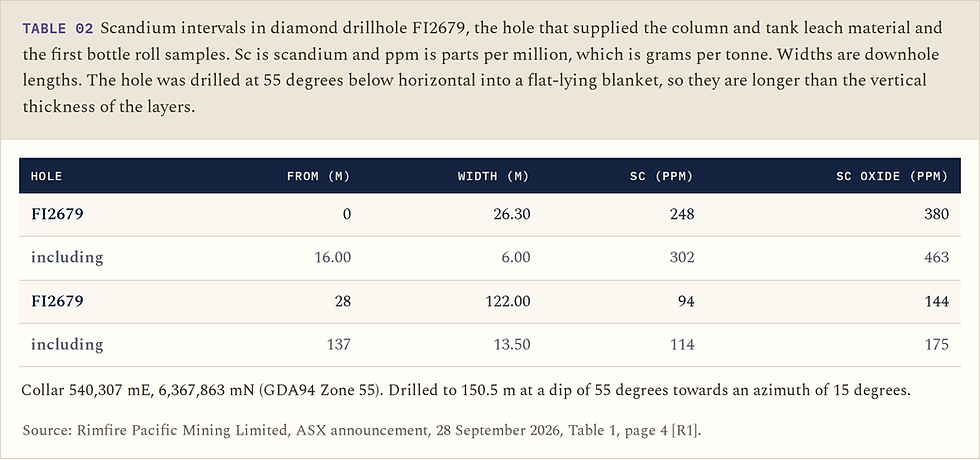
The column and tank leach samples come from diamond drillhole FI2679, which cut 26.3 metres downhole at 248 parts per million scandium from surface [R1] (TABLE 02).
A bottle roll update is targeted for early to mid October 2026, column results for early November and tank results for late November. A desktop financial study follows once all three are in.


Murga's Iron Content, Atmospheric Leaching and HPAL
At Murga the scandium is held in laterite and saprolite. These are the soft, clay-rich layers that form near the surface when the original rock weathers over a very long time. At Murga this weathered blanket is up to 45 metres thick and lies over weathered ultramafic rocks, including pyroxenite [R1].
There are two broad ways to get scandium out of this kind of material with acid. High Pressure Acid Leaching, known as HPAL, dissolves the ore in acid inside a pressure vessel at high temperature. It is the route Rimfire says other Fifield deposits are contemplating, naming Syerston, Burra and Flemington [R1]. Atmospheric leaching does the job at ordinary air pressure, in a heap, a vat or an open tank. The equipment is simpler, but it only works if the rock releases its scandium without the high temperature and pressure of an autoclave.
Iron is the reason Rimfire thinks Murga may suit the simpler route. The company reports an average of about 16 per cent iron in Murga's scandium-bearing rock. It compares that with 34 per cent iron at Rio Tinto's Burra deposit, a figure it sources to its February and April 2026 releases and a December 2018 announcement by Platina Resources, which held Burra at the time [R1] [R2].
Rimfire's June release describes iron as a major acid consumer, and reported that relatively little iron dissolved during the first tests [R3]. On the company's reasoning, rock with less iron should use less acid. Iron is not the only acid consumer, though. Murga's scandium is in and above weathered serpentinised ultramafic rock [R1], and in laterite leaching the magnesium in such rock also uses up acid. That last point is Samso's general explanation. The release gives no acid consumption figure.

What Published Research Says About Leaching Low-Iron Laterite
Rimfire's case rests on one idea. Rock with less iron should give up its metal more easily at atmospheric pressure. Published research supports a related idea. Metal leaches more readily from clay-rich saprolite than from iron-rich limonite. Most of it comes from nickel laterites, which are the same kind of deeply weathered rock and which can carry scandium alongside nickel and cobalt. TABLE 03 sets out four studies.
The broadest is a review by R.G. McDonald and B.I. Whittington, "Atmospheric acid leaching of nickel laterites review", published in the journal Hydrometallurgy in 2008. It brought together the published work on leaching these ores with sulphuric acid at ordinary pressure. It found that nickel leaches more readily from clay-rich saprolite and high-magnesium ores than from iron-rich limonite, where the metal is held in the iron mineral goethite [R6]. Murga's upper scandium layer is clay-dominant, and its host rock averages about 16 per cent iron [R1]. On that measure Murga looks closer to the easier ore type. That is Samso's comparison. The review does not discuss Murga.
The same review lists the problems. Heap leaching of laterite uses a lot of acid, the heaped rock can break down, and the acid dissolves iron and magnesium as well as the metal being recovered [R6].
Rimfire cites a heap leach trial at Çaldağ in Turkey as support. Anne Oxley, Nursun Sirvanci and Simon Purkiss described European Nickel's demonstration heaps there in a 2007 paper in the journal Metalurgija. The ore in the first heap averaged 24.35 per cent iron, against about 16 per cent at Murga. Its first heap ran for 548 days and recovered 79.4 per cent of the nickel and 82.7 per cent of the cobalt, while only 30 per cent of the iron dissolved. The paper calculates acid use of more than 500 kilograms per tonne of dry ore [R7]. So heap leaching at atmospheric pressure has worked on laterite, over a long time and at a high acid cost, on rock with more iron than Murga.
For scandium itself, a 2019 study by Mathieu Chassé, William Griffin, Suzanne O'Reilly and Georges Calas in the journal Geochimica et Cosmochimica Acta traced how scandium moves as Australian laterites form. It found that in the saprolite, scandium is held in smectite clays and attached to the surface of iron oxyhydroxide minerals [R8]. So the scandium is inside the structure of the clays and on the surface of the iron minerals. The paper does not measure how easily acid releases either, and it does not discuss Murga.
A 2026 study led by M. Fahrurrozi in the journal Transition Metal Chemistry leached an Indonesian limonite, an iron-rich laterite, with sulphuric acid at atmospheric pressure. It recovered up to 92.94 per cent of the scandium, at 90°C and very strong acid [R9]. That is a different type of ore, leached under harsher conditions than a heap. It shows scandium can come out of laterite without an autoclave. It does not show that Murga's will.
None of this research uses Murga rock, which is why the company is testing its own samples. What it shows is that the ore-type difference behind the low-iron argument is recognised in the metallurgy of these ores, and that its main risk, high acid use, is also well documented.

What the Bottle Roll Tests Have Measured So Far
A bottle roll test tumbles finely ground rock with acid in a sealed bottle on powered rollers (PLATE 01). It is a low-cost early test of whether a metal will dissolve [R1]. Rimfire's first tests ran for 14 days at room temperature on two pulverised samples of about 3.5 kilograms each, one of laterite and one of saprolite [R3]. A heap uses coarser crushed rock, so a bottle roll shows what can dissolve rather than what a heap would recover.
The June release said recoveries of 60 to 90 per cent could potentially be achieved if the extraction rate held over a longer period [R3]. On 13 August 2026 Rimfire issued a clarification at the ASX's request. Rimfire said the clarification was provided in accordance with Listing Rule 5.7. That rule sets out what a mining company must include when it reports exploration results. The measured recoveries after 14 days were 11.3 per cent for saprolite and 10.5 per cent for laterite [R4].
The 60 to 90 per cent range came from a straight line fitted to the 14-day data, leaving out the rapid extraction at the start, and extended out to 200 days. The company said a definitive conclusion from 14 days of data would be "premature and potentially misleading" [R4]. It also cited published research in which European and Western Australian saprolite ores reached 70 to 80 per cent extraction over extended leaching. Those are other deposits, not Murga.
The longer bottle roll tests that the new release refers to began in June and run for 160 to 180 days with weekly sampling [R3]. Counting from the 23 June release, an update in early to mid October would come at least 100 to 115 days into those tests. That is Samso's arithmetic from the release dates. The company has not published an exact start date. FIG. 02 sets the dates out in order, from the April resource to the tests still to report.


Qualifications and Open Questions
The column and tank samples come from one drillhole, FI2679 [R1]. So did the first bottle roll samples [R3]. The releases do not say which hole supplied the long-term bottle roll samples. The resource the tests are meant to inform is 56.1 million tonnes. One hole can show how that part of the deposit behaves, but it cannot show whether the rest of the deposit behaves the same way. That would need material from more holes across the deposit.
The column and tank samples are saprolite [R1], so laterite is not part of the new tests. The release gives no scandium grade or iron content for the test samples. FI2679's upper interval grades 248 ppm scandium, against a resource average of 138 ppm [R1] [R2].
The 23 June release said Rimfire may run a column test, depending on the longer bottle roll data. It described such a test as using 50 kilograms at ambient temperature and low acidity over 3 to 6 months [R3]. The 28 September release describes two columns of 40 kilograms each, run at different acid strengths and flow rates over about 30 days [R1]. Both are quoted here as published. The new release does not explain the difference, and the columns were being loaded before the longer bottle roll results are out.
Atmospheric refers to pressure only. The tank leach runs at 90 to 95°C, so it needs heat. The release gives no recovery target, no acid consumption figure and no cost estimate, and it describes the desktop financial study only as an evaluation of the commercial viability of atmospheric leaching at Murga, with no release date.
The release text does not discuss ownership, although its map (FIG. 01) marks the Fifield Project as GPR earning 50.1 per cent. Murga is split across two of Rimfire's projects. The April release places the deposit on exploration licence EL8935 in the Fifield Project, where Golden Plains Resources can earn up to a 50.1 per cent interest [R2]. Rimfire's 8 July release says the northwestern portion of Murga lies within the Avondale Project, where Rimfire holds 60 per cent and Golden Plains 40 per cent [R5].
An earn-in is a deal where a partner gains a share of a project by spending money on it. Under the Fifield agreement Golden Plains would also fund development of a mine, including Rimfire's share, which Rimfire would repay from operating cash flow [R2]. The 11,900 tonnes of scandium oxide is a figure for the whole deposit. The releases reviewed here do not say how it divides between the two projects.

Leadership Commentary
Executive Chair Bronwyn Barnes described the expanded study as "an important development in our understanding of the Murga deposit" and said that "the deposit's low-iron host rocks represent a key point of difference to the other deposits in the area" [R1]. She also said scandium demand is accelerating across advanced manufacturing, AI data centres, defence and aerospace. That is the company's view of the market. The release gives no figures for it.
Near-term Milestones to Watch
Early to mid October 2026. Update on the long-term bottle roll tests, the first update since the 14-day results.
Early November 2026. Column leach results from Electric Metals.
Late November 2026. Agitated tank leach results from Simulus.
After that. A desktop financial study on atmospheric leaching at Murga, with no date given.
Samso Concluding Comments
Rimfire has moved the Murga metallurgy from one type of test to three, with a date set for each result. By the end of November the company expects to have given an update on the bottle roll tests and reported results from the column and tank leach tests. The release itself describes the testing, the timetable and the laboratories, and the results are still to come.
The company describes the tank leach as its alternative atmospheric route if heap or vat leaching does not extract enough scandium [R1]. The columns check for slumping and loss of permeability, the risk the release names for heap leaching.
Samso's 30 June piece on Murga's low-iron scandium reported the 60 to 90 per cent projection in its second paragraph. The October update is the next scheduled report on the bottle roll tests since the 14-day results.
In the company's favour, it has put a date on each result and kept a heated tank test in the program as an alternative. Electric Metals is running both columns at no cost to Rimfire [R1].
SAMSO TAKE Low iron is Rimfire's main argument for Murga, and in my opinion it is the right thing to be testing first. A scandium deposit that can avoid an autoclave has a very different capital bill from one that cannot. But the market has already seen a projection that the measured figure later qualified, so I would read the October bottle roll update for the measured recovery at that day, not a projection. If the curve is still climbing at around 100 days, the argument gets stronger. If it has flattened well short of 60 per cent, the columns and the tank leach will carry more of the case. Which of those two will the October update show? |
THE OTHER WAY TO READ THIS A more cautious reading is that the release adds a timetable but no new data. The only measured recoveries so far are 10.5 and 11.3 per cent, from two 14-day bottle roll tests. A column test described in June as taking 3 to 6 months is now expected to take about 30 days, and the company's August release says heap leaching of similar ores typically takes 100 to 250 days [R4]. On that view, a good November result would still describe one drillhole and a short test. |
Previous Samso Coverage of Rimfire Pacific Mining
Every earlier Samso post on Rimfire, newest first, followed by the two Samso Insights on the scandium market.
RIMFIRE PACIFIC MINING
11 AUG 2026 "Rimfire Pacific Mining (ASX:RIM) Strengthens Leadership as Scandium Strategy Advances". Bronwyn Barnes appointed Executive Chair alongside a $2.3 million raising at $0.008 a share.
30 JUN 2026 "Rimfire Pacific Mining: Murga's Low-Iron Scandium Points to a Cheaper Route". The first 14-day bottle roll results and the 60 to 90 per cent projection, before the August clarification.
15 JUN 2026 "Rimfire Pacific Mining Limited (ASX: RIM) to Secure 60% of Avondale Scandium Project as Seismic Survey Kicks Off at Fifield". Rimfire moves to 60 per cent of Avondale as Golden Plains moves to vest 40 per cent, and a seismic survey begins at Fifield.
14 MAY 2026 "Rimfire Pacific Mining Limited – Fifield District Scandium Resource Builder Investigating Lower-Cost Leaching Pathway at Murga". The low-iron argument and the start of the metallurgical study at Simulus.
14 APR 2026 "Rimfire Pacific Mining Limited – Murga Scandium Mineral Resource Increases". The 56.1 million tonne Murga Inferred resource and Rimfire's place among the Fifield scandium companies.
THE SCANDIUM MARKET
28 AUG 2026 "The Scandium Market in 2026 - Does a lower scandium price make the investment case stronger?". Samso Insight on scandium prices and demand, with Rimfire as a case study including the August clarification and the Golden Plains earn-in.
6 APR 2026 "The Scandium Story - A Small-Market Metal with Outsized Leverage in Lightweight Alloys and Clean-Energy Ceramics". Samso Insight on where scandium comes from and what it is used for.
The vocabulary, in plain English Scandium and scandium oxide Scandium is a light metal used mainly to strengthen aluminium alloys and in solid oxide fuel cells. It is usually sold as scandium oxide, and resources are often quoted in oxide terms. Parts per million (ppm) Grams per tonne. 138 ppm scandium means about 138 grams of scandium in each tonne of rock. Mineral Resource, Inferred An estimate of how much metal is in the ground. Inferred is the lowest confidence level, based on limited drilling. It is not an Ore Reserve and carries no mine plan. JORC Code The Australian standard that governs how companies report exploration results, resources and reserves. Laterite and saprolite Soft, clay-rich layers formed near the surface when rock weathers over a very long time. Laterite is the upper layer, saprolite is below it. Metallurgical testing Laboratory work that shows whether a metal can be recovered from the rock, how much, and at what cost in chemicals, heat and time. Limonite and goethite Limonite is the iron-rich upper part of a laterite. Goethite is the iron oxyhydroxide mineral that makes up much of it. Smectite A family of clay minerals that forms as rock weathers. It can hold metals such as scandium within its structure. HPAL High Pressure Acid Leaching. Dissolving ore in acid inside a pressure vessel, called an autoclave, at high temperature. Rimfire describes it as more complex and more capital-intensive than atmospheric leaching. Atmospheric leaching Dissolving metal out of ore at ordinary air pressure, in a heap, a vat or an open tank. The word refers to pressure, not temperature. Bottle roll test Finely ground rock and acid tumbled in a sealed bottle on rollers. A low-cost first test of whether a metal dissolves. Column leach test Crushed rock loaded into a vertical pipe with acid dripped through it from the top. It imitates a heap leach and shows whether the rock slumps and blocks the flow. Heap leach and vat leach Recovering metal by trickling acid through a large pile of crushed ore on a lined pad, or through ore held in a tank. Agitated tank leach Finely ground ore stirred with acid in a heated tank. It shows the most metal the acid can extract over a short time. Diamond drillhole A hole drilled with a diamond-tipped bit that cuts a solid cylinder of rock, so the sample keeps its original structure. Listing Rule 5.7 The ASX rule that sets out what a mining company must include when it reports exploration results for a material project. Earn-in An agreement where a partner gains a share of a project by spending money on it. Desktop financial study An office-based cost and revenue estimate built from test data rather than detailed engineering. The release says only that it will evaluate the commercial viability of atmospheric leaching at Murga. |
References and sources
Each source carries an identifier, [R1] to [R9], and the same identifier appears in the text wherever that source is used. All company figures are quoted as published at the dates given. FIG. 01 and PLATE 01 are reproduced from Rimfire's public ASX releases. FIG. 02 is an original Samso timeline built only from dates and figures in [R1] to [R4]. TABLE 03 is a Samso table built from the published papers [R6] to [R9]. Those papers are about other deposits, not Murga. TABLE 01 and TABLE 02 are Samso tables built from the 28 September 2026 release. Where two company documents give different figures for the same thing, both are quoted and the document each came from is named. This article does not attempt to resolve them.
[R1] Rimfire Pacific Mining Limited (ASX: RIM), "Rimfire accelerates Murga scandium pathway with expanded metallurgical study", ASX announcement, 28 September 2026. Source for the three workstreams, the laboratories, sample sizes, conditions and timetable, the iron comparison, Table 1 and Figure 1, and the Executive Chair's comments. announcements.asx.com.au/asxpdf/20260928/pdf/074lfz2tb01bgx.pdf
[R2] Rimfire Pacific Mining Limited (ASX: RIM), "Murga Scandium MRE increases by 300%", ASX announcement, 13 April 2026. Source for the Inferred Mineral Resource of 56.1 million tonnes at 138 ppm scandium for 11,900 tonnes of scandium oxide at a 100 ppm cut-off, and for EL8935 and the Golden Plains Resources earn-in over the Fifield Project, including its development funding terms. announcements.asx.com.au/asxpdf/20260413/pdf/06ydvt2jy8w85w.pdf
[R3] Rimfire Pacific Mining Limited (ASX: RIM), "Strong Encouragement from Initial Murga Scandium Metallurgical Study", ASX announcement, 23 June 2026, listed on the ASX platform as "Early Encouragement from Murga Scandium Metallurgy". Source for the 14-day bottle roll tests, the samples from FI2679, iron as an acid consumer, the 60 to 90 per cent projection, the start of the 160 to 180 day tests, the column test as first described, and Figure 2, the bottle roll photograph. announcements.asx.com.au/asxpdf/20260623/pdf/070x61qrd7tb4z.pdf
[R4] Rimfire Pacific Mining Limited (ASX: RIM), "Clarification to ASX announcement released on 23 June 2026", ASX announcement, 13 August 2026. Source for the measured 14-day recoveries of 11.3 and 10.5 per cent, the basis of the 60 to 90 per cent projection, the 100 to 250 day heap leach period and the published 70 to 80 per cent extractions for other saprolite ores. announcements.asx.com.au/asxpdf/20260813/pdf/072qfvzhc27qdv.pdf
[R5] Rimfire Pacific Mining Limited (ASX: RIM), "Rimfire secures 60% of Avondale Project", ASX announcement, 8 July 2026. Source for Golden Plains vesting a 40 per cent interest in Avondale and for the northwestern portion of the Murga deposit lying within the Avondale Project. announcements.asx.com.au/asxpdf/20260708/pdf/071hnmpc1rxh09.pdf
[R6] McDonald, R.G. and Whittington, B.I. (2008), "Atmospheric acid leaching of nickel laterites review. Part I. Sulphuric acid technologies", Hydrometallurgy, volume 91, pages 35 to 55. doi.org/10.1016/j.hydromet.2007.11.009. Source for saprolite and clay ores leaching more readily than limonite, and for the listed problems of heap leaching laterite.
[R7] Oxley, A., Sirvanci, N. and Purkiss, S. (2007), "Çaldağ nickel laterite atmospheric heap leach project", Metalurgija, Journal of Metallurgy, volume 13, issue 1. Cited by Rimfire in its 13 August 2026 release. Source for the 548-day heap, the nickel, cobalt and iron extractions and the acid use.
[R8] Chassé, M., Griffin, W.L., O'Reilly, S.Y. and Calas, G. (2019), "Australian laterites reveal mechanisms governing scandium dynamics in the critical zone", Geochimica et Cosmochimica Acta, volume 260, pages 292 to 310. doi.org/10.1016/j.gca.2019.06.036. Source for scandium being held in smectite clays and on iron oxyhydroxides in the saprolite.
[R9] Fahrurrozi, M. and co-authors (2026), "Towards sustainable scandium extraction: atmospheric sulfuric acid leaching of Indonesian lateritic nickel ore", Transition Metal Chemistry, volume 51, article 12. doi.org/10.1007/s11243-025-00699-7. Source for the 92.94 per cent scandium recovery at 90°C.
The cover photograph shows the bottle roll test equipment used for the Murga metallurgical study, from Rimfire Pacific Mining Limited, ASX announcement of 23 June 2026, Figure 2, page 5. Cropped by Samso.
 The Samso Way – Seek the ResearchHere at Samso, we pride ourselves on delivering content for investors that is independent and informed by over three decades of experience in the industry. Our content is well-researched and is only created if I see merit in discussing the company's story. Our mission is simple. Cut through the noise and spotlight what matters. Genuine stories, grounded insights, and real opportunity. Investors can explore our four core platforms:
There may be numerous paths to success in investing, but the common thread among successful individuals is that they remain committed to making informed decisions. Equip yourself with the right knowledge and tools, and you will be well on your way to achieving your financial goals. Most importantly, investors need to be absolutely diligent in understanding their own risk-reward tolerance and capabilities. Never bite off more than you can chew. As they say, Rome wasn't built in a day, and the Great Wall stood because it took centuries to complete. The Samso Philosophy: Stay curious. Stay sharp. And remember, digging deeper always uncovers the real value. In Life, there is no such thing as a Free Lunch. Never bite off more than you can chew is my parting comment. Happy Investing, and the only four-letter word you need to know is DYOR. To support our independent work, please head over to our Support Page and give us a helping hand in any of the ways listed. This is a new initiative for the Samso Platform, and it was always the concept of Samso when we started this journey in 2018. DisclaimerThe information or opinions provided herein do not constitute investment advice, an offer, or solicitation to subscribe for, purchase, or sell the investment product(s) mentioned herein. It does not take into consideration, nor have any regard to your specific investment objectives, financial situation, risk profile, tax position and particular, or unique needs and constraints. About SamsoSamso is a trusted platform that equips dedicated investors with up-to-date industry knowledge and insights from top CEOs and thought leaders. By staying informed on business advancements and market trends, investors can enhance their financial decisions through a combination of expert guidance and their own research. Coffee with Samso, Samso Insights, Samso News and Samso Research are four ways into the same work. Interviews, long-form research, short takes on announcements and company-specific studies. Every one of them is about how to think about investing rather than what to buy. Samso News | www.samso.com.au | An Investor Lens on ASX-Listed Companies Samso News is independent research commentary for general information only. Nothing in this article is financial product advice, and it does not take into account any reader's objectives, financial situation or needs. Figures are drawn from public sources believed reliable at the stated dates but are not guaranteed. Market-sensitive numbers change daily. Samso or associated parties may hold positions in, or have commercial arrangements with, companies mentioned. Seek professional advice before making investment decisions. © Samso 2026 · samso.com.au |

Comments