

Rimfire Pacific Mining (ASX: RIM) - Fifield Scandium Recovery Results and the Scandium Market

Rimfire Pacific Mining (ASX: RIM) has reported the first measured results from the long-term acid leach tests on its Murga scandium deposit in the Fifield district of central New South Wales. After 15 weeks, 22.7 per cent of the scandium had come out of the saprolite sample and 15.2 per cent out of the laterite sample [R1]. These are the two weathered clay layers that hold the scandium. The company projects at least 60 per cent and 30 per cent if the same rate holds for a year. Our piece of 30 September said we would read this release for the measured recovery. Samso has followed Rimfire since April 2026, and the earlier posts are listed after the Samso Concluding Comments.

THE SOURCE DOCUMENT Rimfire Pacific Mining Limited, "Strong Scandium Recoveries Support Lower-Capital Processing Pathway at Murga", ASX announcement, 8 October 2026, 15 pages, authorised for release by the Board. It is on the ASX announcements page for RIM [R1]. |
Announcement
Rimfire is testing whether the scandium at Murga can be dissolved out of the rock with acid at ordinary air pressure. The industry calls this atmospheric leaching. Rimfire says the other scandium deposits in the Fifield district are contemplating High Pressure Acid Leaching, or HPAL. That route does the same job inside a heated pressure vessel called an autoclave, and the company describes it as more complex and more capital-intensive [R1].
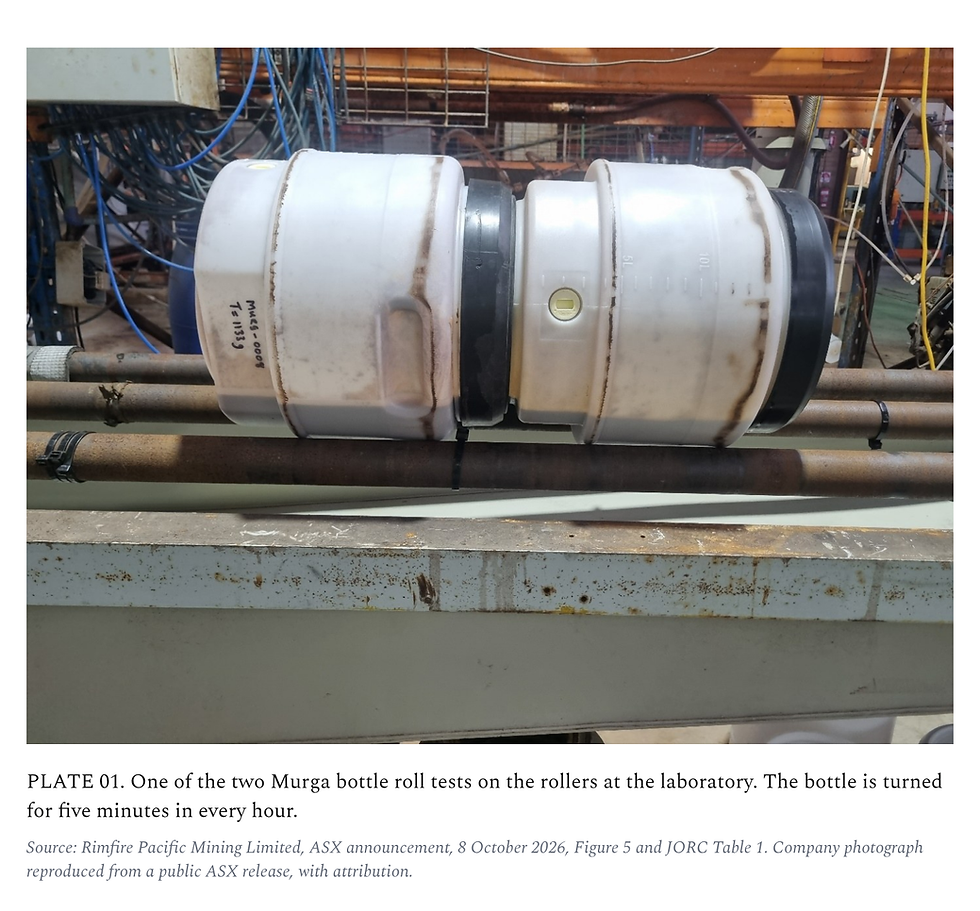
The test in this release is what we call a bottle roll (PLATE 01). Finely ground rock and acid are turned in a sealed bottle on rollers. It is a low-cost first look at how much metal will dissolve. Simulus, a specialist metallurgical laboratory, is running two bottles at room temperature. One holds 0.74 kilograms of saprolite and the other 1 kilogram of laterite. Laterite is the upper, most weathered layer and saprolite is below it. Both samples came from one diamond drillhole, FI2679. A diamond drillhole brings up a solid cylinder of rock called core [R1].
Highlights
The measured recoveries are 22.7 per cent for saprolite and 15.2 per cent for laterite (TABLE 01). Recovery is the share of the scandium in the sample that has moved into the acid solution. Metallurgists would call it extraction, because the scandium is in solution and has not yet been made into a product. The bottles are still turning [R1].
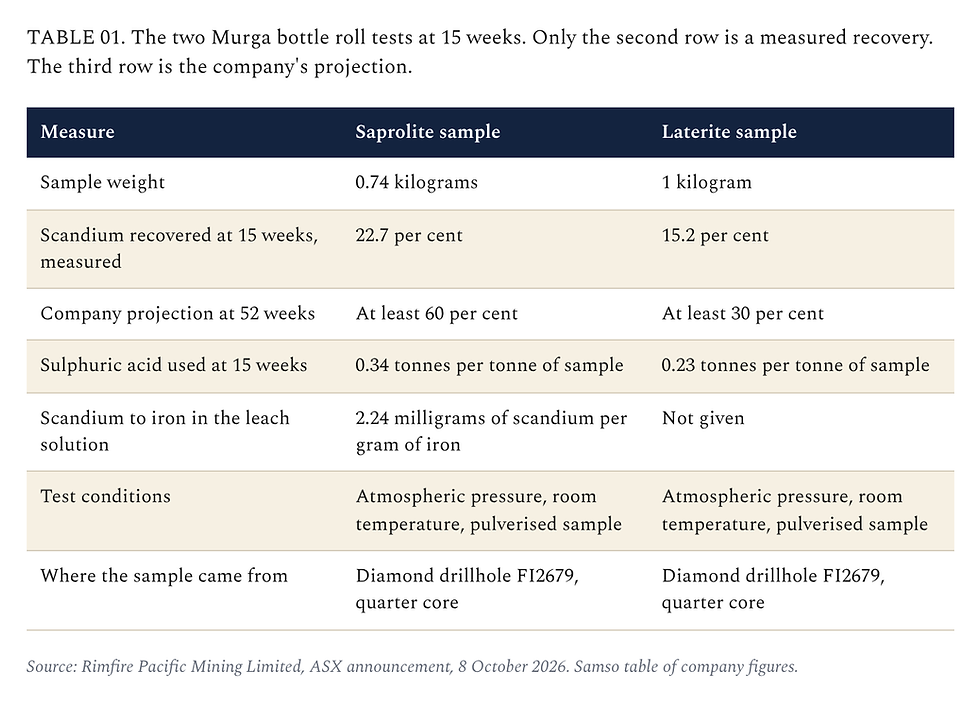
The acid used so far is 0.34 tonnes for each tonne of saprolite and 0.23 tonnes for each tonne of laterite. Rimfire says that is considered low for atmospheric leaching. The laboratory tops the acid up to a set strength as the test runs. The release does not say if the figure counts all the acid added or only what the rock has consumed [R1].
The solution from the saprolite bottle carries 2.24 milligrams of scandium for every gram of iron. Rimfire says this ratio is high compared with atmospheric leaching of other scandium ores. It matters because iron and scandium behave alike in the purification steps that follow, and too much iron makes the scandium harder and more costly to separate [R1]. The release gives no figure for those other ores.
The laterite gave up less scandium. The company's explanation is that calcium, manganese and magnesium in the laterite may be using up acid that would otherwise work on the scandium [R1].

The 52-Week Projection for Murga Scandium
The 60 per cent and 30 per cent figures are projections. Rimfire drew a straight line of best fit through the weekly readings, left out the fast extraction at the start, and extended the line to 52 weeks (FIG. 01 and FIG. 02). Rimfire states that the projected recoveries hold if the same rate of extraction is maintained for the whole 52 weeks [R1].
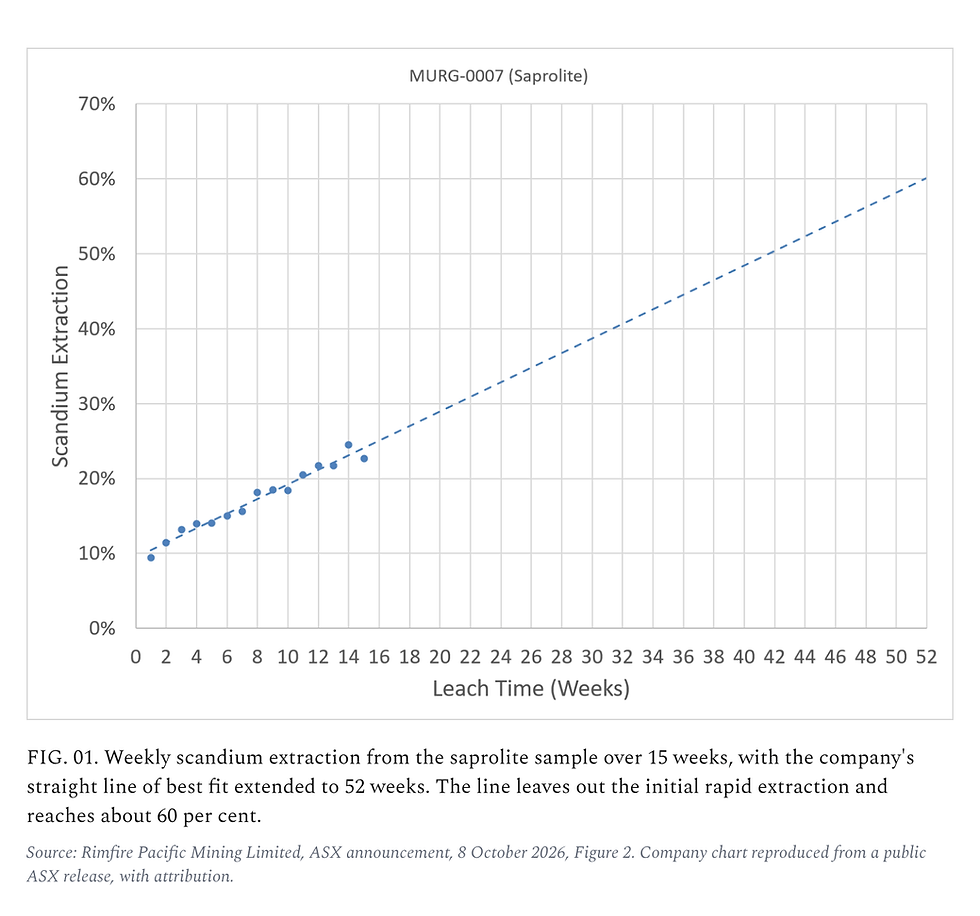
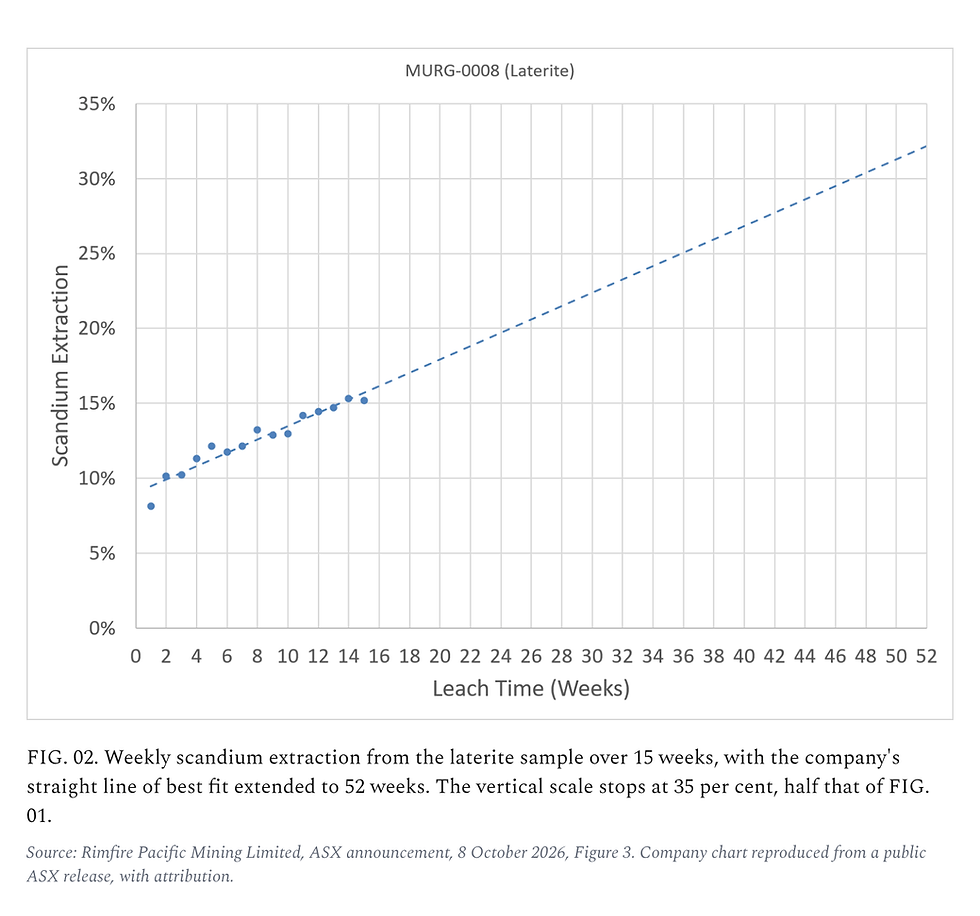
Rimfire says the longer period is justified because commercial heap leaching of similar laterites takes 100 to 400 days, or longer. A heap leach trickles acid through a large pile of crushed ore on a lined pad. The release cites papers on heap leach projects at Murrin Murrin in Western Australia and Çaldağ in Turkey. It says they confirm saprolite ores achieve 70 to 80 per cent extraction over extended leaching periods, and that heap leaching of saprolite shows a roughly linear response [R1].
We did some simple arithmetic on the company's numbers (FIG. 03). To get from 22.7 per cent at week 15 to 60 per cent at week 52, the saprolite has to keep giving up about one percentage point of its scandium every week for another 37 weeks. The laterite needs about 0.4 of a point a week. On the company's saprolite chart, the week 15 reading is a little below week 14. The release does not comment on that, and one reading does not set a trend.
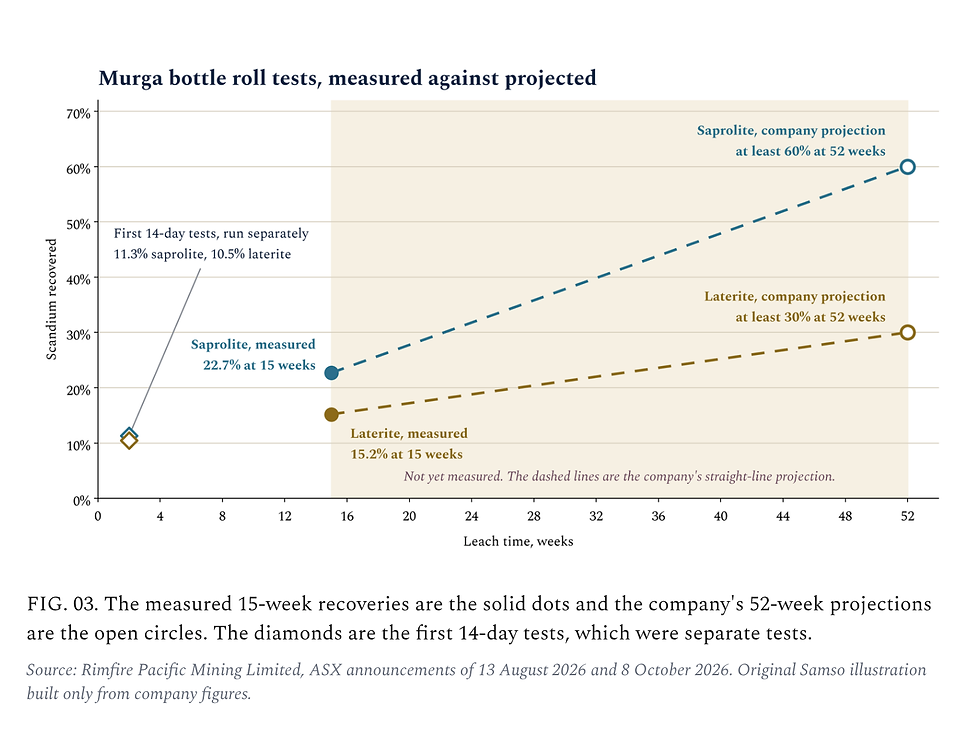
The projection has also changed since June. The June release, read with the August clarification, pointed to 60 to 90 per cent if the early rate held out to 200 days [R3][R4]. Today's figures are at least 60 per cent for saprolite and 30 per cent for laterite at 52 weeks, which is 364 days. The August clarification gave the commercial heap leach period as 100 to 250 days, and today's release gives 100 to 400 days [R1][R4]. Both sets of figures are quoted here as published. The September release described these bottle rolls as tests of 160 to 180 days [R5]. Today's release does not say if they will run for the full 52 weeks.
Qualifications and Open Questions
The two samples weigh less than 2 kilograms together and come from one drillhole. The Murga resource is 56.1 million tonnes at 138 parts per million scandium, which is 138 grams in each tonne of rock. All of it is Inferred, the lowest confidence category of Mineral Resource under the JORC Code, the Australian reporting standard [R2]. The top interval of FI2679 grades 248 parts per million [R1]. The release does not give the grade of the two test samples or the depths they came from.
The rock in the bottles was pulverised, which means ground to a powder. A heap uses much coarser crushed rock, which is harder to leach. The column tests at Electric Metals, a processing facility in the Philippines, are the ones that imitate a heap. They use saprolite only and run for about 30 days [R5].
The acid figures are at 15 weeks, with less than a quarter of the scandium out, and acid use will keep rising as the bottles keep turning. For comparison, Srećko Stanković and co-authors reviewed the processing of nickel laterite ores in the journal Metals in 2022. They put heap leaching at 200 to 500 kilograms of acid per tonne of ore for nickel recoveries of 65 to 85 per cent [R6]. Rimfire's 340 and 230 kilograms are already inside that range, with most of the scandium still in the rock. The same review puts atmospheric tank leaching at 600 to 800 kilograms a tonne [R6]. It covers nickel ores, so the comparison is a rough guide only.
The release gives no capital cost, no operating cost and no date for the desktop financial study, which is a first estimate of costs made from test data. The release also restates that Murga is on the Fifield Project, where partner Golden Plains Resources can earn a 50.1 per cent interest [R1].

Leadership Commentary
Executive Chair Bronwyn Barnes said the scandium recoveries at the end of 15 weeks "are highly encouraging". She said the deposit's low-iron host rocks "represent a potential gamechanger when compared to the other deposits in the area" [R1]. She also said scandium demand is accelerating across advanced manufacturing, AI data centres, defence and aerospace. The release gives no figures for that.
Scandium News Since Our Last Rimfire Piece
Our last Rimfire piece went out on 30 September 2026. This is what has happened in scandium since then.
The company next door plans to become a US company. On 2 October, Sunrise Energy Metals (ASX: SRL) said it had signed a deed to move its domicile to the United States, with its main listing on Nasdaq and a secondary listing on the ASX. Sunrise owns the Syerston scandium deposit next to Murga. The plan needs shareholder, court and regulator approvals, and the indicative timetable has it completed in December 2026 [R7]. Sunrise already holds a conditional loan commitment of up to US$400 million from the US Office of Strategic Capital, announced in August [R8].
China has required an export licence for scandium since April 2025. The US Geological Survey recorded that rule as still in effect at December 2025, and a Tech Times report of 6 October 2026 says it was never suspended [R9][R11]. The wider trade truce between the US and China was extended to 10 January 2027, which China's commerce ministry confirmed on 28 September. The reports we read differ on how much of China's October 2025 rare earth controls that extension covers.
Scandium Canada (TSXV: SCD) reported a drill hole on 7 October of 150.1 metres at 292 parts per million scandium oxide. The hole is about 150 metres north of its Crater Lake resource in Quebec [R10]. That is one drill intercept and not a resource grade. Murga's resource averages 212 parts per million as scandium oxide, the form scandium is sold in [R2].
Geopolitics, Economics and Rimfire
Scandium is a very small market. The US Geological Survey estimates the world used about 60 tonnes of scandium oxide in 2025 and produced about 80 tonnes. It names China as the leading producer and says the United States imported all of its supply [R11].
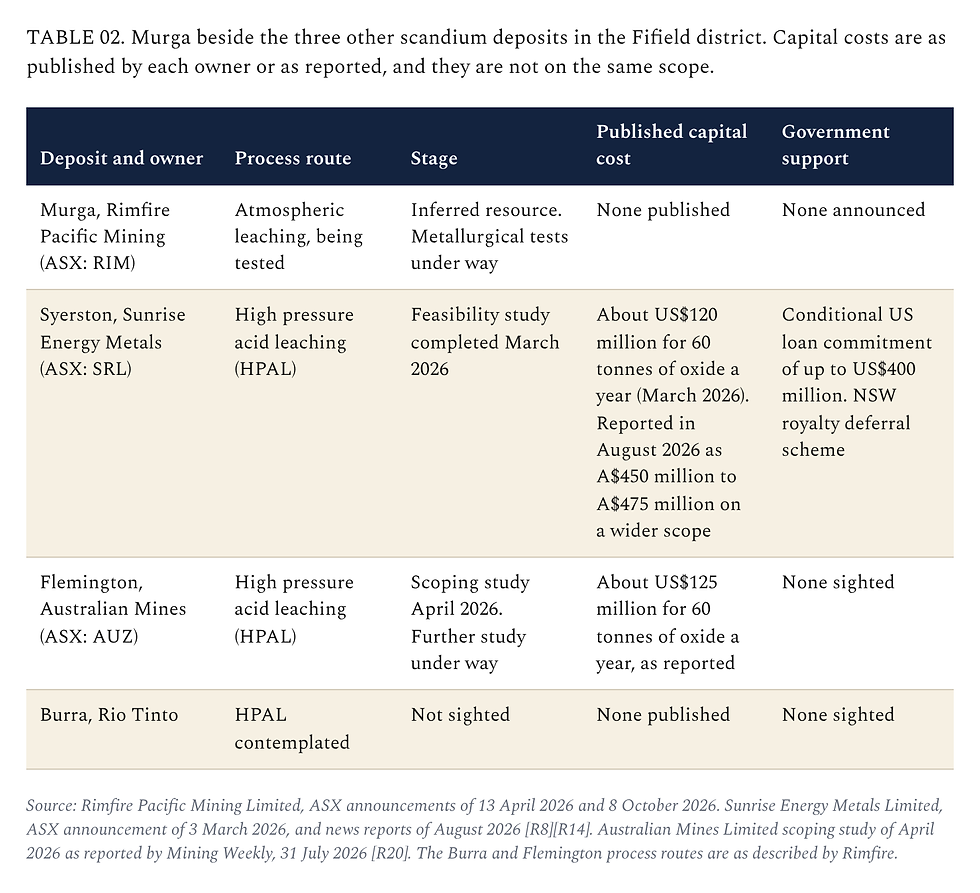
Government support has been offered to a project in Rimfire's district (TABLE 02). The US loan commitment to Syerston is conditional. The NSW Government named Syerston in July as one of the first two projects in its critical minerals royalty deferral scheme, which defers a new mine's state royalties for five years [R8][R12]. Rimfire receives none of it. Rimfire could gain a funded neighbour with a plant, which could become a partner or a customer. That is our view, and no release says any such talks exist.
Scandium costs far less inside China than outside it. Inside China, Shanghai Metals Market assessed scandium oxide at about US$592 a kilogram on 30 September 2026 [R13]. Outside China, Sunrise's feasibility study assumes US$3,000 a kilogram in its economic analysis and US$1,500 for its Ore Reserve. The US defence stockpile planned to buy 6.4 tonnes from Rio Tinto over five years for up to US$40 million, which is up to about US$6,250 a kilogram by our arithmetic [R14][R15]. In our view the gap reflects what Western buyers will pay for supply that needs no Chinese export licence. It helps projects outside China while the licensing rules stay.
The Chinese price has been falling. The US Geological Survey puts scandium oxide at US$890 to US$1,000 a kilogram in 2021 and about US$640 in 2025 [R11]. A lower price cuts what a producer earns on each kilogram. It can also bring scandium closer to being affordable for the aluminium industry, which has never used it at scale because of its cost. Our August Insight on the scandium price looked at that idea. It treated the idea as a possibility that the numbers do not yet show.
The Reserve Bank of Australia raised its cash rate to 4.60 per cent on 29 September 2026, the fourth rise this year [R16]. Higher rates make construction debt cost more, which in our view favours a cheaper plant. Sunrise's March study put the Syerston plant at about US$120 million for 60 tonnes of oxide a year, using pressure leaching. News reports in August gave a revised A$450 million to A$475 million on a wider scope that includes a US refinery [R14]. Rimfire says an atmospheric route would be less complex and less capital-intensive [R1]. No Murga plant has been costed, so that is still to be tested.
Sulphuric acid has become dearer. S&P Global reported acid delivered to the US Gulf at US$400 a tonne in May 2026, up from US$155 in February. It put that down to supply disruption in the Middle East and new Chinese limits on acid exports [R17]. We have no price after May. An ore that uses less acid is less exposed to that price, and Rimfire describes its acid use so far as low [R1].
Rimfire is a small company. It had A$583,770 in cash at 30 June 2026, and the going concern note in its annual report states a material uncertainty. That means it needs to raise more money to keep paying its bills. A placement in August, which is a sale of new shares to selected investors, brought in A$1.6 million after costs. A further A$0.6 million is subject to shareholder approval at a meeting in November [R18]. At 1.1 cents on 7 October, the company's market value was about A$33 million by our arithmetic [R19]. Good metallurgy can help the next raise to be priced higher.

Near-term Milestones to Watch
Early November 2026. Update on the column leach tests, which drip acid through crushed rock in a pipe.
November 2026. General meeting to approve the rest of the August placement.
Late November 2026. Update on the agitated tank leach tests, which stir ground ore with acid in a heated tank.
Early December 2026. Next bottle roll update.
10 January 2027. The extended US and China trade truce ends.
Samso Concluding Comments
In our last piece we said we would read the October release for the measured recovery and not the projection. The measured numbers are 22.7 and 15.2 per cent at 15 weeks. The company's chart shows the saprolite readings rising along a fairly straight line. That is a better result than a curve that has flattened, and the December update will show if the line holds.
It is also less than the June headline suggested. A reader who took 60 to 90 per cent in 200 days from the June release and its August clarification now has at least 60 per cent in a year for the saprolite and 30 per cent for the laterite. A year is near the long end of the 100 to 400 days Rimfire gives for commercial heap leaching.
Some outside events help Rimfire. China's export rules for scandium are still in place, by the reports we read. The owner of the deposit next door has a conditional US loan commitment and plans a Nasdaq listing, which still needs approvals. These events do not change the metallurgy. They may matter if the tests succeed.
SAMSO TAKE In my opinion this result keeps the low-iron story alive, and that is all a 15-week bottle roll can do. I like that the acid use and the scandium to iron ratio were reported with the recovery, because those two numbers drive the cost. The saprolite is the part of Murga to follow. What I want from the November column update is a recovery from crushed rock and not pulverised rock. Will the coarse rock give up its scandium at anything like the same rate? |
THE OTHER WAY TO READ THIS A more cautious reading is that less than a quarter of the scandium has come out in 15 weeks, from under 2 kilograms of pulverised rock from one hole. The 60 per cent figure needs the line to stay straight for another 37 weeks, and the laterite is projected at 30 per cent. The market Rimfire wants to sell into used about 60 tonnes in 2025. Syerston alone plans to make 60 tonnes a year [R11][R14]. On that view, the geopolitics helps the first project built and may leave less room for the second. |
Previous Samso Coverage of Rimfire Pacific Mining
Every earlier Samso post on Rimfire, newest first, followed by the two Samso Insights on the scandium market.
30 SEP 2026. Rimfire Pacific Mining (ASX: RIM) - Murga Scandium Study Adds Column and Tank Leach Tests. The study grows from one type of test to three, with a timetable for each.
11 AUG 2026. Rimfire Pacific Mining (ASX:RIM) Strengthens Leadership as Scandium Strategy Advances. Bronwyn Barnes becomes Executive Chair alongside a capital raising.
30 JUN 2026. Rimfire Pacific Mining: Murga's Low-Iron Scandium Points to a Cheaper Route. The first 14-day bottle roll results and the 60 to 90 per cent projection, before the August clarification.
15 JUN 2026. Rimfire Pacific Mining Limited (ASX: RIM) to Secure 60% of Avondale Scandium Project as Seismic Survey Kicks Off at Fifield. Rimfire moves to 60 per cent of Avondale and a seismic survey begins.
14 MAY 2026. Rimfire Pacific Mining Limited - Fifield District Scandium Resource Builder Investigating Lower-Cost Leaching Pathway at Murga. The low-iron argument and the start of the metallurgical study.
14 APR 2026. Rimfire Pacific Mining Limited - Murga Scandium Mineral Resource Increases. The 56.1 million tonne Murga Inferred resource.
28 AUG 2026. The Scandium Market in 2026 - Does a lower scandium price make the investment case stronger? Samso Insight on scandium prices and demand.
6 APR 2026. The Scandium Story - A Small-Market Metal with Outsized Leverage in Lightweight Alloys and Clean-Energy Ceramics. Samso Insight on where scandium comes from and what it is used for.
THE VOCABULARY, IN PLAIN ENGLISH Scandium and scandium oxide Scandium is a light metal used mainly to strengthen aluminium alloys and in solid oxide fuel cells. It is usually sold as scandium oxide. Parts per million (ppm) Grams per tonne. 138 ppm scandium means about 138 grams of scandium in each tonne of rock. Laterite and saprolite Layers formed near the surface when rock weathers over a very long time. Laterite is the upper, most weathered layer. Saprolite is below it and still shows the texture of the original rock. Recovery The share of the metal in a sample that the test gets out. A recovery of 22.7 per cent means 22.7 per cent of the scandium moved into the acid solution. Bottle roll test Finely ground rock and acid turned in a sealed bottle on rollers. A low-cost first test of how much metal dissolves and how fast. Atmospheric leaching Dissolving metal out of ore at ordinary air pressure, in a heap, a vat or an open tank. HPAL High Pressure Acid Leaching. Dissolving ore in acid inside a heated pressure vessel called an autoclave. Heap leach Recovering metal by trickling acid through a large pile of crushed ore on a lined pad. Column leach and agitated tank leach A column test drips acid through crushed rock in a vertical pipe to imitate a heap. A tank test stirs finely ground ore with acid in a heated tank. Line of best fit A straight line drawn through a set of readings so that it is as close as possible to all of them. Extending it past the last reading is a projection and not a measurement. Pregnant leach solution The acid solution after it has dissolved metal out of the rock. The metal is recovered from it in later steps. Scandium to iron ratio How much scandium the solution holds for each gram of iron. A higher ratio means less iron to remove before the scandium can be purified. Mineral Resource, Inferred An estimate of how much metal is in the ground. Inferred is the lowest confidence level under the JORC Code and rests on limited drilling. Earn-in An agreement where a partner gains a share of a project by spending money on it. Export licensing A rule that a product cannot leave a country without a government permit. China has applied one to scandium since April 2025. Going concern The accounting assumption that a company can pay its bills for the next 12 months. A material uncertainty means that depends on raising more money. |
References and sources
Each source carries an identifier and the same identifier appears in the text where that source is used. Company figures are quoted as published at the dates given. FIG. 01, FIG. 02 and PLATE 01 are reproduced from Rimfire's public ASX release of 8 October 2026. FIG. 03 is an original Samso chart built only from company figures. TABLE 01 and TABLE 02 are Samso tables. Sources [R6] to [R17] and [R20] were read on 8 October 2026. Where a figure comes from a news report of a company document, the reference says so.
[R1] Rimfire Pacific Mining Limited (ASX: RIM), "Strong Scandium Recoveries Support Lower-Capital Processing Pathway at Murga", ASX announcement, 8 October 2026.
[R2] Rimfire Pacific Mining Limited, "Murga Scandium MRE increases by 300%", ASX announcement, 13 April 2026. announcements.asx.com.au/asxpdf/20260413/pdf/06ydvt2jy8w85w.pdf
[R3] Rimfire Pacific Mining Limited, "Strong Encouragement from Initial Murga Scandium Metallurgical Study", ASX announcement, 23 June 2026. announcements.asx.com.au/asxpdf/20260623/pdf/070x61qrd7tb4z.pdf
[R4] Rimfire Pacific Mining Limited, "Clarification to ASX announcement released on 23 June 2026", ASX announcement, 13 August 2026. announcements.asx.com.au/asxpdf/20260813/pdf/072qfvzhc27qdv.pdf
[R5] Rimfire Pacific Mining Limited, "Rimfire accelerates Murga scandium pathway with expanded metallurgical study", ASX announcement, 28 September 2026. announcements.asx.com.au/asxpdf/20260928/pdf/074lfz2tb01bgx.pdf
[R6] Stanković, S. and co-authors (2022), "Options for Hydrometallurgical Treatment of Ni-Co Lateritic Ores for Sustainable Supply of Nickel and Cobalt for European Battery Industry from South-Eastern Europe and Turkey", Metals, volume 12, issue 5, article 807. doi.org/10.3390/met12050807
[R7] Sunrise Energy Metals Limited (ASX: SRL), "Redomicile to the US and progress on Nasdaq listing", ASX announcement, 2 October 2026. ASX announcement. Also Reuters, "Australia's Sunrise Energy Metals plans US redomicile, primary Nasdaq listing", 2 October 2026, as carried by Investing.com.
[R8] Mining.com, "Sunrise Energy Metals scandium project gets $400M conditional loan from US Department of War", August 2026. mining.com. Also Al Jazeera, "US announces $400m investment in Australian rare earth mine", 8 August 2026.
[R9] Rawmaterials.net, "Rare earth export controls: China confirms extension of trade arrangements with U.S.", 28 September 2026. rawmaterials.net. Tech Times, "Congress Moves to Break China Rare Earth Grip Before November Deadline", 6 October 2026. Startup Fortune, 8 October 2026. US Geological Survey [R11] for the April 2025 controls remaining in effect at December 2025.
[R10] Scandium Canada Ltd, "Scandium Canada Finds More Scandium Outside Current Crater Lake Resource", news release, 7 October 2026, as carried by StockTitan. stocktitan.net. Downhole length, true thickness not determined.
[R11] US Geological Survey, Mineral Commodity Summaries 2026, Scandium. pubs.usgs.gov/periodicals/mcs2026/mcs2026-scandium.pdf
[R12] NSW Government, "Two major NSW critical minerals projects to benefit from Australia-first royalty deferral scheme", ministerial release, July 2026. nsw.gov.au
[R13] Shanghai Metals Market, scandium oxide price assessment, 30 September 2026, 4,500 yuan a kilogram, shown by SMM as US$592.1 excluding VAT. metal.com
[R14] Sunrise Energy Metals Limited (ASX: SRL), Syerston Scandium Project feasibility study, ASX announcement, 3 March 2026. ASX announcement. News reports in August 2026 gave a revised estimate of A$450 million to A$475 million on a wider scope that includes a US refinery.
[R15] Reuters, "US agency wants to buy scandium oxide from Rio Tinto for defence stockpile", 22 September 2025, as carried by Mining.com. mining.com. The purchase is over five years. The price per kilogram is Samso arithmetic.
[R16] Commonwealth Bank newsroom, report of the RBA cash rate decision of 29 September 2026, published 30 September 2026. commbank.com.au
[R17] S&P Global, "Global sulfur prices surge on Middle East disruptions, China export ban", 7 May 2026. spglobal.com
[R18] Rimfire Pacific Mining Limited, 2026 Annual Report to Shareholders, lodged with the ASX on 30 September 2026.
[R19] ASX market data for RIM, read 8 October 2026 before the open. Last price A$0.011 on 7 October 2026 and 2,999,138,802 shares on issue. Market value is Samso arithmetic.
[R20] Mining Weekly, "Flemington scandium project, Australia, update", 31 July 2026. miningweekly.com. Source for the Flemington row of TABLE 02.
The cover photograph shows a bottle roll test on Murga samples, from Rimfire Pacific Mining Limited, ASX announcement of 8 October 2026, Figure 5. Cropped by Samso.
 The Samso Way – Seek the ResearchHere at Samso, we pride ourselves on delivering content for investors that is independent and informed by over three decades of experience in the industry. Our content is well-researched and is only created if I see merit in discussing the company's story. Our mission is simple. Cut through the noise and spotlight what matters. Genuine stories, grounded insights, and real opportunity. Investors can explore our four core platforms:
There may be numerous paths to success in investing, but the common thread among successful individuals is that they remain committed to making informed decisions. Equip yourself with the right knowledge and tools, and you will be well on your way to achieving your financial goals. Most importantly, investors need to be absolutely diligent in understanding their own risk-reward tolerance and capabilities. Never bite off more than you can chew. As they say, Rome wasn't built in a day, and the Great Wall stood because it took centuries to complete. The Samso Philosophy: Stay curious. Stay sharp. And remember, digging deeper always uncovers the real value. In Life, there is no such thing as a Free Lunch. Never bite off more than you can chew is my parting comment. Happy Investing, and the only four-letter word you need to know is DYOR. To support our independent work, please head over to our Support Page and give us a helping hand in any of the ways listed. This is a new initiative for the Samso Platform, and it was always the concept of Samso when we started this journey in 2018. DisclaimerThe information or opinions provided herein do not constitute investment advice, an offer, or solicitation to subscribe for, purchase, or sell the investment product(s) mentioned herein. It does not take into consideration, nor have any regard to your specific investment objectives, financial situation, risk profile, tax position and particular, or unique needs and constraints. About SamsoSamso is a trusted platform that equips dedicated investors with up-to-date industry knowledge and insights from top CEOs and thought leaders. By staying informed on business advancements and market trends, investors can enhance their financial decisions through a combination of expert guidance and their own research. Coffee with Samso, Samso Insights, Samso News and Samso Research are four ways into the same work. Interviews, long-form research, short takes on announcements and company-specific studies. Every one of them is about how to think about investing rather than what to buy. Samso News | www.samso.com.au | An Investor Lens on ASX-Listed Companies Samso News is independent research commentary for general information only. Nothing in this article is financial product advice, and it does not take into account any reader's objectives, financial situation or needs. Figures are drawn from public sources believed reliable at the stated dates but are not guaranteed. Market-sensitive numbers change daily. Samso or associated parties may hold positions in, or have commercial arrangements with, companies mentioned. Seek professional advice before making investment decisions. © Samso 2026 · samso.com.au |

Comments