


Island Pharmaceuticals (ASX: ILA) - Galidesivir, Marburg and the Ebola Outbreak

Island Pharmaceuticals bought galidesivir, an antiviral drug, from BioCryst in 2025. It wants United States approval for the drug as a Marburg treatment under the FDA Animal Rule. Dosing in its next monkey study is due to start this quarter. Its first newly made drug is earmarked for an Ebola emergency use program in Uganda. It held A$7.83 million in cash at 30 September 2026, which its Appendix 4C puts at 1.6 quarters of funding.


Island Pharmaceuticals (ASX: ILA) is a Melbourne drug developer that owns galidesivir, an antiviral drug first developed in the United States with more than US$70 million of US Government money. Island bought it from BioCryst Pharmaceuticals in July 2025 for an upfront price of US$550,000 [R22] [R4]. The company is taking galidesivir towards United States approval as a treatment for Marburg virus disease, a close relative of Ebola that is often fatal.
The route it has chosen is the US Food and Drug Administration's Animal Rule. Under that rule a drug for a disease that cannot be tested on people is approved on animal results plus human safety data. Island's next study uses 20 monkeys at a US Army laboratory. The animals had been screened and trained by 19 October 2026, and dosing is expected in the current quarter [R1].
At the same time a large Ebola outbreak caused by Bundibugyo virus is running in the Democratic Republic of the Congo. The World Health Organization counted 9,637 confirmed cases and 4,646 confirmed deaths there to 19 October 2026 [R34]. Island holds approval to supply galidesivir for emergency use in Uganda, where the WHO and Africa CDC marked the end of the outbreak on 27 August 2026 [R35]. Island's first batch of newly made drug was targeted for completion at the end of October [R2].
All prices in this piece are as at the close of ASX trading on 3 November 2026.
WHAT THIS PIECE COVERS 1.00 The company and what it owns. Galidesivir, ISLA-101 and ISLA-6181, and what Island still owes BioCryst. How a nucleoside analogue stops a virus copying itself, and the human safety data. The Marburg and Ebola monkey studies, group by group. 4.00 The FDA Animal Rule and what the FDA has said. The rule, the two FDA letters, the natural history data and the ASX query. 5.00 The studies still to run. The 20-animal and 12-animal studies, and how the expected dates have moved. 6.00 The Bundibugyo outbreak and the Uganda program. The WHO case count, the Uganda emergency use program and the other drugs on trial. 7.00 The buyers of a biodefence drug. The stockpile, the priority review voucher and outbreak supply. The PROTECT challenge study and its group sizes. 9.00 Cash, shares and the share price. A$7.83 million at 30 September 2026, the options on issue and the share price. 10.00 What to watch and the counter-case. The dated events, the differing figures, the counterargument and the Samso Take. |
HOW TO USE THIS PIECE Medical, regulatory and laboratory terms are explained in plain English where they first appear. The main terms are collected again in one box near the end. Each source has a marker such as [R1]. The marker appears in the text at the point the source is used. Click it to go to the full entry in the reference list. Where Island's documents give two different figures for the same thing, this piece quotes both as they were published and names the document each came from. It leaves the reconciliation to the company. This piece is built from public documents. Samso has not interviewed the company for it. |
1.00 — THE COMPANY AND WHAT IT OWNS
Three programs, two of them bought from BioCryst in 2025
Island Pharmaceuticals describes itself as a drug repurposing company. Repurposing means taking a drug first made for one disease and testing it against another. Its first drug was ISLA-101, an old compound being tested against dengue fever, a virus spread by mosquitoes [R4].
In July 2025 Island bought the galidesivir program from BioCryst Pharmaceuticals, a Nasdaq-listed company that had moved its focus to rare diseases [R22]. The purchase was completed on 31 July 2025 [R23]. Island received the patents, the manufacturing and regulatory records, completed human safety studies and the results of earlier animal studies [R4].
The upfront payment was US$550,000, which the annual report records as A$841,703 [R4]. That is a small sum against the more than US$70 million of US Government money spent on the drug before. The remaining payments are due only if galidesivir reaches each stage. TABLE 01 sets them out.
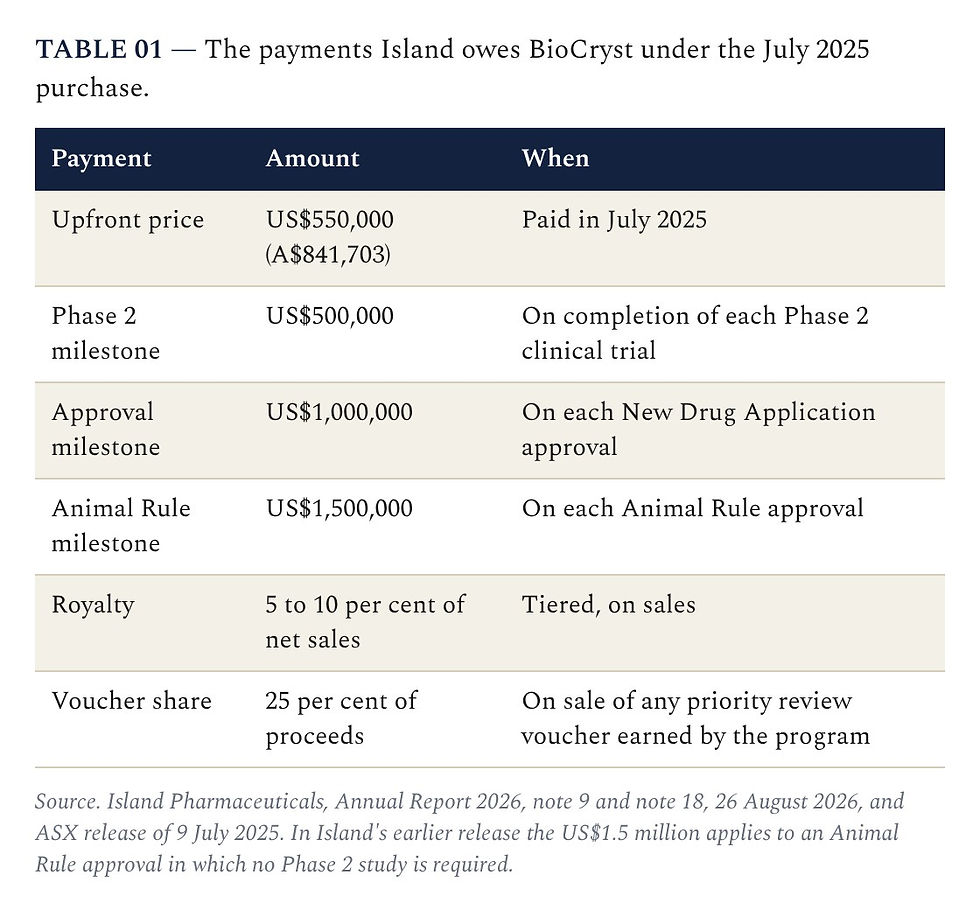
For Island's shareholders, that means any voucher sale and any product sales are shared with BioCryst. The voucher, a tradable FDA reward, is covered in section 7.
Island now runs three programs. Galidesivir is the lead. ISLA-101 is for dengue. ISLA-6181 is an oral form of galidesivir, a modified molecule designed to be swallowed and turned into galidesivir inside the body. It came with the BioCryst purchase and is at the stage of planning the laboratory and animal work needed before human trials [R7]. FIG. 01 is Island's chart of where each program stands.

The board has three directors. Jason Carroll is the non-executive chairman. Dr David Foster is the chief executive and managing director. Chris Ntoumenopoulos is a non-executive director [R4]. He also consults to the company, and the board classes him as non-independent [R42].
2.00 — HOW GALIDESIVIR WORKS
How galidesivir stops a virus copying itself
Ebola and Marburg are filoviruses. The name comes from the long thread-like shape of the virus particle, which PLATE 01 shows. Both cause a severe illness with fever, organ failure and in many cases bleeding. Their genetic material is RNA rather than DNA.

To multiply inside a human cell, an RNA virus has to copy its RNA. It does that with an enzyme of its own called RNA-dependent RNA polymerase, usually shortened to the polymerase. The enzyme strings building blocks called nucleotides together, one after another, to make a new copy.
Galidesivir is a nucleoside analogue, a drug that imitates one of those building blocks. Inside the cell it is converted into an active form that mimics ATP, the building block that carries adenine. The virus's polymerase mistakes it for the real thing, and RNA copying is blocked [R22]. Because many RNA viruses copy themselves in a similar way, a drug of this kind can work against more than one virus. Island describes activity against more than 20 RNA viruses in laboratory tests [R4].
Laboratory tests show whether a drug slows a virus in cells grown in a dish. What later work has to show is whether enough of the drug reaches the right tissues in a person, and whether it does so safely.
What the laboratory numbers measure
FIG. 02 is Island's table of laboratory results. The main measure is the EC50. It is the concentration of drug needed to cut the virus's activity in the test by half. A smaller number means less drug is needed, so the drug is more potent in that test. The units are micromolar (µM), a measure of concentration.

The raw EC50 for the filoviruses runs from 4.0 to 11.8 µM. The adjusted column multiplies each raw value by the percentage in the column headed CLE. That percentage is 35 per cent for the filoviruses and 8 to 10 per cent for some of the other viruses. Measles is the lowest in the adjusted column, at 0.5 µM, because of that smaller factor. Chikungunya and Venezuelan equine encephalitis virus gave raw readings above 100 µM, which is weak activity in that test [R6]. In plain terms, the amount of drug needed varies about threefold across the filoviruses tested. These numbers compare fairly only with results from the same kind of test.
The row for Bundibugyo, the Ebola species now spreading in the Congo, reads TBD, to be determined, in every column [R6]. The company's argument for using the drug in this outbreak rests on its results against related filoviruses and on the shared copying mechanism.
Human safety data
Galidesivir has already been given to people. FIG. 03 is Island's summary of three completed early studies. Two were Phase 1 studies in healthy volunteers. Phase 1 is the first stage of human testing and is mainly about safety and dose. One healthy volunteer study gave the drug as an injection into muscle and the other as an infusion into a vein. The third was a Phase 1b study designed for yellow fever and COVID-19. Island's summary shows 25 COVID-19 patients enrolled [R6].

Island reports no serious adverse events in the two healthy volunteer studies. The most common side effect in the muscle injection study was pain where the needle went in. The Phase 1b study reported no safety signals and drew no conclusion on whether the drug worked [R6]. Island has published these as summaries in its presentations. They mean galidesivir starts the Animal Rule path with human safety data already in hand.
3.00 — THE ANIMAL EVIDENCE
Seventeen of eighteen treated monkeys survived Marburg
Nobody can be deliberately infected with Marburg or Ebola. Marburg outbreaks have been too small and short for a normal trial. Large Ebola outbreaks have allowed randomised trials, which is how the two approved Ebola antibodies were tested [R33]. The Animal Rule is only available where no other route to approval exists [R30]. For Marburg, the main evidence for galidesivir comes from non-human primates, which in these studies are monkeys. They are the animals whose illness is most like the human disease.
The studies were run before Island owned the drug, by BioCryst and the US Army Medical Research Institute of Infectious Diseases, known as USAMRIID [R21] [R29].
The Marburg study
Monkeys were infected with the Musoke strain of Marburg virus. Groups of six were treated starting 1 hour, 24 hours or 48 hours after infection. Six more were given a placebo, an inactive dose that looks the same [R21] [R19]. FIG. 04 shows the survival curves.

All six placebo animals died. Five of six survived when treatment started at 1 hour, and six of six survived at both 24 and 48 hours. That is 17 survivors from 18 treated animals, which Island reports as 94 per cent overall survival [R21]. The 94 per cent is the three treated groups added together. In this study, treatment that started later did at least as well as treatment that started early.
The Marburg results were published in Nature in 2014 by Travis Warren of USAMRIID and colleagues. They reported that galidesivir, then called BCX4430, protected monkeys when given up to 48 hours after infection [R28] [R29]. The group-by-group figures above are as Island reports them.
The Ebola studies
For Ebola, Island reports two studies. The second used rhesus monkeys infected with the Kikwit strain of Zaire ebolavirus, the species behind the large West African epidemic of 2013 to 2016. Zaire ebolavirus is a different species from Bundibugyo. FIG. 05 shows the second study.

Six of six survived when treatment started two days after infection with a loading dose, a larger first dose to raise drug levels quickly. Four of six survived when treatment started on day three. Four of six survived when treatment started on day two without the loading dose. All six untreated animals died [R6] [R21]. Island's release of 17 September 2025 also lists a first study in which six of six survived when treatment started immediately. That release does not give the strain or species for the first study [R21].
The source Island gives for the second Ebola study is a poster presented at the IDWeek conference in 2017 [R6]. Conference posters usually get lighter outside review than journal papers, so the Ebola results have had less scrutiny than the Marburg paper. TABLE 02 sets out every arm Island has published.

Six survivors of six against none of six untreated is a clear difference. Small groups make the size of the effect, and comparisons between treated groups, uncertain. One death more or less in a group of six moves the survival figure by 17 percentage points.
The FDA has accepted the Angola strain of Marburg for Island's program. The monkey studies so far used the Musoke strain for Marburg and the Kikwit strain for Ebola. Island's Angola work to date is laboratory data and a study in guinea pigs [R6] [R17]. The monkey studies in section 5 are the next step.

4.00 — THE FDA ANIMAL RULE AND WHAT THE FDA HAS SAID
Approval on animal results and human safety data
The Animal Rule is a set of FDA regulations dating from 2002. It applies to drugs for serious conditions caused by lethal chemical, biological, radiological or nuclear agents, where human efficacy trials would be unethical and field trials are not feasible [R30].
The FDA lists four conditions for relying on animal results. The way the agent causes disease, and the way the drug prevents it, must be reasonably well understood. The effect must be shown in more than one animal species, unless one species is a well-characterised model. The animal endpoint must relate to the benefit wanted in people, which is usually survival. And the drug's behaviour in animals and people must allow an effective human dose to be chosen. Human safety still has to be shown in people [R30].
The last condition is about pharmacokinetics, the study of how a drug is absorbed, spread through the body and cleared. The aim is to show that a human dose gives drug levels in the blood at least as high as those that protected the animals.
The FDA's list of Animal Rule approvals runs from 2003. It includes two antiviral drugs, both for smallpox. TPOXX from SIGA Technologies was approved in 2018 and Tembexa from Chimerix in 2021 [R31]. No drug on the list treats a filovirus. If galidesivir is approved this way, it would be the first filovirus treatment on that list. The two smallpox drugs show the route has been used for antivirals before.
What the FDA has told Island
The company holds an existing Investigational New Drug application for galidesivir, the US filing that allows a drug to be tested in people. In August 2025 Island asked for a Type C meeting, a formal request for the FDA's written advice [R4].
Island reports that the FDA's written reply of 12 November 2025 said the Animal Rule is an appropriate pathway for galidesivir in Marburg. Island also reports that the FDA said galidesivir would qualify for a tropical disease priority review voucher on approval under that rule [R19].
A second FDA letter, received on 30 January 2026, agreed the core of the animal model. That is the Angola strain of Marburg, the cynomolgus macaque as the monkey species, and the size of the infecting dose. It set out a two-stage path. The first stage is dose-finding and pharmacokinetic studies. The second is a pivotal study, the main confirming study the FDA relies on for approval, with its design to be agreed with the FDA after stage one [R17] [R4].
Island's presentation of 5 February 2026 lists what the FDA asked for. The FDA wanted a complete natural history dataset, which describes how the disease runs in untreated animals. It asked for further justification of the model, toxicology and pharmacokinetic data, and refinements to the study design to identify the lowest effective dose [R16]. Put together, the FDA agreed the model and asked for more data before the pivotal study can be designed.
On 31 August 2026 Island announced a signed letter giving it the right to refer the FDA to a full Marburg Angola natural history study held by another party. Island said the FDA had found the published information on the model not detailed enough and had asked for the full report. Island said it had spent more than six months negotiating access [R3]. The announcement does not name the owner of the study. As Island reports it, the letter answers the FDA's request for a complete natural history dataset.
In June 2026 the FDA granted galidesivir orphan drug designation for post-exposure prophylaxis of Marburg. Post-exposure prophylaxis means giving a drug to someone who has been exposed, before they fall ill. Orphan designation is for rare diseases. It brings seven years of US market exclusivity after approval for that use, some fee exemptions and regulatory help [R10]. The exclusivity applies to that use. The animal studies and the outbreak program are about treatment of people already ill.
The disclosure query of February 2026
The FDA letter of 30 January 2026 arrived at 9.42am Sydney time on a Friday. Island entered a trading halt on Monday 2 February and announced the FDA feedback and a placement of A$9 million before the market opened on 4 February [R15] [R18].
The ASX then asked Island about the timing. In its reply of 10 February 2026, Island said it had shared the FDA feedback with its corporate adviser, Ora Capital, on 1 February. Information about the feedback was then shared with prospective placement investors during the halt under confidentiality arrangements. Island stated that its conduct was not strictly in compliance with Listing Rule 15.7, which bars a company from giving market-sensitive information to anyone before releasing it to the ASX. Island described this as unintentional and said staff and advisers had been reminded of its disclosure policy [R15]. In plain terms, placement investors heard about the FDA feedback before the rest of the market, and Island has said so on the record.
5.00 — THE STUDIES STILL TO RUN
Twenty monkeys, then twelve, then the pivotal study
Stage one is two studies in cynomolgus macaques infected with the Angola strain of Marburg. Both are run in BSL-4 laboratories. BSL-4, biosafety level 4, is the highest level of containment, used for viruses that have no approved treatment and can kill.
The first study is at USAMRIID under a cooperative research and development agreement, a formal arrangement for a company to work with a US Government laboratory. The Geneva Foundation is the third party to the agreement [R12]. FIG. 06 is Island's published protocol.

The study has five groups of four animals. Four groups get galidesivir by drip into a vein twice a day for 14 days. Three of them start 24 hours after infection, at maintenance doses of 15, 10 and 3 milligrams of drug per kilogram of body weight (mg/kg). One starts at 48 hours at 15 mg/kg. Each treated group gets two loading doses of 100 mg/kg on the first day. The fifth group gets an inactive control [R11]. The main endpoint is survival at day 28. Viral load, clinical signs and drug levels in the blood are also measured [R1].
The purpose is to find the lowest dose that works. With four animals a group, the study can show a dose that clearly works or clearly fails. It cannot reliably separate doses that perform alike.
On 19 October 2026 Island reported that 22 animals had passed health checks and been trained to wear the jackets and tethers used for drug delivery and blood sampling. Twenty are needed and two are reserves. Dosing is expected in the current quarter, observations end about 30 days after the study starts, and results follow analysis [R1]. Dr Foster said that day that alongside the Texas Biomed study, "the data generated will help establish optimal dosing parameters and treatment windows, informing the design of our pivotal efficacy study" [R1]. That is a statement about design. The study is not itself the pivotal study.
The second study is at Texas Biomedical Research Institute, in 12 animals. It will start treatment on the days that match the first signs of illness, typically three to five days after infection. Island says animal preparation starts in the December 2026 quarter and infection and treatment in early 2027 [R8]. The later start is the harder test. It is also closer to how patients are treated in an outbreak, because people are rarely diagnosed in the first two days.
After those two studies comes the pivotal study. Island's August 2026 presentation estimates about 24 animals in the June 2027 quarter, then preparation of a New Drug Application, the formal request for approval, in the September 2027 quarter [R6]. The company marks these dates as indicative and subject to change.
The human dose question
The human studies gave galidesivir for up to seven days, at up to 10 mg/kg into muscle, a single 20 mg/kg dose into a vein, or 20 mg/kg followed by 5 mg/kg twice a day into a vein [R6]. The historical Marburg study in monkeys used 15 mg/kg twice a day for 14 days [R21]. The new monkey studies run for 14 days with 100 mg/kg loading doses [R11].
Doses in mg/kg do not convert directly between monkeys and people. The FDA compares drug levels in the blood instead. Island may still need human safety data at the dose and length of treatment the monkey studies select.
How the expected dates have moved
Each Island document since the purchase has given a date for the first Marburg animal study. FIG. 07 plots each date against the date of the document that gave it.

On 31 July 2025 Island expected an animal study before the end of 2025 [R23]. Its presentation of 17 September 2025 listed the study for November 2025 and the filing of a New Drug Application for the June 2026 quarter [R21]. In February 2026, after the FDA set out its two stages, the dose study moved to the first half of 2026 and New Drug Application preparation to the March 2027 quarter [R16]. In June and July 2026 the start was the September quarter [R12] [R7]. By August it was the December quarter, with New Drug Application preparation in the September 2027 quarter [R6]. In plain terms, the first study is about a year later than Island first expected.
Some of the movement comes from the FDA asking for more. In September 2025 Island expected that one more successful animal study might be enough [R21]. The FDA's letter of January 2026 set out two stages, and its request for the natural history report took Island more than six months to meet [R3]. The program now has three animal studies ahead of a filing where the plan in September 2025 had one. FIG. 08 is the list of coming events from Island's August 2026 presentation.

6.00 — THE BUNDIBUGYO OUTBREAK AND THE UGANDA PROGRAM
The Bundibugyo Ebola outbreak, with no approved treatment for its species
Ebola is the name for a group of related viruses. Zaire ebolavirus caused the West African epidemic. Bundibugyo ebolavirus is a separate species. The current one was declared in May 2026 in the Democratic Republic of the Congo and Uganda [R24]. FIG. 09 is the map Island published in July, which shows the affected provinces and districts at that time.

The outbreak has grown since then. The WHO's situation report of 19 October 2026 counts 9,637 confirmed cases and 4,646 confirmed deaths in the Congo, a crude case fatality ratio of 48.2 per cent. The case fatality ratio is the share of confirmed cases who have died. Cases are in 66 health zones across eight provinces. Ituri accounts for 72.7 per cent of all confirmed cases [R34].
The same report counts nine cases and one death in Kenya and one case in Nigeria. Both outbreaks are listed as active. The case in Nigeria had travelled from Uganda on 3 October, and the WHO says her travel history is still being investigated. Uganda recorded 20 cases and two deaths, and its outbreak is listed as ended [R34]. The WHO and Africa CDC marked the end of Uganda's outbreak on 27 August 2026, after 42 days without a new case [R35].
FIG. 10 is Island's chart comparing the pace of this outbreak with the two largest Zaire outbreaks. Island's chart says this outbreak passed the final total of the 2018 to 2020 Kivu outbreak in about 70 days [R6].

Island's Uganda program
On 7 July 2026 Island announced that all government, regulatory and ethics approvals were in place for galidesivir to be used in patients with Bundibugyo disease in Uganda [R9]. The use falls under the WHO's MEURI framework, which stands for Monitored Emergency Use of Unregistered and Investigational Interventions. It lets doctors give an unapproved drug in an outbreak when no approved treatment exists and a randomised trial cannot be run at once, provided clinical, safety and virus data are collected under a set protocol [R9].
Under MEURI every eligible patient can receive the drug, so the data describe what happened to treated patients without a matching untreated group. A randomised trial allocates patients to the drug or a comparison by chance, which is what allows a fair judgement of whether a drug works.
Island says the program is sponsored by the Uganda Ministry of Health, run with the ACCEPT-Africa Consortium and the Infectious Diseases Institute at Makerere University, and approved by Uganda's Research Ethics Committee, National Drug Authority and National Council for Science and Technology. Island says the program is funded by the government and supporting institutions, and that Island's part is the supply of the drug [R9].
To supply it, Island hired PI Health Sciences, a contract drug manufacturer, in June 2026 [R13]. GMP manufacture, which means production under the quality rules that medicines for people must meet, started on 1 October 2026. The first 5 kg batch of active ingredient was targeted for the end of October and earmarked for the Uganda program. A second 5 kg batch was targeted for late November 2026 [R2]. After the active ingredient is made, it still has to be finished, put into vials, packed and shipped [R2]. Island expects about 700 to 800 treatment courses in total once both campaigns are finished [R5].
Island's September quarterly, lodged on 26 October 2026, still calls the outbreak in Uganda ongoing and expects drug to be shipped to Africa before the end of 2026 [R41]. The WHO and Africa CDC marked the end of Uganda's outbreak on 27 August 2026 [R35]. Island's July announcement says the approved program covers the current outbreak and later ones [R9]. Where the first patients will be treated is the next thing to watch for in Island's updates.
Other treatments being tested
The WHO is running studies in the Congo. TABLE 03 lists the products the WHO reports in its October 2026 situation report, with Island's program alongside.

The PARTNERS trial is randomised and opened on 2 July 2026. It tests MBP134, an antibody treatment, and remdesivir from Gilead, and the two together [R36]. A monoclonal antibody is a manufactured antibody that latches onto one target on the virus. Remdesivir works in a similar way to galidesivir, as a nucleoside analogue. By 19 October 520 patients had been enrolled across five treatment centres [R34].
A second study, EBO-PEP, tests oral obeldesivir from Gilead against a placebo in people exposed to a case but not yet ill [R37]. By 19 October it had enrolled 230 people in that randomised arm and 77 in a separate compassionate-use remdesivir group [R34].
If one of these studies shows a benefit, galidesivir will be measured against a proven treatment for Bundibugyo. The WHO's randomised platform is the main route for testing treatments in this outbreak. Galidesivir's route is the Uganda program, which is separate from the WHO trials and is not listed in the WHO situation report [R34].

7.00 — THE BUYERS OF A BIODEFENCE DRUG
Government stockpiles and the priority review voucher
The customers for a Marburg drug are governments. In the United States the main buyer is the Strategic National Stockpile, the federal reserve of medicines and equipment held for emergencies such as a bioterror attack. Island points to three possible sources of value, which are a stockpile contract, a priority review voucher, and supply to outbreak responses.
The stockpile
Island's presentation of 7 August 2026 states that Animal Rule approval has led to eight bioterror countermeasures joining the stockpile since 2012, that seven remain under contract, and that lifetime sales range from US$100 million to US$1.2 billion with an average of US$467 million [R6]. That is the size of the prize Island points to if galidesivir reaches the stockpile. Island's release of 21 August 2026 gives the average as US$625 million [R5]. TABLE 05 in section 10 sets out this and other differences.
The FDA list of Animal Rule approvals since 2012 differs from the company's list. AUVI-Q, Nuzyra and Jynneos are on the company's list and not on the FDA's. The FDA list includes antibiotics for plague and treatments for radiation injury that the company table does not show [R6] [R31]. The sales figures are as Island reports them.
Island also cites Ebanga and Inmazeb, the two antibody treatments the FDA approved in 2020 for Zaire ebolavirus. Its July 2026 announcement describes their approval as based on moderate efficacy supported by real-world outbreak data [R9]. The FDA's approval notice for Ebanga, from Ridgeback Biotherapeutics, describes the PALM trial as a multi-centre, open-label, randomised controlled trial in the Congo in 2018 and 2019. In that trial 35.1 per cent of 174 patients given Ebanga died within 28 days, against 49.4 per cent of 168 patients given an investigational comparison treatment [R33]. Ebanga's approval covers Zaire ebolavirus [R33]. Island states that the two products have generated more than US$1 billion in government and stockpile orders since approval [R9].
The priority review voucher
The FDA awards a tropical disease priority review voucher to the sponsor of an approved new drug for a listed tropical disease. Filovirus diseases are on the list [R32]. A voucher entitles its holder to a faster FDA review of a later drug, and holders have sold them to other drug companies.
Three conditions apply to Island's voucher. Two are FDA rules and one is in the BioCryst agreement. First, the application must contain no active ingredient the FDA has already approved [R32]. Island's annual report notes that other companies are developing galidesivir's molecule for other uses, and that an earlier FDA approval by one of them would stop Island receiving a voucher [R4]. Because the ingredient can only be new once, galidesivir can earn one tropical disease voucher at most. Second, the application must include at least one new human study essential to approval, conducted or sponsored by the applicant [R32]. Island's announcements have not said which study it would rely on. Third, 25 per cent of any sale proceeds go to BioCryst [R4].
Island's documents have quoted different voucher values over time. TABLE 04 sets them out next to sales reported by the companies or trade press.

The four sales in TABLE 04 range from US$103 million in February 2024 to US$210 million in October 2026 [R38] [R39]. A voucher is only received on approval, and its price is set when it is sold. Island's annual report states that there is no assurance a voucher will be awarded or realise the value expected [R4].
Outbreak supply
The third possibility is sales or supply to governments and agencies during outbreaks. Island says its 700 to 800 treatment courses give it stock to respond without starting a new manufacturing run each time [R5]. Island is building that stock now. A purchase order or supply contract would be the next step, and none has been announced in 2026.
8.00 — ISLA-101 AND DENGUE
ISLA-101 and the PROTECT dengue study
ISLA-101 is an old compound first developed by a large drug company as a cancer drug and never approved. Island licenses it from Monash University for use against dengue and related viruses [R26] [R4]. Dengue is a virus spread by mosquitoes.
Island tested ISLA-101 in a study called PROTECT at SUNY Upstate Medical University in the United States. It used a human challenge model, in which healthy volunteers are deliberately infected with dengue under close monitoring. The prevention group had three volunteers on ISLA-101 and one on placebo. The treatment group had eight on ISLA-101 and two on placebo [R26].
Island reports a reduction in the amount of virus and in symptoms in the prevention group, and signs of drug activity in the treatment group [R26] [R4]. Groups of four and ten can show whether the drug behaves as expected. Showing how well it works needs a larger trial. Island's June 2026 presentation says the full data are unpublished and a manuscript is in preparation [R26]. Island is assessing oral and intravenous formulations and talking with possible partners for further trials [R26].
9.00 — CASH, SHARES AND THE SHARE PRICE
A$7.83 million at 30 September and a rising quarterly spend
Island held A$7.83 million in cash at 30 September 2026, down from A$12.87 million at 30 June, and had no debt [R41] [R7]. The net operating cash outflow in the September 2026 quarter was A$4.93 million, more than three times the A$1.53 million of the June quarter and the highest of the past five quarters. FIG. 11 sets out cash and spending by quarter from the company's Appendix 4C reports [R20] [R19] [R14] [R7] [R41].

The Appendix 4C for the September quarter divides cash by that quarter's outflow and gives 1.6 quarters of funding, against 8.4 quarters in the June report [R41] [R7]. Island says the quarter carried large payments for the USAMRIID study, monkeys and BSL-4 facility costs for the Texas Biomed study, regulatory work on the clinical program in Africa and GMP manufacturing, and that it expects continued large research spending until the animal studies are complete [R41].
GMP production started on 1 October 2026, a second manufacturing campaign was added in August, and the first animal study is due to be dosed in the December quarter [R2] [R5]. What we still need to know is what the two animal studies and the two manufacturing campaigns cost, because Island has not published those figures. The 1.6 quarters assumes spending stays at the September quarter's level. At that rate, and before any money from options, the cash runs out in the March 2027 quarter. That is Samso's arithmetic.
The 30 June cash came largely from a placement of A$9 million in February 2026 at 35 cents a share, and about A$2.6 million from the exercise of options during the year to June 2026 [R4]. Island said at the time that the capital would "fully fund Galidesivir through its two-stage FDA Animal Rule development pathway and NDA submission in Marburg" [R18]. Since then it has added the Uganda program and a second manufacturing campaign [R9] [R5]. The annual report shows a loss of A$9.84 million for the year, of which A$5.05 million was a non-cash charge for share options [R4]. So about half the reported loss did not use cash.
Shares, options and holders
Island had 296,096,682 shares on issue at 9 October 2026. It also had 52,244,803 unlisted options. They include 19,428,969 options at 7 cents that expire on 4 December 2026 [R25]. If all of those 7 cent options are exercised, Island receives about A$1.36 million. That is Samso's arithmetic. Island's September quarterly expects up to that amount in the December quarter. It says about A$3.2 million of vested options are in the money, that it is "actively discussing and considering capital management and corporate plans", and that it is "confident of funding the ongoing and future operations" [R41].
The board proposes to grant each director three million options at 55 cents, subject to shareholder approval at the annual meeting [R42]. That meeting moved from 8 October to 24 November 2026 [R27]. Half vest on FDA approval of galidesivir for any use other than under the Animal Rule. Half vest on a US Government stockpile contract worth at least A$100 million [R42]. The June quarterly described the first condition as approval in any indication [R7]. So an Animal Rule approval for Marburg would not vest the first half.
The largest holders in the annual report, at 7 August 2026, were Dr William Garner with 13.67 per cent, BNP Paribas Nominees with 12.86 per cent, chairman Jason Carroll with 10.84 per cent and Dr Daniel Tillett with 7.09 per cent [R4]. Island's investor presentation of the same date gives Dr Garner 15.50 per cent, Mr Carroll 11.92 per cent, MWP Partners 8.25 per cent and Dr Tillett 7.80 per cent. The presentation figures come from substantial holder notices lodged in June and December 2025 [R6].
The share price
FIG. 12 shows the share price since January 2025. It was about 16 cents when the BioCryst purchase was announced in July 2025 and reached an intraday high of 63 cents on 24 November 2025, a week after the first FDA letter was announced. It closed at 27 cents on 2 November 2026, its lowest close in a year, and at 30.5 cents on 3 November 2026, about 13 per cent under the February placement price [R40].

At 30.5 cents the 296.1 million shares are worth about A$90.3 million. Cash of A$7.83 million at 30 September 2026 is about 9 per cent of that. That is Samso's arithmetic. So about 91 per cent of the market value is what investors are paying for the programs.

10.00 — WHAT TO WATCH AND THE COUNTER-CASE
The first dose result, the first patients and the funding
Island has put dates on the following events. Dosing of the 20-animal USAMRIID study is expected in the December 2026 quarter, with results after about 30 days of observation and analysis [R1]. The first 5 kg batch of active ingredient was targeted for the end of October, and Island had not reported its completion at 3 November 2026. The second is targeted for late November [R2]. Island expects to ship drug to Africa before the end of 2026 [R41]. The August presentation puts data from the emergency use program in the December 2026 quarter to the June 2027 quarter [R6].
The 19.4 million 7 cent options expire on 4 December 2026 [R25]. The annual meeting on 24 November 2026 votes on the directors' options and on a further 10 per cent placement capacity [R27] [R42]. The notice of 23 October says Island has no current intention to use that capacity [R42]. The quarterly three days later says Island is discussing capital management [R41]. The Texas Biomed study is due in early 2027, the pivotal study in the June 2027 quarter and New Drug Application preparation in the September 2027 quarter [R6] [R8].
Where Island's documents differ
Several figures differ between Island's documents. TABLE 05 sets them out as published.

THE COUNTERARGUMENT The case against Island is that strong historical animal results may not carry over to the program the FDA has now defined. The past Marburg study used the Musoke strain and groups of six. The FDA wants the Angola strain, a dose-finding stage, a later-treatment study and then a pivotal study, each of which can fail or produce a dose higher than expected. Human safety data may then be needed at that dose and for 14 days of treatment. The timeline has moved by about a year since September 2025, and each delay costs cash. Island held A$7.83 million at 30 September 2026, which its Appendix 4C puts at 1.6 quarters of funding at that quarter's spending. At that rate the cash lasts into the March 2027 quarter, and the pivotal study is due in the June 2027 quarter. The A$3.2 million of in-the-money options is less than one quarter's spending at that rate. That is Samso's arithmetic. A further raising would dilute existing holders. The Bundibugyo outbreak gives Island an opportunity to treat patients, but Uganda, the country where its program is approved, declared its outbreak over on 27 August. Island's table lists the laboratory result against Bundibugyo as to be determined, and the WHO is testing other drugs in randomised trials. None of the monkey studies used Bundibugyo, and the Ebola results come from a 2017 conference poster. Data from the Uganda program will have no comparison group, so good outcomes there would not on their own show that the drug works. Finally, the commercial case depends on events still ahead, including a first government order. A voucher is awarded only on approval, it can be lost if another company gains approval for the same molecule first, and a quarter of its sale price goes to BioCryst. |
The company's case is also on the record. Galidesivir comes with more than US$70 million of earlier US Government development, human safety data from three studies, an FDA-agreed animal model, an orphan designation and laboratory partners at USAMRIID and Texas Biomed [R4]. Marburg has no approved treatment, and the FDA list of Animal Rule approvals shows that antiviral drugs for a biothreat have been approved this way before [R31]. Island has GMP drug in production and an approved route to give it to patients in an outbreak. Island says it is confident of funding its ongoing and future operations [R41].
Samso has also written on cancer blood tests in Australia and on AI in healthcare on the ASX.
THE SAMSO TAKE Galidesivir came to Island with a long history. A larger company and the US Government spent more than US$70 million developing it, and then it was sold for an upfront US$550,000. Island now has to show the results again to the standard the FDA has set, and pay for it. The earlier work is real. Island reports that seventeen of eighteen treated monkeys survived Marburg, and Nature published the study in 2014. What the FDA has asked for since is a fresh set of studies in a different strain, and the first of those is due to start dosing this quarter. The next result to watch is the 20-animal study at USAMRIID. It answers a narrow question, which is the lowest dose that keeps infected monkeys alive. If the answer is a dose the human safety data support, the program moves forward on its own terms. If it is not, the timeline will come under pressure. Either way, at the September quarter's spending Island will need more money to finish the pivotal study. How much of the value rests on the Marburg program, which has a defined path, and how much on the outbreak and the voucher, which depend on events outside Island's control? |
THE TERMS USED IN THIS PIECE Active ingredient (API) The chemical in a medicine that does the work, made before it is put into vials or tablets. Animal Rule FDA regulations that allow approval on animal efficacy results plus human safety data, where human efficacy trials are unethical or not feasible. Appendix 4C The quarterly cash flow report some ASX companies must lodge. BSL-4 Biosafety level 4, the highest level of laboratory containment, used for lethal viruses with no approved treatment. Case fatality ratio The share of confirmed cases who have died. Compassionate use Giving an unapproved drug to a seriously ill patient outside a clinical trial. Cooperative research and development agreement A formal arrangement for a company to work with a US Government laboratory. Cynomolgus macaque A species of monkey used in the FDA-agreed Marburg model. EC50 The drug concentration that halves a virus's activity in a laboratory test. Lower means more potent in that test. Filovirus The virus family that includes Ebola and Marburg, named for the thread-like shape of the particle. GMP Good Manufacturing Practice, the quality rules medicines for people must be made under. Investigational New Drug application The US filing that allows a drug to be tested in people. Loading dose A larger first dose given to raise drug levels quickly. MEURI Monitored Emergency Use of Unregistered and Investigational Interventions, a WHO framework for using an unapproved drug in an outbreak with data collected under a protocol. Monoclonal antibody A manufactured antibody that latches onto one target on a virus. Natural history study A study of how a disease runs in untreated animals, the baseline a treatment is measured against. New Drug Application The formal request to the FDA to approve a drug for sale. Non-human primate A monkey or ape used in research. In these studies, macaques. Nucleoside analogue A drug that imitates a natural building block of RNA or DNA and disrupts copying. Orphan drug designation FDA status for a drug for a rare disease, bringing seven years of US market exclusivity after approval for that use. Pharmacokinetics The study of how a drug is absorbed, spread through the body and cleared. Phase 1 The first stage of human testing, mainly about safety and dose. Pivotal study The main study a regulator relies on to decide whether a drug works. Placebo An inactive dose made to look the same as the drug. Post-exposure prophylaxis Giving a drug to someone who has been exposed, before they fall ill. Priority review voucher An FDA reward for approval of a drug for a listed tropical disease, entitling the holder to a faster review of a later drug. It can be sold. Randomised trial A study in which patients are allocated by chance to the drug or a comparison. RNA polymerase The enzyme an RNA virus uses to copy its genetic material. Strategic National Stockpile The US federal reserve of medicines and equipment held for emergencies. Type C meeting A formal request for the FDA's written advice on a development program. |
REFERENCES
References and sources
REFERENCES
[R1] Island Pharmaceuticals Limited, "USAMRIID Marburg NHP study advances as 22 non-human primates successfully complete screening", ASX release, 19 October 2026, pages 1 to 3. Island ASX release, 19 Oct 2026
[R2] Island Pharmaceuticals Limited, "Galidesivir GMP manufacturing commences to support Ebola treatment and pivotal Marburg programs", ASX release, 2 October 2026. Island ASX release, 2 Oct 2026
[R3] Island Pharmaceuticals Limited, "Pivotal Marburg data secured for Galidesivir FDA pathway", ASX release, 31 August 2026. Island ASX release, 31 Aug 2026
[R4] Island Pharmaceuticals Limited, "FY26 Annual Report", lodged with the ASX on 26 August 2026, including the directors' report, notes 9 and 18, and shareholder information at 7 August 2026. Island Annual Report 2026
[R5] Island Pharmaceuticals Limited, "Second manufacturing campaign of GMP grade Galidesivir commissioned to strengthen active outbreak and biodefence inventory", ASX release, 21 August 2026. Island ASX release, 21 Aug 2026
[R6] Island Pharmaceuticals Limited, investor presentation, BioShares 2026, 7 August 2026, slides 2, 4, 8, 9, 12, 13, 15, 18 and 19. Island presentation, 7 Aug 2026
[R7] Island Pharmaceuticals Limited, "June 2026 Quarterly Activities Report" and Appendix 4C, lodged with the ASX on 30 July 2026, items 1.9, 4.6 and 8.5. Island June 2026 quarterly
[R8] Island Pharmaceuticals Limited, "Texas Biomed agreement to further advance Galidesivir towards pivotal FDA Animal Rule study", ASX release, 13 July 2026. Island ASX release, 13 Jul 2026
[R9] Island Pharmaceuticals Limited, "Government approvals secured for the use of Galidesivir as a treatment for Bundibugyo Ebola epidemic in Africa", ASX release, 7 July 2026 (the body is dated 6 July 2026). Island ASX document, 7 Jul 2026
[R10] Island Pharmaceuticals Limited, "Galidesivir granted Orphan Drug Designation by US Food & Drug Administration for Marburg", ASX release, 17 June 2026. Island ASX document, 17 Jun 2026
[R11] Island Pharmaceuticals Limited, investor presentation (updated), 11 June 2026, slides 13 and 14. Island ASX document, 11 Jun 2026
[R12] Island Pharmaceuticals Limited, "Expanded CRADA executed with USAMRIID for Galidesivir study", ASX release, 10 June 2026. Island ASX document, 10 Jun 2026
[R13] Island Pharmaceuticals Limited, "Galidesivir GMP manufacturing underway to support pivotal study and broader biodefence opportunities", ASX release, 4 June 2026. Island ASX document, 4 Jun 2026
[R14] Island Pharmaceuticals Limited, "March 2026 Quarterly Activities Report" and Appendix 4C, lodged with the ASX on 27 April 2026. Island ASX document, 27 Apr 2026
[R15] Island Pharmaceuticals Limited, "Response to ASX Aware Letter", 10 February 2026, with the ASX letter of 5 February 2026. Island ASX document, 10 Feb 2026
[R16] Island Pharmaceuticals Limited, investor presentation, 5 February 2026, slides 17 to 23. Island ASX document, 5 Feb 2026
[R17] Island Pharmaceuticals Limited, "FDA confirms Galidesivir development pathway, unlocking accelerated approval route", ASX release, 4 February 2026. Island ASX document, 4 Feb 2026
[R18] Island Pharmaceuticals Limited, "$9m in strategic funding secured to fast-track US Government Strategic National Stockpile opportunities", ASX release, 4 February 2026. Island ASX document, 4 Feb 2026
[R19] Island Pharmaceuticals Limited, "December 2025 Quarterly Activities Report" and Appendix 4C, and investor presentation, both lodged with the ASX on 27 January 2026 (presentation slide 11). Island ASX document, 27 Jan 2026
[R20] Island Pharmaceuticals Limited, "September 2025 Quarterly Activities Report" and Appendix 4C, 30 October 2025. ASX announcement, 30 Oct 2025
[R21] Island Pharmaceuticals Limited, "Investor presentation: Galidesivir underpins high level survival rates in Marburg and Ebola animal studies", ASX release and presentation, 17 September 2025. ASX announcement, 17 Sep 2025
[R22] Island Pharmaceuticals Limited, "Portfolio expansion achieved with acquisition of Galidesivir", ASX release, 9 July 2025. ASX announcement, 9 Jul 2025
[R23] Island Pharmaceuticals Limited, "Galidesivir transaction completed ahead of schedule", ASX release, 31 July 2025. ASX announcement, 31 Jul 2025
[R24] Island Pharmaceuticals Limited, "Investor Presentation - Ebola Clinical Program", 8 July 2026, slide 4. Island ASX document, 8 Jul 2026
[R25] Island Pharmaceuticals Limited, Appendix 3G, "Notification regarding unquoted securities", 9 October 2026, parts 4.1 and 4.2. Island Appendix 3G, 9 Oct 2026
[R26] Island Pharmaceuticals Limited, "Investor Presentation - Asia Dengue Summit", 16 June 2026. Island ASX document, 16 Jun 2026
[R27] Island Pharmaceuticals Limited, "Annual General Meeting - Rescheduled Date", ASX release, 30 September 2026. Island ASX document, 30 Sep 2026
[R28] Warren TK and others, "Protection against filovirus diseases by a novel broad-spectrum nucleoside analogue BCX4430", Nature 508, 402 to 405, 2014. Not read in full by Samso. DOI 10.1038/nature13027
[R29] US Army Medical Research Institute of Infectious Diseases, news release on BCX4430 and Marburg virus, March 2014. usamriid.health.mil
[R30] US Food and Drug Administration, "Animal Rule Information". fda.gov
[R31] US Food and Drug Administration, "CDER and CBER Animal Rule Approvals", list linked from the Animal Rule Approvals page (page current at 28 July 2026). fda.gov
[R32] US Food and Drug Administration, "Tropical Disease Priority Review Voucher Program" (content current at 3 September 2026). fda.gov
[R33] US Food and Drug Administration, "FDA Approves Treatment for Ebola Virus", on Ebanga (ansuvimab-zykl), December 2020. fda.gov
[R34] WHO Regional Office for Africa, "Bundibugyo Virus Disease Outbreak, Weekly External Situation Report 23", data as of 19 October 2026. Read in full. afro.who.int
[R35] WHO Regional Office for Africa, "Uganda ends Ebola outbreak following completion of 42-day countdown", 27 August 2026. afro.who.int
[R36] World Health Organization, "Patient enrolment begins in a scientific trial to identify the first effective treatments for Bundibugyo virus disease", 2 July 2026. who.int
[R37] Agence France-Presse, "Trial of potential Ebola antiviral under way, says WHO", published by The Jakarta Post, 15 July 2026. Secondary report. thejakartapost.com
[R38] Fierce Pharma, report on Bavarian Nordic's sale of a tropical disease priority review voucher for US$160 million, 18 June 2025. Secondary report. fiercepharma.com
[R39] BioPharm International, "Ultragenyx to Sell Rare Pediatric Disease Voucher for $210 Million", 8 October 2026. Secondary report. biopharminternational.com
[R40] Yahoo Finance, daily price history for ILA.AX, 2 January 2025 to 3 November 2026, retrieved 3 November 2026. Secondary data source. finance.yahoo.com
[R41] Island Pharmaceuticals Limited, "September 2026 Quarterly Activities Report" and Appendix 4C, lodged with the ASX on 26 October 2026, items 1.9, 4.6, 7.1, 8.5 and 8.6. Island September 2026 quarterly
[R42] Island Pharmaceuticals Limited, "Letter to Shareholders, Notice of AGM & Proxy Form", ASX release, 23 October 2026, resolutions 3 and 6 to 8. Island notice of meeting, 23 Oct 2026
Cover photo: Ebola virus particle, electron micrograph, digitally coloured. US Centers for Disease Control and Prevention, Public Health Image Library 23186, photographer Dr Frederick Murphy. Public domain (https://phil.cdc.gov/Details.aspx?pid=23186)
 The Samso Way – Seek the ResearchHere at Samso, we pride ourselves on delivering content for investors that is independent and informed by over three decades of experience in the industry. Our content is well-researched and is only created if I see merit in discussing the company's story. Our mission is simple. Cut through the noise and spotlight what matters. Genuine stories, grounded insights, and real opportunity. Investors can explore our four core platforms:
There may be numerous paths to success in investing, but the common thread among successful individuals is that they remain committed to making informed decisions. Equip yourself with the right knowledge and tools, and you will be well on your way to achieving your financial goals. Most importantly, investors need to be absolutely diligent in understanding their own risk-reward tolerance and capabilities. Never bite off more than you can chew. As they say, Rome wasn't built in a day, and the Great Wall stood because it took centuries to complete. The Samso Philosophy: Stay curious. Stay sharp. And remember, digging deeper always uncovers the real value. In Life, there is no such thing as a Free Lunch. Never bite off more than you can chew is my parting comment. Happy Investing, and the only four-letter word you need to know is DYOR. To support our independent work, please head over to our Support Page and give us a helping hand in any of the ways listed. This is a new initiative for the Samso Platform, and it was always the concept of Samso when we started this journey in 2018. DisclaimerThis article is general information only. It is not financial product advice and it does not take into account any reader's objectives, financial situation or needs. It contains no price targets, no valuations and no recommendation to buy, hold or sell any security. Companies named in this article are used as historical illustrations of events that have already occurred and no view is expressed on their current merits. Readers should consider obtaining advice from a licensed financial adviser and should conduct their own research before making any investment decision. Samso and its associates may hold interests in companies mentioned. About SamsoSamso is a trusted platform that equips dedicated investors with up-to-date industry knowledge and insights from top CEOs and thought leaders. By staying informed on business advancements and market trends, investors can enhance their financial decisions through a combination of expert guidance and their own research. Coffee with Samso, Samso Insights, Samso News and Samso Research are four ways into the same work. Interviews, long-form research, short takes on announcements and company-specific studies. Every one of them is about how to think about investing rather than what to buy. Samso Insights | www.samso.com.au | An Investor Lens on ASX-Listed Companies Samso Insights are independent research commentary for general information only. Nothing in this document is financial product advice, and it does not take into account any reader's objectives, financial situation or needs. Figures are drawn from public sources believed reliable at the stated dates but are not guaranteed; market-sensitive numbers change daily. Samso or associated parties may hold positions in, or have commercial arrangements with, companies mentioned. Seek professional advice before making investment decisions. © Samso 2026 · samso.com.au |

Comments