
The Young Scientist Who Checked Twice


four grains of zircon from Mount Narryer, and the machine that could read them
Some time in the first months of 1983, a PhD student in Canberra looked at a number in the computer output and, as his supervisor later told it, decided not to tell anyone about it at first.
The student was Derek Froude, a New Zealander working under Bill Compston at the Australian National University. The number was an age. It said that a grain of zircon from a hill in the Murchison country of Western Australia was about 4.1 billion years old. No rock on Earth was known to be that old.
Compston told the story himself in a 2005 interview with the Australian Academy of Science. "When Derek saw that the computer output said 4.1 billion he couldn't believe it and he didn't tell anyone at first in case he had done something wrong." According to Compston, Froude ran it again. "This time he got the same answer, and then he found a couple of others and felt confident that this was right."
I like this story because the first thing the young scientist did with an extraordinary result was doubt it. That is the habit every geologist is taught and not all of us keep.
CANBERRA, 1973 TO 1981
Building SHRIMP at the ANU
The number came from an instrument called SHRIMP, the Sensitive High Resolution Ion Micro Probe. Compston explained the name as a pun. Real shrimps are small, he said, but "our SHRIMP is large."
In plain terms, SHRIMP fires a fine beam of charged oxygen at a spot on a mineral grain about 20 thousandths of a millimetre across. That knocks atoms off the surface. The machine then sorts those atoms by weight and counts them. Counting the uranium and the lead in that tiny spot gives you an age for that spot alone, rather than an average for a whole handful of grains.
Smaller commercial machines of the 1970s could do something similar, but they could not tell lead apart from molecules of almost exactly the same weight. Compston's answer was to build something much bigger. His colleague Steve Clement, a physicist and a former ANU PhD student, designed the ion optics. Compston recalled that its magnet had a turning radius of 100 centimetres, against about 30 centimetres in a normal instrument.
The obituary written by Ian Williams of the ANU Research School of Earth Sciences in 2025 records it this way. "The undertaking was a huge risk (an expert committee advised against it), made possible by block funding to RSES and the strong support of the then Director, Anton Hales."
Construction began in 1974 and was done in the university's workshops. By about 1979 the instrument was working as hoped. In 1981 Compston and Ian Williams started dating zircon with it. Compston recalled that the Mount Narryer result came "just after the machine really became operational".
In our geological jargon Zircon is a small, hard mineral found in many rocks, usually as grains finer than a grain of sugar. When a zircon crystal grows, it takes in a little uranium and almost no lead. Uranium then slowly turns into lead at a known rate. So the amount of lead that has built up inside the crystal works like a clock that started when the crystal formed. Zircon is also very tough. It survives being weathered out of its original rock, washed down rivers and buried again in sand, and it usually keeps its clock running the whole time. |

MOUNT NARRYER, WESTERN AUSTRALIA, 1983
Detrital zircons in the Mount Narryer quartzite
The job Compston gave Froude was simple to describe. Take the old sedimentary rocks of Australia, pull the zircon grains out of them, and see whether any were older than about 3.7 billion years, which Compston recalled was then about the age of the oldest known rocks.
Mount Narryer is in the Murchison district, about 100 kilometres inland from Shark Bay. The grains came from a quartzite there, a sandstone that has been squeezed and heated until it is very hard.
The accounts differ on how the sample reached Canberra. Compston said in 2005 that Froude collected rocks "collaborating with various other geologists and geological surveys who knew the area." The 2025 obituary by Malcolm McCulloch and Ian Williams says the zircons came "in a sample provided by Bob Pidgeon (also a former student)."

The paper went to Nature on 18 May 1983 and was published on 18 August. Froude was the first author. Compston was fifth of seven, and two of the authors, I. R. Williams and J. S. Myers, were from the Geological Survey of Western Australia. It reported four zircon grains between 4,100 and 4,200 million years old, among a population that was mostly about 3,750 and 3,500 million years old.
The opening line of the paper said the grains were "far older than any known terrestrial rocks." News reached the papers before the paper was even published. A wire dispatch from Sydney, printed in the Christian Science Monitor on 23 May 1983, said the grains had been "discovered last month", which puts the first measurement in about April 1983.
The grains were older than the quartzite that held them. In our geological jargon they are detrital zircons. They were worn out of some earlier rock, carried away by water and laid down in a younger sand that later became the quartzite. Compston said in 2005 that the team searched the area for a few years for igneous rock of that age and found none.
PARIS AND CANBERRA, 1985
When another laboratory could not repeat it
A result like this also has to be checked by other laboratories. In 1985 one of those checks came back the other way.
Urs Schärer and Claude Allègre in Paris analysed zircons from the same Mount Narryer population, using the older method of dissolving single grains and measuring them in a conventional mass spectrometer. Their paper in Nature in May 1985 said their results "confirm neither the 4,200–4,100-Myr ages nor the particular discordancy patterns obtained on the ion probe." They explained the ages they measured as zircon crystallisation between 3,800 and 3,300 million years ago.
The Canberra group replied in Nature later that year with a short note titled "The age of (a tiny part of) the Australian continent." A further answer came the next year, from the Jack Hills.

JACK HILLS, WESTERN AUSTRALIA, 1986 TO 2014
The Jack Hills zircons
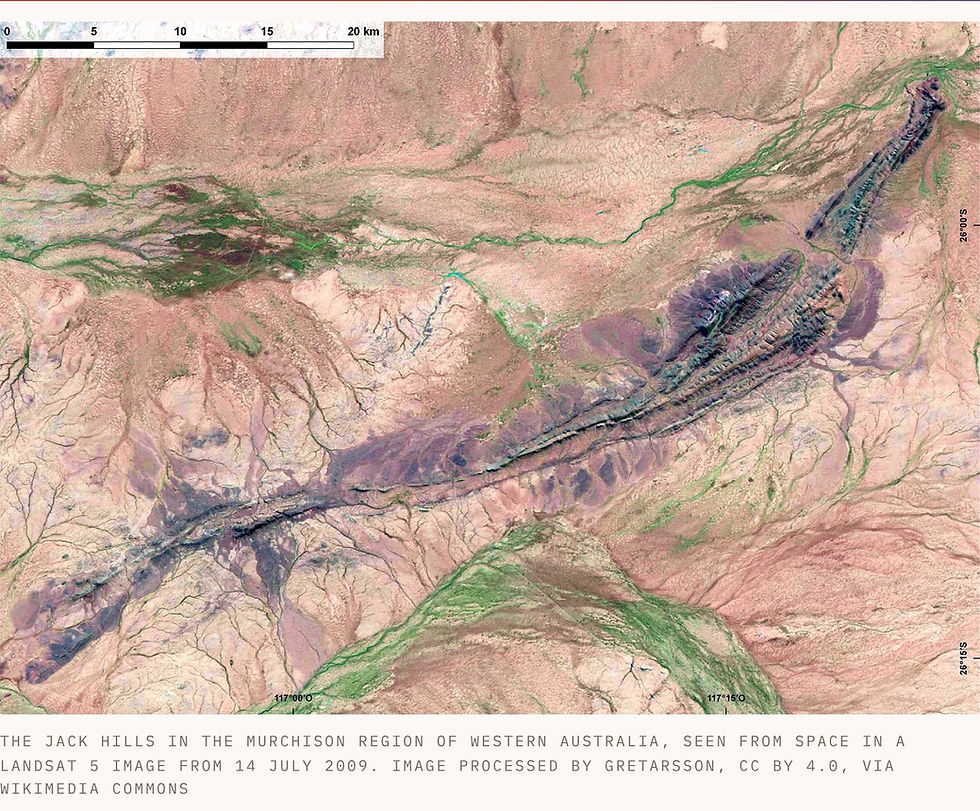
The Jack Hills are about 60 kilometres north-east of Mount Narryer. The rocks there include an old conglomerate, a rock made of rounded pebbles cemented in sand. Bob Pidgeon and the field geologist Simon Wilde had already worked on the geology there.

In June 1986 Compston and Pidgeon published "Jack Hills, evidence of more very old detrital zircons in Western Australia" in Nature. One zircon gave 4,276 million years, give or take 6 million, which they described as a minimum. Sixteen other grains might be the same age or slightly younger. About 12 per cent of the zircons they measured were very old, about five times as often as at Mount Narryer.
They also dealt with the Paris result directly. Their abstract says the conventional work on the Narryer concentrate "confirmed the younger ages but failed to observe any at ∼4,180 Myr, probably because of their low abundance." In plain words, if only a small share of the grains are that old, a method that measures fewer grains can easily miss them.
The Jack Hills went on to hold the record. In January 2001 Simon Wilde, John Valley and their colleagues reported a Jack Hills grain dated at 4,404 million years, give or take 8 million. In 2014 a team including Valley and Wilde checked a 4.4 billion year old Jack Hills zircon with a completely different method, atom-probe tomography, and confirmed it formed about 4.4 billion years ago. The checking has gone on for more than thirty years.
McCulloch and Williams wrote in 2025 that Froude's discovery "marked the start of the field of what is now known as Hadean (>4.0 Ga) geoscience." The Hadean is the name geologists give to Earth's first half a billion years or so, the period these grains come from.

LOOKING BACK
What I take from it
Bill Compston died on 16 May 2025, aged 94. The machine he was told not to build became a commercial instrument, and the last of about twenty built by the ANU was installed in China in 2023. The two obituaries give the count as 20 and 21.
Derek Froude finished his PhD thesis at the ANU in 1985. Everything above about his first look at that result is as Compston remembered it in 2005, more than twenty years later.
What stays with me is the order in which things happened. As Compston told it, a young man saw a number older than any known rock, told no one at first, ran it again and then looked for more grains. When a laboratory on the other side of the world could not repeat the result, the Canberra group replied in Nature. The lasting answer came from more grains at the Jack Hills and, years later, a different method.
In exploration we see the same thing with a good drill hole. The first assay that comes back far above everything around it is the one you trust least. You ask the laboratory to run it again. You look for the next hole to confirm it. In my experience most discoveries are results that held up after other people checked them.
Compston said something in that 2005 interview that fits this story. "But 'stupid' things need to be explored, because they're not all stupid."
When did you last check something twice before telling anyone?
A note on the sources
Compston's recollections are from his 2005 interview with David Salt for the Australian Academy of Science, Conversations with Australian Scientists, given more than twenty years after the events. The published results are from Froude and others, Nature 304, 616 to 618 (1983), Schärer and Allègre, Nature 315, 52 to 55 (1985), Compston and others, Nature 317, 559 to 560 (1985), Compston and Pidgeon, Nature 321, 766 to 769 (1986), Wilde and others, Nature 409, 175 to 178 (2001), and Valley and others, Nature Geoscience 7, 219 to 223 (2014). For those papers I read the published abstracts and metadata, not the full text.
The SHRIMP history and obituary details are from the ANU Research School of Earth Sciences vale (May 2025) and McCulloch and Williams, Journal of the Royal Society of Western Australia 108 (2025). The 1983 press report is from the Christian Science Monitor, 23 May 1983.
The Words According To Samso is about sharing the experiences of decades in my journey. These are stories and news I have heard, brought back to life in 2026. Many of them have been told before, and The Words According To Samso is now bringing them back to readers, to share with those interested in 2026 and with future generations. No tickers, no research, no opinions on what anyone should own. samso.com.au

Comments