

AML3D Limited (ASX: AL3)

Abstract
AML3D Limited makes solid metal components on a welding robot it calls ARCEMY, laying down one weld bead on top of another until the part exists. Its largest customer is the United States Navy and the parts go into submarines. This is the first Samso Research Workup on a company that does not dig anything up. The analysis behind it was done by a panel of five specialists assembled for advanced manufacturing and the defence industrial base, in place of the four mining practitioners this product normally uses.
The operating story turned in FY2026. Revenue was A$12.5 million, up 70 per cent, and the second half produced earnings before interest, tax, depreciation and amortisation of a positive A$608,000. That is the first EBITDA-positive half in the company's history. The loss after tax narrowed 38 per cent to A$4.48 million. AML3D has not raised equity since November 2024 and held A$26.67 million in cash at 30 June 2026. Over roughly the same twelve months the shares fell about 46 per cent, to A$0.150 on 21 September 2026.
The gap between those two facts is what this workup examines. Samso's view is that the business has not deteriorated. What has happened is that the company's disclosures do not yet answer a set of questions. AML3D does not report feedstock revenue and does not report utilisation of its installed base. A machine business whose customers come back is a different company from one whose customers do not, and on the evidence available two customers have come back.
Two constraints deserve to be read before any of the growth figures. Every US Navy parts contract AML3D announced up to March 2026 was for components the company itself described as non-safety-critical, which is obsolescence and supply-chain gap filling rather than pressure-boundary work. And the same programme office that funds AML3D funded Lincoln Electric, a very much larger welding company, for the same purpose in September 2025. Neither point is fatal, and both change what the story is.
One of those two moved on 17 September 2026. AML3D announced a A$0.5 million order from Austal USA Advanced Technologies for three large, high-pressure copper-nickel fluid control components for US Navy nuclear submarines, and said the order converts a copper-nickel qualification programme into production part manufacturing. It is the first production parts order the company has announced in that alloy. It is also the first submarine parts release that does not carry the non-safety-critical qualifier, and AML3D has not said why. Section 6 sets out both.
The balance sheet is comfortable and has been committed. A$26.67 million funds either a long runway or the announced A$17 million expansion of US and European capacity, and it does not obviously fund both plus a weak year. AML3D enters FY2027 with A$16.8 million of contracted orders against A$9 million a year earlier, which is the strongest number in the outlook and is a real one. The company has issued no numerical FY2027 revenue guidance and never has.
The Samso Call is Watch and DYOR. FY2027 is a year of checkable events with dates on them. The A$16.8 million has to be delivered, the Ohio expansion has to be built, four ARCEMY X systems have to be commissioned at Newport News Shipbuilding in the March 2027 quarter, and the three copper-nickel components have to be delivered and commissioned by the end of that same quarter.
Contents
Snapshot
Prices below are as at the date in the meta line above, the point this workup was compiled from. This is a living document: the share price and market cap will have moved, up or down, in the time since (check a live quote before acting on anything here, and see the note on data currency in the disclaimer).
Metric | Value |
Share price | A$0.150 (ASX, 21 September 2026, unchanged on the day) |
Market capitalisation | approximately A$85.1 million, Samso's own multiplication of price by shares on issue |
Shares on issue | 567,445,783 (30 June 2026) |
Unquoted options | 45,070,383, held by eight holders |
Cash | A$26,670,484 (30 June 2026) |
FY2026 revenue | A$12.5 million, up 70 per cent |
FY2026 result | loss after tax A$4,482,811. H2 EBITDA positive A$608,000 |
Contracted orders into FY2027 | A$16.8 million at 30 June 2026 (A$9 million a year earlier), plus a A$0.5 million parts order signed 17 September 2026 |
Sales pipeline | A$78 million, company estimate, not contracted |
Revenue guidance | none issued |
Product | ARCEMY wire arc additive manufacturing systems, and printed parts |
Principal customer | US Navy Maritime Industrial Base, contracted through BlueForge Alliance |
ARCEMY systems in the US Navy supply chain | 16 deployed on the company's 17 September 2026 count, against 14 contracted on its 31 August 2026 count |
52-week range | A$0.090 to A$0.290 |
Samso Call | Watch and DYOR |
Substantial holders (AML3D 2026 Annual Report, register as at 24 August 2026): Netwealth Investments Limited (Wrap Services A/C) 35,716,514 shares, 6.29 per cent. That is the only substantial holding disclosed. The twenty largest holders together hold 178,210,262 shares, 31.41 per cent, and most of the top ten lines are platform and custodian nominees rather than beneficial owners. There were 6,500 holders in total, of whom 1,605 held less than a marketable parcel.
Share price context: AL3 closed at A$0.150 on 21 September 2026, unchanged on the day, against a 52-week range of A$0.090 to A$0.290. The shares are down about 46 per cent over the twelve months to that date. The twelve-month base sits close to the stock's high for the period, so the figure overstates the fall. Measured from the end of September 2025 it is about 41 per cent. Over three years the shares are up and over five years they are down, and the shape across the three periods matters more than any one of them. AML3D has never paid a dividend, so total shareholder return equals price return. Coverage is thin. Two boutique brokers publish on the stock, and Samso found no note from either published after the order announced on 17 September 2026, on the searches it ran to 21 September 2026. Two highs appear in this workup on different bases. A$0.275 was the highest monthly close in the series behind Figure 1, and A$0.290 is the 52-week intraday high the ASX publishes at the data date. The A$0.29 daily close of 17 September 2025 has now passed out of the 52-week window. |
1 Why This Company Warrants A Full Workup
AML3D Limited builds metal parts by welding them into existence, one bead at a time. Its customer of consequence is the United States Navy, and the parts are for submarines.
That sentence is the reason this workup exists. Almost every company Samso writes about is looking for something in the ground. AML3D makes things instead. It is a manufacturer, listed on the ASX, with a market capitalisation of about A$85 million, selling machines and components into the United States submarine construction programme, which the FY2027 US budget request funds at US$13.99 billion for the Virginia-class line alone. It is the first Samso Research Workup on a company of this kind, and the analysis behind it was done by a panel of five specialists assembled for the sector rather than by the four mining practitioners this product normally uses.
Three things make it worth the length.
The first is that the company reported its first EBITDA-positive half in the six months to 30 June 2026. EBITDA is earnings before interest, tax, depreciation and amortisation, a measure of operating performance that excludes financing costs and the accounting cost of assets as they are used up. It came in at a positive A$608,000 for that half.[R1] Full-year revenue was A$12.5 million, up 70 per cent. For a company that recorded revenue of A$634,422 in FY2023, that is a change of state, and it happened without a capital raising since November 2024.
The second is that the share price has gone the other way. AL3 closed at A$0.150 on 21 September 2026, unchanged on the day.[R2] Over twelve months that is a fall of about 46 per cent. The comparison is unkind by accident, because the stock was running through September 2025 and reached its closing high of A$0.29 on 17 September that year. Measured from the end of September 2025 the fall is about 41 per cent. Either way the company delivered its best year and its shares fell, and that gap between operating performance and share price is the situation a workup is for.

Figure 1. AML3D monthly closing share price, January 2023 to 21 September 2026, with six announcements marked. The company reported its best operating year in the twelve months to June 2026, and over the twelve months to 21 September 2026 the shares fell about 46 per cent, to A$0.150. The last three points are the 16, 18 and 21 September closes rather than month ends, because September 2026 had not closed when this was drawn. Source: Samso, built from AL3 closing prices retrieved 21 September 2026 and announcement dates from AML3D company releases.
The third is that the whole thesis rests on one customer relationship, in one country, funded by one government programme, for a class of part AML3D had until recently described as non-safety-critical. Each of those clauses is a real constraint. The last of them moved on 17 September 2026, when the company announced its first production parts order in copper-nickel, and section 6 sets out both what changed and the fact that the release, unlike every earlier parts announcement, does not describe the components as non-safety-critical and does not say why.[R3]
This workup does not tell anyone what to do with the shares. It sets out what AML3D makes, who buys it, what has actually been contracted as against what has been forecast, what the accounts say, and what would have to hold for the story to keep working.
It is a living document. It was built on 9 September 2026, updated on 19 September 2026 to carry the production parts order announced two days earlier, and refreshed before release. Company data runs to 17 September 2026 and market data to the close of 21 September 2026, which are the two dates in the line under the title.
What this workup does not attempt
There is no valuation here and no price target. Samso does not publish them. There is also no estimate of AML3D's addressable market, and that omission is deliberate. The arithmetic is available and tempting. The US Navy has forecast a need for up to 100 additive manufacturing systems, AML3D has disclosed prices for systems it has sold, and multiplying the two takes ten seconds. It would also be a revenue forecast invented by Samso and presented in a document readers treat as research. Section 5 gives the customer's forecast and the company's disclosed contract values as two separate published facts, and stops there.
2 What AML3D Actually Does
AML3D's product is a machine called ARCEMY, and a service that uses the same machines to print parts to order.
The process is wire arc additive manufacturing, shortened in the industry to WAAM. AML3D trademarks its version as WAM, for Wire Additive Manufacturing. In plain terms it is an industrial welding robot that has been taught to build a solid object rather than join two objects together. A spool of certified welding wire feeds into an electric arc, the arc melts the wire, and the molten metal is laid down on a base plate. The robot moves, lays the next bead beside or on top of the last, and repeats. After enough passes there is a metal part where there was nothing.
In the company's words, "the certified wire feedstock is melted by an electric arc, and the molten metal is deposited onto a substrate, layer by layer to create a three-dimensional part". The formal classification is direct energy deposition, arc, usually written DED-arc.[R4]
Why ARCEMY has no chamber
Most metal 3D printing happens inside a sealed chamber. Powder bed fusion, the process most people picture when they hear metal 3D printing, spreads a thin layer of metal powder inside a box and melts it with a laser. The box works. It also sets a hard ceiling on how big the part can be.
ARCEMY has no chamber. It uses shielding gas delivered at the torch itself, which protects the weld pool from the air without needing to enclose the whole machine. AML3D states that this "localised gas shielding eliminates the need for an enclosed chamber, unlocking the potential for larger component build sizes".
Local shielding works well for steels, copper alloys and nickel alloys. Reactive metals are a harder case. Titanium keeps absorbing oxygen and nitrogen from the air well below its melting point, and it embrittles when it does, so depositing it usually needs trailing shields or a local shielding tent rather than the torch alone. AML3D lists titanium among its feedstocks and has not published how it shields it.
That single decision is the basis of the company's commercial position. It is why AML3D talks about propeller components and pressure spools rather than turbine blades and dental implants. It is also why the parts come out rough, which section 3 deals with.
The four steps of a print
AML3D's workflow runs through three pieces of its software and then the hardware.
WAMSoft. The company describes it as "the first software package used in AML3D's WAM workflow. It turns a computer aided design (CAD) model into a path plan that the ARCEMY welding torch will follow."
AMLSoft. "The ARCEMY operating system that uses the WAMSoft path plan to metal 3D print parts. AMLSoft provides real-time feedback and displays all measurable parameters during the metal 3D printing process."
AMLRapid. It "translates AMLSoft instructions into the specific commands that control the robot, welder, lights, and all other peripherals that are integrated into an ARCEMY Wire Additive Manufacturing system."
The deposition. An ABB robot arm carrying a Fronius welding package, running as an eight-axis system. Six axes are the arm itself.[R5] The other two are a positioner that tilts and rotates the part underneath the torch, so the robot can always weld into a convenient orientation.
Sensors watch the build as it happens. A laser profile sensor measures the bead geometry. An infrared pyrometer, a non-contact thermometer, reads the temperature of the metal between passes. A dynamic cooler adjusts to keep that temperature in range.
Temperature control is the hard part of the process. Every new bead re-melts and re-heats the metal beneath it. Deposit too hot and the wall slumps and the grain structure coarsens. Deposit too cold and you get poor fusion between beads and voids. Managing that thermal cycle is the technology. It is also the difference between a part that will survive a surveyor's inspection and an expensive lump of metal.
Machining after the print
Cost and risk sit in what happens after the robot stops.
WAAM is a near-net-shape process. The part comes out approximately the right shape and then has to be machined. The foundational academic paper on the process puts numbers on it. That paper is Williams, S. W., Martina, F., Addison, A. C., Ding, J., Pardal, G. and Colegrove, P., "Wire + Arc Additive Manufacturing", Materials Science and Technology, 2016, volume 32, number 7, pages 641 to 647.[R6]
Layer height is normally 1 mm to 2 mm, and the paper reports a surface waviness of roughly 500 micrometres for single track deposits. Waviness is the peak-to-valley variation left by the deposition itself rather than a fine surface texture. Half a millimetre of texture is far coarser than any bearing, sealing or mating face can tolerate, so it is the machining allowance that has to be cut off every functional face. A WAAM part is priced with a machining operation attached.
The same paper measured peak longitudinal residual stress in steel WAAM at about 600 megapascals, written MPa. Residual stress is force locked inside the metal by the heating and cooling cycle, and it can bow a part off its base plate or shorten its fatigue life. Rolling the surface between passes brought that figure down to about 250 MPa in the Cranfield work. AML3D markets "minimal stress/distortion" as an attribute of WAM but publishes no stress data of its own, so that claim sits as marketing rather than evidence.
Heat treatment is standard practice for these alloys, to even out the microstructure and relieve stress. AML3D does not publish its heat treatment routes. Nor does it publish as-printed surface figures, residual stress magnitudes, or its non-destructive testing protocols.
Non-destructive testing is inspection that does not damage the part, usually X-ray or ultrasound, and for a pressure-boundary or safety-critical component it has to be done to a defined acceptance standard. A wire arc deposit's rough as-built surface makes ultrasonic inspection difficult until the surface has been machined, so the inspection plan and the machining plan are tied together. That is the practical mechanism behind the phrase non-safety-critical, which section 6 takes up. AML3D's commercial answer on quality is accreditation rather than per-part disclosure.
3 What ARCEMY Can And Cannot Make
AML3D sells four baseline ARCEMY editions, described as fully customisable. The numbers that appear in announcements, 2600 and 6700, are the ABB robot arm models inside them rather than product names. AML3D's announcements use "ARCEMY X 6700" for the flagship, and its product page lists the 6700-series arm for that edition.

The systems actually sold to the US Navy's shipbuilders are larger than anything on that list. The four ARCEMY X systems ordered by Huntington Ingalls Industries Newport News Shipbuilding in March 2026 are described by AML3D as "custom systems based on the large scale ARCEMY X 6700 but using a ~11,000 kg positioner to create a heavy capacity build capability".[R8] Two systems already commissioned at the same yard use a 10,886 kg positioner, which is the same 24,000-pound rating rounded a different way. Either figure is about four times the catalogue X Edition's 2,700 kg rating. The biggest machines AML3D sells are bespoke, not off the price list.
Minimum print size
Every commercial ARCEMY has a stated minimum safe print footprint 0.5 m wide by 0.5 m long. That is a machine constraint the company states rather than something inferred here. It is not strictly a minimum part size, because several small parts can share one substrate, but it tells a reader what the machine was designed around.
The reason the economics work that way is worth spelling out. For a small precision component, machining from a solid block is cheap and the waste is trivial. For a large one, waste dominates. The Cranfield work reports aerospace buy-to-fly ratios of 10 to 20 when machining from solid, against about 1.2 for WAAM titanium spars and landing gear. Buy-to-fly is the mass of metal bought divided by the mass that ends up in the finished part. Buying twenty kilograms to fly one is normal in aerospace machining and is a large number when the metal is titanium. AML3D claims up to 80 per cent savings in material waste against cast and forged methods.
The same logic runs the other way on surface finish. Machining 500 micrometres off every face is a rounding error on a 1.5 m pressure spool and a total loss on a 30 mm fitting.
The alloys
Because the feedstock is ordinary certified welding wire, the material range is wide. AML3D publishes the following.
Aluminium alloys 2319, 4043, 5183, 5183 with scandium, and 5356.
Nickel aluminium bronze, and copper-nickel 70/30 and 90/10.
INVAR, and Inconel 622, 625 and 718.
Duplex 2209, super duplex 2594, and stainless 304, 310, 316LSi, 410 and 420.
Carbon steels ER70S-6 to ER120.
Titanium Ti-6Al-4V and commercially pure titanium.
The company says it has tested and printed with close to 30 feedstocks.
The marine alloys in that list show what the product was built for. Nickel aluminium bronze is what propellers and seawater valves are made from. Copper-nickel 70/30 and 90/10 are seawater piping alloys. Super duplex 2594 is high-pressure seawater service. This is a product for navies and offshore work rather than for aerospace structures.
What ARCEMY cannot do
Six limits, each of them stated by the company or measured in the literature rather than inferred here.
It cannot make fine-featured parts. The 1 mm to 2 mm layer height and the bead width of an arc process rule them out.
It cannot deliver a finished surface. Machining is required on every functional face.
It cannot yet make safety-critical US Navy submarine components. AML3D's contract language is "non-safety critical", and section 6 deals with what that means.
It cannot achieve the geometric complexity of powder bed fusion. Internal lattices, fine cooling channels and thin walls are outside the resolution of an arc process.
The material has to be weldable in wire form. No ceramics, no non-weldable alloys, no metal matrix composites off the shelf.
Reactive metals are not simply a matter of having a compatible wire, for the shielding reason set out in section 2.
One number AML3D does not publish is a deposition rate, in kilograms per hour, for any ARCEMY edition. It does not appear on any product page, in the February 2026 presentation or in the FY2025 Annual Report.
The company does market a claim that WAM makes parts "up to 75% faster, 30% stronger and 50% more resistant to metal fatigue, compared to traditional manufacturing". That sentence mixes a lead-time comparison with two mechanical property claims. The property claims carry no stated alloy, no comparison baseline, no test orientation and no test standard, and Samso could locate no published dataset behind any of the three.
The absence is not neutral, because deposition rate is a known constraint the company is spending money on. The FY2025 Annual Report describes a A$2.24 million project called ARCEMY Increase Deposition Rates, supported by a A$1.12 million grant from South Australia's Economic Recovery Fund, whose end point is a multi-robot, twin wire ARCEMY system. Research and development spending rose 83 per cent to A$1.07 million in FY2025, focused on that programme, which the company expects to finalise in FY2027.[R7] For a general benchmark rather than an AML3D figure, the Cranfield paper reports WAAM deposition rates of 1 kg to 4 kg per hour depending on material, and notes that higher rates compromise fidelity.
4 The Problem AML3D Is Selling Into
The United States Navy cannot build submarines fast enough, and one of the reasons is that it cannot get the metal parts.
The Congressional Research Service, reporting to Congress in January 2026, sets out the shape of it. The Navy has procured 41 Virginia-class attack submarines through FY2025 and funds two per year. Actual deliveries have run at about 1.1 to 1.2 boats per year since 2022, against a target of two and then 2.33. Procurement cost is about US$5.0 billion per boat under the FY2026 budget submission.[R9]
The gap between two funded and 1.1 delivered is the market. Ken Jeanos, vice president of supply chain, materials and logistics at General Dynamics Electric Boat, put the cause plainly in the joint announcement of 30 September 2025 that section 13 returns to. "Material availability continues to drive construction delays across the submarine enterprise."[R10] The supplier base for large marine castings has thinned over decades, and some of the parts needed are for boats whose original manufacturer no longer supports them.
Additive manufacturing is one of the levers the Navy has chosen. AML3D is one of the suppliers it has funded.
How the money reaches AML3D
Almost every US Navy contract AML3D has announced ran through BlueForge Alliance rather than directly with the Navy. BlueForge is a Texas non-profit spun out of the Texas A&M Engineering Experiment Station in 2022. AML3D describes it as the "neutral convener and integrator" for the US Navy's Submarine Industrial Base.
A note on names, because AML3D and the Navy use two. The earlier contracts were written under the Submarine Industrial Base label. The programme office was later stood up as the Maritime Industrial Base, and AML3D's 2025 and 2026 releases use that name. They refer to the same effort, and this workup uses Maritime Industrial Base for anything dated 2025 or later.
The scale of the vehicle is public. On 10 September 2024 the Navy awarded BlueForge a sole-source contract of US$950,744,520, with options to US$980,744,520, of which US$503.1 million in FY2024 shipbuilding and foreign-partner funds was obligated at award. Naval Sea Systems Command, the US Navy body which sets and approves technical standards for ships and submarines and which is usually written NAVSEA, told USNI News that BlueForge had received approximately US$1.3 billion since inception.[R11]
AML3D signed a Manufacturing License Agreement with BlueForge on 11 September 2024. That agreement permits AML3D to work with suppliers inside the Submarine Industrial Base and to receive technical assistance and data, which in turn allows it to print, test and validate a wider range of Navy parts. It is the enabling instrument for everything that has followed.[R12]
Payment terms on the parts contracts are described as payable up front and on milestones. For a small company that is a material feature. It means the customer funds the work rather than AML3D carrying it.
The Letter of Intent
On 6 July 2025 AML3D announced a Letter of Intent from the US Department of the Navy, signed by Matthew D Evans, Deputy Program Manager for Ships, US Navy Maritime Industrial Base. The release describes it as outlining plans to collaborate, and it carries no dollar value.[R13] Samso notes, as its reading rather than the company's wording, that a letter of intent of this kind creates no contractual obligation on either party.
What it does carry is a demand forecast. As announced in July 2025, the figures were about 400 parts required in 2026, about 1,600 parts by 2030, and up to 100 additive manufacturing systems.
Two cautions belong with those numbers, and they are the company's rather than Samso's.
First, this is the customer's forecast of its own future need, in a letter of intent rather than a contract. It is not an order and it is not revenue. It is the strongest signal of intent AML3D has received and it should be read as exactly that.
Second, AML3D has quoted the 2030 parts figure two different ways. The July 2025 release says about 1,600 parts by 2030. The release of 19 June 2026 quotes Managing Director Sean Ebert describing the same letter as indicating "a need for up to 100 additive manufacturing systems and 3,400 additively manufactured parts by 2030".[R14] The company has not reconciled the two publicly. Samso quotes the figure from the release that announced the letter, 1,600, and notes the discrepancy.
The most recent release, of 17 September 2026, returns to the lower figure. It states that "US Navy forecasts indicated a need for up to 100 advanced additive manufacturing systems and 1,600 additively manufactured components by 2030". That is the same 1,600 this workup uses, and it is the company's most recent wording.
Key to AML3D's successful US growth strategy is our ability to support the US Navy's Additive Manufacturing needs and our strong relationships within the US Navy Maritime Industrial Base. We are looking forward to continuing to build these relationships, to working with the US Navy to meet the surging demand for additive manufacturing identified in the Letter of Intent and continuing our strong investment in our US manufacturing capability. Sean Ebert, CEO, AML3D, in "US Navy Issues AML3D with Letter of Intent", AML3D company release, 6 July 2025
The quote claims a relationship and an intention to invest against a forecast. It stops short of claiming an order, and it should not be read as one.
The policy weather
The programme AML3D depends on sits inside AUKUS and inside the US shipbuilding budget, and both are political. AUKUS is the defence partnership between Australia, the United Kingdom and the United States. Its first pillar, usually written Pillar 1, is the transfer of nuclear-powered submarine capability to Australia.
The US Department of Defense began a review of AUKUS in June 2025. By early December 2025, administration officials had publicly affirmed support for AUKUS including Pillar 1, though the Congressional Research Service records that further details of the review were not publicly disclosed. Australia is providing the United States US$3 billion, about A$4.2 billion, to increase American shipbuilding capacity. The first AUKUS-specific contract award followed on 24 April 2026, when General Dynamics Electric Boat received US$197 million, about A$276 million, for engineering and design work supporting the transfer of nuclear submarine capability to Australia, with options that could take it to US$930 million.[R15]
The FY2027 US budget request, released in April 2026, was reported by Naval News as including US$65.83 billion for Navy shipbuilding, of which US$13.99 billion is the Virginia-class line. Samso has taken those figures from that report rather than from the budget documents themselves, so a reader wanting the exact appropriation account should go to the budget highlights book. Australia's May 2026 defence budget was reported at A$45.2 billion with a ramp-up in AUKUS spending.[R16]
Samso found no evidence of a 2026 cut to US Navy Submarine Industrial Base funding or to the BlueForge vehicle. That search covered US Navy budget documents, USNI News, Naval News and the Congressional Research Service reporting, and it ran to 9 September 2026. Commentary questioning whether AUKUS will hold has continued through 2026, and it is commentary rather than policy. The honest position is that the funding has been appropriated and is flowing, and that a programme dependent on political continuity across two governments carries a risk that no operating performance by AML3D can remove.
5 The Contract Record, 2023 To 2026
AML3D has announced two kinds of US defence work. It sells ARCEMY systems to companies inside the submarine supply chain, and it prints parts and runs alloy testing under contract to BlueForge Alliance. The two revenue lines behave differently and are worth keeping apart.
A currency warning, before the numbers
AML3D reports in Australian dollars, and its announcement headlines drop the currency prefix. The March 2026 release is headlined "$9.9M ARCEMY X Order from US Military Shipbuilder: HII-NNS". The body of the same release says "~AU$9.9 million" and carries the footnote "1 USD = 1.4306 AUD at 02/03/2026". Applying the company's rate, which is Samso's arithmetic rather than a published figure, the order is worth about US$6.9 million.
Several trade outlets have reported that contract as a US dollar figure. It is an Australian dollar figure. Every figure in the tables below is taken from the body of the company's release, in the currency the company used. Where trade press has converted a figure to US dollars at its own rate on its own day, Samso has ignored the conversion, because different outlets used different rates and do not agree with each other.
![Table 2. ARCEMY system orders into the US Navy supply chain. Columns: Date announced, Customer, Value as published, What was bought. Date announced 1 Feb 2023, Customer US Department of Defense via BlueForge Alliance, installed at Oak Ridge National Laboratory, Value as published AUD$1.0 million (US$697,800), What was bought One ARCEMY X-Edition 6700. Date announced 20 Jul 2023, Customer US Navy Additive Manufacturing Center of Excellence, Danville VA, via reseller Phillips Corporation, Value as published AUD$1.1 million (US$771,686), What was bought One ARCEMY X-Edition 6700. Date announced 20 Sep 2023, Customer Laser Welding Solutions, Value as published Not disclosed in the release Samso could access, What was bought ARCEMY 2600 Edition for nickel aluminium bronze Navy components. Date announced 6 Nov 2023, Customer Cogitic Corporation, Value as published $2.5 million, prefix not stated, What was bought ARCEMY X-Edition, submarine component supply chain. Date announced 20 Nov 2023, Customer Austal USA, Virginia, Value as published AUD$2.2 million, What was bought Custom-built ARCEMY, largest to that date. Date announced 20 May 2024, Customer Laser Welding Solutions, Value as published $0.7 million, prefix not stated, What was bought Lease of two further systems for submarine component qualification. Date announced 2 Jul 2024, Customer Laser Welding Solutions, Value as published $1.1 million, prefix not stated, What was bought System sale. Date announced 21 Jul 2025, Customer Austal USA, Value as published ~AU$1.2 million, What was bought ARCEMY Small Edition, portable, for the US Navy AM Center of Excellence. Date announced 20 Oct 2025, Customer HII Newport News Shipbuilding, Value as published ~A$4.5 million, What was bought Two custom ARCEMY X with 10,886 kg positioner. Described by AML3D as the 9th and 10th systems ordered to support the US Navy Maritime Industrial Base. Date announced 18 Nov 2025, Customer FasTech LLC, Danville VA, Value as published ~A$1.69 million, What was bought One ARCEMY X. Date announced 17 Mar 2026, Customer HII Newport News Shipbuilding, Value as published ~AU$9.9 million, What was bought Four custom ARCEMY X 6700 with ~11,000 kg positioner. Installation expected Q3 FY2027. Table 2 lists every ARCEMY system order AML3D has announced into the US Navy supply chain. Values are quoted from the body of each company release, in the currency the company used, not from headlines and not from trade press conversions. Three 2023 and 2024 rows carry a bare dollar sign in the release and are marked as such rather than assigned a currency here, although AML3D reports in Australian dollars throughout. The 20 September 2023 value could not be verified from an accessible primary release. Oak Ridge National Laboratory is a US Department of Energy laboratory, and the contracting party on that first order was the Department of Defense. Sources: AML3D company releases dated as shown, aml3d.com/news. [R17]](https://static.wixstatic.com/media/8d6c37_3c81320e7d4346f9a33756ee5c87acf1~mv2.jpg/v1/fill/w_980,h_1948,al_c,q_85,usm_0.66_1.00_0.01,enc_avif,quality_auto/8d6c37_3c81320e7d4346f9a33756ee5c87acf1~mv2.jpg)
![Table 3. Parts, feedstock and alloy qualification contracts. Columns: Date announced, Contracting party, Value as published, Scope. Date announced 21 Mar 2023, Contracting party BlueForge Alliance, with US DoD, Value as published AUD$264,300, Scope Alloy characterisation and testing for the submarine industrial base. Date announced 14 Aug 2023, Contracting party BlueForge Alliance, Value as published A$0.37 million (US$0.28 million), Scope Extension: nickel aluminium bronze corrosion and strength testing. Date announced 16 Aug 2023, Contracting party BlueForge Alliance, Value as published A$2.02 million (US$1.51 million), Scope One non-safety-critical nickel aluminium bronze replacement submarine component. Date announced 12 Sep 2023, Contracting party BlueForge Alliance, Value as published A$0.35 million (US$0.23 million), Scope Copper-nickel component development and testing, performed in Adelaide. Date announced 7 May 2024, Contracting party BlueForge Alliance, Value as published A$1.54 million (US$1.01 million), Scope Copper-nickel qualification testing, with US$0.2 million allocated to wire feedstock capacity. Date announced 11 Sep 2024, Contracting party BlueForge Alliance, Value as published Framework, no value, Scope Manufacturing License Agreement. The release references prior contracts totalling approximately A$5.44 million. Date announced 6 Jan 2025, Contracting party US Navy, Value as published A$156,000, Scope Copper-nickel tailpiece prototypes for Virginia-class, for testing and in-service trial. Date announced 26 Mar 2026, Contracting party BlueForge Alliance on behalf of the US Navy, Value as published ~AU$2.61 million (US$1.84 million), Scope Five high-demand, non-safety-critical nickel aluminium bronze replacement submarine parts, about 10 months from Q4 FY2026. Date announced 17 Sep 2026, Contracting party Austal USA Advanced Technologies, Value as published ~AU$0.5 million, Scope Three large, high pressure copper-nickel fluid control components for US Navy nuclear submarines. Described by AML3D as an initial production parts order. 50 per cent paid up front, the balance on delivery, testing and commissioning, expected complete by the end of Q3 FY2027. Table 3 lists the parts, feedstock and qualification contracts. Every one up to March 2026 was contracted through BlueForge Alliance rather than directly with the Navy, other than the January 2025 prototype order. The September 2026 order is the exception and names Austal USA Advanced Technologies as the ordering party, with BlueForge Alliance not mentioned in the release at all. Values are as published by AML3D in the body of each release. Sources: AML3D company releases dated as shown, aml3d.com/news, and the ASX-lodged release of 17 September 2026. [R18]](https://static.wixstatic.com/media/8d6c37_c3dc35ff00954505942073b1369d49ec~mv2.jpg/v1/fill/w_980,h_1641,al_c,q_85,usm_0.66_1.00_0.01,enc_avif,quality_auto/8d6c37_c3dc35ff00954505942073b1369d49ec~mv2.jpg)
Contracted is not installed
In its FY2026 results release of 31 August 2026, AML3D states that it "has signed contracts to deploy 14 ARCEMY systems into the US Navy's supply chain", plus two further systems supporting high-value US industrial manufacturing.
Table 2 does not reconcile cleanly to fourteen. Counting the units in that table gives sixteen, because the May 2024 entry is a lease of two systems and the November 2025 FasTech system may be one of the two the company assigns to industrial rather than Navy work. The October 2025 release called the two Newport News systems the ninth and tenth, and adding the four ordered in March 2026 gives fourteen only if the leased pair and FasTech are excluded. AML3D has not published the reconciliation and Samso has not attempted one on the company's behalf.
The count also moved, and the company has not explained how. The release of 17 September 2026 states in its body that there are "16 systems deployed to support the US Navy SIB to date", and quotes Sean Ebert saying AML3D has "already deployed 17 ARCEMY systems to meet US demand to date, with 16 of those in support of the US Navy SIB". Seventeen days earlier the FY2026 results release said the company "has signed contracts to deploy 14 ARCEMY systems into the US Navy's supply chain, together with two further orders for systems supporting high-value US industrial manufacturing".
A third figure sits between them. The 2026 Annual Report, lodged the same day as the results release, says AML3D "signed orders for a further eight ARCEMY systems for deployment into the US Navy supply chain during the year", and that this "brings the total number of ARCEMY System orders to support the of [sic] US Defence sector to fifteen, including the ARCEMY X at FasTech". So two documents lodged on 31 August 2026 give fourteen and fifteen, and the release of 17 September gives sixteen and seventeen.
Three things differ between those sentences and none is defined in any of the documents. The verb moves from signed contracts to deploy to deployed. The population moves, because August splits fourteen Navy systems from two non-Navy ones while September puts sixteen inside Navy support. And the name of the programme moves, from Maritime Industrial Base in August to submarine industrial base in September, which are not the same scope. Samso has quoted each figure as published and named the document it came from. AML3D announced nothing between 31 August and 17 September, so there is no further document to read against them.
Signed contracts to deploy is not the same as installed and operational. As at June 2026, of the six systems ordered by Newport News Shipbuilding, two were operational and four were due in FY2027. The February 2026 investor presentation shows three systems installed at Austal and two at Huntington Ingalls, and the two at Newport News were not announced as operational until 19 June 2026. Table 2 records two Austal orders rather than three, so the presentation's Austal count includes a unit Samso could not match to an announced order.
The distinction matters because it tells a reader where the revenue is. A system that is contracted but not yet built sits in the order book. Commissioning releases the last payment and is when the revenue lands. The 19 June 2026 release makes the mechanism visible. Commissioning the two Newport News systems triggered "the final payment of ~$892,000" on a A$4.5 million order, which is about a fifth of the contract value held to the end.
Share price response to the 2026 announcements
The share price reaction to the 2026 announcements says something about how the market reads this company.
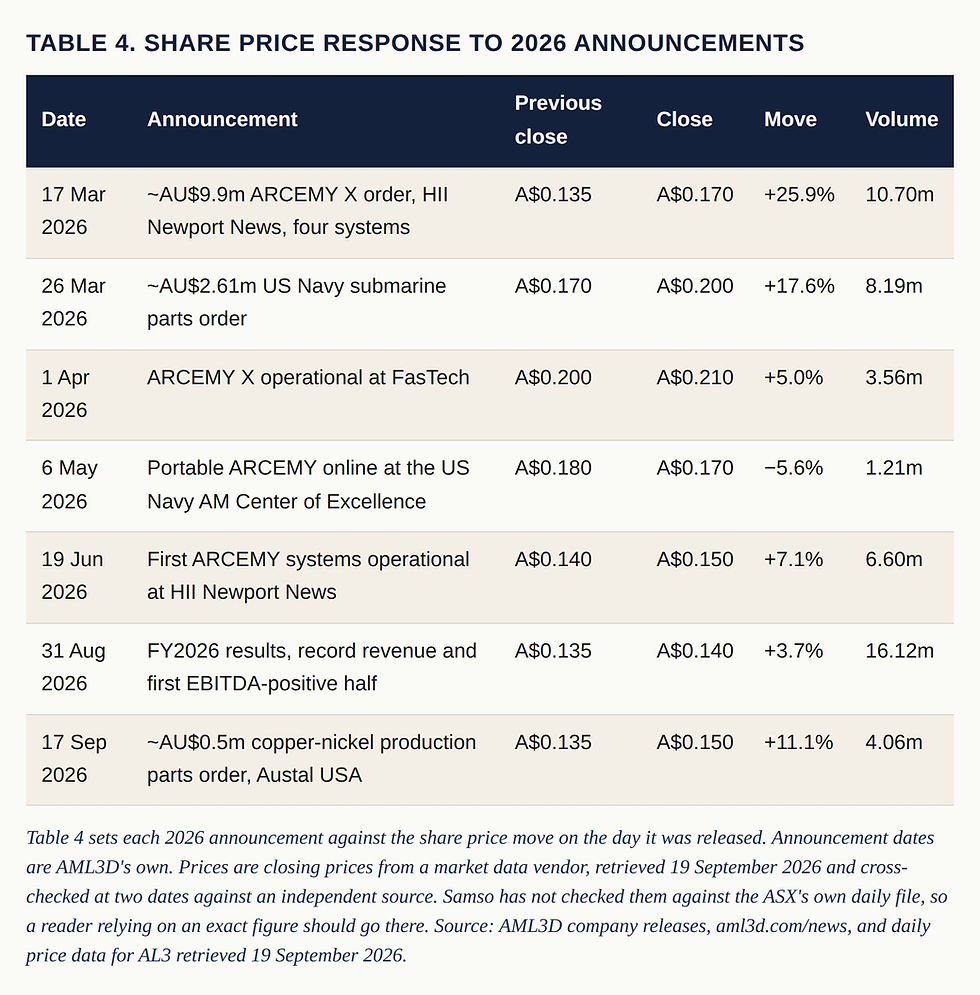
Two readings come out of that table.
On the seven announcements in Table 4, the market moved further on orders than on delivery. The three order announcements moved the stock 26 per cent, 18 per cent and 11 per cent. The three delivery and commissioning milestones moved it 5 per cent, minus 5.6 per cent and 7 per cent, even though those were the events that turned contracts into cash. Samso's view is that this is a pattern rather than a coincidence. Seven announcements in one year is a small sample and it is offered as an interpretation.
The FY2026 result moved the stock 3.7 per cent on the heaviest volume of the year, 16.12 million shares. Samso's view is that heavy volume with a small move on genuinely good news is what selling into good news looks like, and that this is a fair description of what happened on 31 August. It is an interpretation rather than a fact, and it is offered as one.
6 What "Qualified" Actually Means Here
The language around qualification in additive manufacturing is loose. Qualifying an alloy on test coupons and holding an approval to supply a given part to a named standard are different things, and the same word gets used for both.
What AML3D verifiably holds
AML3D holds four accreditations and two further listings, each announced or published and dated.
DNV Additive Manufacturing Facility accreditation with wire feedstock, for marine components. Announced 3 August 2022 and described by the company as a world first.[R19] DNV is a Norwegian classification society, one of the bodies that certifies ships and offshore structures.
AS 9100D aerospace quality management, announced 2 April 2024.
Lloyd's Register Certified AM Facility and ISO 9001, both listed in the investor presentation lodged 27 February 2026.
Listed as an AUKUS Community member in the same presentation. Separately, the FY2026 results release of 31 August 2026 reports onboarding to the Australian Submarine Agency's Defence Industry Vendor Qualification programme, which runs an additive manufacturing stream.
The FY2025 Annual Report treats these as material. It states that "the reputation of AML3D's products and services is largely dependent on retaining Lloyd's Register and AS 9100 accreditation". A company that names its accreditations as a principal business risk is telling you they are load-bearing.
None of them is a US Navy credential. DNV and Lloyd's Register are commercial marine classification societies, and their approval carries no automatic standing in US Navy procurement. AS 9100D is a quality management system certification, which is a statement about how a factory is run rather than an approval of any product or process. Those certificates are not nothing, and they carry no automatic standing in US Navy procurement, so they should not be read as a step towards one.
What AML3D does not hold, or does not disclose
Samso searched AML3D's announcements, annual reports, investor presentations and website, and the trade press covering the company, for a NAVSEA technical publication number, a NAVSEA approval letter, or a Qualified Products List entry. A Qualified Products List is the register of suppliers approved to make a given item. That search ran to 19 September 2026 and found none, and the release of 17 September 2026 makes no NAVSEA claim either. AML3D's Industry Standards page lists standards that apply to wire arc additive manufacturing generally, including ASTM F3187, AMS 7004 and 7005, AWS D20.1 and ASME BPVC Section IX, and names "NAVSEA, Mil-Spec, Def Stans" as a category. It does not claim AML3D holds any of them.[R20]
That is a claim of absence, so the search behind it is stated. It does not mean no such approval exists. It means AML3D has not announced one, and a reader should not assume one.
Alloy by alloy
Nickel aluminium bronze is the furthest advanced. Characterisation, corrosion and strength testing were contracted through BlueForge in 2023. The FY2025 Annual Report, in August 2025, still described the nickel aluminium bronze and copper-nickel qualification programmes as continuing. By March 2026, AML3D announced an order for five replacement parts in that alloy following successful US Navy hydrostatic testing of ARCEMY-printed components. Hydrostatic testing is a pressure test, where the part is filled with water and pressurised to prove it does not leak or deform.
Copper-nickel has moved furthest in the shortest time. Testing contracts came in September 2023 and May 2024, and prototype Virginia-class tailpieces were supplied in January 2025 for testing and in-service trial. Until September 2026 that was as far as the public record went, and this workup treated the alloy as in progress with prototypes delivered.
The release of 17 September 2026 changes that. AML3D states that the order "demonstrates AML3D can successfully convert a successful CuNi qualification program in support of the US Navy submarine industrial base (“SIB”) into production part manufacturing". That is the company saying a qualification programme has produced a production order, which is the step this workup identified as the one that matters. The release does not use the word qualified, it does not name a qualifying authority, and it does not link the order back to the January 2025 prototypes. It is the first production parts order AML3D has announced in that alloy.
Super duplex stainless steel has published fatigue data behind it, covered below, and test components were supplied to Australia's Defence Science and Technology Group in April 2024. That is materials development and test supply, not a US Navy qualification.
Non-safety-critical
Every US Navy parts contract AML3D announced up to March 2026 was for non-safety-critical components. The FY2026 results release of 31 August 2026 describes that work as "high demand, non-safety critical replacement components used in US Navy submarines". The March 2026 order was for parts no longer supported by the original manufacturer.
The 17 September 2026 release does not use the phrase. Samso ran a term scan over the full text of the ASX-lodged release and over the version on the company's website. The words safety, critical and non-safety critical do not appear in either. The release describes the parts as "three large, high pressure, fluid control components for use in US Navy nuclear submarines" and classifies them no further.
Read that as an absence and nothing more. AML3D has not said the parts are safety-critical, and it has not repeated the qualifier it used before. The qualifier was in current use as recently as 31 August 2026, in the document describing the immediately preceding submarine parts contract, so this is not a phrase the company had dropped from its vocabulary months earlier. Why it is absent from the September release is not something the release settles, and Samso is not going to infer it. Samso's concern is that the phrase has carried real information in every earlier parts release, and a reader who relied on it to judge what class of work AML3D is doing no longer has it.
Non-safety-critical is the company's language, and it describes the current work accurately. The work is obsolescence and supply-chain gap filling rather than primary pressure-hull or safety-critical manufacture. It also says how far the qualification journey still has to run.
Nothing about that is a criticism. Non-safety-critical replacement parts for boats whose original suppliers have gone is a real problem the Navy is paying real money to solve, and being trusted with it is how a supplier earns the next thing. It is a different business from the one an investor pictures on reading the words US Navy submarine parts.
What the anisotropy evidence shows
AML3D's Chief Technology Officer Andrew Sales is the first author of a peer-reviewed paper that is unusually useful here, because it publishes a nuanced result rather than a promotional one. The paper is "Fatigue Crack Growth Rates and Crack Tip Opening Loads in CT Specimens Made of SDSS and Manufactured Using WAAM", in Materials, 2024, volume 17, article 1842, with co-authors from the University of Queensland and the University of Adelaide. SDSS is super duplex stainless steel. CT specimens are compact tension coupons, small test pieces machined out of a printed wall rather than components, so coupon behaviour is where a qualification programme starts rather than where it finishes.[R21]
Anisotropy means a material behaving differently depending on direction, which is a known weakness of layer-built metal. AML3D's summary of the work, published on 10 May 2024,[R22] states that "fatigue properties are almost identical, or Isotropic, in both directions when expressed in terms of the effective stress intensity factor range". The paper itself puts it as fatigue crack growth rates being very similar in both directions when correlated by the effective stress intensity factor range. Either way it is a genuine positive for super duplex stainless steel on that measure.
The same work is candid about what remains. AML3D's summary states that "the difference in crack tip opening loads between the two directions can be attributed to any residual stresses induced by the WAM process", and that "if a component is overloaded in service, this difference can affect its fatigue life". It follows that "to prolong the fatigue life of a load-bearing SDSS component, one can account for a longitudinal deposition direction in the component design". Print direction is a design variable that affects fatigue life. That is the anisotropy problem managed rather than removed. The company adds that more research is needed to confirm the findings using different printing parameters.
Publishing that, with the CTO's name on it, is a point in the company's favour. It is also the clearest independent statement available of what the process still has to prove.
7 The FY2026 Result
AML3D lodged its FY2026 results on 31 August 2026 under the heading "AML3D Delivers Record FY2026 Revenue and Reports H2 Profit". The numbers behind that heading are the best the company has produced.

Revenue including lease income was A$12,473,338, up 70 per cent on FY2025. Revenue on its own, before the A$713,026 of equipment lease income, was A$11,760,312, which the Annual Report describes as up 76 per cent. Both are AML3D's figures on different bases, and the A$12.5 million the company led with is the first of them. Gross profit was A$7,801,528, up 54 per cent. EBITDA improved to a loss of A$4,234,179 from A$6,541,507. The loss after tax narrowed 38 per cent to A$4,482,811.
Gross margin fell during the year and the company states both ends of it. The Annual Report gives a gross profit margin of 63 per cent against 68 per cent in the prior year, on gross profit of A$7,801,528 against A$5,051,738. That is five points of margin compression in the year of record system deliveries. It matters because it is the number that says whether the big bespoke systems are being sold at catalogue economics or bought into, and AML3D does not comment on the move.
The number the company led with is smaller than any of those. EBITDA for the second half was a positive A$607,607, which the results release rounds to A$608,000. It is the first EBITDA-positive half in the company's history.
The 2026 financial year saw rapid growth in ARCEMY system installations and component manufacturing in the USA. It is encouraging to see our strategy of moving beyond the US Defence market begin to gain traction. During the year, we achieved record revenue growth and delivered our first profitable half-year in the second six months. Sean Ebert, Managing Director, AML3D, "AML3D Delivers Record FY2026 Revenue and Reports H2 Profit", 31 August 2026
The claim in the middle of that quote is worth testing. Moving beyond the US defence market is what AML3D says is gaining traction, and the evidence for it is thin in the disclosures. The two named non-defence customers are Tennessee Valley Authority and FasTech, and the company published no defence against non-defence revenue split for FY2026. On what is public, the FY2026 growth was overwhelmingly a US defence story.
How lopsided the year was
The full-year figures cover a first half that was poor. In the six months to 31 December 2025, revenue was A$3.2 million, down 30.4 per cent on the A$4.6 million of the prior first half. Gross profit fell 47.1 per cent to A$1.8 million. The net loss for that half was A$5.0 million, against A$3.3 million a year earlier.[R24]
Set that against the full year and the shape becomes clear. A first half with A$3.2 million of revenue and a A$5.0 million loss sits inside a full year of A$12.5 million and a A$4.48 million loss. AML3D did not publish a discrete second-half revenue figure or a discrete first-half EBITDA figure, so the split has to be derived. Samso's subtraction gives second-half revenue of about A$9.3 million and a second-half net profit of about A$0.5 million. Both of those are Samso arithmetic on published half-year and full-year figures, not company disclosures, and they should be read that way. The profit figure in particular is a small difference between two large numbers, so it is sensitive to the rounding in the published half-year loss.
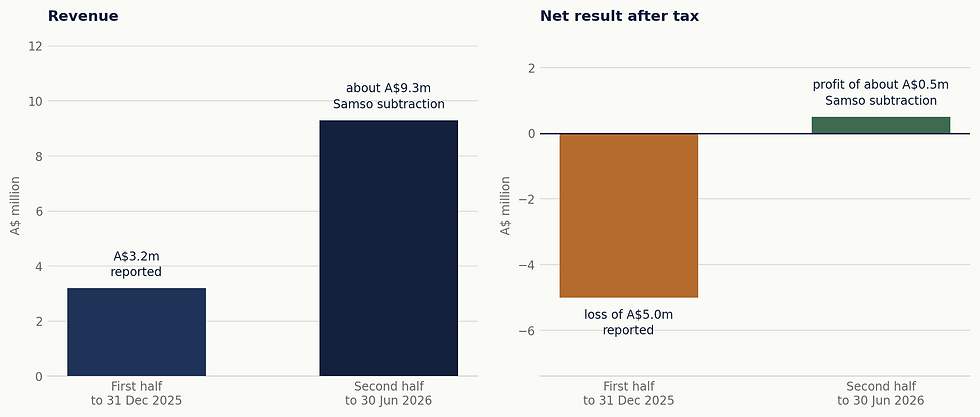
Figure 2. AML3D's FY2026 by half. Roughly three quarters of the year's revenue landed in the six months to 30 June 2026. First-half figures are as reported. Second-half figures are Samso's subtraction of the reported first half from the reported full year and are not company disclosures. Source: Samso, from AML3D half-year report of 27 February 2026 and AML3D FY2026 results release and 2026 Annual Report of 31 August 2026.
What the arithmetic says is that essentially three quarters of the year's revenue landed in the second half. That is a commissioning-driven business. Revenue arrives when systems are installed and signed off, and the installations clustered.
Two consequences follow, and they pull in opposite directions.
The favourable one is that the company has now demonstrated it can be profitable at a revenue rate it has actually achieved, rather than at a hypothetical one. The unfavourable one is that a half-year result driven by the timing of commissioning is not a run rate. A first half like FY2026's could happen again whenever installations bunch at the far end of a year, and the FY2026 first half is the evidence for that.
Where the growth came from
AML3D does not disclose a defence against non-defence revenue split, and it has not for either year. What it does disclose is the split between machines and printing, and that moved a long way.
In FY2025, 48 per cent of revenue came from the sale of ARCEMY units and associated parts and 40 per cent from print revenue. In FY2026 the Annual Report gives 75 per cent from ARCEMY units and associated parts, 23 per cent from print revenue, and the remainder from recurring licence and lease fees.
That is the most useful disclosure in the report and it cuts against the easy reading of the year. The record revenue was machine-led. The share coming from printing parts, which is the repeatable end of the business, fell from 40 per cent to 23 per cent. In dollar terms print revenue was roughly flat, because the total nearly doubled while the share more than halved. Samso's view is that a reader looking for evidence that the installed base generates recurring work will not find it in the FY2026 split, and that the September 2026 parts order matters partly because it is the first sign of that line growing again.
Two cash figures in the same results release
The FY2026 results release states cash at bank of A$26.7 million in its Highlights and a A$26.8 million cash balance at 30 June 2026 in its Outlook, in the same document. The Appendix 4C is the quarterly cash flow report an ASX company of this kind has to lodge. The one lodged on 27 July 2026 gives A$26,670,484, made up of A$6.67 million at bank and A$20.0 million in call deposits, and the Annual Report gives the same figure. Samso uses A$26,670,484. The discrepancy is noted because it is in a published document.
A prior period restatement
Note 36 of the 2026 Annual Report[R25] discloses four misstatements identified in the prior financial year, corrected by restating FY2025 across the profit and loss, balance sheet, statement of changes in equity and cash flows.
A$10,000,000 of at-call deposits with a term over three months was reclassified out of cash and cash equivalents into other financial assets.
A$147,836 of interest accruing on term deposits was recognised as a receivable, which is what restated the FY2025 loss after tax from A$7,401,734 to A$7,253,898.
Grant funding of A$423,268 was recognised as a receivable with a matching deferred grant income liability.
A transposition error meant the FY2025 potential tax benefit was overstated by A$1,880,571, reducing carried-forward tax benefits not brought to account from A$8,227,965 to A$6,347,394.
Only one of the four changed the reported loss, and by A$147,836. A prior period restatement of four items in a company of this size is nonetheless a governance data point, and it belongs in a workup rather than in a footnote.
8 Cash, Capital Commitments And Dilution
AML3D held A$26,670,484 in cash and cash equivalents at 30 June 2026, against a restated A$20,398,193 a year earlier. On that line cash rose about A$6.3 million. The company has not raised equity since November 2024, so the rise needs explaining, and the explanation is in the restatement.
At 30 June 2025 AML3D also held A$10,079,840 in other financial assets, almost all of it at-call deposits with a term over three months that Note 36 moved out of cash and cash equivalents. At 30 June 2026 that line was A$79,840. Add the two together and total liquid funds went from A$30,478,033 to A$26,750,324, a fall of about A$3.7 million.
Both numbers are true and they say different things. Cash and cash equivalents rose because money moved back out of term deposits. Total liquidity fell by A$3.7 million, which is what running the business cost after receipts. A reader comparing AML3D's cash line to last year's without the other financial assets line beside it will reach the wrong conclusion, and this workup uses the total.
That November 2024 raising was a two-tranche institutional placement of approximately A$30 million at A$0.19, issuing about 157.9 million new shares. The issue price was a 17.4 per cent discount to the A$0.23 close of 19 November 2024. It is the money the company is still spending.
The raising before it was smaller and struck at a far lower price. In May 2024 AML3D raised A$6,938,389 at A$0.05 through a one-for-three non-renounceable rights issue, its shortfall and two placements. Those two events are the reference points for what a raising costs this company when it needs one.
![Table 6. Cash flow, the two most recent quarters and the full year. Columns: Item, Mar 2026 quarter, Jun 2026 quarter, FY2026 full year. Item Receipts from customers, Mar 2026 quarter A$2.2 million, Jun 2026 quarter A$3.5 million, FY2026 full year A$10.4 million. Item Net cash used in operating activities, Mar 2026 quarter A$(2.058) million, Jun 2026 quarter A$(0.603) million, FY2026 full year A$(4.655) million. Item Cash at end of period, Mar 2026 quarter A$26.454 million, Jun 2026 quarter A$26.670 million, FY2026 full year A$26.670 million. Table 6 sets the last two quarters of FY2026 against the full year. FY2026 receipts of A$10.4 million were up about 20 per cent year on year. Sources: AML3D Appendix 4C quarterly cash flow reports lodged 27 April 2026 and 27 July 2026. [R23]](https://static.wixstatic.com/media/8d6c37_918aa2bb46944c6abf670bf10c5c3d90~mv2.jpg/v1/fill/w_980,h_543,al_c,q_85,usm_0.66_1.00_0.01,enc_avif,quality_auto/8d6c37_918aa2bb46944c6abf670bf10c5c3d90~mv2.jpg)
The operating burn is falling within the year and rising across years. The June quarter used A$603,000 of operating cash, against A$2.058 million in the March quarter. Full-year operating outflow was A$4.65 million, which the Annual Report notes is up from A$2.89 million in FY2025. At the FY2026 rate the balance covers more than five years.
Two things stop that being a comfortable reading, before the capital programme is even counted. The burn is volatile because the revenue is lumpy, so a single quarter's outflow is not a rate. And total liquid funds went backwards during FY2026, by about A$3.7 million, in the year the company describes as its best. A falling quarterly burn inside a falling annual balance is what a business looks like when it is improving and still consuming capital.
There is also a gap between cash and revenue. FY2026 receipts from customers were A$10.4 million against revenue of A$12.5 million. The A$2.1 million difference sits in receivables and contract assets, which is the working capital AML3D carries between doing the work and being paid for it.
Then there is the capital programme. AML3D has announced a A$17 million investment, A$12 million to double US manufacturing capacity at Stow, Ohio, and A$5 million for a UK and European Technology Centre. That is money the company intends to spend out of the A$26.67 million balance, and it is capital expenditure rather than operating burn, so it does not appear in the operating cash flow figures above.
Set the two against each other and the position is that the cash balance funds operations comfortably and funds the expansion comfortably, and does not obviously fund both plus a downturn. Samso is not modelling the timing of that spend, because AML3D has not published a schedule for it. The point for a reader is that A$26.67 million is not A$26.67 million of runway once A$17 million of it has been committed to plant.
The A$17 million is not a new commitment. The November 2024 placement announcement already allocated approximately A$12 million to the Ohio expansion and approximately A$5 million to United Kingdom and European market opportunities, alongside about A$3 million for research and development. The structure has been public since the raising.
Dilution overhang
AML3D had 567,445,783 fully paid ordinary shares on issue at 30 June 2026, up from 537,740,595 a year earlier, with share capital of A$60,148,146. That is 29,705,188 new shares in a year with no capital raising. The 2026 Annual Report attributes A$3,145,519 of share capital to those issues, and Samso has not established from the documents available how the issues break down between option exercises, vesting rights and consideration shares.
The 2026 Annual Report also records eight holders of 45,070,383 unquoted options, each converting one for one, and separately about 8.2 million performance rights. Together those are about 9.4 per cent of the current share count. AML3D does not publish the exercise prices or expiry dates of those options in the material Samso could access. Without them a reader cannot tell how much of the overhang is live at A$0.150 and how much is well out of the money.
Several data services carry share counts between 552 million and 556 million for AL3. Those registers are stale. The figure above is from Note 23 of the 2026 Annual Report and is confirmed in the Additional Shareholder Information as at 24 August 2026.
9 The Order Book Nearly Doubled, And How It Converts
AML3D's order book is the most quoted number in its story and the one most easily misread.
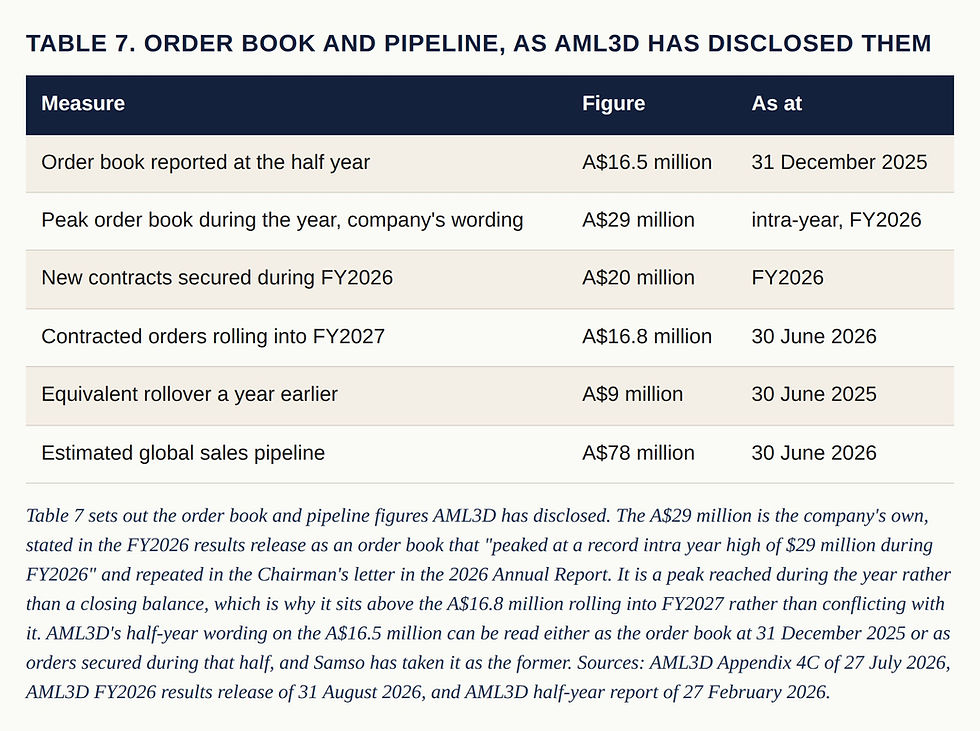
The roll-forward is a useful cross-check. AML3D opened FY2026 with A$9 million of contracted orders, won A$20 million of new contracts during the year, and closed with A$16.8 million. The difference, about A$12.2 million, is what it delivered, against A$12.5 million of reported revenue. Those two numbers being close is a point in favour of both.
Three distinctions in that table do real work.
An order book is not revenue. A$16.8 million of contracted orders roll into FY2027. That is work AML3D has been engaged to do, and it converts to revenue only as systems are built, delivered and commissioned. The four Newport News systems ordered in March 2026 are expected to be installed in the third quarter of FY2027, which is January to March 2027. Revenue on those arrives when they are signed off, not when they were ordered.
A pipeline is not an order book. The A$78 million is AML3D's estimate of opportunities it is pursuing. It is not contracted, and the company does not publish a conversion rate on it or a definition of what qualifies for inclusion. It is a useful indicator of activity and it should not be added to anything.
The rollover almost doubled. A$9 million became A$16.8 million. On the company's numbers, AML3D enters FY2027 with more contracted work in hand than it entered FY2026 with, and FY2026 was a record year. That is the strongest single number in the outlook and it is a real one.
One order has been added since. The A$0.5 million copper-nickel parts order announced on 17 September 2026 was signed after the 31 August balance date, so on the dates it is additional to the A$16.8 million. AML3D does not say so. The September release does not mention the order book at all, and Samso has not added the two figures together in any table here.
Demand that supported our FY26 performance has continued into FY27. While we continue to deliver the $16.8 million orders in hand, we are also working to convert our $78 million global sales pipeline and have visibility on potential near-term contracts in the US and the UK. Our strong balance sheet means we have the capacity to complete our planned $17 million investment to double US manufacturing capacity and establish a European Technology Centre to support growth. We are focused on continuing AML3D's multi-year track record of record delivery and building shareholder value over time. Sean Ebert, Managing Director, AML3D, "AML3D Delivers Record FY2026 Revenue and Reports H2 Profit", 31 August 2026
The quote expresses confidence that FY2027 can deliver another record revenue performance, and it names the two numbers behind that confidence. What it stops short of is a forecast. AML3D has issued no FY2027 revenue guidance. Any FY2027 revenue figure a reader encounters is either an analyst estimate or somebody's arithmetic, and it should be labelled as one of those.
The repeatability question
The panel's manufacturing systems seat asks a question AML3D's disclosures do not answer. What happens after a customer buys a machine?
There are three possible answers. The customer buys more machines, which Austal USA and Newport News Shipbuilding have both done. The customer becomes a consumables annuity, buying certified wire feedstock in volume, which AML3D has invested in the capacity to supply but does not report as a separate revenue line. Or the customer buys once and is finished.
On the evidence, the first is happening with two customers. Austal USA has taken three systems on the company's count, two of which Samso can match to an announced order, and Newport News has ordered six. Austal USA has now also placed a parts order, which is a third kind of repeat from the same customer. The FY2026 split in section 7 sets a limit on how much comfort to take from that, because print revenue fell from 40 per cent of the total to 23 per cent while machines went to 75 per cent.
The second is plausible and undisclosed. AML3D took US$0.2 million of a May 2024 BlueForge contract specifically to build copper-nickel wire feedstock capacity, and it sourced 8.5 tonnes of nickel aluminium bronze wire for a BAE Systems UK programme in April 2025. It does not report feedstock revenue separately, so nobody outside the company can size it.
That is the gap in the story. A machine business whose customers repeat is worth considerably more than one whose customers do not, and AML3D's reporting does not yet let a reader tell which it is.
10 The Register
AML3D's share register has one substantial holder, and that holder is a retail platform rather than an institution.
At 24 August 2026 there were 6,500 holders of 567,445,783 shares. The twenty largest held 178,210,262 shares between them, or 31.41 per cent. There was one substantial shareholder, Netwealth Investments Limited, holding 35,716,514 shares or 6.29 per cent. A substantial shareholder is one holding 5 per cent or more, a level that triggers a disclosure notice to the ASX.

Rows 1, 2, 5, 6 and 7 are platforms and custodians, which are administrative wrappers holding shares for many underlying accounts rather than conviction positions. Netwealth is a wrap platform, so the largest single line on the register is beneficially thousands of retail investors. Those five lines alone are 15.13 per cent of the company, against 31.41 per cent held by the top twenty in total. Samso has not put a figure on identifiable end holders across the full twenty, because AML3D publishes only the twenty largest lines and not the beneficial ownership behind them.
There is no cornerstone institution and no director line in the top twenty. Nor is there a US defence strategic holder.
Samso's view is that this is a structural weakness rather than a neutral fact, and that it is consistent with two other things in this workup. It fits the thin broker coverage, and it fits the 3.7 per cent move on the heaviest volume of the year when the company reported its first profitable half. A register with no anchor holder has nobody with the position or the incentive to look closely.
The distribution adds to the picture. Holders of 50,001 shares and over hold 87.72 per cent of the company, and 1,605 holders, 24.7 per cent of the register, hold less than a marketable parcel. A marketable parcel is a holding worth at least A$500 at the current price, and a holder below it can be bought out under the ASX listing rules.
The founder's holding
Andrew Sales founded the company in 2014 and is now Executive Director and Chief Technology Officer. The FY2025 Annual Report gives his relevant interest as a director at 30 June 2025 as 26,207,707 shares plus four million options.
He sold 7,000,000 shares during FY2025, reducing that interest from 33,207,707 at 1 July 2024. He does not appear in the twenty largest holders at 24 August 2026, where twentieth place was 3,328,760 shares. His holding has therefore either fallen a long way in about fourteen months or moved into a nominee account, and Samso could not establish which. The place a reader would settle it is the directors' interests disclosure in the 2026 Annual Report and any Appendix 3Y lodged since.
Founder selling is not by itself a signal. Founders sell for reasons that have nothing to do with the company. It is a fact a reader is entitled to have, and the reduction is disclosed in AML3D's annual report.
11 The People
AML3D has a four-person board, unchanged since 15 January 2024.

The chairman ran steel manufacturing in Ohio. AML3D's US manufacturing base is in Stow, Ohio. Samso's view is that this is unlikely to be a coincidence, and it is the kind of thing a small company's board is for.
The founder is still in the building, as Chief Technology Officer rather than as Managing Director. He handed the chief executive role to Ryan Millar on 26 September 2022 and moved to Chief Technology Officer the same day. Millar resigned on 15 June 2023, Sean Ebert stepped in as interim Chief Executive that day, and Ebert was confirmed as Managing Director and Chief Executive Officer on 18 September 2023. In a technology company whose entire product is a process, having the person who developed the process still running the technical side is an asset. It is also a key-person risk that AML3D does not quantify.
The US bench
The more interesting appointments are one level down, at AML3D USA Inc.
Pete Goumas was appointed President of AML3D USA on 18 September 2023 and is described in the company's 2026 materials as President and Chief Executive Officer of AML3D USA. His background is given as more than 38 years leading technical and manufacturing organisations in government and civil nuclear power, power generation and technology development.
Frederick J Stefany's appointment to the board of AML3D USA Inc as a Non-Executive Director was announced on 26 June 2025. His record, as set out in the company's release, is the reason the appointment matters. He established and served as the first Program Manager of the US Navy's Maritime Industrial Base, from July 2024 to February 2025. He was Principal Civilian Deputy Assistant Secretary of the Navy for Research, Development and Acquisition from October 2019 to August 2024, overseeing the start of the Columbia submarine programme and the expansion of the Virginia programme, [R26] and spent almost three years as acting Assistant Secretary in that role.
AML3D's release also dates his entry to the Department of the Navy to 1985. That does not sit exactly with the 43 years of service he describes in the quotation below, and Samso has left both as published.
After 43 years of deeply fulfilling service, I was happy to retire from the US Department of the Navy earlier this year. This decision created an opportunity to join the Board of AML3D USA and I am proud to be able to continue to support the great work being done to enhance the US Navy's capabilities. Frederick J Stefany, Non-Executive Director, AML3D USA Inc, in "Senior US Navy Program Lead Appointed to Board of AML3D USA", 26 June 2025
A retired US Navy Rear Admiral, David Goggins, was announced as a US Board Advisor on 16 June 2026. He is an advisor rather than a director of either entity. AML3D has not published that release on its own website and Samso could not open the primary announcement, so the detail of his background here rests on trade press reporting rather than on a company document, and no quotation from him is reproduced.
What this bench amounts to is straightforward. AML3D has hired the people who used to run the programme it now sells into. That is a legitimate and common way to build a defence business, it is disclosed, and it is worth naming as the commercial asset it is.
Two things belong beside it. Access to a programme office is not a qualification, and it does not by itself convert a non-safety-critical parts contract into a safety-critical one. And United States post-government employment rules constrain what former officials may do on behalf of a contractor. Frederick Stefany left the Maritime Industrial Base programme in February 2025 and joined the board of a supplier to that programme in June 2025. Nothing about that sequence is improper on its face, and AML3D has not published how those restrictions are managed.
12 Peer Comparison
A Samso workup compares its subject against peers on five dimensions. On a mining company those are market capitalisation, stage of exploration, commodity, jurisdiction risk and geological potential. On a manufacturer the first, second and fourth carry over, commodity becomes technology and end market, and geological potential becomes the credibility of the path to sustained profit. Table 10 sets out all five for the two closest analogues, using the result and the auditor's position as the evidence on that last dimension.
Titomic and Amaero
Two ASX-listed companies are doing something recognisably similar. Titomic (ASX: TTT) makes cold spray systems, which build parts by firing metal powder at supersonic speed rather than melting it. Amaero (ASX: 3DA) makes the specialty alloy powders that other people's machines consume. All three began as Australian companies, all three are selling into the US defence industrial base, and all three are loss-making.
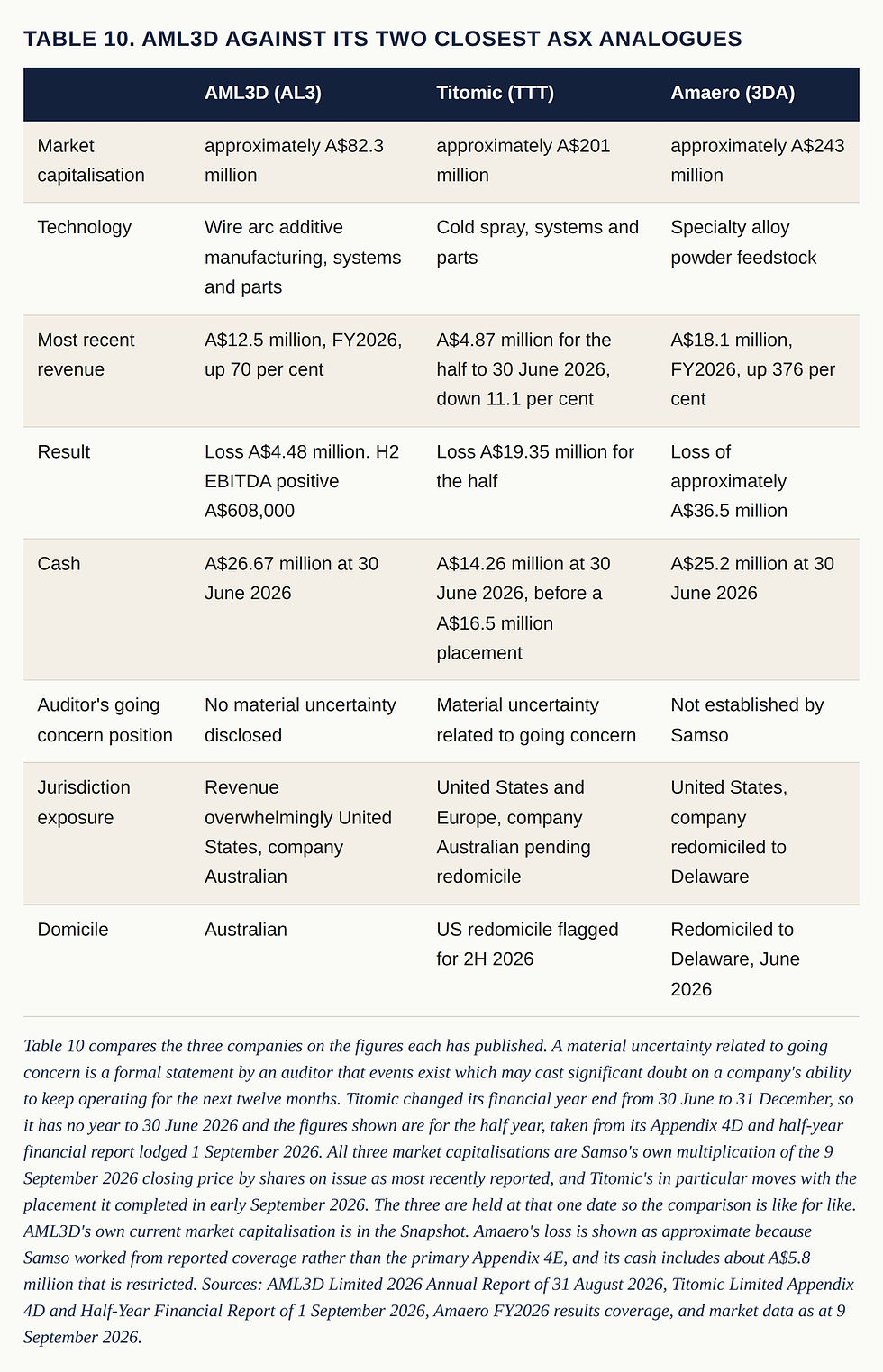
Four things come out of that comparison.
AML3D is the only one of the three approaching profitability. On the periods examined here, a positive EBITDA half is something neither of the others has produced.
AML3D is the cheaper of the two that can be compared on a full year. On its most recent full-year revenue it trades at about 6.6 times revenue, and Amaero at about 13 times. Both multiples are Samso's division of market capitalisation by reported revenue rather than published figures. Titomic has no comparable year, because it moved its balance date from 30 June to 31 December. AML3D has more revenue than Titomic on any comparable basis, a fraction of the loss, roughly double the cash, and a market capitalisation about A$120 million lower.
The Titomic comparison needs care, and this is a warning for anyone building a peer table from a data service. Titomic moved its balance date from 30 June to 31 December to align with its US and Netherlands subsidiaries. Data aggregators have stitched the mismatched periods together and report a Titomic FY2026 revenue of A$10.54 million, up 11.8 per cent. There is no such year.
The audited half to 30 June 2026 shows total revenue of A$4,869,881, down 11.1 per cent, of which only A$3,508,590 came from contracts with customers. The balance was research and development tax incentive, grants and interest. Its auditor, RSM Australia Partners, drew attention to a material uncertainty related to going concern, noting a half-year loss of A$19,351,495 and operating cash outflows of A$14,488,995. Titomic announced a A$16.5 million placement at A$0.13 within days of that report.[R27]
Both peers are leaving Australia and AML3D is not. Amaero completed its redomicile to Delaware in June 2026 and has confidentially submitted a draft registration statement on Form S-1 to the US Securities and Exchange Commission. Titomic has flagged a US redomicile for the second half of 2026.[R28] AML3D remains Australian. Samso's view is that this is the clearest strategic divergence in the group, that it is a real question rather than a settled one, and that the market has not visibly rewarded AML3D for staying.
The wider ASX comparison
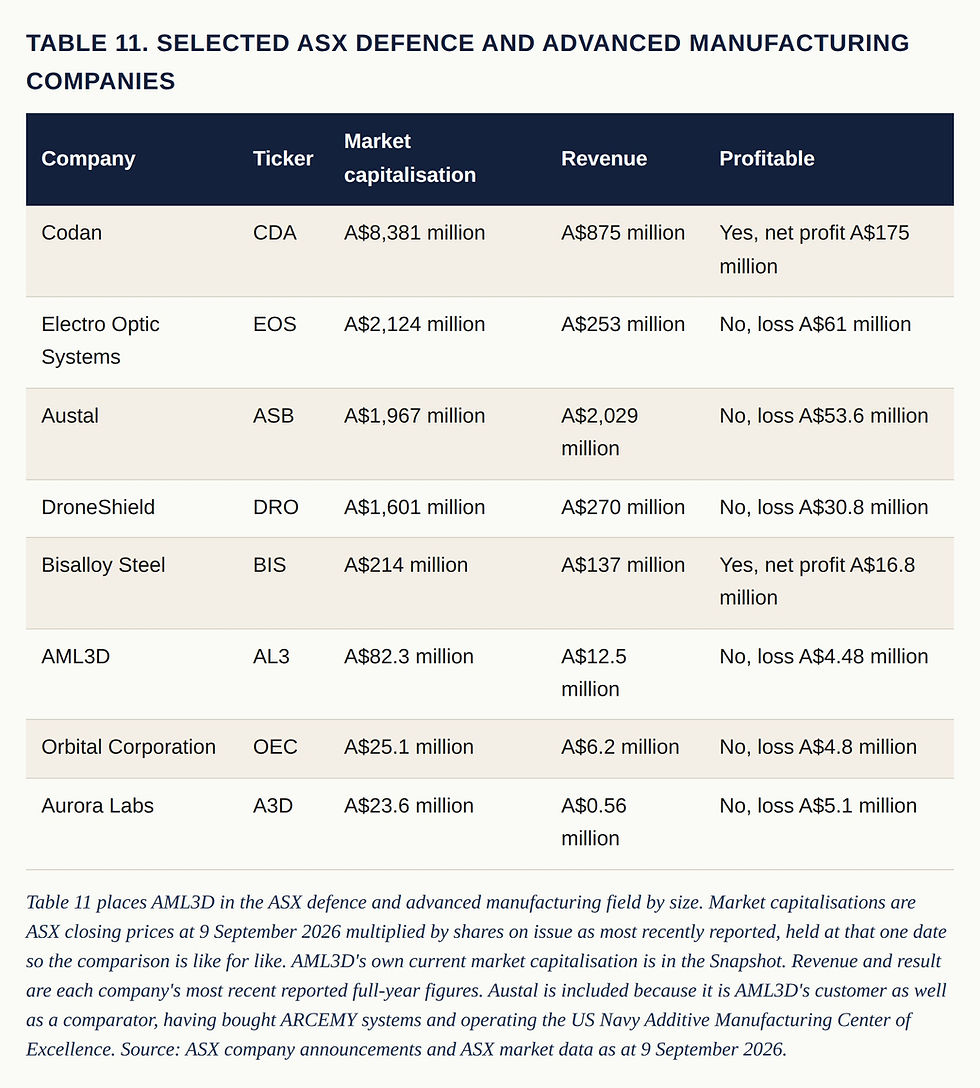
Aurora Labs is in that table deliberately. It is an ASX-listed metal 3D printing company that has been listed for years and reports revenue of A$560,000. It is what this sector can look like when a technology reaches the market and the commercialisation does not follow, and it is the downside case a reader should hold beside the upside one.
The companies that are gone
A peer table built only from companies still listed is flattering by construction. The listed history of metal additive manufacturing is a history of value destruction, and the full comparison includes the companies that are gone.
Desktop Metal was removed from the New York Stock Exchange on 14 April 2025 and filed for Chapter 11 bankruptcy protection on 28 July 2025. Its core remaining assets were sold for about US$7 million, with the foreign subsidiaries fetching a further US$10 million. Equity was cancelled and shareholders received nothing.[R29]
Markforged was acquired by Nano Dimension for approximately US$116 million, closing on 25 April 2025, and delisted.
Nikon SLM Solutions was acquired by Nikon in 2023 and taken private. In February 2026 Nikon wrote down about ¥90.6 billion against that acquisition, reported in the trade press at about US$591 million, and cut its guidance, citing an intensifying competitive environment in the metal 3D printer market.
Of the remaining large listed names, 3D Systems reported second quarter 2026 revenue of US$94.6 million, down 0.3 per cent year on year, with a net loss of US$12.9 million.[R30] Nano Dimension holds cash of about US$432 million, and its market capitalisation is below that figure, so the market values the whole company for less than the money in it.
Only one of the international names commonly grouped into this sector is profitable, Protolabs, and it is a digital manufacturing bureau rather than a metal additive manufacturing company.
None of that is an argument against AML3D. AML3D is doing something the others largely did not, which is selling into a customer with a budget, a shortage and a political mandate. It is context, and it is the context in which a reader should hold the phrase "3D printing company".
13 The Competition
AML3D's technology is not unique and the company does not claim it is. Wire arc additive manufacturing is a well-understood process built from off-the-shelf industrial robots and off-the-shelf welding equipment. AML3D uses ABB arms and Fronius welding packages, both of which anyone can buy.
What AML3D owns is a set of commercial positions rather than a technical monopoly. It holds patents on its method and apparatus, granted in Australia, Europe, India, Japan, New Zealand, the Republic of Korea, Singapore, Malaysia and the United Kingdom. It owns its software stack, and it holds the DNV, Lloyd's Register and AS 9100D accreditations. It has a working relationship with the US Navy's Maritime Industrial Base and, on the company's September 2026 count, sixteen systems deployed in support of it. Those advantages are built from relationships and time. They are real, and they are not barriers to entry in the technology itself.
The United States is not on that patent list, in the material Samso could access, and the United States is where the entire business is. Either AML3D has no granted US patent, which matters given who it is competing with, or the list Samso worked from is incomplete. The intellectual property note in the annual report is where a reader would settle it.
Lincoln Electric
Lincoln Electric Additive Solutions, part of Lincoln Electric Holdings (Nasdaq: LECO), is, in Samso's view, the most serious competitive threat, and it is funded by AML3D's customer.
On 30 September 2025 the US Navy's Maritime Industrial Base Program, General Dynamics Electric Boat and Lincoln Electric announced a Maritime Industrial Base-funded investment for Lincoln Electric to supply critical components for nuclear submarine construction, using four large-format metal additive manufacturing machines at its Cleveland facility. Steven B Hedlund, Chairman and Chief Executive of Lincoln Electric, described it as strengthening the company's partnership with Electric Boat. Matt Sermon, Executive Director of the Maritime Industrial Base Program, described the programme as charged with strengthening and expanding the shipbuilding and repair capacity the nation needs.
Lincoln Electric is a welding company more than a century old, with a US manufacturing footprint, a consumables business, a balance sheet AML3D cannot match, and arc expertise as deep as anyone's. It is competing on the same proposition, wire arc for shipbuilding, funded by the same programme office. Matt Sermon also appears in AML3D's February 2026 investor presentation, photographed visiting AML3D USA. The same programme is courting both.
The wording in the two announcements is worth holding side by side. The Maritime Industrial Base funded Lincoln Electric to supply critical components for nuclear submarine construction. Every AML3D parts contract up to March 2026 was for components the company described as non-safety-critical, and its September 2026 order classifies its parts neither way.
Samso's view is that this fact gets less attention than it deserves. It does not make the company's position worthless. Navies deliberately fund more than one supplier, and being one of two funded suppliers to a programme with a shortage is a defensible place to be. What it does rule out is any reading in which AML3D has a clear run at the US Navy.
The private competitors
![Table 12. The large-format metal additive manufacturing field. Columns: Company, Technology, Listed, Position relative to AML3D. Company Lincoln Electric Additive Solutions, Technology Wire arc, Listed Yes, parent Nasdaq: LECO, Position relative to AML3D Direct competitor for US Navy work, funded by the same programme, far larger. Company DEEP Manufacturing, Technology Wire arc, Listed No, Position relative to AML3D Four platforms in Houston since May 2026. Has held, since September 2025, DNV Approval of Manufacture for wire arc pressure vessels rated for human occupancy. That is a product approval against a pressure-boundary standard, a harder class of credential than a facility accreditation, though like AML3D's certificates it carries no automatic standing with the US Navy. Company Horizon Manufacturing Technologies, from Relativity Space, Technology Robotic deposition, Listed No, Position relative to AML3D Well-capitalised US entrant using the Stargate platform built for rockets, targeting the same replace-the-casting market [R31]. Company Sciaky, Technology Electron beam, wire fed, in vacuum, Listed No, subsidiary of Phillips Service Industries, Position relative to AML3D Among the highest deposition rates in metal additive manufacturing, quoted by Sciaky at up to about 20 pounds, roughly 9 kg, of titanium per hour. Needs a vacuum chamber, which caps part size. Company Norsk Titanium, Technology Wire fed plasma arc, Listed Yes, Euronext Growth Oslo, Position relative to AML3D Aerospace structures, qualified titanium. The nearest listed comparable by business model. Company GEFERTEC, Technology Wire arc, Listed No, Position relative to AML3D German machine builder with a build volume up to 8 cubic metres. The European incumbent in wire arc machines. Company MX3D, Technology Robotic wire arc, Listed No, Position relative to AML3D Dutch, raised €7 million, sells software and robotic cells. Company WAAM3D, Technology Wire arc, Listed No, Position relative to AML3D Cranfield University spin-out, small but carrying the most credentialled research lineage in the field. Company SPEE3D, Technology Cold spray, Listed No, Position relative to AML3D Australian, with US Navy and Department of Defense work. Its absence from any listed peer table flatters that table. Table 12 sets out the companies competing in or adjacent to AML3D's part of the metal additive manufacturing market. Most of the direct competition is private, which is why a listed-company comparison alone understates it. Sources: the joint US Navy Maritime Industrial Base, General Dynamics Electric Boat and Lincoln Electric announcement of 30 September 2025, DEEP Manufacturing's DNV Approval of Manufacture announcement of September 2025 and its Houston facility launch of May 2026, and each company's own published product and corporate material, all retrieved 19 September 2026.](https://static.wixstatic.com/media/8d6c37_0687bb32f6964eda9c38567101b364f4~mv2.jpg/v1/fill/w_980,h_1803,al_c,q_85,usm_0.66_1.00_0.01,enc_avif,quality_auto/8d6c37_0687bb32f6964eda9c38567101b364f4~mv2.jpg)
Most of AML3D's real competition is private. A reader comparing AML3D only against listed companies is looking at the smaller half of the field.
14 What Has To Go Right, And What Could Go Wrong
The analysis in this workup was done by a panel of five specialists constituted for this sector, and the risks below are grouped by the seat that raised each one. The seats are the welding and materials engineer, the manufacturing systems engineer, the defence procurement and qualification analyst, the capital goods financial analyst, and the programme and policy analyst.
What has to go right
Four things have to happen.
The A$16.8 million order book has to convert on time. Most of it is the four Newport News systems due in the third quarter of FY2027. Systems that slip a quarter move revenue across a reporting line, and FY2026's first half showed what that looks like.
The A$17 million capital programme has to produce capacity that gets used. Doubling US manufacturing capacity is only value-creating if the demand arrives to fill it. AML3D is spending most of its cash on a bet that it does.
The qualification pathway has to keep moving. Replacement parts of the kind AML3D has been contracted for are a real business and a small one. The value in the story is the move up the qualification ladder. The September 2026 copper-nickel order is one step along it, at A$0.5 million, and the next measure is whether a second and larger order in that alloy follows.
The programme funding has to hold. Everything above assumes the US Navy keeps paying and that AUKUS survives politically for long enough.
What could go wrong
Materials seat. Qualification stalls short of safety-critical work. Every US Navy parts contract AML3D announced up to March 2026 was for non-safety-critical components, and the September 2026 order classifies its parts neither way. The company's published research shows residual stress is present and consequential, and that print orientation is a design variable affecting fatigue life. Moving from parts where a failure is an inconvenience to parts where a failure is a casualty is a large step, and no announced approval shows AML3D has taken it. Samso found no NAVSEA technical publication number, approval letter or Qualified Products List entry for AML3D, having searched company announcements, annual reports, presentations, its website and the trade press to 19 September 2026.
Manufacturing systems seat. The machine sales do not repeat. AML3D does not disclose feedstock revenue separately, nor utilisation of its installed base. What it does disclose is that print revenue fell from 40 per cent of the total to 23 per cent in FY2026 while machine sales went to 75 per cent, so on the year just reported the installed base did not generate a growing annuity. Fourteen systems contracted, against a customer forecast of up to a hundred, is either an early position in a programme that keeps buying, or most of the demand there was ever going to be. AML3D's disclosures do not settle which, and Samso is not going to multiply the two figures together to pretend they do.
Procurement seat. The customer funds a competitor on the same rationale. Lincoln Electric received Maritime Industrial Base funding for the same purpose in September 2025, and for critical components rather than non-safety-critical ones. DEEP Manufacturing holds a product-level DNV certification for wire arc pressure vessels rated for human occupancy that AML3D has not announced an equivalent of. AML3D was early into this customer. The programme has not yet settled on anyone.
Financial seat. The cash is committed. The A$26.67 million balance funds either a long runway or a A$17 million expansion, and it does not comfortably fund both plus a bad year. Revenue is lumpy enough that a bad year is a real possibility, and a company that needs to raise after a weak half raises on weak terms. AML3D's history shows what that looks like. The November 2024 placement was struck at a 17.4 per cent discount to the previous close, and the May 2024 raising was priced at A$0.05.
Policy seat. The programme is political and the exposure is unhedged in two ways. The obvious exposure is that US Navy Maritime Industrial Base funding, and AUKUS behind it, depend on political continuity in two countries. The less obvious one is currency. AML3D reports in Australian dollars and an increasing share of its revenue is earned in US dollars from US customers through a US subsidiary. The company has not quantified that exposure in any document Samso could access, so a reader cannot tell how much of the FY2026 revenue growth was operational and how much was translation.
Currency cuts the other way too. The A$16.8 million order book is largely US dollar work reported in Australian dollars, and AML3D's release footnotes an exchange rate on the day of the order. A stronger Australian dollar reduces the Australian dollar value of that order book before a single system ships.
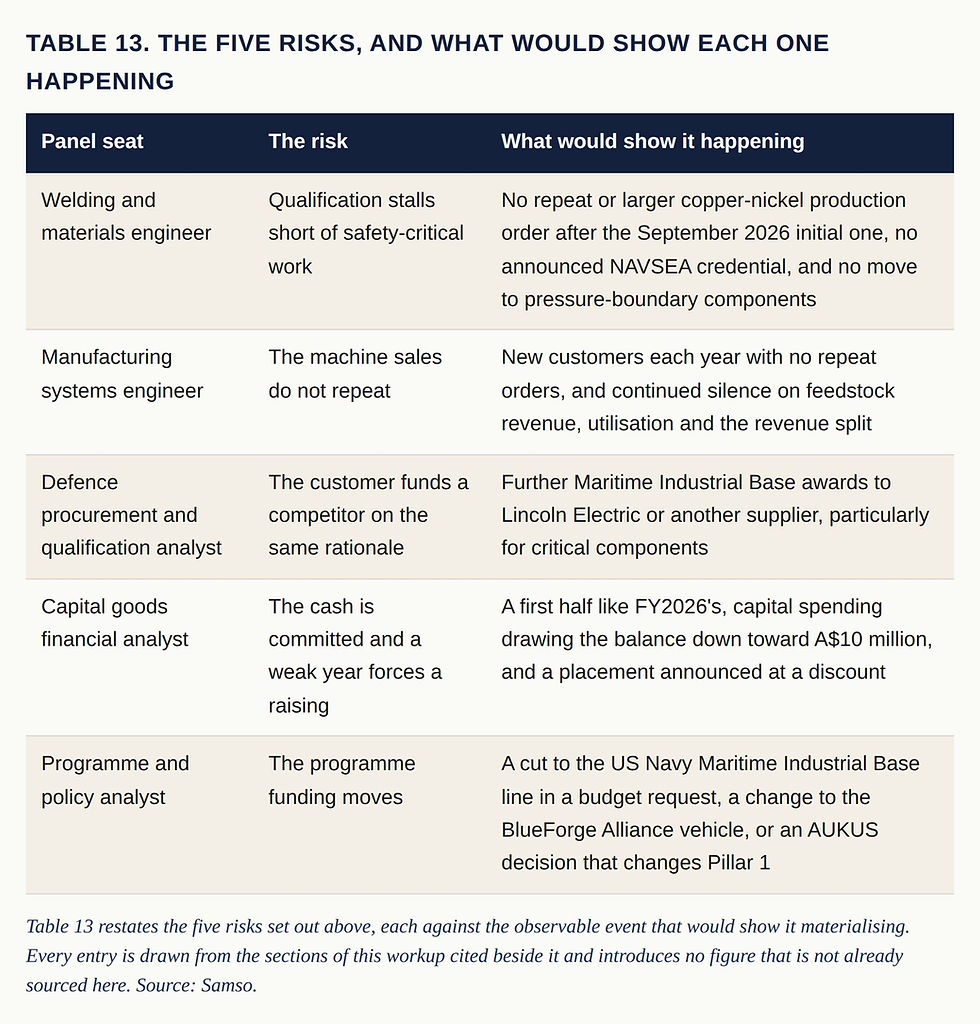
The case for AML3D, stated fairly
The risks above run to some length, so the argument on the other side deserves the same treatment in one place rather than scattered through the workup. Every figure in it is sourced in the sections above.
The operating numbers moved in the right direction on every line but one. Gross margin fell five points. Revenue up 70 per cent to A$12.5 million. Gross profit up 54 per cent to A$7.8 million. EBITDA improved 35 per cent. The loss after tax narrowed 38 per cent. And the second half produced the first EBITDA-positive half in the company's history. A company that reaches operating breakeven at a revenue level it has actually achieved is in a different position from one that projects reaching it.
The order book nearly doubled. A$16.8 million of contracted work rolls into FY2027 against A$9 million a year earlier, and the roll-forward reconciles closely to reported revenue. That is the most useful forward indicator AML3D publishes, and it is a contracted number rather than a pipeline estimate.
The customer is real, is funded, and has a problem its existing supply chain has not solved. The US Navy is delivering about 1.1 Virginia-class submarines a year against a target of two, its contractor names material availability as a cause, and the shipbuilding budget request runs to tens of billions of dollars. Very few ASX small caps sell into a customer of that size with a shortage of that kind.
Two customers have come back and bought more. Austal USA has taken three systems and Newport News Shipbuilding has ordered six. Repeat orders from a shipyard are the best evidence publicly available that the machines are performing. In September 2026 Austal USA came back again, this time for parts rather than a machine.
A qualification programme has produced a production order. AML3D says the September 2026 copper-nickel order converts a qualification programme into production part manufacturing. It is small at A$0.5 million, and it is the first time the company has been able to say that sentence about an alloy in the US Navy supply chain. It also comes in the year the print revenue share fell, so it is the counterweight to that rather than a confirmation of it.
The company has not needed money since November 2024. A$26.67 million of cash, a falling operating burn, and no raising in nearly two years is an unusual position for an ASX company of this size and stage.
The bench is credible and the published technical claims are stated with their limitations. AML3D has hired people who ran the programme it sells into, and its Chief Technology Officer publishes peer-reviewed work that reports the limitations of the process as well as its strengths. Neither is common at this end of the market.
The share price fall and the absence of guidance are not risks
The share price fall is not evidence of a deteriorating business. The operating numbers improved on every line but gross margin through FY2026 while the shares fell about 46 per cent over the twelve months to 21 September 2026. Those two facts sit together and only the operating performance is about the company.
The absence of formal FY2027 guidance is not a warning signal. AML3D has never issued numerical revenue guidance. A company that has not given guidance before is not withholding it now.
15 Samso Concluding Comments
AML3D is a small Australian manufacturer that has done something unusual. It has taken a well-understood industrial process, certified it, and sold it to the United States Navy at a moment when the Navy has a shortage its existing supply chain has not solved. It has done that without raising equity for nearly two years, and it has just posted its first EBITDA-positive half.
The market has marked the shares down about 46 per cent over the twelve months to 21 September 2026.
Samso's view is that both can be true at once, and that the reason is that AML3D's disclosures do not yet show whether an installed ARCEMY generates revenue after the sale. Whether the company can win contracts is no longer the open question. It has won them and the record is in section 5.
First, the question is whether an installed base of ARCEMY systems generates anything after the sale. The FY2026 accounts answer part of it and the answer is not the flattering one. Machines went from 48 per cent of revenue to 75 per cent, and printing parts fell from 40 per cent to 23 per cent. The record year was machine-led, and the repeatable line did not grow with it. AML3D still does not report feedstock revenue or utilisation. Two customers have come back and bought more, and in September 2026 one of them came back for parts rather than machines. That last point is the one to watch, because it is the first move in the right direction on the line that matters.
Second, the phrase non-safety-critical is AML3D's and it has been the most honest measure of where the business sits. Printing replacement parts that nobody else can supply, for boats whose original manufacturers are gone, is a real service to a customer with a real problem, and it is how a supplier earns the right to be asked about harder parts. The distance between that and what most people picture when they read US Navy submarine components is where the value in this company sits.
The September 2026 order is the first evidence of that distance closing. It is a production order rather than a prototype, it is in an alloy AML3D says it has taken through qualification, and it does not carry the qualifier the earlier orders carried. It is also A$0.5 million, which is small. Both of those are true and a reader should hold them together.
Third, the competitive position is more contested than the announcements suggest. The same programme office that funds AML3D funded Lincoln Electric for the same purpose in September 2025, and Lincoln Electric is a very much larger welding company with a US manufacturing base of its own. Navies fund more than one supplier on purpose, so none of this is fatal. It does mean AML3D is not the only supplier the programme is backing for this work.
Fourth, the register deserves more attention than it gets. There is one substantial holder, and that holder is a retail wrap platform. There is no institution, no strategic industry holder and no director in the top twenty, and of 6,500 shareholders a quarter hold less than a marketable parcel. A company whose entire story is a relationship with the US Navy has attracted no strategic holder from that world. Samso's view is that this helps explain both the thin coverage and the muted reaction to a good result, and that it is a fair thing for a prospective holder to weigh.
Finally, the balance sheet is the part of this story that is currently comfortable and could stop being. A$26.67 million against a falling operating burn is a strong position. A$26.67 million against a falling operating burn and a A$17 million capital commitment is a decision, and the company has made it. If the demand arrives to fill the capacity, that decision looks correct in FY2028. If it does not, AML3D will be raising money with a smaller cash balance than it has now, and its two prior raisings were struck at a 17.4 per cent discount and at a price of A$0.05.
What AML3D has that most of its peers do not is a customer with a budget and a shortage. What it does not yet have is proof that the relationship compounds. FY2027 is the year that starts to answer that. The A$16.8 million already contracted has to be delivered, the four Newport News systems have to be commissioned in the March 2027 quarter, and the three copper-nickel components have to be delivered, tested and commissioned by the end of that same quarter. Those are checkable events with dates on them.
The Samso Call on AML3D is Watch and DYOR. This is a company doing real work for a real customer, at a point where its numbers have turned and its share price has not. It is also a company whose thesis depends on one programme, one customer relationship and a qualification step it has not yet taken. That combination is worth watching, and anyone who acts on it should do their own research, starting with the phrase AML3D itself uses about the parts it makes, non-safety-critical.
16 References and Sources
Every source used in this workup is listed below with its date. Each entry carries an identifier, and the same identifier appears in the body at the point that source is used, so any number, quotation or finding here can be traced back to the document behind it in one step.
[R1] AML3D Limited, AML3D Delivers Record FY2026 Revenue and Reports H2 Profit , ASX release, 31 August 2026.
[R2] Daily closing price data for AL3, retrieved 21 September 2026. Cross-checked at two dates against an independent market data source.
[R3] AML3D Limited, AML3D signs initial production parts order for US Navy submarines , ASX release, 17 September 2026.
[R4] AML3D Limited, WAM technology and ARCEMY product pages, aml3d.com/technology and aml3d.com/arcemy, retrieved 19 September 2026.
[R5] AML3D Limited, Investor Presentation , lodged 27 February 2026.
[R6] Williams, S. W., Martina, F., Addison, A. C., Ding, J., Pardal, G. and Colegrove, P., “Wire + Arc Additive Manufacturing”, Materials Science and Technology , 2016, volume 32, number 7, pages 641 to 647.
[R7] AML3D Limited, FY2025 Annual Report , lodged 18 August 2025.
[R8] AML3D Limited, $9.9M ARCEMY X Order from US Military Shipbuilder: HII-NNS , ASX release, 17 March 2026.
[R9] Congressional Research Service, report to Congress on the Virginia-class submarine programme and AUKUS Pillar 1, 26 January 2026.
[R10] US Navy Maritime Industrial Base Program, General Dynamics Electric Boat and Lincoln Electric, joint announcement on additive manufacturing for submarine production, 30 September 2025.
[R11] USNI News, Navy Awards BlueForge Alliance $951M Contract for ‘Uplifting’ U.S. Sub Base , 10 September 2024.
[R12] AML3D Limited, MLA Expands AML3D’s Delivery to US Navy via BFA , ASX release, 11 September 2024.
[R13] AML3D Limited, US Navy Issues AML3D with Letter of Intent , ASX release, 6 July 2025.
[R14] AML3D Limited, First ARCEMY Systems Operational at Largest U.S. Military Shipbuilder , ASX release, 19 June 2026.
[R15] ABC News, report on the first AUKUS-specific US Navy contract award to General Dynamics Electric Boat, April 2026.
[R16] Naval News, Landmark U.S. Budget Request Includes $65.8 Billion for Navy Shipbuilding , 10 April 2026, and Breaking Defense, report on Australia’s May 2026 defence budget.
[R17] AML3D Limited, Order Received for Portable ARCEMY System from Austal USA , 21 July 2025. AML3D Receives Order from Largest Shipbuilder in USA, HII-NNS , 20 October 2025. AML3D Receives ARCEMY X Order from Defence & Industry Supplier , 18 November 2025. Earlier system orders as dated in Table 2.
[R18] AML3D Limited, BlueForge Alliance parts, feedstock and alloy qualification releases as dated in Table 3, 2023 to 2026, including AML3D Receives Order for Submarine Parts , 16 August 2023, and AML3D Order for US Navy Submarine Parts , 26 March 2026.
[R19] AML3D Limited, DNV Accreditation Received to Manufacture Marine Parts , 3 August 2022, and AML3D Soars to New Heights with AS 9100D , 2 April 2024.
[R20] AML3D Limited, Industry Standards page, aml3d.com/industries/industry-standards, retrieved 19 September 2026.
[R21] Sales, A., Khanna, A., Hughes, J., Yin, L. and Kotousov, A., “Fatigue Crack Growth Rates and Crack Tip Opening Loads in CT Specimens Made of SDSS and Manufactured Using WAAM”, Materials , 2024, volume 17, article 1842.
[R22] AML3D Limited, Super Duplex Stainless Steel Shows Promising Fatigue Life , 10 May 2024.
[R23] AML3D Limited, Appendix 4C quarterly activities and cash flow reports, lodged 27 April 2026 and 27 July 2026.
[R24] AML3D Limited, half-year report and accounts for the six months to 31 December 2025, lodged 27 February 2026.
[R25] AML3D Limited, 2026 Annual Report to shareholders , lodged 31 August 2026.
[R26] AML3D Limited, Senior US Navy Program Lead Appointed to Board of AML3D USA , ASX release, 26 June 2025.
[R27] Titomic Limited, Appendix 4D and half-year financial report for the six months to 30 June 2026, lodged 1 September 2026.
[R28] Amaero Inc, FY2026 results materials and redomicile announcements, June to August 2026, and Titomic Limited redomicile disclosures, 2026.
[R29] Desktop Metal Chapter 11 filing of 28 July 2025 and delisting of 14 April 2025, Nano Dimension’s completion of the Markforged acquisition on 25 April 2025, and Nikon’s February 2026 write-down against SLM Solutions, as reported in the additive manufacturing trade press.
[R30] 3D Systems Corporation, second quarter 2026 results announcement, 3 August 2026.
[R31] DEEP Manufacturing DNV Approval of Manufacture announcement, September 2025, and Houston facility launch, May 2026. Horizon Manufacturing Technologies and Relativity Space published material. Sciaky EBAM published deposition rates. GEFERTEC arc series specifications. MX3D funding announcement. All retrieved 19 September 2026.
17 Disclaimer
The information contained on this website is the writer's personal opinion and is provided to you for information only and is not intended to or nor will it create/induce the creation of any binding legal relations. There may be a conflict of interest present with commercial arrangements with companies and/or stock held. Samso or an associate may receive a commission for funds raised. The information or opinions provided herein do not constitute investment advice, an offer or solicitation to subscribe for, purchase or sell the investment product(s) mentioned herein. It does not take into consideration, nor have any regard to your specific investment objectives, financial situation, risk profile, tax position and particular, or unique needs and constraints. Accordingly, no warranty whatsoever is given, and no liability whatsoever is accepted for any loss arising, whether directly or indirectly as a result of this information. Investments are subject to investment risks, including possible loss of the principal amount invested. The value of the product and the income from them may fall as well as rise. You may wish to seek advice from an independent financial adviser before committing to purchase or invest in the investment product(s) mentioned herein. If you choose not to do so, you should consider whether the investment product(s) mentioned herein are suitable for you. The writer will not, in any event, be liable to you for any direct/indirect or any other damages of any kind arising from or in connection with your reliance on any information in and/or materials appended herein. The information and/or materials are provided "as is" without warranty of any kind, either express or implied. In particular, no warranty regarding accuracy or fitness for a purpose is given in connection with such information and materials.
 The Samso Way – Seek the ResearchHere at Samso, we pride ourselves on delivering content for investors that is independent and informed by over three decades of experience in the industry. Our content is well-researched and is only created if I see merit in discussing the company's story. Our mission is simple. Cut through the noise and spotlight what matters. Genuine stories, grounded insights, and real opportunity. Investors can explore our four core platforms:
There may be numerous paths to success in investing, but the common thread among successful individuals is that they remain committed to making informed decisions. Equip yourself with the right knowledge and tools, and you will be well on your way to achieving your financial goals. The Samso Philosophy: Stay curious. Stay sharp. And remember, digging deeper always uncovers the real value. Happy Investing, and the only four-letter word you need to know is DYOR. DisclaimerThis Samso Research Workup is independent research commentary for general information only. Nothing in this document is financial product advice, and it does not take into account any reader's objectives, financial situation or needs. Figures are drawn from public sources believed reliable at the stated dates but are not guaranteed; market-sensitive numbers change daily. Samso or associated parties may hold positions in, or have commercial arrangements with, companies mentioned. Seek professional advice before making investment decisions. About SamsoSamso is a trusted platform that equips dedicated investors with up-to-date industry knowledge and insights from top CEOs and thought leaders. Samso Research | www.samso.com.au | An Investor Lens on ASX-Listed Companies |

Comments